Find a column by business decision
These topics can overlap; start with the question closest to your current decision.
AllVisa & Residency (56)Administrative Appeal (23)Contracts & Fact-finding (23)Licensing & Permits (57)Nonprofit & Company Formation (16)Other (12)
Other
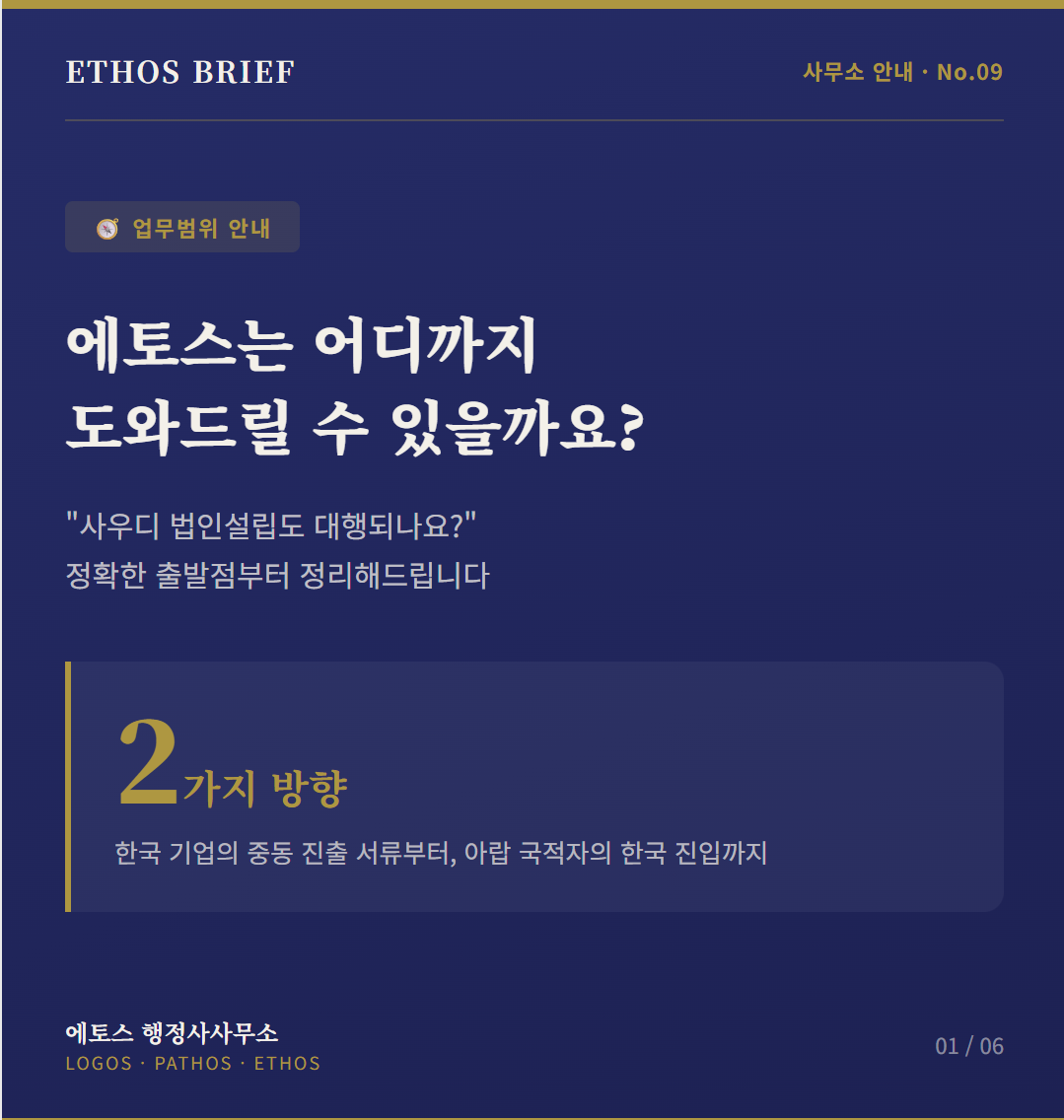
What Can Ethos Administrative Agent Office Help With? Scope of Services for Middle East Expansion, Arabic Documents, Visas, and Administrative Procedures
Ethos Administrative Agent Office does not directly handle Saudi or UAE local company formation or local halal certification procedures. Instead, it helps organize Korea-side procedures such as apostille and consular legalization, powers of attorney, contracts, Arabic and English administrative documents, Korean visa, startup, and investment procedures for foreigners, and explains Middle Eastern official materials in a way Korean companies can understand.
8/19/2026Sangjin Ji, Administrative Attorney
Other
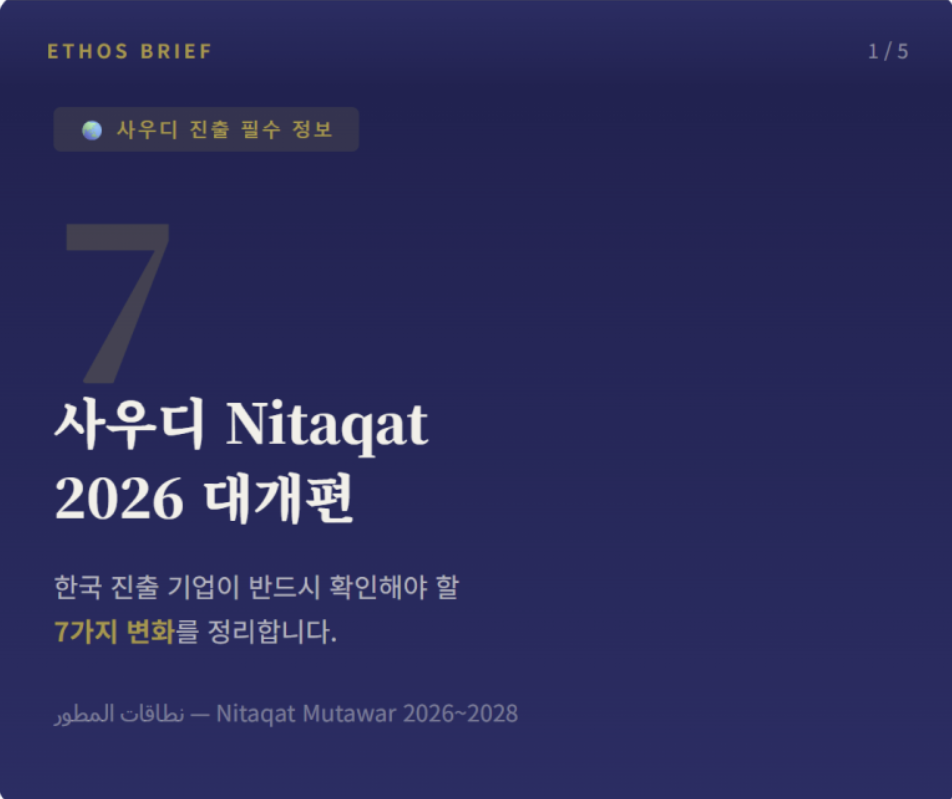
Saudi Nitaqat 2026 Reform: What Korean Companies Need to Check Now
Saudi Arabia’s 2026 Nitaqat reform is not merely a recommendation to hire more Saudi nationals. It is an operational compliance risk connected to Qiwa electronic contracts, GOSI registration, profession-specific Saudization quotas, instant work visa caps, and Saudi employee wage thresholds. Korean companies operating in or preparing to enter Saudi Arabia should first review their current Nitaqat classification and workforce and visa structure.
8/19/2026Sangjin Ji, Administrative Attorney
Other
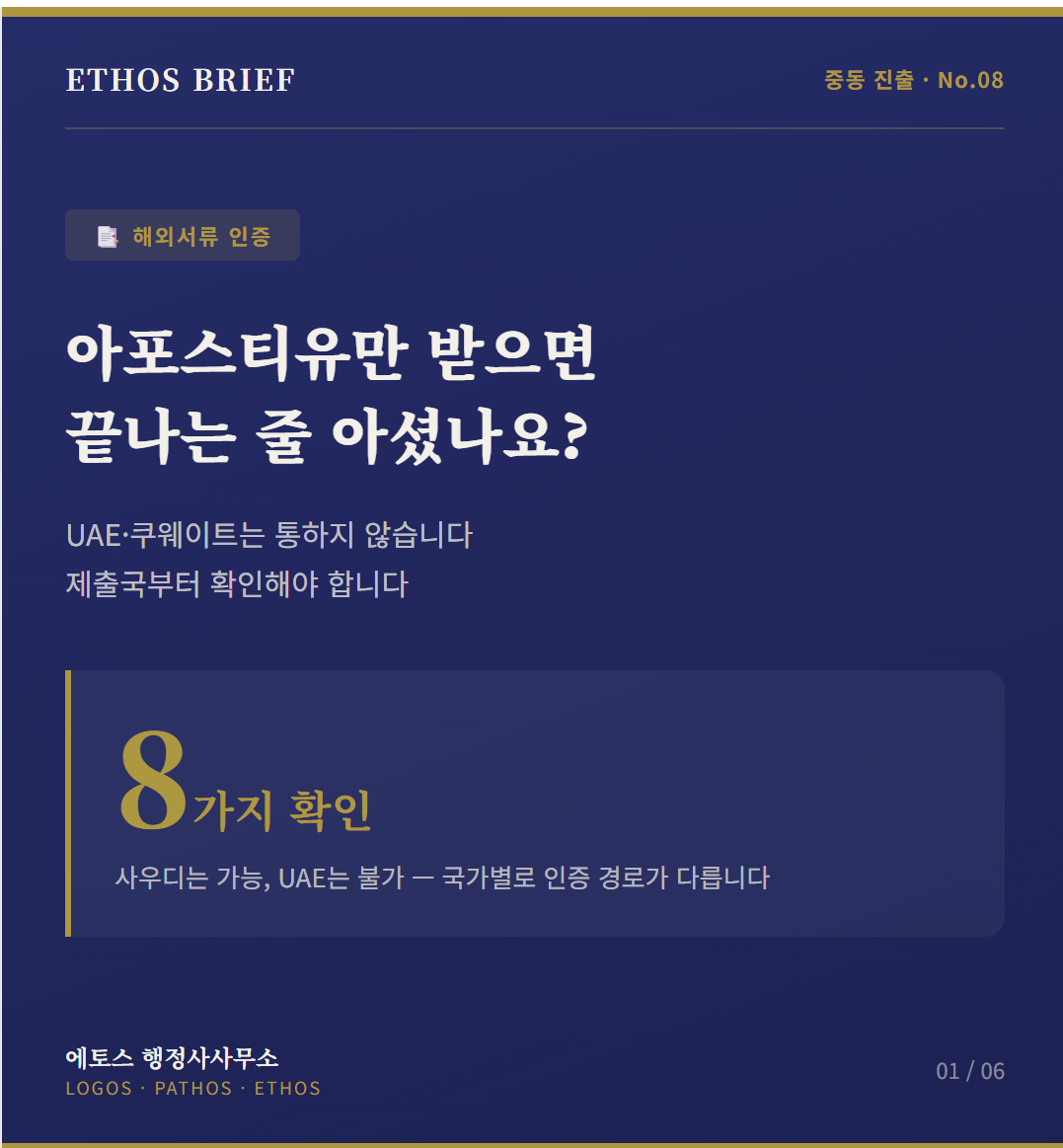
Is an Apostille Enough When Sending Documents to the Middle East?
When sending documents to the Middle East, it is risky to assume that one apostille will be accepted everywhere. Some countries, such as Saudi Arabia, can use the apostille system, while non-member countries such as the UAE require consular legalization and embassy attestation procedures to be reviewed. As document authentication needs for contracts, powers of attorney, and corporate documents increase after the Korea-UAE CEPA, companies should first confirm the destination country and receiving authority.
8/19/2026Sangjin Ji, Administrative Attorney
Other
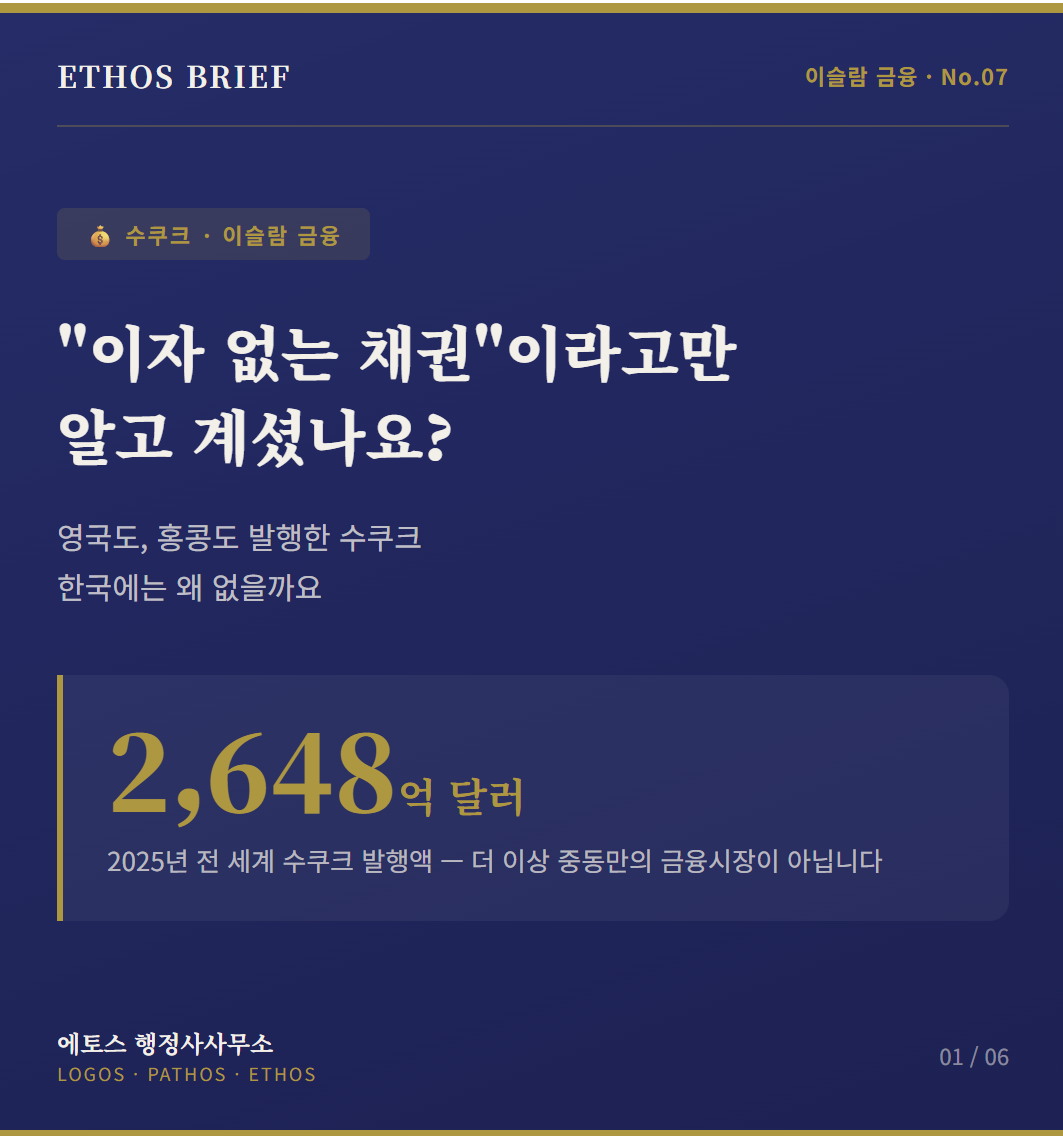
What Is Sukuk? - Islamic Finance That Has Grown Into a USD 264.8 Billion Market and Korea’s Missing Piece
Sukuk is not simply a “bond without interest.” It is an Islamic finance investment certificate structured to provide returns through assets, leases, sales, business income, or investment relationships in accordance with Sharia principles. With global sukuk issuance reaching approximately USD 264.8 billion in 2025, Korean companies participating in Middle Eastern infrastructure and energy projects should understand sukuk and Islamic finance structures.
8/19/2026Sangjin Ji, Administrative Attorney
Other
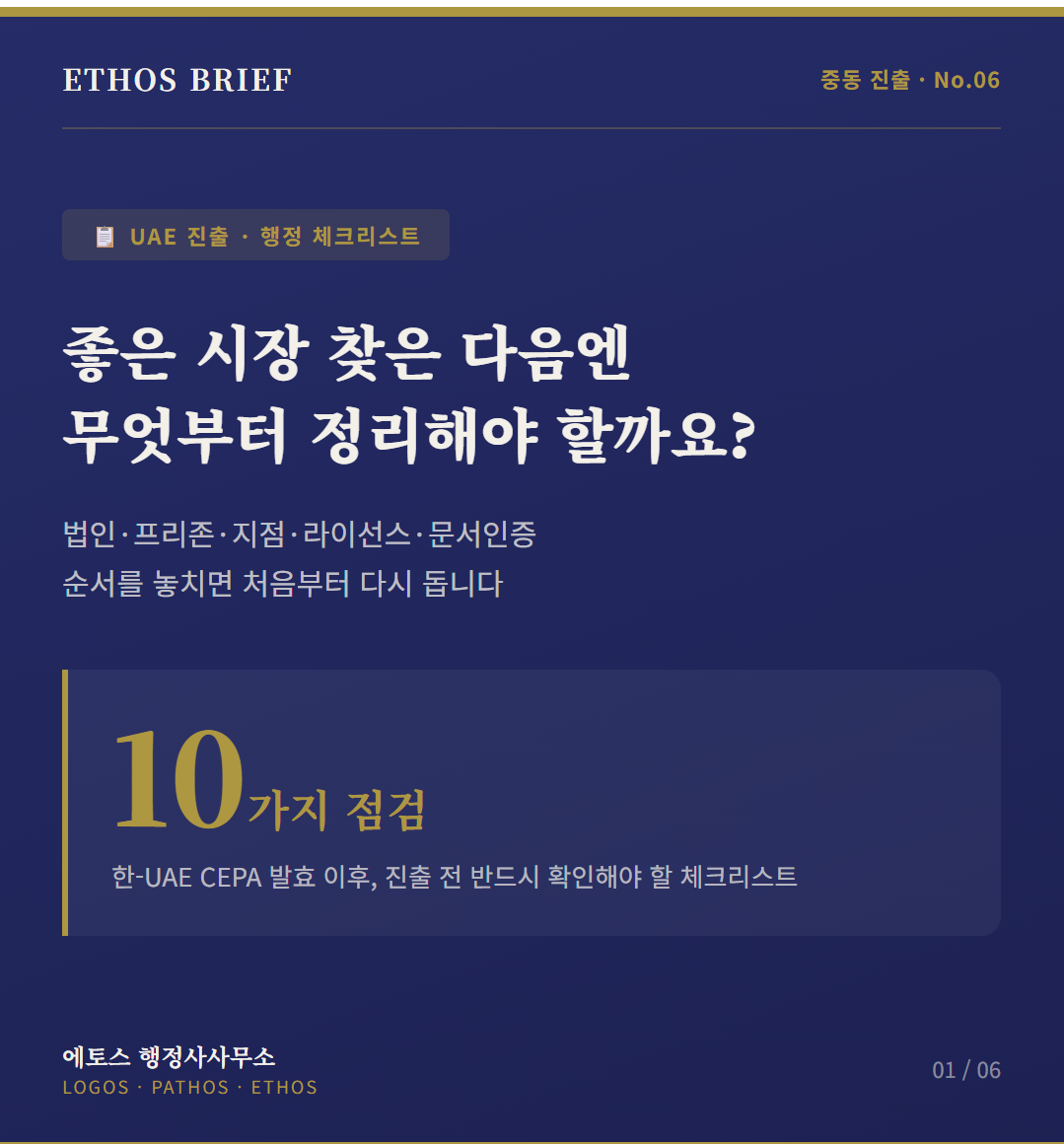
UAE Market Entry: Administrative Preparation Before Market Potential - A Checklist Covering Company Formation, Free Zones, Branches, Licensing, and Document Attestation
Entering the UAE is not completed by confirming market potential alone. Korean companies should organize the actual business activities, operating structure such as Mainland, Free Zone, or branch, licensing, authentication and translation of Korean documents, responsible personnel, and the role of local partners in the correct sequence.
8/19/2026Sangjin Ji, Administrative Attorney
Other
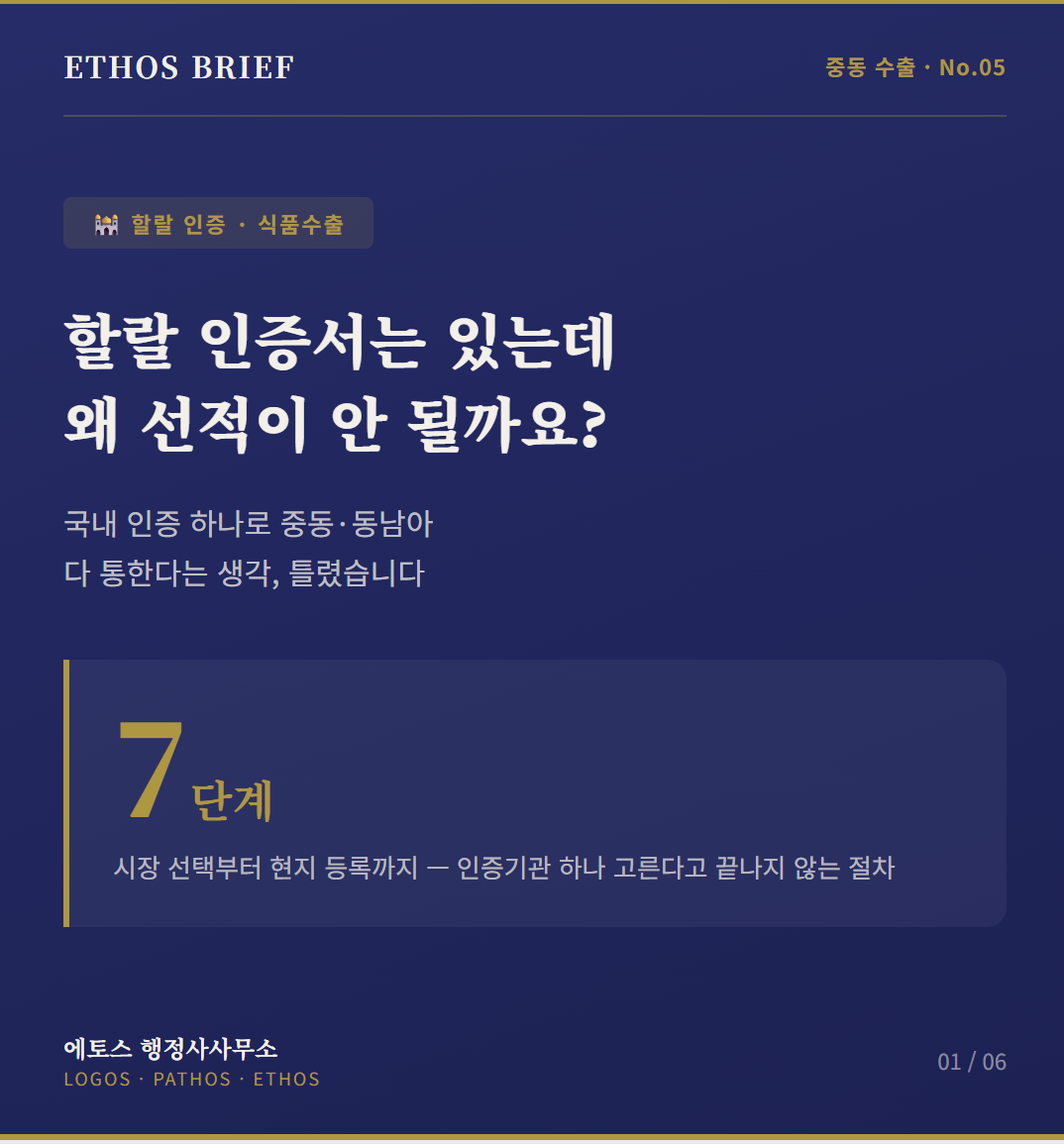
Can Halal Certification Be Obtained in Korea? — Decide the Export Country Before Choosing a Certification Body
Halal certification can be obtained in Korea, but the first question should not be which certification body to choose. It should be which country the product will be exported to. Malaysia, Indonesia, and Saudi Arabia each have different rules on recognized certification bodies, local registration, and product-specific import requirements, so products, ingredients, manufacturing processes, certification bodies, and customs procedures should be reviewed as one export structure.
8/19/2026Sangjin Ji, Administrative Attorney
Other
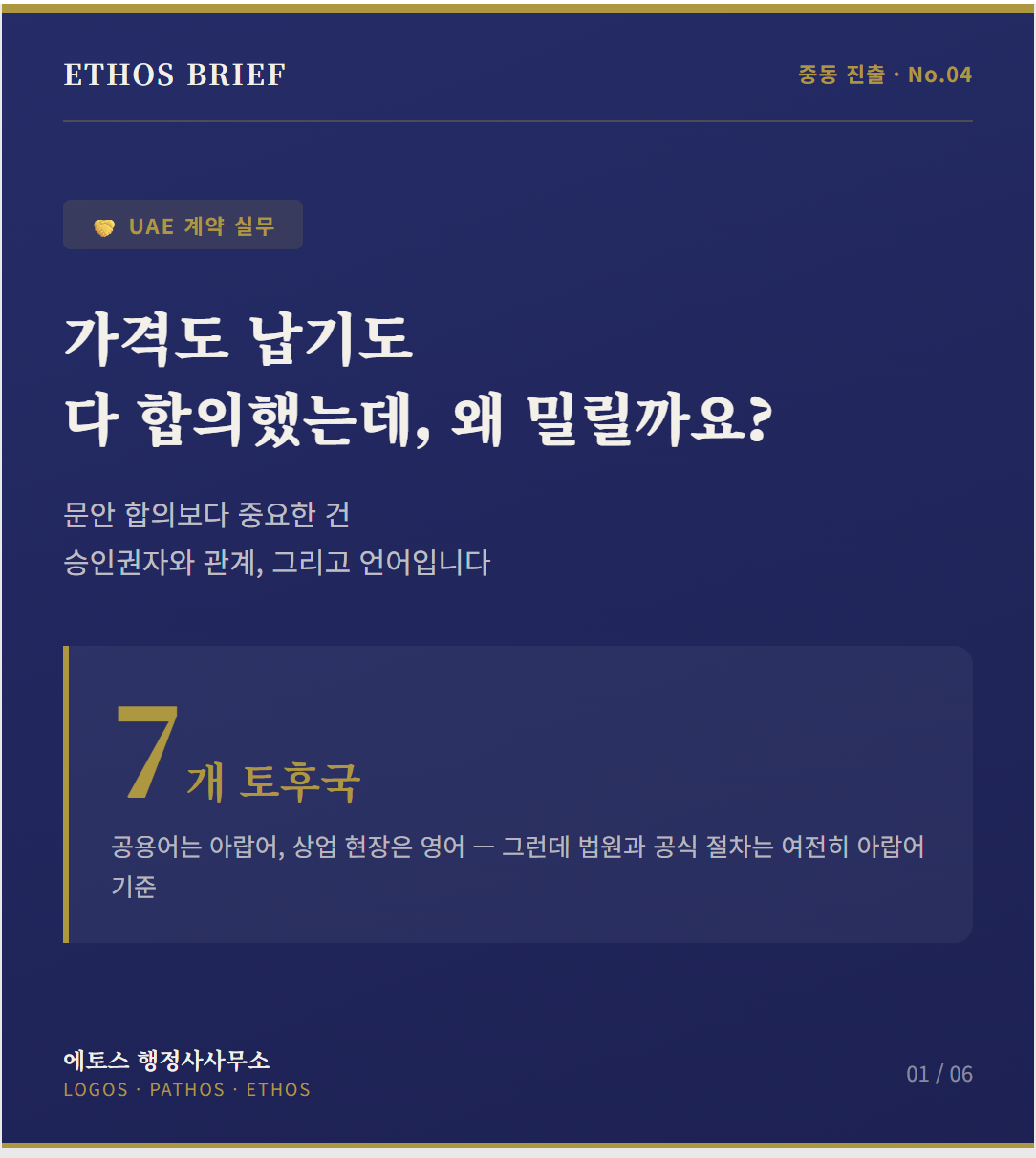
Why Contracts with UAE Buyers Keep Getting Delayed - Relationship, Authority, and Contract Practice for Korean Companies
If a contract with a UAE buyer keeps being delayed even after price, delivery, and samples have been agreed, the issue may not be the wording of the contract itself. It may lie in relationship-building, internal approval authority, signing authority, dispute resolution clauses, and documentation practices. Korean companies doing business with UAE partners should confirm not only commercial terms, but also authority, timeline, and contract structure.
8/19/2026Sangjin Ji, Administrative Attorney
Nonprofit & Company Formation
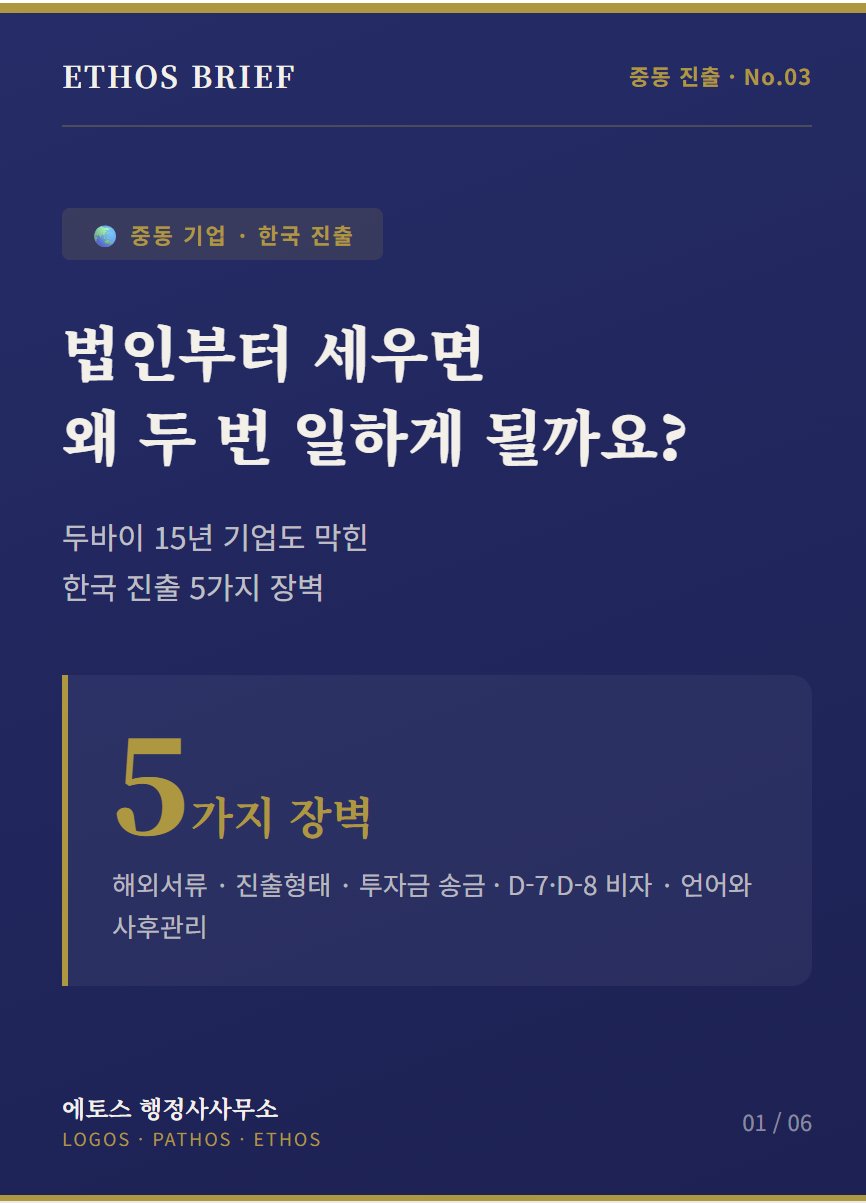
Five Common Barriers Middle Eastern Companies Face When Entering Korea -From Company Incorporation to D-7 and D-8 Visas
For Middle Eastern companies entering Korea, company incorporation alone is not enough. Overseas corporate document authentication, the choice between a local corporation, branch, or liaison office, foreign investment reporting and remittance, D-7 and D-8 visa eligibility, translation, and post-entry compliance should all be reviewed as one connected structure.
8/19/2026Sangjin Ji, Administrative Attorney
Other
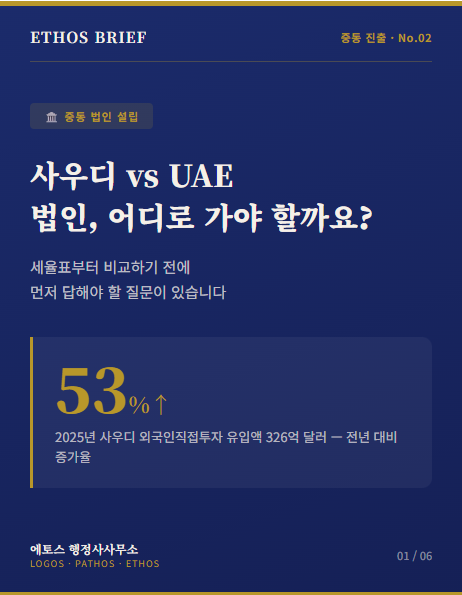
Saudi Arabia vs UAE Company Formation: Where Should Korean Companies Go?
For Korean companies considering expansion into the Middle East, one of the first questions is whether to establish a company in Saudi Arabia or the UAE. This article compares Saudi Arabia and the UAE from a practical company formation perspective, focusing on market-entry structure, investment rules, corporate tax, Saudization and Nitaqat, UAE Mainland and Free Zones, RHQ incentives, Korean outbound investment reporting, and document authentication.
8/19/2026Sangjin Ji, Administrative Attorney
Visa & Residency
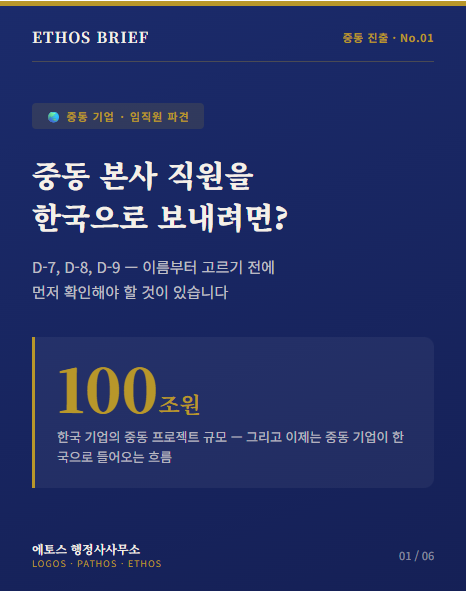
How Can Middle Eastern Companies Dispatch Employees to Korea? Start With D-7, D-8, and D-9 Visas
Middle Eastern companies from Saudi Arabia, the UAE, and other Gulf countries must carefully distinguish between D-7, D-8, and D-9 visa categories when dispatching executives or employees to Korea. This article explains how to review D-7 intra-company transfer, D-8 foreign investment, and D-9 trade management visas based on the company’s entry structure, funding structure, role of the dispatched employee, and practical documentation issues such as Arabic-to-English name variations.
8/19/2026Sangjin Ji, Administrative Attorney
Administrative Appeal
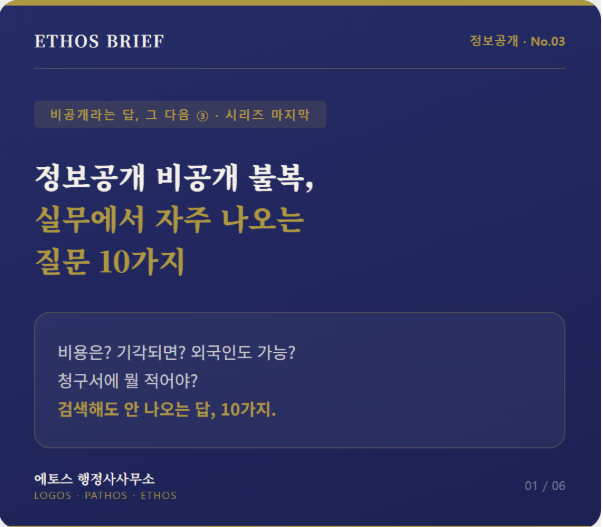
10 Practical Questions About Challenging a Non-Disclosure Decision
After receiving a non-disclosure decision on an information disclosure request, many people wonder whether they must file an objection first, how much an administrative appeal costs, whether dismissal creates any disadvantage, whether foreigners can file requests, and what should be written in the appeal petition. This article answers 10 practical questions frequently asked in non-disclosure challenges, based on statutes and court precedents.
8/19/2026Sangjin Ji, Administrative Attorney
Administrative Appeal
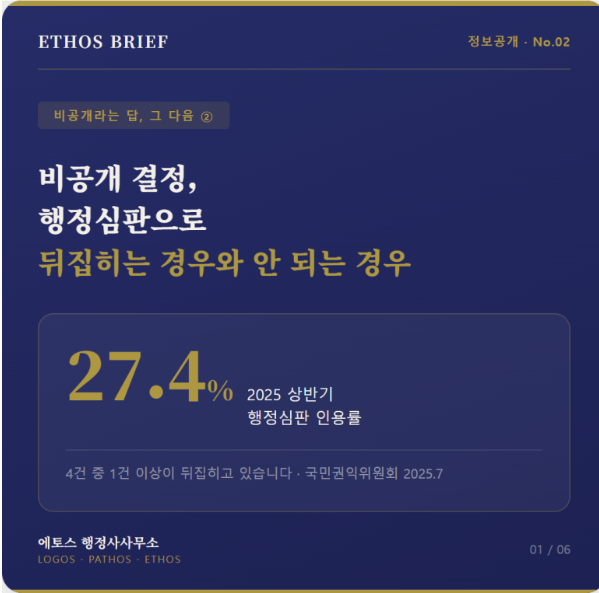
When Can a Non-Disclosure Decision Be Reversed Through Administrative Appeal?
If your information disclosure request was denied, an administrative appeal may be a possible next step. But not every non-disclosure decision can be reversed. This article explains when a non-disclosure decision may be overturned, when it is likely to be upheld, and what to check before filing an administrative appeal, including specificity of reasons, high probability of harm, partial disclosure, post-hoc changes of grounds, and the 90-day deadline.
8/19/2026Sangjin Ji, Administrative Attorney
Most read
- 1What AI Startups Must Check Before Launching: Incorporation, Privacy, the AI Basic Act, and Government Support Programs640 views
- 2Game Development — Required Registration Before Uploading to App Stores570 views
- 3 [Employment Contracts and the E-7 Visa in Korea ⑤] 2026 E-7 Visa Salary Requirements: How Much Should Employers Pay?423 views
- 4 Regional Specialized Visa, Part 1 — F-2-R, E-7-4R, or F-4-R: Which Route Fits Your Situation?391 views
- 5Korea e-Arrival Card — There Is Only One Official Website383 views
Get new columns by email
Practical insights on visas, administrative appeals, and permits — delivered whenever a new post goes live.
You can unsubscribe anytime; your email is used only for the newsletter.
Have a question?
Have a specific case?
Columns are general guidance. Individual cases are reviewed after consultation.