
What Is Sukuk? - Islamic Finance That Has Grown Into a USD 264.8 Billion Market and Korea’s Missing Piece
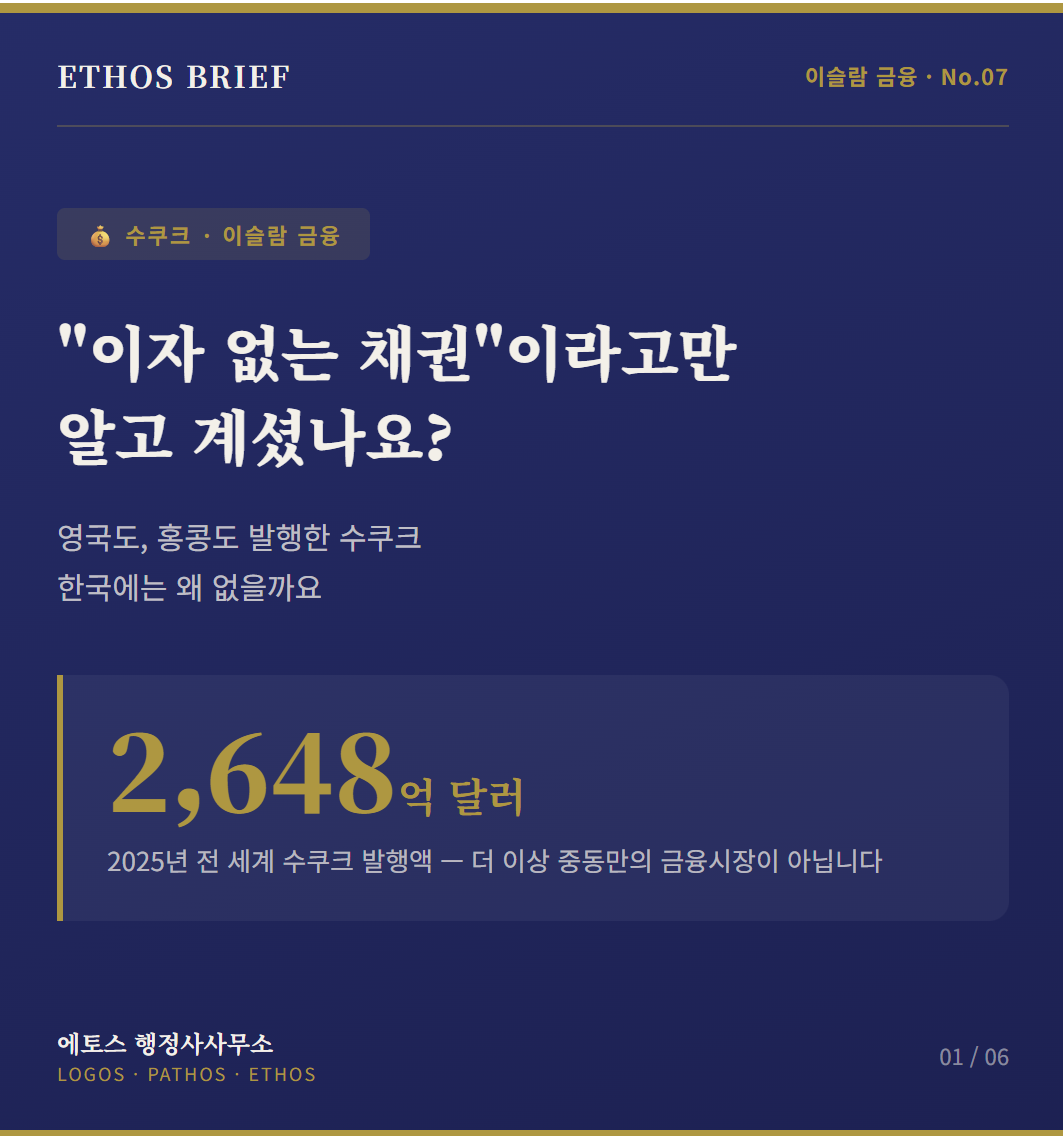
Hello, this is Administrative Agent Jean of Ethos Administrative Agent Office.
Have you heard the term Sukuk, صكوك?
If you are interested in Middle Eastern business or Islamic finance, you may have come across it at least once.
In Korea, it is usually translated as an “Islamic bond.”
But if sukuk is understood only as:
“a bond that does not pay interest,”
that is only half the story.
In an ordinary bond, the issuer borrows money from investors and pays principal and interest in return.
In Islamic finance, however, traditional interest-paying financial transactions cannot be used in the same way because of the Sharia principle prohibiting Riba, ربا, or interest.
Sukuk is therefore structured to achieve a funding effect similar to ordinary bonds by using lease income from assets, sale transactions, business income, investment relationships, and similar structures.
And this market is no longer a small financial market limited to the Middle East.
According to S&P Global Ratings, global sukuk issuance reached approximately USD 264.8 billion in 2025.
This was an increase from approximately USD 234.9 billion in 2024.
Non-Islamic financial hubs such as the United Kingdom and Hong Kong have also issued sovereign sukuk directly.
In Korea, however, although there was a major policy debate about introducing sukuk about 15 years ago, a separate tax framework for sukuk has not become firmly established.
Why did that happen?
And why should Korean companies in 2026, especially those involved in large-scale infrastructure and energy projects with Saudi Arabia and the UAE, understand sukuk?
Let’s take a closer look.
Is Sukuk Really Just a “Bond Without Interest”?
Looking only at the economic result, sukuk may feel similar to an ordinary bond.
Investors provide funds.
They receive periodic returns for a certain period.
At maturity, many structures allow recovery of an amount equivalent to the investment principal.
But the legal and contractual structure that creates those returns is different.
An ordinary corporate bond is relatively simple.
Investor → lends funds to the company
Company → pays interest to the investor
Maturity → principal is repaid
In sukuk, asset leasing, sale transactions, investment arrangements, or agency relationships may be inserted into the structure.
This is why the IIFM continues to separately track sukuk as a core Islamic capital market instrument distinct from ordinary bond markets.
The Easiest Structure to Understand Is Sukuk al-Ijarah
One representative structure is Sukuk al-Ijarah, صكوك الإجارة, or lease-based sukuk.
Let’s simplify it with an example.
Suppose an airline needs USD 100 million to acquire a new aircraft.
In an ordinary bond, the airline issues bonds.
Investors lend USD 100 million, and the airline pays interest.
In Sukuk al-Ijarah, the structure is different.
The funds provided by investors are connected to a specific asset.
The airline uses that asset and pays lease payments.
Those lease payments become the source of returns distributed to sukuk investors.
At maturity, depending on the agreed structure, the asset may be reacquired or the transaction may be unwound, allowing the investment amount to be recovered.
The United Kingdom’s second sovereign sukuk issued in 2021 was also structured as al-Ijarah. Through that transaction, the UK government raised £500 million.
But It Is Not the Same as Selling and Repurchasing a Building
It may be tempting to explain sukuk by comparing it to familiar Korean legal concepts such as repurchase.
But legally, it is difficult to treat sukuk as the same as repurchase under the Korean Civil Act.
Sukuk is not a single contract type.
The contractual relationship changes depending on the structure used.
Common structures include:
- Ijarah — lease
- Murabaha — sale with a disclosed profit margin
- Musharakah — partnership or joint investment
- Mudarabah — investment structure separating capital and management
- Wakalah — investment agency
More accurately, sukuk is closer to:
an investment certificate structured by linking assets, transactions, or business activity in accordance with Sharia principles.
The phrase “bond without interest” may be useful for beginners, but it is not enough to explain the actual structure.
Another Misunderstanding — Not All Sukuk Give Investors Full Ownership of Physical Assets
Sukuk is often explained as:
“investors own the underlying asset.”
But this is not always the case.
In the modern sukuk market, it is necessary to distinguish between asset-backed and asset-based structures.
In some structures, legal ownership of the asset and credit risk are substantially transferred to investors.
In other structures, assets are included in the transaction structure, but investors’ actual recovery prospects may depend heavily on the issuer’s creditworthiness.
This distinction is important.
Even if two instruments are both called “sukuk,” the actual risk borne by investors may differ depending on the structure.
In the international Islamic finance market, the issue of asset ownership and risk transfer has recently become an important topic in discussions on strengthening Sharia standards for sukuk.
In other words, sukuk is not merely a conventional bond with an Islamic label.
But not every sukuk is a full equity-like investment product either.
The contract structure must be reviewed.
Why Make It So Complicated?
The most direct reason is that sukuk provides access to Islamic finance markets.
For Islamic financial institutions and Sharia-compliant investors who cannot easily invest in ordinary interest-bearing bonds, sukuk is an important investment instrument.
For companies and governments, it can therefore become a funding tool that provides access to a separate investor base, in addition to conventional bond market investors.
In fact, sukuk is no longer used only by a few Islamic countries.
The United Kingdom Issued Sukuk Too
In June 2014, the UK government issued £200 million of sovereign sukuk.
HM Treasury officially described it as the first sovereign sukuk issued outside the Islamic world.
What was more interesting was investor demand.
The £200 million issuance attracted around £2.3 billion in orders.
That was more than 11 times the issuance size.
Investors included Islamic financial institutions from the Middle East and Asia, as well as sovereign wealth funds, central banks, and UK and international financial institutions.
The UK did not stop there.
In 2021, it issued a second sovereign sukuk.
This time, the size was £500 million, more than double the first issuance.
One of the UK government’s stated purposes was to develop the UK as a Western hub for Islamic finance.
The UK did not issue sukuk because it is an Islamic country.
It issued sukuk as a financial market strategy.
Hong Kong Also Issued USD 1 Billion Three Times
Hong Kong is another interesting example.
The Government of the Hong Kong Special Administrative Region issued its first sukuk in September 2014.
The size was USD 1 billion, with a five-year maturity.
It then issued additional sukuk:
- June 2015 — USD 1 billion
- February 2017 — USD 1 billion
In total, Hong Kong issued sukuk three times.
Official materials from the Hong Kong Monetary Authority, HKMA, confirm that each of the three issuances was USD 1 billion.
Hong Kong’s purpose was also clear.
It aimed to develop the sukuk market and attract more diverse issuers and investors to Hong Kong’s bond market.
The UK and Hong Kong examples show one thing:
Sukuk is not a bond reserved for Islamic countries. It can be a financial instrument connecting global capital markets with Islamic finance investors.
What Are the Advantages of Sukuk?
First, It Can Broaden the Investor Base
In addition to ordinary bond market investors, issuers may be able to access investors seeking Sharia-compliant financial products, such as:
- Islamic banks
- Islamic investment funds
- Sovereign wealth funds
- Middle Eastern institutional investors
The UK’s first sukuk, which attracted not only Middle Eastern and Asian investors but also central banks and sovereign wealth funds, demonstrates this point.
However, sukuk does not automatically mean cheaper funding than ordinary bonds.
Pricing depends on the issuer’s creditworthiness, market rates, currency, maturity, structure, and investor demand.
The core advantage of sukuk is not “always cheaper money,” but the possibility of expanding funding channels and investor base.
Second, It Can Connect With Large-Scale Project Finance in the Middle East
From the perspective of Korean companies, this may be even more important.
Saudi Arabia and the UAE are carrying out large asset-linked projects in areas such as:
- Infrastructure
- Energy
- Real estate
- Transport
- Data centers
- Industrial facilities
Because sukuk has developed as a structure that connects assets or business activities with financial transactions, it can be used as one tool linking projects with capital market funding.
This does not mean Korean construction, plant, or energy companies must directly issue sukuk when participating in Middle Eastern projects.
But sukuk is a financial instrument worth understanding in order to grasp how project owners or local partners may be financing major projects.
Third, the Green and Sustainable Sukuk Market Is Growing
Sukuk should be connected with ESG carefully.
It would be too simplistic to say:
“Islamic finance is ESG because investors participate actively in business.”
Instead, the international market is now creating a more direct link.
That link is Green Sukuk, Social Sukuk, and Sustainability Sukuk.
In 2024, ICMA, the Islamic Development Bank, IsDB, and the London Stock Exchange Group prepared joint guidance on Green, Social and Sustainability Sukuk.
This means a single issuance may be structured to satisfy two sets of standards at the same time:
Sharia compliance
and
green or social use of proceeds
This is why sukuk can be connected to projects such as:
- Solar power
- Green transport
- Water resources
- Energy efficiency
- Social infrastructure
This area directly overlaps with major infrastructure and energy transition projects in the Middle East.
The Market Is Actually Growing
If sukuk is still viewed as an unfamiliar product discussed in Korea around 2011, the current market will be missed.
According to S&P Global Ratings, global sukuk issuance increased as follows:
- 2024: approximately USD 234.9 billion
- 2025: approximately USD 264.8 billion
Converted roughly into Korean won, this is an annual issuance market worth hundreds of trillions of won.
The IFSB also reported that total assets of the global Islamic financial services industry reached USD 3.88 trillion in 2024, increasing 14.9% year on year.
The same report recorded 25.6% growth in sukuk issuance.
Using a separate methodology, IIFM estimated 2024 global sukuk issuance at around USD 205 billion, and stated that international sukuk issuance reached an all-time high of USD 65.6 billion.
The figures differ depending on each institution’s scope and methodology.
But the direction is clear:
Sukuk is no longer a marginal financial product.
Korea Once Tried to Introduce Sukuk
Korea has not been entirely absent from this discussion.
Beginning in 2009, the government pursued amendments to the Restriction of Special Taxation Act to make sukuk issuance possible.
Why was a tax law amendment needed?
This is directly connected to the structure of sukuk.
Ordinary Bonds Involve One Financial Transaction, but Sukuk May Include Asset Transactions
Suppose a company issues an ordinary foreign currency bond.
The company borrows money and pays interest.
But if Sukuk al-Ijarah is structured by transferring assets to a special purpose vehicle and leasing them back, the structure may formally include separate transactions such as:
asset transfer
and
lease
As a result, issues not normally present in ordinary bonds may arise, including:
- Value-added tax
- Acquisition-related taxes
- Transfer-related taxes
- Withholding tax issues
This could mean that, although the economic purpose is similar, additional taxes arise simply because sukuk was chosen.
The Government’s Proposal Was Not Simply “Give Sukuk a Special Tax Exemption”
The core of the proposed tax amendment pursued from 2009 was to reduce tax imbalance between ordinary foreign currency bonds and sukuk.
According to related research, the government proposal aimed to create a basis for Korean companies to issue sukuk by adjusting withholding tax issues on sukuk investment returns and tax burdens such as VAT that could arise from asset transactions required by the sukuk structure.
So the debate was not simply about:
“Should Islamic finance receive tax cuts?”
Supporters argued that if sukuk performs an economic function similar to ordinary foreign currency bonds, additional taxes arising only from sukuk’s contractual form should be removed to achieve tax neutrality.
Opponents argued that this could grant overly broad tax preferences to a specific financial product.
This distinction is necessary to understand the debate at the time.
Why Did the 2011 Debate Become So Controversial?
The sukuk amendment did not remain only a tax or economic debate.
Religious and political controversy became intertwined.
At the time, some Christian groups strongly opposed the tax treatment of sukuk as preferential treatment for Islamic finance, and some politicians raised similar concerns.
The bill was discussed several times in the National Assembly but ultimately did not pass.
During the political debate, concerns about possible terrorism financing were also raised.
However, this point must be explained carefully today.
Zakat, Hawala, and Sukuk are different systems.
There is no basis to generalize that a fixed percentage of sukuk investment returns automatically flows to a particular charity, or that sukuk transactions are inherently processed through hawala.
Therefore, when explaining the 2011 debate today, it would not be accurate to write:
“2.5% of sukuk returns could have been transferred through hawala and used for terrorism financing.”
The historical fact that such concerns and political claims existed should be distinguished from the actual structure of sukuk as a financial product.
What Happened to Korea’s Sukuk Discussion?
The amendment did not pass.
Related academic research also summarizes that although the government pursued tax reform for introducing sukuk from 2009, the proposal did not pass the National Assembly after controversy over preferential treatment and other issues.
One important point should be noted.
This does not mean that sukuk issuance is absolutely prohibited by law in Korea.
The issue is that no separate institutional framework was established to adjust the additional transaction costs and tax issues arising from sukuk’s unique structure to a level that could compete with ordinary bonds.
Related legal studies also pointed to this tax and legal structure as one of the main reasons Korean companies had limited incentive to issue sukuk at the time.
Therefore, rather than saying:
“Korea has no sukuk law, so sukuk cannot be issued,”
it is more accurate to say:
“An institutional reform intended to allow sukuk issuance under tax conditions similar to ordinary foreign currency bonds was attempted but failed.”
This Is Where the UK and Hong Kong Examples Matter Again
These financial hubs did not initially have systems perfectly suited for sukuk.
The HKMA explained that before Hong Kong’s first government sukuk issuance in 2014, a tax framework enabling sukuk issuance had been prepared.
After that, the Hong Kong government issued sukuk three times, each in the amount of USD 1 billion.
The UK also issued sovereign sukuk twice, in 2014 and 2021, after establishing an institutional basis.
In other words, when non-Islamic countries introduce sukuk, the meaning is closer to:
adjusting existing tax and financial systems to accommodate a new capital market product
rather than simply adopting a religious financial system.
Is There a Reason for Korea to Reconsider Sukuk in 2026?
The situation is quite different from 15 years ago.
Most importantly, the market size is different.
According to S&P, global sukuk issuance reached USD 264.8 billion in 2025.
Saudi Arabia and the UAE also continue to pursue large-scale infrastructure, energy transition, data center, and industrial investments.
Korean companies are participating in these markets in areas such as:
- Construction
- Plant projects
- Energy
- Smart cities
- IT
- Logistics
- Defense
- Infrastructure
Even if Korean companies do not directly issue sukuk, the need to understand how Middle Eastern project owners and financial institutions raise project capital is growing.
Consider This Example
Suppose a Korean construction company participates in a large infrastructure project in Saudi Arabia.
The Korean company may be an EPC contractor.
The project owner may be a Saudi company or project company.
Large-scale project funding may be raised through multiple methods:
- Bank loans
- Conventional bonds
- Government funding
- Project finance
- Sukuk
In this case, even if the Korean company is not the sukuk issuer, the following may still be connected to the project contract:
- Use of sukuk proceeds
- Project assets
- Issuance conditions
- Project owner’s payment capacity
- Financial close schedule
This is why understanding Middle Eastern finance is not only a matter for financial institutions.
It may also be important information for companies participating in real-sector projects.
Five Things Korean Companies Should Know When Reviewing Sukuk
1. Do Not Look Only at “No Interest”
You should check the basis on which returns are paid.
The structure may involve:
- Lease payments
- Sale margin
- Business income
- Investment agency returns
2. Check the Type of Sukuk
Even under the same name “sukuk,” contractual relationships and risk may differ depending on whether the structure is:
- Ijarah
- Murabaha
- Musharakah
- Mudarabah
- Wakalah
3. Check the Role of the Underlying Asset
It is necessary to distinguish whether the structure is asset-backed, where assets actually serve as a source of investor recovery, or asset-based, where the issuer’s credit remains central.
4. Check Which Country’s Law and Sharia Standards Apply
Islamic finance does not operate under one single global law.
Financial laws and tax laws differ by country, and Sharia compliance assessments may also involve different standards and interpretations.
It is therefore difficult to assume that a structure possible in Saudi Arabia will be exactly the same in Malaysia, the UAE, or the UK.
5. Review Taxes and Asset Transfer Costs Together
When comparing sukuk with ordinary bonds, looking only at yield is not enough.
Additional structuring costs may arise, including:
- Asset transfer
- SPV
- Registration
- Taxes
- Documentation
- Sharia review
- Legal advice
This is why countries such as the UK and Hong Kong first worked on tax neutrality before developing their sukuk markets.
Sukuk Is No Longer Just “Basic Middle Eastern Finance Knowledge”
When sukuk was debated in Korea around 2011, the product itself was very unfamiliar domestically.
Fifteen years later, the situation has changed.
The UK has issued sovereign sukuk twice.
Hong Kong has issued sukuk three times.
The international sukuk market now sees hundreds of billions of dollars in issuance each year.
Green, Social, and Sustainability Sukuk have also emerged, connecting sukuk with green and social infrastructure finance.
S&P estimated global issuance in 2025 at USD 264.8 billion.
At this scale, sukuk can no longer be explained merely as:
“a strange bond created because Islam does not allow interest.”
The market has become too large for that.
This Does Not Mean Korea Immediately Needs a “Sukuk Law”
A line should be drawn here.
The fact that the sukuk market has grown and the policy conclusion that Korea must immediately adopt a specific sukuk tax support law are separate issues.
If such a system is to be created, several issues must be reviewed together:
- Tax neutrality
- Issuance demand
- Relationship with the domestic capital market
- Financial supervision
- Foreign exchange
- Sharia compliance review
- SPV and asset transfer
- Investor protection
However, it is also inappropriate to evaluate the sukuk market of 2026 only through the religious and political debates of 2011.
How the global market has changed,
why non-Islamic financial hubs such as the UK and Hong Kong created the necessary systems,
and what sukuk means for Korean companies as economic cooperation with Saudi Arabia and the UAE expands
are all matters worth reviewing again.
Summary
Sukuk is often called an “Islamic bond,” but it is not exactly the same as an ordinary bond.
Instead of interest payments prohibited in Islamic finance, sukuk should be understood more accurately as:
a Sharia-compliant investment certificate that provides returns to investors by using structures such as asset leasing, sale transactions, business income, and investment returns.
Several important facts follow.
First, sukuk is issued outside the Islamic world.
The UK issued the first sovereign sukuk outside the Islamic world in 2014 and issued a second one in 2021.
Second, Hong Kong also used sukuk actively.
It issued government sukuk of USD 1 billion each in 2014, 2015, and 2017.
Third, the market has grown significantly.
According to S&P, global sukuk issuance in 2025 was approximately USD 264.8 billion.
Fourth, Korea also once reviewed institutional introduction.
Beginning in 2009, amendments to the Restriction of Special Taxation Act were pursued to adjust structural tax burdens of sukuk in comparison with ordinary foreign currency bonds. However, after economic, tax, political, and religious controversy, the proposal did not pass the National Assembly.
Finally,
sukuk is not something only financial institutions need to understand.
If Korean companies are involved in infrastructure, energy, or industrial projects in Saudi Arabia, the UAE, or other Middle Eastern markets, understanding how local project owners and investors raise capital is part of Middle Eastern business.
As economic relations between Korea and the Middle East deepen, the ability to understand not only contracts and investment but also the financial structure behind them will become increasingly important.
If You Are Preparing Transactions With Middle Eastern Companies or Investors
Ethos Administrative Agent Office handles Korean administrative procedures, overseas submission documents, Arabic and English documents, and foreign investment-related administrative matters needed to connect Korea with Saudi Arabia, the UAE, and other Middle Eastern markets.
Specific financial and legal advice on sukuk issuance, securities underwriting, investment advisory, domestic or foreign capital markets law, or tax law requires review by relevant professionals such as financial investment firms, attorneys, accountants, or tax advisors.
However, if documents related to sukuk or Islamic finance appear in a Middle Eastern transaction, it may first be necessary to understand what transaction structure the document belongs to and how it connects with Korean administrative or contract documents.
References
- S&P Global Ratings, Sukuk Market: Strong Growth To Continue, 2026.
- International Islamic Financial Market, IIFM, Sukuk Report 2025.
- Islamic Financial Services Board, IFSB, Islamic Financial Services Industry Stability Report 2025.
- HM Treasury, official materials on UK Sovereign Sukuk.
- Hong Kong Monetary Authority, Government Sukuk Programme.
- ICMA, Guidance on Green, Social and Sustainability Sukuk.
- “A Study on the Introduction of Islamic Bonds Sukuk,” Korea Citation Index, KCI.