
Why Contracts with UAE Buyers Keep Getting Delayed - Relationship, Authority, and Contract Practice for Korean Companies
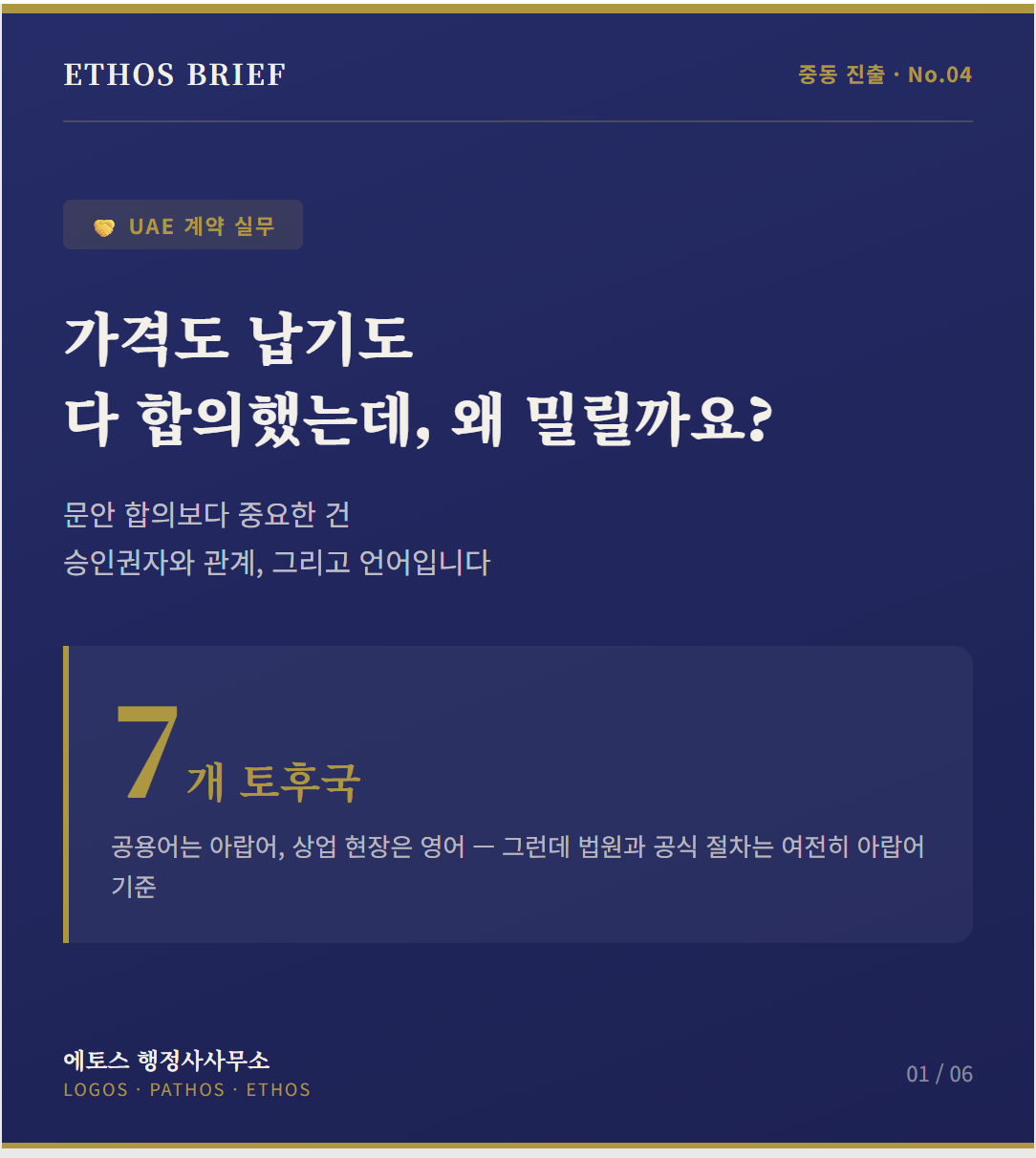
Hello, this is Administrative Agent Jean.
When translating legal and business documents, I often see a similar situation.
A Korean company and a UAE buyer agree on the price.
They agree on delivery.
Sample testing is completed.
From the Korean company’s perspective, all that remains is signing the contract and receiving the purchase order.
But even after a week, the contract does not arrive.
When the person in charge is contacted, the response is positive.
“Everything looks good.”
And then several more days pass.
From the Korean company’s perspective, this is frustrating.
“We already agreed on the terms. Why are they not signing?”
But in transactions with UAE buyers, the answer is not always found in the wording of the contract.
The real issue may be that the final decision-maker has not yet been confirmed, internal approval is still pending, or the counterparty is still verifying the business relationship.
In UAE business, personal relationships and trust can play an important role. Building that relationship often requires repeated communication, local presence, and time.
That is why UAE contracts should be reviewed through three keywords:
Relationship
Authority
Document
This article explains why contract timelines with UAE buyers and partners may shift, and what Korean companies should check before finalizing the contract.
Why Does UAE Business Not End With Agreement on Commercial Terms?
Korean companies are often used to fast practical negotiations.
Price.
Delivery.
Quantity.
Quality.
Payment terms.
After agreeing on the main terms, the deal is usually confirmed in writing.
In the UAE market, however, commercial terms and personal trust may develop in parallel.
The first meeting may therefore have a different meaning from what Korean staff expect.
A Korean company may think:
“Let’s decide the price and delivery today.”
But the UAE side may also be asking:
“Can we do business with this company in the long term?”
If this difference is not understood, the two sides may evaluate the same meeting differently.
The Korean side may record:
“Terms agreed.”
But the UAE side may understand it as:
“First review completed.”
Pitfall 1 — The Person in Charge May Not Be the Decision-Maker
In UAE transactions, one thing should be checked before price:
How much authority does the person you are speaking with actually have?
For example, suppose a purchasing manager at a UAE distributor negotiates with a Korean cosmetics company.
The samples are satisfactory.
The price is agreed.
The manager continues to respond positively.
But if that purchasing manager does not have final signing authority, the contract is not yet complete.
Approval from a department head may be required.
Approval from the owner or General Manager may be required.
Finance or legal review may still remain.
For UAE contracts, it is useful to separate the negotiating contact from the approval authority.
At minimum, check the following:
- Who will actually sign the contract
- What the current contact person’s position and authority are
- How many internal approval steps remain
- Whether separate legal or finance review is required
- Whether the purchase order issuer and contracting party are the same
- If an agent or distributor is involved, who the actual contracting party is
If these questions are not clarified, the Korean company may keep asking every week:
“When will the contract be ready?”
But from the other side’s perspective, the matter may not even have entered the final approval stage yet.
Pitfall 2 — Even If Meetings Are Delayed, Your Response Should Not Be
Differences in business timing do exist in UAE transactions.
Meetings may be delayed, and project schedules may shift.
But this does not mean that the Korean company should also manage its schedule loosely.
A flexible counterparty schedule does not mean your own schedule management should become flexible.
In fact, the opposite is safer.
To connect UAE-style relationship-based negotiation with Korean document-based business practice, the Korean side should record agreed points more clearly.
A useful way to think about it is this:
Meetings build relationships.
Emails fix agreements.
After a meeting, do not end with only:
“Thank you for today’s meeting.”
Instead, confirm the key points separately:
- Confirmed price
- Sample approval
- Delivery schedule
- Payment terms
- Documents required
- Pending internal approval
- Next action
- Target date
The record should show who will do what by when.
A relationship-based market does not make documentation less important.
The more relationship-based the market is, the safer it is to document agreed points clearly.
Is a Cup of Coffee Part of the Contract Process in the UAE?
Not every UAE businessperson follows one cultural pattern.
Work styles differ depending on company size, nationality, generation, and industry.
However, face-to-face meetings and hospitality often play a meaningful role in building business relationships.
In Korea, this may look like simple courtesy.
But in practice, it is better to approach it differently.
Instead of opening a laptop immediately after sitting down and jumping into price negotiation, time spent discussing the company, business background, the local market, future plans, and mutual experience may become part of the foundation for the transaction.
The point is not to imitate a certain culture.
It is not to interpret the time spent building relationship and trust as “wasted time.”
Pitfall 3 — “The Contract Is in English, So the Language Issue Is Over”
English is widely used in UAE commercial practice.
So it is not unusual for Korean and UAE companies to prepare contracts in English.
The issue arises at the dispute stage.
In ordinary UAE courts, documents submitted to court may need to be in Arabic, and documents prepared in another language may require Arabic translation by an approved legal translator.
Therefore, an English contract does not eliminate all language issues.
If a dispute goes to an ordinary UAE court, contracts, emails, purchase orders, and technical materials may need to be translated into Arabic.
But there is one more point to understand.
Not All UAE Courts Operate Only in Arabic
This point is often missed in discussions about UAE contracts.
DIFC Courts and ADGM Courts are different.
The DIFC Courts in the Dubai International Financial Centre operate in English.
The ADGM Courts in Abu Dhabi Global Market also conduct proceedings and accept documents in English.
ADGM also has a legal system based on direct application of English Common Law.
Therefore, it is not accurate to simplify UAE contracts by saying:
“UAE courts use Arabic, so arbitration is always the answer.”
Depending on the parties’ location and transaction structure, different dispute resolution options may be reviewed:
- Ordinary UAE courts
- DIFC Courts
- ADGM Courts
- International arbitration
This is why the dispute resolution clause should not be copied and pasted at the end of the contract.
Pitfall 4 — Reviewing the Dispute Resolution Clause Last
In many contracts prepared by Korean companies, the beginning is very detailed.
Product name.
Unit price.
Quantity.
Delivery date.
Quality standards.
But in the final pages, the wording suddenly becomes short.
“Any disputes shall be resolved through mutual consultation.”
There is no next step if consultation fails.
Or an arbitration clause copied from an old English contract is inserted without review.
But the dispute resolution clause can be one of the most expensive clauses in the contract.
If a dispute occurs, the contract should answer at least the following questions:
Which country’s law applies?
Which court or arbitral institution will resolve the dispute?
Where is the seat of arbitration?
What is the language of the proceedings?
How many arbitrators will there be?
Will negotiation or mediation come first?
A single sentence such as:
“Arbitration in Dubai.”
is usually not enough.
Why Is Arbitration Often Considered in the UAE?
The UAE has a federal arbitration law, Federal Law No. 6 of 2018 on Arbitration, and arbitral institutions such as DIAC in Dubai and arbitrateAD in Abu Dhabi.
In international transactions, litigation is not the only possible dispute resolution route.
However, it is also incorrect to assume that arbitration is always better than court litigation.
The choice should depend on the contract amount, location of the counterparty’s assets, expected type of dispute, enforceability, and cost.
The important point is not to decide where to fight after a dispute arises.
It is to decide the route when the contract is signed.
Pitfall 5 — Trusting the Person More Than the Company
In a relationship-based market, legal authority checks are even more important.
The conversation went well.
You received an introduction.
The counterparty introduced himself as a Director.
But that does not automatically mean he has authority to bind the company.
This is especially important when the transaction involves:
- Local agent
- Distributor
- Free Zone company
- Mainland company
- Representative
- Consultant
Before signing, check at least:
- Exact legal name of the company
- Trade licence
- Legal status of the contracting party
- Signing authority
- Actual importer or distributor
- Payment entity
If the company on the business card, the company in the contract, and the company making payment are different, first confirm why.
Pitfall 6 — Thinking Electronic Signatures Are Impossible, or That Any Electronic Signature Is Enough
The UAE has a legal framework that actively recognizes electronic transactions and electronic signatures.
Therefore, it is not correct to say:
“Middle Eastern contracts must always be exchanged as original paper documents by international courier.”
But the opposite is also risky:
“If we paste an image signature into a PDF, every contract has the same effect.”
Depending on the type of contract, applicable law, and required authentication level, the method and evidentiary value of an electronic signature may differ.
Before signing, it is useful to decide:
How far email agreement will be recognized
Whether scanned signatures will be accepted as the final execution copy
Whether an electronic signature platform will be used
Whether any documents require original submission
Clarifying these four points can greatly reduce confusion at the execution stage.
Why Is There No Reply Until Monday to an Urgent Email Sent on Friday Afternoon?
The UAE work rhythm should also be reflected in the schedule.
The UAE federal government operates on a 4.5-day workweek, with normal working days from Monday to Thursday and Friday working hours from 7:30 a.m. to noon. Saturday and Sunday are the official weekend.
However, this should not be generalized to every private company in the UAE.
Private-sector work schedules may differ by company.
Still, for Korean companies, one practical point matters:
Friday afternoon should not be treated the same as a normal Korean weekday afternoon.
If Ramadan or Islamic holidays are involved, the schedule may change further.
When setting important approval or delivery dates, it is safer to check:
- UAE public holidays
- Ramadan
- Fridays
- Korean public holidays
- Shipping dates
I Recommend Organizing Korea-UAE Contracts Into Four Groups
UAE contracts do not need to be treated as overly complicated.
But the order of review should change.
① Relationship and Authority
Do not check only the price in the first meeting.
Confirm who leads the transaction, who gives final approval, who signs the contract, and who makes payment.
Understand the person, but verify authority through documents.
② Schedule and Approval Management
After a meeting, document the agreed points.
In particular, separate:
- Next contact person
- Additional documents
- Internal approval
- Sample approval
- Legal review
- PO issuance
- Expected signing date
Do not leave everything under one vague status such as “contract in progress.”
③ Contract Structure
Along with commercial terms, check:
- Exact contracting party
- Signing authority
- Governing law
- Jurisdiction or arbitration
- Seat of arbitration
- Contract language
- Dispute language
- Official notice method
- Delivery date
- Liability for delay
- Payment terms
- Termination
These clauses are not very visible when the transaction goes well.
Their real cost appears when the transaction goes wrong.
④ Document and Version Control
A relationship-based market does not mean document management is less necessary.
It is even more important to record:
who promised what, and when.
In a CRM or document management system, it is useful to connect at least:
- Counterparty company
- Contact person
- Approval authority
- Contract version
- English and Arabic versions
- Quotation
- Purchase order
- Meeting notes
- Official notice address
- Next action
If a Draft Contract Is Already Being Exchanged, Check These Eight Points First
If negotiations with a UAE buyer are already underway, you do not need to reread the entire contract from the beginning.
First answer these questions:
1. Have you confirmed the exact legal name of the contracting company?
2. Does the signer actually have signing authority?
3. Is the current negotiating contact the same person as the final approval authority?
4. Does the contract state which law applies?
5. If a dispute occurs, which court or arbitral institution will handle it?
6. What is the language of the contract and the dispute procedure?
7. Are the parties in the quotation, PO, contract, and invoice the same?
8. Are the counterparty’s next action and target date recorded in writing?
If it is difficult to answer several of these questions, the problem may not be price negotiation.
It may be that the transaction structure has not yet been fully fixed.
“English Works in the UAE” Is Only the Starting Point
The UAE is clearly an international business hub.
English is widely used.
The electronic transaction environment is well developed.
International arbitration institutions such as DIAC and dispute resolution infrastructure such as DIFC and ADGM also exist.
That is exactly why Korean companies may misunderstand the situation.
“Email communication in English works well, so it must be similar to doing business with a Korean partner.”
But sharing a language and sharing the same contract system are different things.
Arabic is important in ordinary UAE courts, while DIFC and ADGM operate in English.
Face-to-face trust matters, but agreed points must still be documented.
Schedules may move flexibly, but your company’s deadline should not disappear.
Electronic signatures may be available, but not every signing method should be treated as having the same effect.
What is needed in UAE transactions is not memorizing a particular “Middle Eastern manner.”
Respect the counterparty’s way of building relationships,
but document authority, schedule, and contract terms more clearly.
That is the more practical approach.
Summary — If a UAE Contract Is Delayed, Check More Than the Contract Wording
The price has been agreed.
The sample has been approved.
But the contract is still delayed.
Before asking, “Why is there no reply?”, check these three points.
First, Relationship.
Has enough relationship been built to move the transaction forward?
Second, Authority.
Is the person you are speaking with the actual decision-maker?
Third, Document.
Have the agreed points and next actions been fixed in writing?
And once the matter reaches the contract stage, check one more point.
Dispute.
Which law, procedure, and language will apply if a problem occurs?
In Korea-UAE contracts, these clauses near the back of the contract may later create the largest cost difference.
If you are currently exchanging a draft contract with a UAE buyer, do not review only price and delivery again.
Check the contracting party, signing authority, language, governing law, and dispute resolution clause first.
If You Are Preparing a Contract With a UAE Company
Ethos Administrative Agent Office reviews matters within the scope of Korean administrative agent services, including English and Arabic contract documents, translation, administrative document structure, and overseas submission documents related to Korea-UAE business.
However, specific legal effects under UAE law, UAE court litigation strategy, representation in arbitration, and local legal advice require review by UAE-qualified lawyers or appropriate legal professionals.
If you already have a draft contract, you do not need to prepare everything from scratch.
You can begin by organizing:
- Contracting party
- Current draft contract
- Transaction structure
- Whether English or Arabic versions exist
- Clauses that concern you most
References
- U.S. Department of Commerce, United Arab Emirates — Selling Factors and Techniques, 2025.
- U.S. Department of Commerce, United Arab Emirates — Business Travel, 2025.
- UAE Government, Civil Cases — Litigation Procedures.
- UAE Ministry of Justice, Federal Law No. 6 of 2018 concerning Arbitration.
- UAE Legislation, Federal Decree-Law No. 46 of 2021 on Electronic Transactions and Trust Services.
- Dubai International Arbitration Centre, DIAC Model Arbitration Clause.
- DIFC Courts, Court Language and Jurisdiction.
- ADGM Courts, English Common Law and Court Language.