
What AI Startups Must Check Before Launching: Incorporation, Privacy, the AI Basic Act, and Government Support Programs
Hello, this is Jean, administrative scrivener.
One of the most common mistakes AI founders make is this:
They move quickly on product development, but postpone business structure and administrative procedures.
At the beginning, it is easy to think, “Let’s build the MVP first,” “Let’s connect an API and launch quickly,” or “We can register the business later.”
But since 2026, the environment has changed.
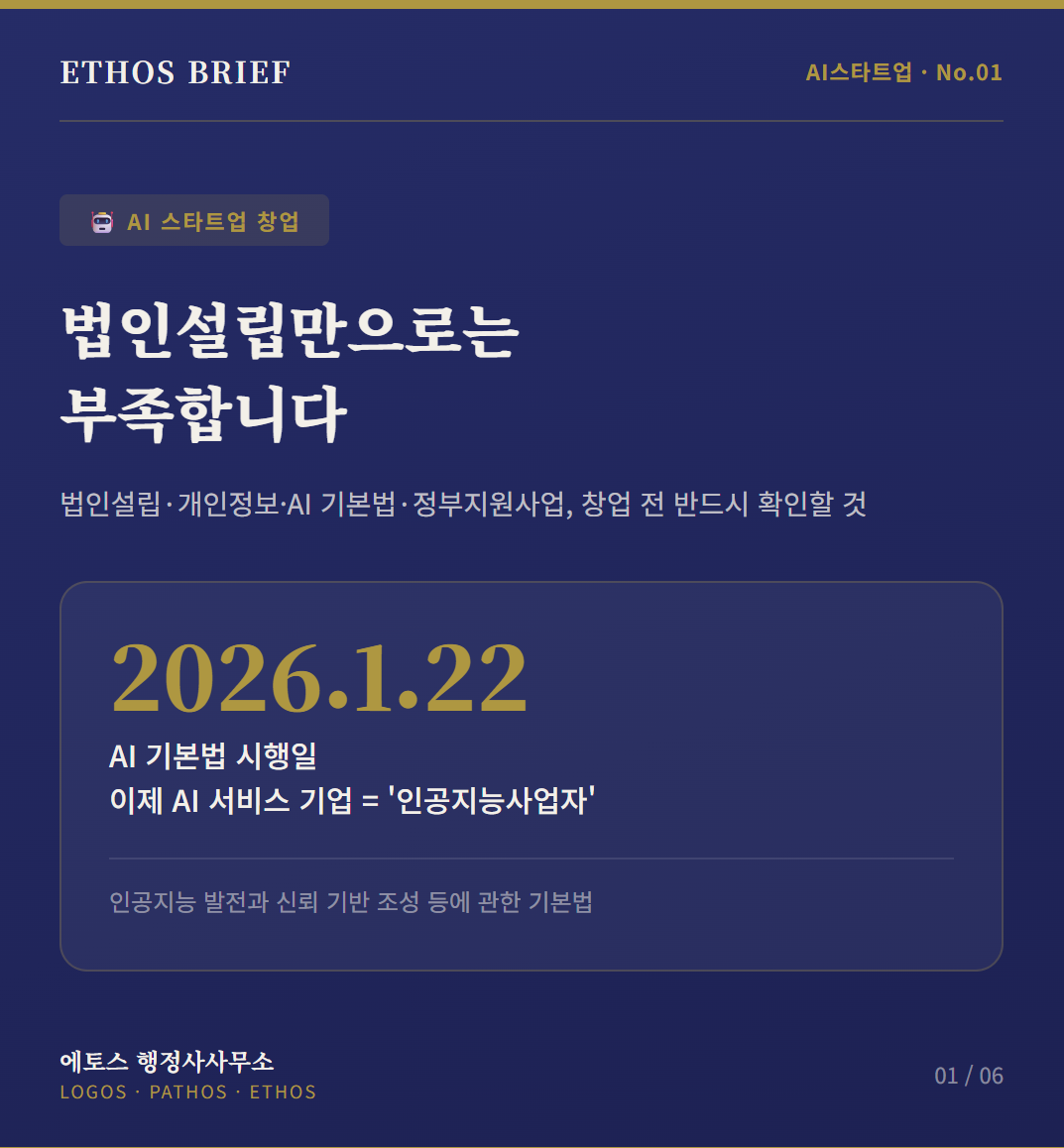
On January 22, 2026, Korea’s 「Framework Act on the Development of Artificial Intelligence and Establishment of Trust Foundation」, commonly referred to as the AI Basic Act, came into effect. As a result, companies operating AI services may now fall under the category of AI business operators.
If you are preparing any of the following services, you should review the required structure before launching:
- Generative AI services
- AI chatbots
- AI agents
- Document automation services
- Image or video generation services
- Data analytics platforms
- Recommendation algorithm-based services
- SaaS products using external AI APIs
- Enterprise workflow automation solutions
AI startup formation should now be viewed as one connected process:
incorporation → business registration → privacy policy → AI Basic Act compliance review → venture certification → government support applications
This article summarizes the key administrative steps AI startup founders should check before launch.
If You Are Asking These Questions, Start Here
Most AI founders eventually face similar questions.
“Can I start as a sole proprietor first?”
“Is incorporation better for investment or government support programs?”
“If I only use APIs like OpenAI, Claude, or Gemini, does the AI Basic Act still apply?”
“Can I prepare the privacy policy after launching the service?”
“When should I start preparing for venture certification or government support programs?”
These are not separate issues.
They are all connected to the initial business structure of an AI startup.
If the business form is chosen incorrectly at the beginning, later conversion to a corporation, contract succession, intellectual property transfer, and investment structure can become more costly.
If privacy policies or AI-use notices are postponed, the service may need to be revised after launch.
If government support programs are prepared too late, founders may miss opportunities because the business plan, corporate documents, and supporting materials are not ready when applications open.
In short, AI startups benefit from designing the structure properly before launch.
Step 1: Decide Whether a Sole Proprietorship or Corporation Is Better
For AI startups, incorporation is often more suitable than a sole proprietorship.
The reason is simple.
Even if an AI service begins as a small one-person or small-team project, it can quickly move into a more complex structure.
- Co-founders may join
- Angel or VC investment may be pursued
- Government support programs may be considered
- Source code and intellectual property rights may need to be organized
- External API, cloud, or data provider contracts may be required
- Personal data and user data may be processed
- B2B customer contracts may be signed
In these cases, a corporation may be more appropriate than a sole proprietorship.
| Category | Sole Proprietorship | Corporation, Stock Company | |---|---|---| | Formation difficulty | Relatively simple | More complex | | Initial cost | Lower | Relatively higher | | Investment | Limited | Generally easier | | Co-founder equity structure | Difficult | Possible | | Government support programs | Some limitations may apply | Generally available | | External credibility | Limited | Generally stronger | | Need for later conversion | May arise later | Structured from the beginning |
Of course, not every AI founder must incorporate immediately.
For a simple test, personal project, or pre-revenue validation stage, starting as a sole proprietor or preparing before incorporation may also be possible.
However, if you are considering investment, government support, co-founders, B2B contracts, or overseas expansion, incorporation from the beginning may be more advantageous in the long term.
Step 2: AI Startup Incorporation Starts With the Business Purpose
Incorporation is not just the process of creating a stock company.
For AI startups, the business purposes in the articles of incorporation should reflect the actual service model.
For example, the following business purposes may be relevant:
- Software development and supply
- AI-based service development
- Data analysis and processing
- Platform operation
- Information and communications services
- Research and development
- Online service provision
- Consulting
- Content production and supply
If the business purposes are too narrow, amendments may be required later for business registration, government support applications, contracts, or investment review.
On the other hand, adding too many unrelated purposes may create the impression that the company lacks focus.
For AI startup incorporation, it is useful to review the following items together:
- Company name and registered office
- Business purposes in the articles of incorporation
- Capital amount
- Shareholder structure
- Co-founder equity structure
- Representative director and officers
- Possibility of future investment
- Stock options or equity compensation
- Eligibility for government support programs
The corporate structure created at the beginning continues to affect investment, contracts, support programs, and intellectual property organization.
For that reason, AI startup incorporation should focus not only on registering quickly, but on starting with a structure that will not need immediate correction later.
Step 3: Business Registration Should Not Be Delayed
Once incorporation registration is complete, business registration should generally be handled promptly.
In Korea, business registration should be filed within 20 days from the business commencement date.
If delayed, an unregistered business penalty may become an issue based on the supply value generated before registration.
For AI startups, even if there is no formal revenue yet, the business commencement issue may need to be reviewed if activities such as the following have started:
- Paid beta service operation
- SaaS subscription payment launch
- Outsourced development contract
- B2B PoC agreement
- Advertising or marketing execution
- Customer data collection
- Government support application
- Submission of materials to investors
The registered business category should also match the actual service.
Not every AI service falls under the same category.
Depending on the revenue model, software development, data processing, platform operation, information services, consulting, or content provision may need to be considered.
Step 4: A Privacy Policy Should Be Prepared Before Launch
Most AI services handle data.
Not only membership information, but also user-entered text, uploaded documents, voice data, images, logs, payment information, and consultation records may be personal information or information that can be combined with personal information.
Therefore, before launching an AI service, the privacy policy should be reviewed.
The following items should match the actual service structure:
| Item | What to Check | |---|---| | Data collected | What personal information and usage data are collected | | Purpose of use | Service provision, quality improvement, AI training use | | Retention period | How long data is kept and when it is deleted | | Third-party provision | Whether data is provided to partners or external companies | | Processing entrustment | Cloud, payment, email, analytics, or other vendors | | Overseas transfer | Whether overseas AI APIs or cloud services are used | | User rights | Access, correction, deletion, and suspension request methods | | Security measures | Access control, encryption, log management, and safeguards |
In particular, if external AI APIs are used, it is important to check where data is transferred, for what purpose it is processed, and whether the service provider stores or uses the data for training.
A privacy policy is not a simple template document.
For AI services, it becomes a trust document that investors, enterprise customers, government support evaluators, and users may all review.
Step 5: Check Whether You Are an AI Business Operator Under the AI Basic Act
The AI Basic Act does not apply only to companies that develop AI models directly.
Companies that use external AI APIs to provide services may also qualify as AI users or AI business operators depending on the circumstances.
| Category | Meaning | |---|---| | AI developer business operator | A business that directly develops and provides AI | | AI user business operator | A business that uses another company’s AI to provide products or services |
For example, the following cases may require review:
- Providing a consultation chatbot connected to a GPT API
- Operating an AI document drafting service
- Providing image generation functions
- Offering recommendation results based on customer data analysis
- Providing enterprise workflow automation AI agents
- Supporting decisions in sensitive areas such as healthcare, recruitment, finance, or education
If the service involves generative AI or high-impact AI, the following points should be checked:
| Item | Review Point | |---|---| | AI-use notice | Whether users should be informed that AI is being used | | AI-generated content labeling | Whether AI-generated content should be identified | | Risk management | How errors, bias, and misuse risks will be managed | | Human intervention | Whether human review is needed for important decisions | | Data management | Standards for training, input, and output data | | Internal documentation | Whether operating standards and response procedures are documented | | Impact assessment | Whether the service qualifies as high-impact AI |
AI Basic Act compliance should not be treated as something added after launch.
It should be designed together with user notices, terms of use, privacy policies, and internal operating documents from the service planning stage.
Step 6: Venture Certification and Government Support Should Be Prepared Early
AI startups are often a good fit for government support programs.
However, support programs are not awarded based on ideas alone.
Evaluators often look at technology, business feasibility, market potential, founder capability, corporate structure, intellectual property, hiring plans, and regulatory readiness.
Representative programs that AI startups may consider include:
| Program | Main Features | |---|---| | Initial Startup Package | Business commercialization funding and startup programs for companies within 3 years of founding | | Startup Leap Package | Growth-stage support for companies 3 to 7 years after founding | | AI-specialized startup support | Support for AI prototypes, commercialization, and technology advancement | | Seoul AI Hub | Space, mentoring, networking, and computing infrastructure support for AI startups | | TIPS | Private investment-led technology startup support program | | Venture certification | Potential tax benefits, policy funding, and support program advantages |
If you plan to apply for government support, the following materials should be prepared early:
- Corporate registry certificate
- Business registration certificate
- Articles of incorporation
- Shareholder list
- Business plan
- Service introduction deck
- Technology description materials
- Privacy policy
- Terms of use
- Intellectual property materials
- Revenue or PoC materials
- Hiring plan
- Investment plan
If preparation starts only after a public notice is published, it may be possible to submit documents, but difficult to make them persuasive.
AI startups should organize their business structure and documents from the beginning in a form that can be used for support program applications.
Frequently Asked Questions
Q. Does the AI Basic Act apply even if I only use external AI APIs?
Yes, depending on the case.
Even if you do not develop the AI model yourself, using an external AI API to provide services to users in Korea may qualify you as an AI user business operator.
The key question is not whether you created the model, but what kind of AI-based service you provide to users.
Q. Should I incorporate even if I do not have revenue yet?
If you are considering investment, co-founders, government support programs, B2B contracts, or intellectual property management, incorporation may be worth reviewing even before revenue.
However, for a simple test or personal project, it may also be possible to remain at a preparation stage or begin as a sole proprietor.
Q. Can I use a template privacy policy?
It is not recommended.
AI services differ significantly in how they process data.
The wording should change depending on whether input data is transmitted to AI APIs, used for training, transferred to overseas servers, or likely to include sensitive information.
Q. When should I start preparing for government support programs?
Ideally, from the early startup stage, not after the announcement is posted.
Business plans, corporate structure, founder profiles, technical materials, and privacy or AI regulatory materials are difficult to prepare persuasively in a short period.
Q. Can a one-person AI startup incorporate?
Yes.
A one-person stock company can be established, and the representative director may also be the sole shareholder.
However, if co-founders, investment, or stock options may become relevant later, the articles of incorporation and share structure should be carefully designed from the beginning.
Minimum Checklist Before Launching an AI Startup
If you are preparing an AI startup, check the following items first:
- Whether a sole proprietorship or corporation is more appropriate
- How to define the business purposes for incorporation
- How to structure co-founder equity
- How to select the business registration category
- Whether the privacy policy reflects the actual service structure
- Whether data flows involving external AI APIs are organized
- Whether the company qualifies as an AI business operator under the AI Basic Act
- Whether generative AI or high-impact AI obligations may apply
- Whether venture certification is possible
- Whether documents for government support applications are ready
If any of these items are unclear, it is better to organize them before launching.
How Ethos Administrative Office Can Help
Ethos Administrative Office helps AI startup founders review the administrative procedures and documentation structures that are often missed in the early stages.
We can assist with matters such as:
- Administrative checklist review before AI startup launch
- Review of sole proprietorship vs. corporation structure
- Preparation of incorporation-related documents
- Business registration procedures
- Privacy policy and service operation documents
- Basic AI Basic Act checklist review
- Preparation for venture certification
- Review of government support application documents
- Administrative procedures for foreign founders or AI companies expanding overseas
Speed matters in AI startup creation.
But to move quickly, the initial structure must be clear.
If you are unsure whether to incorporate first, how to prepare a privacy policy, whether the AI Basic Act applies, or whether your startup may qualify for government support, start by reviewing the structure of your service.
Ethos Administrative Office can help organize your startup stage, service structure, and required administrative procedures.
For consultation, please contact us through the consultation channel.
References
- Korea Law Information Center: Framework Act on the Development of Artificial Intelligence and Establishment of Trust Foundation
- National Tax Service: Corporate Tax Rates
- Korea Institute of Startup & Entrepreneurship Development: Initial Startup Package
- Seoul AI Hub
- Bizinfo: 2026 TIPS Startup Company Support Plan Notice