
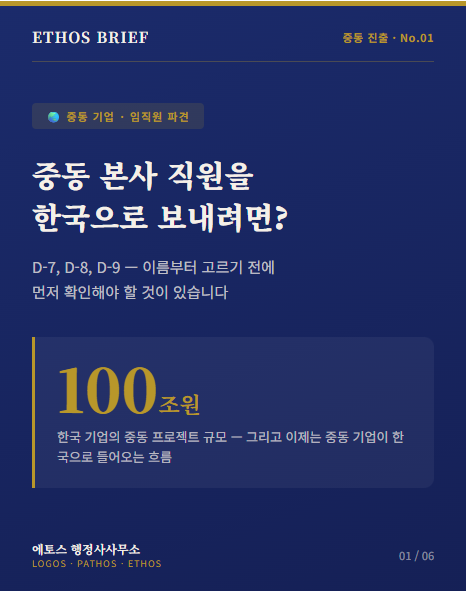
How Can Middle Eastern Companies Dispatch Employees to Korea? Start With D-7, D-8, and D-9 Visas
Hello, this is Jean, a licensed administrative agent.
When reading recent news about the Middle East, one number stands out.
The scale of Middle Eastern projects won or participated in by Korean companies has grown to exceed KRW 100 trillion.
From Saudi Arabia’s NEOM City to AI data centers in the UAE, as well as energy, construction, and plant projects, it is no longer unusual to see Korean companies expanding into the Middle East.
Recently, however, the opposite trend has also been growing.
That is, Middle Eastern companies are entering Korea.
As Gulf countries expand investment in non-oil industries, including through Saudi Vision 2030, collaboration with Korean companies is increasing in construction, IT, AI, content, gaming, and culture.
At first, a company may only enter into contracts with Korean companies.
Later, it may establish a liaison office in Korea, set up a branch, or even incorporate a Korean company.
Once an actual business base is established in Korea, the next question quickly arises.
“What visa is needed to send an employee from the Saudi headquarters to Korea?”
If you search online, D-7, D-8, and D-9 all appear.
Their names sound similar, and all of them relate to business activities, so it is naturally confusing at first.
But if you start by choosing the visa first, the order may be reversed.
The first thing to check is how the company has entered Korea.
The applicable status of stay may differ depending on whether the Korean presence is a branch, a foreign-invested company, or a business entity for trade or management activities.
In this article, we will focus on the visa categories often reviewed when Middle Eastern companies enter Korea and dispatch headquarters personnel: D-7 intra-company transfer, D-8 corporate investment, and D-9 trade management.
Start With the Korean Entry Structure, Not the Visa Name
There is more than one way for a Middle Eastern company to enter Korea.
Common structures include the following.
| Entry Structure | Basic Structure | Commonly Reviewed Visa Category | |---|---|---| | Branch or liaison office | The foreign headquarters remains overseas while a Korean base is established | D-7 | | Foreign-invested company | The foreign company invests capital and establishes a Korean corporation | D-8 | | Trade or management activities | Trade, business management, equipment-related activities, and similar work | D-9 |
However, this table should not be understood as an automatic formula such as “branch means D-7, corporation means D-8.”
In actual immigration review, the company form is only one factor.
The applicant’s position and career, the relationship between the headquarters and the Korean entity, the investment and funding structure, and the work to be performed in Korea are also reviewed together.
For example, even if three people are dispatched from the same Saudi company, one may be the representative director of the Korean corporation, another may be a technical expert from the headquarters, and another may need to stay for several years to supervise a project installation.
All three may have “Manager” written on their business cards, but immigration review may assess their actual activities differently.
For this reason, when a Middle Eastern company enters Korea, it is important to review company establishment and visa strategy as one structure from the beginning, rather than treating them separately.
D-7 Visa — Intra-Company Transfer From Overseas Headquarters to a Korean Branch
D-7 is generally reviewed when an executive or employee who has worked for an overseas company is dispatched to a Korean branch, subsidiary, or liaison office.
In simple terms, the company itself is not moving to Korea.
The foreign headquarters remains overseas, and a person from that company moves to the Korean base.
For example, consider this situation.
An IT company headquartered in Dubai, UAE, establishes a branch in Seoul to enter the Korean market.
Rather than hiring a large local team immediately, the company wants to send a business development manager from headquarters to manage Korean clients and partners.
In this type of case, D-7 is usually one of the first visa categories to review.
What Matters for D-7 Is the Substance of the Dispatch
When preparing a D-7 application, submitting only one dispatch order is not enough.
The review ultimately looks at questions such as:
Did this person actually work for the overseas headquarters?
Does the Korean branch actually exist and operate?
Why does this person need to work in Korea?
Therefore, the relationship between the headquarters and the Korean business entity, the applicant’s work history at headquarters, the duties to be performed in Korea, and the substance of the Korean office must be explained in a connected way.
This is especially important for a newly established branch or liaison office.
A newly established office is different from a company that has already operated for many years.
It may not yet have sufficient past revenue or domestic sales records.
In that case, it becomes important to show through documents such as business plans, expected domestic transactions, office lease materials, operating funds, and organizational structure that the Korean base was not created merely to obtain a visa, but has a real business purpose.
What Documents Are Usually Reviewed for D-7?
Specific documents may vary depending on the application type and jurisdiction, but generally the following categories are reviewed.
- Documents proving the legal existence of the overseas headquarters
- Documents related to establishment of the Korean branch or office
- Materials showing the relationship between headquarters and the Korean business entity
- Applicant’s employment and career documents
- Dispatch order
- Materials explaining the work to be performed in Korea
- Workplace-related documents
- Evidence of operating funds or business operation
The important point is not the number of documents.
What matters is whether all documents tell the same story.
If the headquarters says the employee is being sent for “market research,” but the Korean business plan says “direct sales management,” and another document says “technical support,” additional explanation may be needed during review.
From an immigration review perspective, consistency among documents is often more important than having one perfect document.
D-8 Visa — When a Foreign-Invested Company Is Established in Korea
If a Middle Eastern company invests capital directly into Korea and establishes a corporation, D-8 corporate investment status may be reviewed.
A common structure looks like this.
A Saudi company establishes a Korean corporation to enter the Korean market directly.
The Saudi headquarters remits investment funds and completes the foreign investment procedure.
Then an executive or management/professional employee from the headquarters is sent to Korea to operate the business.
In this case, D-8 becomes an important visa category to review.
Establishing a Korean Corporation Does Not Automatically Mean D-8
This is one of the most common misunderstandings.
Simply establishing a Korean corporation does not mean that a foreign executive or employee automatically qualifies for a corporate investment visa.
First, the investment structure behind the corporation must be reviewed.
Then the applicant’s role in the foreign-invested company must also be examined.
For example, even if a foreign-invested company exists, the assessment may differ depending on whether the person coming to Korea is a general employee, an executive responsible for management or administration, or a person providing technical or professional expertise.
The core question for D-8 is similar:
Why does this person need to work for the investment company in Korea?
Whether the company is actually conducting business, whether the applicant’s duties are connected to that business, and whether the size of the organization and the dispatched personnel are reasonable may also be reviewed.
For Middle Eastern Companies, It Is Important to Identify the Actual Investor
When Saudi Arabian or UAE companies enter Korea, the structure may sometimes differ from that of ordinary private companies.
There may be multiple layers of control, such as a state-owned company, government-related entity, company invested by a sovereign wealth fund, or affiliate owned by such a company.
For that reason, it is risky to assume that a company is a public institution simply because its name includes “Saudi” or “Government.”
It is equally risky to assume that it is fully private merely because it is organized as a corporation.
It is necessary to clearly document who invested, who dispatched the employee, and how that entity is related to the Korean corporation.
In particular, if the investor listed in the foreign investment report appears different from the headquarters or dispatching company described in the visa application, the relationship may need to be explained again.
This is why it is often more efficient to review dispatched personnel from the initial investment-structure planning stage, rather than creating the Korean corporation first and thinking about visas later.
D-9 Visa — Trade, Business Management, and Equipment-Related Activities
D-9 is commonly called a trade management visa.
However, it should not be understood as “if you operate a company in Korea, use D-9.”
D-9 may include different types of activities, such as trade transactions, business management, installation, operation or maintenance of export equipment, and manufacturing or supervision of industrial facilities.
Therefore, for D-9, the first step is to confirm what the applicant will actually do in Korea, and then determine the relevant subcategory.
Not All D-9 Categories Operate Under a Points System
When searching existing materials, you may see references to a points system together with D-9.
This requires caution.
The points system is not one common requirement that applies uniformly to every D-9 category.
D-9 includes multiple activity types, so the applicable requirements must be checked according to the specific subcategory.
For example, a person who directly manages a trade business and a technical employee dispatched to supervise installation of overseas industrial equipment cannot be assessed under the same standard.
Therefore, approaching D-9 as “you only need to exceed a certain score” can be risky.
How Are D-7 and D-8 Actually Distinguished?
This is one of the most confusing points for Middle Eastern companies.
A simple distinction is this.
D-7 is strongly connected to dispatch between an overseas headquarters and a Korean base.
By contrast, D-8 is strongly connected to investment, management, or professional activities within a foreign-invested company in Korea.
Suppose a UAE company is considering entering Korea.
Option 1 — Establishing a Korean Branch of the UAE Company
The UAE headquarters remains overseas.
A Korean branch of the foreign company is established.
An employee of the UAE headquarters is dispatched to the Korean branch.
In this case, D-7 becomes an important category to review.
Option 2 — Establishing a Separate Korean Corporation
The UAE headquarters sends investment funds and establishes a Korean corporation.
The company operates as a foreign-invested enterprise, and an executive or necessary professional employee from headquarters is assigned to the Korean corporation.
In this case, D-8 becomes important.
At first glance, both may look like “the Korean office of a UAE company.”
But the legal structures are different.
That difference may affect not only the visa, but also foreign investment reporting, corporate registration, foreign exchange, tax, and contract structure.
What Problems Arise If Visa Review Comes After Company Setup?
A common practical problem in Korean market entry is that the order becomes misaligned.
The company has already been established.
The office lease has already been signed.
Business cards have been printed, and meetings with Korean partners have been scheduled.
Only then does the company begin reviewing how to send an employee from headquarters.
But the employee’s role may not match the structure already created in Korea.
In that case, the investment and incorporation procedures already completed may need to be reviewed again.
For example, if the Korean corporation’s business purpose only states simple consulting, but the employee to be dispatched is supposed to supervise an equipment installation project, the business plan and dispatch purpose may need additional explanation.
For Middle Eastern companies entering Korea, the following three elements should be reviewed together rather than separately.
Company structure
Funding structure
Status of stay for the person
Ultimately, people carry out the business, and immigration review examines what that person will actually do in Korea.
What to Check Before Dispatching an Employee From a Middle Eastern Headquarters
Before choosing the visa name, check the following questions.
What Form Has the Company Used to Enter Korea?
The starting point differs depending on whether the Korean presence is a foreign company branch, liaison office, or foreign-invested corporation.
What Is the Nature of the Money Brought Into Korea?
It is necessary to distinguish whether the funds are investment capital, operating funds for a branch, or payment for transactions.
Who Is Coming to Korea?
The person’s actual role must be identified: representative, executive, manager, technical expert, project supervisor, or another role.
A job title alone is not enough.
Can the Relationship Between Headquarters and the Korean Entity Be Explained With Documents?
Company registration documents, shareholding structure, organization chart, investment documents, and dispatch orders should all show the same structure.
What Exactly Will This Person Do in Korea?
Rather than simply stating “responsible for Korean business,” the actual duties should be connected to the applicant’s career and expertise.
Arabic Documents Require Careful Review of Company and Personal Names
When Middle Eastern companies enter Korea, one practical issue appears more often than with companies from English-speaking countries.
That issue is English spelling variations of Arabic proper nouns.
For example, the same Arabic company name may be written slightly differently in the local commercial registration certificate, English translation, and bank remittance documents.
Personal names can create the same issue.
Because there is no single fixed way to romanize Arabic names, a passport may state Mohammed, an employment certificate may state Mohammad, and another document may state Muhammad.
A human reader may understand that they refer to the same person.
But in administrative documents, it may become necessary to separately explain that they refer to the same person or the same company.
Therefore, for corporate and dispatch documents issued in the Middle East, it is important to review not only the translation itself, but also whether the passport, company name, corporate registration number, and investor name are all connected consistently.
It is much easier to standardize names from the beginning than to discover inconsistencies after all documents have already been prepared.
Can Family Members Come to Korea Together?
For foreigners holding long-term statuses such as D-7, D-8, or D-9, the accompanying family status F-3 may be reviewed for a spouse and minor children if requirements are met.
However, the principal employee’s visa does not automatically create status for family members.
Documents proving the family relationship must also be prepared separately.
Family relationship documents issued overseas may require translation, apostille, or consular confirmation depending on the issuing country.
Middle Eastern countries differ in their participation in international conventions and their document authentication methods.
Therefore, it is safer to check based on the country where the document is issued, rather than assuming that the method used in another country will also apply.
Receiving the Visa Does Not End All Reporting Duties
Receiving entry and stay permission in Korea does not mean all immigration administration is complete.
If there are changes to a foreigner’s occupation, workplace, or details of stay, separate reporting may be required.
From a company perspective, it is necessary to manage whether the employee dispatched from headquarters is actually performing the approved duties in Korea, and whether the workplace or employment relationship has changed.
From 2026, online procedures related to reporting foreign workers’ employment information are expanding, so HR and general affairs teams should also manage post-visa stay compliance.
For companies, maintaining lawful status in Korea over time is a longer task than obtaining the visa once.
Middle Eastern Market Entry Into Korea Does Not End With Incorporation
When preparing to enter Korea, many companies first search for company incorporation.
But when the actual procedure is laid out, it is much longer.
- Decide on a foreign investment or branch structure
- Bring funds into Korea
- Register the company or branch
- Secure a workplace
- Review the status of stay for headquarters personnel
- If necessary, proceed with family stay procedures
Depending on the business, separate licenses or permits may also be required.
Therefore, if a Saudi or UAE company is planning to enter Korea, the first question should not be:
“How should we establish the company?”
It should be:
“Who will do what business in Korea, under what company structure?”
Once this question is clear, it becomes much easier to determine whether D-7, D-8, or another status of stay should be reviewed.
Summary
When a Middle Eastern company dispatches executives or employees to Korea, the choice among D-7, D-8, and D-9 is not determined by nationality alone.
D-7 is commonly reviewed when personnel are dispatched from an overseas headquarters to a Korean branch or base.
D-8 is reviewed in connection with investment, management, or professional activities in a foreign-invested company.
D-9 is reviewed when the activity fits a relevant subcategory, such as trade, business management, or industrial equipment-related activities.
In practice, the following three points matter more than the visa name.
- What structure does the Korean business entity have?
- What is the applicant’s relationship with the headquarters?
- What will the applicant actually do in Korea?
Even among employees of the same Middle Eastern company, if these three points differ, the applicable status of stay and required documents may also differ.
If a corporation or branch has already been established, the visa should be reviewed based on the current structure.
If the company is still planning its Korean market entry, designing the company structure and dispatched personnel’s visa together from the beginning can reduce unnecessary revisions and schedule delays.
If You Are Reviewing Korean Market Entry and Visa Status for Middle Eastern Company Personnel
For companies from Saudi Arabia, the UAE, and other Middle Eastern countries, it may be difficult to assess Korean market entry based only on the company form.
The investor, local headquarters, actual dispatching company, and Korean corporation may be connected through multiple layers.
Arabic and English spellings of company names and personal names may also need to be checked.
If you are preparing to enter Korea, or if you have already established a corporation or branch and are reviewing employee dispatch, the starting point is to organize the company structure and the role of the person to be dispatched.
Ethos Administrative Agent Office reviews foreign investment and branch-related administrative procedures, D-7, D-8, D-9 and other statuses of stay, overseas headquarters dispatch documents, English and Arabic documents, and overseas document authentication procedures related to Middle Eastern companies entering Korea.