
Five Common Barriers Middle Eastern Companies Face When Entering Korea -From Company Incorporation to D-7 and D-8 Visas
Hello, this is Administrative Agent Jean.
Imagine the following situation.
A company that has operated in Dubai for 15 years decides to enter the Korean market.
It has already secured Korean business partners and prepared investment funds. The company expects that if it establishes a corporation in Seoul and sends one executive from headquarters, it will be able to start business within a few months.
But once preparation begins, things turn out to be different.
Corporate documents prepared in Arabic must be reorganized for submission in Korea. The procedure changes depending on whether the company chooses a local corporation, branch, or liaison office. Investment funds also cannot simply be sent to a Korean bank account without structure.
The company thought incorporation would be enough. But when it tries to send a headquarters executive to Korea, it must again determine whether D-7 or D-8 is the appropriate visa category.
The Korean government actively promotes foreign investment.
Invest KOREA also provides structured guidance on foreign company incorporation and investment procedures in Korea. However, “foreign investment is possible” and “a foreign company can enter Korea easily without preparation” are completely different statements.
For Middle Eastern companies, especially from Saudi Arabia, the UAE, and similar jurisdictions, the issue is not simply one additional procedure. It is a connected matter involving home-country corporate documents, Korea’s investment system, immigration, and language.
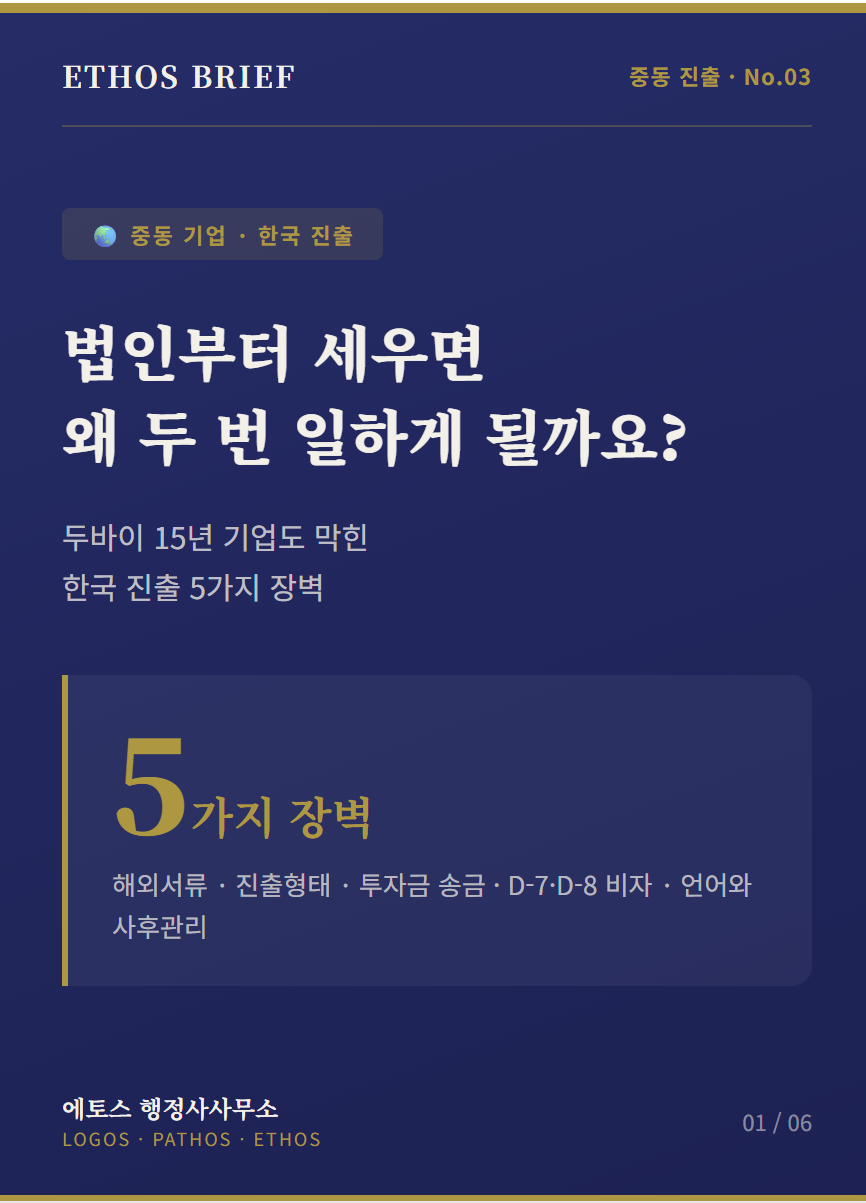
The major barriers Middle Eastern companies should check first when preparing to enter Korea can be summarized into five areas.
Where Do Middle Eastern Companies Most Often Get Stuck When Entering Korea?
| Barrier | Practical Issue | What to Check First | |---|---|---| | ① Overseas document authentication | Arabic corporate documents are difficult to submit as-is | Authentication route by issuing country and document type | | ② Entry structure | A local corporation, branch, and liaison office have different functions | What the company will actually do in Korea | | ③ Investment remittance | Company incorporation and recognition as foreign investment are not the same | Investment report, remittance, shareholding structure | | ④ D-7 and D-8 visas | Company incorporation alone does not create visa eligibility for headquarters staff | Dispatch relationship, role, investment structure | | ⑤ Language and post-entry compliance | Korean administrative procedures continue even after translation | Korean administration + Arabic originals |
The important point is that these five issues are not independent problems.
Documents prepared in the first stage may later become visa review materials in the fourth stage, and the company structure decided during the investment stage may affect the future visa status of executives and employees.
That is why sequence matters.
Barrier ① Arabic Corporate Documents — It Is Not Just About Translation
When a Middle Eastern company establishes a corporation or branch in Korea, the first issue it usually faces is overseas documentation.
Corporate registration records, articles of incorporation, board resolutions, shareholder documents, representative certificates, powers of attorney, and similar documents are generally created overseas.
The problem is that the procedure for making those documents usable in Korea differs depending on which country issued them and what type of document they are.
Apostille is one of the clearest examples.
Saudi Arabia and the UAE Differ From the Document Authentication Stage
Saudi Arabia joined the Apostille Convention in April 2022, and the Convention entered into force for Saudi Arabia on December 7, 2022. Therefore, Saudi public documents covered by the Convention may generally use the apostille system.
By contrast, as of August 2026, the UAE is not included in the list of contracting parties to the HCCH Apostille Convention.
This difference is very important.
“Since these are Middle Eastern documents, apostille should be enough for all of them.”
Or the opposite:
“Since they are from Arab countries, they must all receive embassy legalization.”
Neither statement is accurate.
You must first check the country where the document was issued.
Other Middle Eastern countries, such as Iraq, Kuwait, and Qatar, should not be treated the same way either. The current HCCH membership status and the authentication method required by the Korean receiving authority must be checked separately at the time of use.
It Is Also Not Accurate to Say “Arabic Documents Always Need Notarized Translation”
There is another point to be careful about.
Just because a document is in a foreign language does not mean every Korean administrative authority uniformly requires the same notarized translation.
Depending on the purpose of the document and the receiving authority, the requirements for the original, translation, notarization, and authentication may differ.
A safer way to prepare is to follow this order:
Where will the document be submitted?
→ What authentication is required for the original?
→ What language translation is required?
→ Does the translation require separate confirmation or notarization?
Simply translating an Arabic document into English does not mean it can automatically be used before all Korean authorities.
Name Consistency Is an Even More Common Problem
In Middle Eastern documents, proper-name consistency is as important as authentication.
For example, suppose one person’s name appears as follows:
In the passport: Mohammed Al ○○
In the headquarters employment certificate: Muhammad Al ○○
In the board resolution: Mohamad Al ○○
In the Arabic originals, they may refer to the same person.
But in Korean administrative documents, “they seem to be the same person” may not be enough.
The same issue applies to company names.
If the Arabic corporate name, English company name, name of the remitter in bank records, and investor name written in the Korean foreign investment report differ from one another, additional explanations may be required later.
Translation is not merely replacing words. It is also the work of consistently connecting the same person and the same company across administrative documents from different countries.
This is where reviewing the Arabic original becomes valuable when handling Middle Eastern corporate documents.
Barrier ② Local Corporation, Branch, or Liaison Office — Should You Choose the Simplest Option?
No.
A foreign company entering Korea may consider several forms depending on its purpose.
The main options are:
- Korean local corporation
- Domestic branch of a foreign company
- Liaison office
Invest KOREA also clearly distinguishes between a local corporation, branch, and liaison office. A domestic branch is a Korean base of a foreign corporation that may conduct revenue-generating business activities in Korea, while a liaison office is described as a form that conducts non-profit activities such as market research, liaison work, and research and development.
What Are the Differences?
| Form | Business Activities in Korea | Foreign-Invested Company Status | Key Feature | |---|---|---|---| | Local corporation | Permitted | Possible if requirements are met | Separate corporation under Korean law | | Branch | Permitted | Generally not an FDI structure | Korean business base of a foreign headquarters | | Liaison office | Profit-making activities not permitted | No | Non-profit activities such as market research and liaison work |
Invest KOREA explains that branches and liaison offices of foreign companies are domestic bases of foreign corporations and are separate from foreign-invested companies under the Foreign Investment Promotion Act.
“Let’s Start Lightly With a Liaison Office” Is Not Always the Best Choice
Suppose a UAE company wants to send one employee to Korea to research the Korean market.
If the purpose is to meet Korean companies, conduct market research, and report to headquarters, a liaison office may fit the purpose.
But if the company already plans to contract directly with Korean customers and receive payments, the answer changes.
A liaison office is not a structure for conducting revenue-generating business activities.
If it seems easy to set up at first but the company must restructure a few months later when actual business begins, it may end up doing the work twice.
Therefore, the first question when deciding the entry structure should not be:
“Which form is the cheapest and simplest?”
It should be:
“What will we actually do in Korea?”
Barrier ③ Does Sending KRW 100 Million Automatically Make You a Foreign-Invested Company?
This is another commonly misunderstood point.
Establishing a corporation in Korea and being recognized as a foreign-invested company under the Foreign Investment Promotion Act should be considered separately.
According to Invest KOREA, a typical form of foreign direct investment is where a foreigner invests KRW 100 million or more for management participation and acquires 10% or more of voting shares or equivalent equity.
In other words, the two elements must be considered together:
KRW 100 million + at least 10% equity
However, failing to meet this threshold does not necessarily mean that a foreigner can never acquire shares in a Korean company. Invest KOREA also explains that share acquisitions not falling under foreign investment under the Foreign Investment Promotion Act may proceed under other procedures related to foreign exchange transactions.
For this reason, “Can we establish a Korean company?” and “Can it be recognized as a foreign-invested company under the Foreign Investment Promotion Act?” should not be treated as the same question.
Investment Funds Should Not Be Sent First and Reported Later
Establishing a foreign-invested company usually proceeds as one connected process.
Determining the investment structure
→ Filing the foreign investment report
→ Remitting investment funds
→ Completing corporate registration
→ Registering the business
→ Obtaining required permits or licenses
→ Registering as a foreign-invested company
These steps should be reviewed in sequence.
Invest KOREA also explains foreign entry into Korean business through this investment and incorporation process.
Therefore, it is better to avoid simply sending money from a Middle Eastern headquarters to a Korean corporate account first and trying to adjust the investment structure later.
The investor name, remitter, share subscriber, and shareholder registry of the Korean company must be able to explain one consistent investment relationship.
Not Every D-8 Investment Is Reviewed in the Same Way as an Individual’s Source of Funds
This is a point that requires particular caution when drafting documents.
Standards such as “the investment funds must be directly formed by the investor personally, and if the funds came from a family gift, these specific documents are required” should not be generalized to every foreign corporate investment.
Where a Middle Eastern company is the investor, unlike an individual entrepreneur’s D-8 application, the overseas corporation itself may be the investment主体.
In that case, the key issue is not only an individual’s salary records, but the overall investment structure, including:
- Substance of the overseas investing corporation
- Authority to make the investment decision
- Remittance relationship
- Equity in the Korean corporation
- Business plan
- Actual arrival of investment funds
In particular, a case where a Middle Eastern corporation invests and a case where a Middle Eastern individual establishes a company with personal funds should not be reviewed in the same way from the beginning.
If this distinction is missed, unnecessary documents may be overprepared, or essential documents may be overlooked.
Barrier ④ Does Creating a Corporation Automatically Lead to a D-8 Visa?
No.
This is one of the most important barriers in Korean market entry for Middle Eastern companies.
Company incorporation and an individual’s visa status are separate reviews.
Just because a foreigner invests does not mean every foreign employee of that company automatically receives D-8 status.
What Is Actually Reviewed for D-8?
The representative corporate investment category, D-8-1, applies to essential professional personnel who intend to engage in management, administration, production, or technology fields at a foreign-invested company.
Invest KOREA’s D-8 guidance also describes D-8-1 applicants as essential professional personnel who will work in management, administration, production, or technology fields at a foreign-invested company.
Therefore, it does not end with:
“He is a headquarters employee, so we will send him.”
The review looks at whether the person is:
- An executive
- A manager
- Personnel with required expertise
- Assigned to a specific role in the Korean company
- Connected to the company’s business and the relevant position
There Is No Formula Such as “One Foreign Employee per KRW 100 Million Investment”
This is one explanation often seen online.
However, it is risky to use it as if it were an automatic allocation formula under law.
For D-8 review, the investment amount is not the only factor. The applicant’s position and duties, the structure of the foreign-invested company, and the actual business activities are reviewed together.
Therefore, you should not calculate the number of dispatched personnel as follows:
KRW 100 million investment = one D-8 visa
KRW 200 million investment = two D-8 visas
A newly established company, in particular, may not yet have sufficient past business performance in Korea compared with a company that has operated for several years.
In such cases, documents explaining the business, organizational structure, investment relationship, and why the applicant is actually necessary become important.
Then When Should D-7 Be Considered?
Unlike establishing a separate foreign-invested corporation in Korea, if an overseas headquarters has a Korean branch or office and dispatches headquarters personnel to Korea, D-7 intra-company transfer status becomes an important option to review.
In very broad terms:
Overseas headquarters → Korean branch or office dispatch structure: consider D-7
Foreign-invested company → essential professional personnel in management, administration, production, or technology: consider D-8
However, actual visa status can differ depending on the specific relationship between the company and the applicant. Therefore, simply memorizing “branch = D-7, corporation = D-8” is not enough.
This is why the company structure and the person’s role should be reviewed together before dispatch.
Barrier ⑤ Even After Translation, Korean Administration Continues in Korean
For Middle Eastern companies, the final barrier is not a single document but the language of the entire administrative process.
Invest KOREA and various government agencies provide English services, and support for foreigners continues to expand.
However, once actual company operations begin, the company must deal with more than one authority.
- Company incorporation
- Business registration
- Foreign investment
- Immigration
- Permits and licenses
- Local governments
- Banks
Each procedure uses different administrative concepts.
The Difficulty in Connecting Arabic and Korean Is Not Mere Translation
Suppose an Arabic document contains a phrase referring to a person with authority to manage the company.
Naturally translating that phrase into Korean is one issue.
Administratively distinguishing whether that person is:
the representative director, the investor’s agent, or a headquarters-dispatched executive
is a different issue.
Likewise, Korean concepts such as:
- Foreign investment report
- Corporate registration
- Business registration
- Foreign-invested company registration
- D-7
- D-8
cannot be explained simply by matching each term to one Arabic word.
Ultimately, what is needed is the combined work of translating language and distinguishing administrative meaning.
From 2026, Employment Information Reporting After Visa Issuance Has Also Changed
Administrative work does not end after the company is established and the visa is issued.
The Ministry of Justice expanded the online reporting system for foreign employees’ employment information from January 2, 2026. D-7, D-8, and D-9 visa categories are also included among the reportable statuses.
According to the Ministry of Justice, covered foreigners must report employment information such as occupation, industry, and income, and if reported information changes, the change must be reported within 15 days.
From a company’s perspective:
“Receiving a D-8 visa = immigration work is complete”
is not correct.
If the person’s duties or working conditions later change, the company must also manage whether those changes are subject to reporting.
For a Middle Eastern headquarters, the longer administrative task may not be the initial incorporation itself, but continuously operating the Korean entity in compliance with Korean rules.
The Most Dangerous Issue Is Getting the Sequence Wrong
Each procedure in a Middle Eastern company’s Korean market entry can be handled.
The problem is that if one step starts incorrectly, it may affect the next step.
For example:
The company plans to conduct business in Korea but first establishes a liaison office.
→ Later, when it tries to start actual business activities, the structure must be reviewed again.
The company establishes a Korean corporation first.
→ Later, it finds that the role of the headquarters employee it intended to send does not fit the D-8 structure it prepared.
The company prepares UAE corporate documents.
→ It assumed apostille would be enough, as with Saudi Arabia, but the UAE is not a party to the Apostille Convention.
The company sends investment funds first.
→ Later, it must explain the relationship among the investment report, shareholders, and remittance.
Each issue may look small in isolation.
But if the incorporation schedule, hiring of Korean employees, office lease, headquarters executive’s entry date, and business start date with Korean partners are all connected, delay in one step becomes delay of the entire project.
Seven Things Middle Eastern Companies Should Check Before Entering Korea
Before preparing actual documents, it is better to organize the following questions first.
1. Will You Actually Conduct Business in Korea?
Check whether the company will only conduct market research or whether contracts and revenue will also arise.
2. Which Structure Fits the Business Purpose: Local Corporation or Branch?
This should be judged based on future business operations and personnel plans, not merely ease of establishment.
3. Is the Investor an Individual or an Overseas Corporation?
The required documents for D-8 and foreign investment may differ.
4. How Much Will Be Invested and How Will the Shares Be Structured?
Check whether the typical FDI standard under the Foreign Investment Promotion Act applies: KRW 100 million or more + at least 10% voting equity.
5. Who Will Be Sent From Headquarters to Korea?
Review the person’s role and the company structure together, such as whether the person is a representative, executive, manager, or engineer.
6. In Which Country Were the Headquarters Corporate Documents Issued?
Whether the documents are from Saudi Arabia or the UAE may affect apostille applicability.
7. Are the English Spellings of the Company Name and Personnel Names Consistent?
Compare passports, corporate documents, bank documents, powers of attorney, and investment-related documents at the same time.
Once these seven points are organized, the required documents become much clearer.
Korean Market Entry for Middle Eastern Companies Is Not Just “Company Incorporation Agency Work”
If foreign company entry into Korea is viewed only as corporate registration, only part of the entire process is being considered.
In practice, the following procedures are connected:
Preparation of home-country corporate documents
→ Authentication and translation
→ Decision on Korean entry structure
→ Investment report and remittance
→ Corporation or branch-related procedures
→ Business registration and permits
→ Review of D-7 or D-8 for headquarters executives and employees
→ Post-entry immigration compliance
For Middle Eastern companies, Arabic originals, English name spellings, and country-specific overseas document authentication procedures are added on top of this.
Therefore, what matters in this work is not simply submitting one document on someone’s behalf.
It is designing the process from the beginning so that later stages do not force the company to go back and redo earlier steps.
That is more important.
Summary — Entering Korea Is Less About Difficulty and More About Connection
The five barriers Middle Eastern companies face when entering Korea can be summarized as follows.
First, overseas documents.
Each issuing country has a different apostille or authentication structure, and Arabic document translation and name consistency must also be checked.
Second, entry structure.
A local corporation, branch, and liaison office have different functions.
Third, investment structure.
Korean company incorporation and foreign investment under the Foreign Investment Promotion Act are not the same concept, and the investment report and remittance sequence must be reviewed together.
Fourth, executive and employee visas.
The existence of a company does not automatically result in D-7 or D-8 status. For D-8-1 in particular, whether the applicant is essential professional personnel in management, administration, production, or technology at a foreign-invested company is important.
Fifth, language and post-entry compliance.
Even after receiving a visa and starting business, various Korean reporting and administrative procedures continue. The online employment information reporting system expanded from 2026 is one example.
All five issues can be resolved.
However, if they are handled separately one by one, the overall structure may not fit together.
If a Middle Eastern company is planning to enter Korea, the starting point should not be simply forming a corporation first.
Instead, the company should first organize, as one structure:
who will invest,
which form the company will use to enter Korea,
what business it will conduct,
who will be dispatched to Korea,
and how the home-country documents are prepared.
If the Korean Entry Structure Has Not Yet Been Decided
For companies from Saudi Arabia, the UAE, and other Middle Eastern countries, Korean company incorporation, foreign investment, D-7 and D-8 visa status, overseas document authentication, and Arabic documents are often interconnected.
There is no need to wait until all documents are prepared before reviewing the structure.
If you first check the following materials, it is possible to determine which procedure should come first:
- Headquarters corporate documents
- Expected investment amount and shareholding structure
- Business to be conducted in Korea
- Position and duties of the person to be dispatched
Ethos Administrative Agent Office reviews Korean administrative procedures, foreign investment-related documents, D-7 and D-8 visa status, overseas document authentication, and the Korean submission structure for Arabic and English documents related to Middle Eastern companies entering Korea.