
Saudi Arabia vs UAE Company Formation: Where Should Korean Companies Go?
Hello, this is Administrative Agent Jean.
One of the most common questions from Korean companies considering expansion into the Middle East is this:
“Should we establish a company in Saudi Arabia or the UAE?”
Both countries are markets of strong interest to Korean companies, but their actual business environments are quite different.
Saudi Arabia has become an important market for companies that want to enter the market directly and perform business on the ground, as it pursues large-scale projects under Vision 2030 in construction, energy, smart cities, defense, tourism, IT, and other sectors.
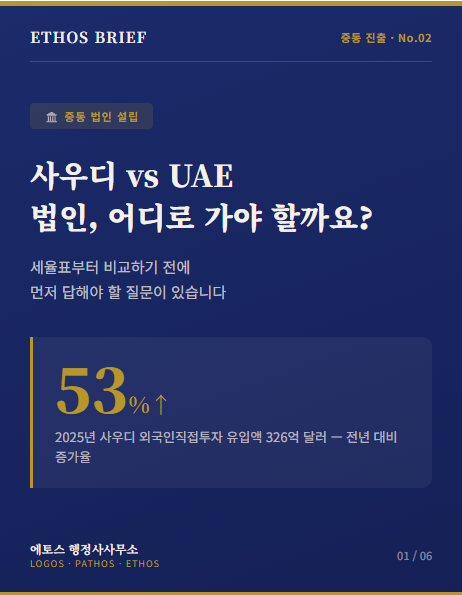
According to the Saudi Ministry of Investment (MISA), foreign direct investment inflows in 2025 reached USD 32.6 billion, an increase of approximately 53% from the previous year.
By contrast, the UAE, especially Dubai, has long served as a regional hub for managing business across the Middle East, Africa, and South Asia, supported by logistics, finance, trade, startup ecosystems, and numerous Free Zones.
So before asking “Which country is better?”, there is another question to ask first.
What are we trying to do in the Middle East market?
A company that intends to perform projects directly in Saudi Arabia and a company that wants to sell products across the GCC from a Dubai base cannot have the same answer.
This article summarizes the key differences between Saudi Arabia and the UAE from the perspective of Korean companies actually considering company formation.
What Is the Biggest Difference Between Saudi Arabia and the UAE?
In very simplified terms:
Saudi Arabia is a market where a local entity is often important for directly entering and operating in the market, while the UAE is often useful as a hub entity connecting the broader Middle East region.
Of course, this is not a formula that applies to every company.
The answer may differ depending on the business sector, customers, contracting parties, local workforce, and the country where revenue is generated.
| Category | Saudi Arabia | UAE | |---|---|---| | Common Use | Direct performance of projects and business in Saudi Arabia | GCC and Middle East regional hub, trade and services | | Entity Types | LLC, Branch, RHQ, etc. | Mainland, Free Zone, etc. | | Foreign Investment | General investment freedom under the updated investment law, with separate restricted activities | 100% foreign ownership possible for many activities, with separate rules for strategic-impact activities | | General Corporate Tax Structure | Income tax regime applies to income attributable to non-Saudi ownership, etc. | Basic 9% rate on taxable income exceeding AED 375,000 | | Key Employment Issue | Saudization and Nitaqat | Visa, employment, and Free Zone-specific requirements | | Language | Arabic administrative documents are highly important | English business environment is relatively broad | | Main Strength | Large domestic market and government projects | Finance, logistics, and international business infrastructure |
The important point is that you should not choose a country based only on the tax rates shown in a table.
For example, being in a UAE Free Zone does not automatically mean that all income is taxed at 0%.
Likewise, Saudi Arabia’s RHQ regime does not simply turn an ordinary operating company into a 0% tax company.
Saudi Company Formation — The Old “MISA License” Explanation Has Changed
If you search for information on entering Saudi Arabia, you may still see explanations like this:
“Foreign companies must first obtain a MISA investment license.”
This was a familiar way to explain the previous system, but today it should be viewed more precisely.
Saudi Arabia’s Updated Investment Law replaced the previous foreign investment law and is structured around the principle that foreign investors may invest in permitted sectors.
In particular, Article 7 of the updated law requires foreign investors to register with the Saudi Ministry of Investment (MISA) before investing. At the same time, activities that are prohibited or restricted for foreign investment are managed through a separate list of excluded activities.
Therefore, when explaining Saudi market entry in 2026, it is more accurate to say:
“The investment activity and business sector should be checked first, and investment registration under the updated investment law and any separate sector-specific licenses should be reviewed.”
rather than simply saying:
“You must obtain MISA approval.”
This may seem like a small difference, but it matters.
Saudi Arabia’s investment regime is moving from a system where foreign investment was treated as an exception to be permitted, toward a system based on general investment freedom with management of restricted activities.
In Saudi Arabia, the First Thing to Check Is the Business Activity
When establishing a company in Saudi Arabia, the first step is not calculating capital.
The first step is to define exactly what business the company will conduct.
The required registration and additional licenses may differ depending on whether the business is construction, engineering, trade, IT services, consulting, or another activity.
For example, suppose a Korean construction company wants to establish an entity to perform subcontracting work for a NEOM project.
Forming one company is not the end.
The company must also review separate registrations, sector-specific requirements, and workforce requirements connected to the actual construction or engineering work to be performed.
This is why the approach of “let’s establish the company first and add the business activity later” can make the process more complicated.
Saudization and Nitaqat — Issues You Meet Right After Company Formation
A policy that foreign companies must understand in Saudi Arabia is Saudization, meaning the employment policy for Saudi nationals.
A representative system is Nitaqat (نطاقات).
The Saudi Ministry of Human Resources and Social Development (MHRSD) manages companies’ Saudi employment levels through Nitaqat, and Qiwa provides an official tool for calculating a company’s Nitaqat level.
The important point is that this is not simply a matter of:
“How many Saudi employees do we need to hire?”
Localization requirements may differ depending on the company’s industry, size, job categories, and current employment structure.
A company’s Nitaqat level may also affect its ability to use certain labor administration services.
For example, MHRSD’s foreign worker occupation-change service expressly requires the establishment to be within the Platinum or Green range.
Consider this situation.
A Korean company wins a project in Saudi Arabia.
The company has established its entity.
It now wants to dispatch a large number of project managers and engineers from Korea.
But when setting up the company, it did not consider how many foreign workers would be needed later, or how Saudi employees should be structured accordingly.
In that case, the problem may not appear at the company formation stage, but in the next stage.
That is why, when entering Saudi Arabia, it is important to design the local workforce plan together with the company formation structure.
Saudi RHQ — Is Corporate Tax Really 0% for 30 Years?
Qualified Regional Headquarters, or RHQs, may receive strong tax incentives.
According to ZATCA’s official RHQ guide, income earned by an eligible RHQ from licensed RHQ activities may be subject to a 0% corporate income tax rate for 30 years.
At first glance, this looks very attractive.
But there is one important condition.
An RHQ is not the same as an ordinary operating company.
ZATCA’s guide clearly explains that, in order to maintain the 0% benefit, an RHQ should not conduct profit-generating activities outside the scope of its licensed RHQ activities.
For example, if an RHQ directly conducts unlicensed commercial activities such as product distribution, that income may not qualify for the RHQ tax incentive.
In other words, you should not understand the rule as:
“If we establish an RHQ in Saudi Arabia, all business income will be tax-free for 30 years.”
An RHQ is a structure for regional strategy, management, and support functions within a group.
In some cases, it may need to be separated from the Operating Company that actually generates revenue.
This is exactly the kind of issue that cannot be seen from a simple comparison of company formation costs.
UAE Company Formation — The First Question Is Mainland or Free Zone
When establishing a company in the UAE, especially in Dubai, one of the first terms you will hear is:
Mainland and Free Zone.
These two structures are not simply about having different addresses.
They are connected to where and how the company will conduct business.
The UAE broadly allows 100% foreign ownership of companies, and the UAE Ministry of Economy and Tourism also identifies 100% foreign ownership as one of the key features of its investment environment.
However, certain activities with strategic impact may be subject to separate rules.
For that reason, the old explanation:
“A UAE Mainland company must be 51% owned by a local person.”
should not be used as if it were the current general rule.
UAE Free Zone — It Is Not Automatically “0% Tax on Everything”
Tax benefits are often mentioned as one of the advantages of UAE Free Zones.
But this point must be reviewed with conditions attached.
According to the UAE Federal Tax Authority (FTA), a Qualifying Free Zone Person may apply a 0% corporate tax rate to Qualifying Income if the requirements are met.
By contrast, income that does not meet the qualifying income requirements may generally be subject to a 9% rate.
A Free Zone company is also not automatically exempt from corporate tax registration obligations.
The UAE’s general corporate tax structure is currently 0% on taxable income up to AED 375,000, and 9% on taxable income exceeding that amount.
Therefore, if you choose a company structure based on the assumption that:
Free Zone = 0% tax on all revenue
the actual tax structure may differ once the business begins.
When selecting a Free Zone, you should compare not only registration costs but also the following:
- Which country the actual customers are located in
- Whether the company will sell directly to UAE Mainland customers
- What type of income will be generated
- Whether the activity qualifies under the Free Zone rules
- How the company will establish sufficient business substance
So Which Is Better: Saudi Arabia or the UAE?
The answer is: it depends on the business model.
However, some directions can be identified based on the company’s purpose.
Cases Where Saudi Arabia May Be Reviewed First
If the Saudi domestic market itself is the purpose, the importance of a Saudi local entity increases.
Examples include:
- Saudi government or public projects
- Construction and plant projects
- Energy
- Smart cities
- Defense
- Large-scale local services
- Businesses targeting local consumers
These are cases where the company must contract directly, deploy personnel, and perform business inside Saudi Arabia.
For these companies, simply establishing a company in Dubai will not automatically solve the Saudi business structure.
Cases Where the UAE May Be Reviewed First
By contrast, if the core of the business is:
- Trade across multiple GCC countries
- International logistics
- IT or SaaS
- Consulting
- Finance or investment
- Regional sales
- International workforce operation
then there may be strong reasons to review the UAE as a regional hub.
Dubai Free Zones, in particular, emphasize advantages such as 100% foreign ownership and specialized business ecosystems.
Can We Establish a UAE Company and Do Business in Saudi Arabia?
Some businesses can be structured this way.
However, there is no formula that says “if you have a UAE company, you do not need a Saudi company.”
A Korean headquarters may establish a regional company in Dubai and manage sales across the GCC.
But if the company will actually sign contracts in Saudi Arabia, station employees there, perform projects locally, or conduct activities requiring local licenses, it must separately review whether a Saudi entity or additional registration is required.
Especially when Saudi government-related contracts and RHQ policy are involved, a simple “one Dubai hub covers all GCC business” strategy may not always be optimal.
On the other hand, not every company needs to establish both a Saudi and UAE company from the beginning.
For some companies, a UAE base may be efficient at the initial market-entry stage.
For others, operating without a Saudi entity may be difficult from the beginning.
Ultimately, what matters more than the number of companies is where the money, contracts, and people actually move.
What Korean Companies Often Miss: Procedures Required in Korea
When preparing for Middle East expansion, most companies focus on local company formation.
But a Korean company also has procedures to handle in Korea.
A representative example is outbound direct investment reporting.
The Korean Foreign Exchange Transactions Act and its Enforcement Decree define certain investments, such as acquiring 10% or more of shares in a foreign corporation in order to participate in its management, as outbound direct investment.
Even if the shareholding is below 10%, it may still qualify as outbound direct investment if certain relationships, such as dispatching officers, are formed.
The Bank of Korea also explains that when acquiring 10% or more of shares in a foreign corporation, an outbound direct investment report should generally be filed with a foreign exchange bank.
In other words, receiving approval to establish a company in Saudi Arabia or the UAE does not mean that the Korean foreign exchange administration is complete.
In general, the following flow should be reviewed together.
Decide the Middle East expansion structure
→ Review outbound direct investment reporting in Korea
→ Remit investment funds
→ Complete local investment and company registration
→ Obtain business licenses and permits
→ Establish local banking, tax, and labor systems
→ Handle local work and residence procedures for Korean employees
→ Manage post-investment changes, liquidation, and follow-up matters
There is one especially important point here.
Korean employees dispatched to Saudi Arabia or the UAE do not prepare D-7 or D-8 visas.
D-7 and D-8 are Korean statuses of stay reviewed when foreigners enter Korea.
If employees of a Korean company will work in Saudi Arabia or the UAE, their work and residence status must be reviewed under the system of that country.
Apostille Rules Are Not the Same for Saudi Arabia and the UAE
When a Korean company establishes a local entity, it may need to submit Korean documents such as corporate registration documents, articles of incorporation, powers of attorney, or board resolutions to local authorities.
Here too, Saudi Arabia and the UAE should not be treated the same way.
The Apostille Convention entered into force for Saudi Arabia on December 7, 2022.
By contrast, as of June 30, 2026, the UAE is not included in the HCCH Apostille Convention status table.
Therefore, documents to be submitted in the UAE should not be handled on the assumption that “apostille is enough,” as may be the case for Saudi Arabia.
The consular legalization or authentication procedure required by the actual receiving authority should be checked separately.
This difference can affect the project timeline.
If the company discovers after starting the formation process that the authentication method for Korean documents differs by country, translation and authentication may need to be prepared again, delaying the entire schedule.
Questions Korean Companies Should Answer Before Forming an Entity
Before deciding between Saudi Arabia and the UAE, it is advisable to organize at least the following points.
First, In Which Country Will Revenue Actually Be Generated?
The answer differs depending on whether the company will contract directly with Saudi customers or conduct sales across the GCC.
Second, Where Will Employees Be Stationed?
Do not think only about Korean employees being dispatched.
In Saudi Arabia, Saudization must also be considered.
Third, What Is the Role of the Local Entity?
It is necessary to distinguish whether the local entity will be an Operating Company generating direct revenue, a regional headquarters, or a simple sales and management base.
Fourth, What Business Activity Will Be Registered?
If the business involves sectors with separate regulators, such as construction, engineering, education, healthcare, or finance, company registration alone may not be enough.
Fifth, What Funds Will Be Sent From Korea, and in What Form?
Whether the funds are investment capital, loans, or operating funds may affect Korean foreign exchange reporting and local accounting treatment.
Only after these points are organized does it become easier to decide whether the structure should be a Saudi entity, a UAE entity, or a structure using both countries together.
Saudi Arabia vs UAE: Look at Business Structure Before Tax Rates
When comparing the two countries, numbers such as UAE’s 9% corporate tax, Saudi tax rates, RHQ 0%, and Free Zone 0% tend to stand out first.
But in actual market entry, the cost of choosing the wrong entity structure may be greater than a few percentage points of tax difference.
A company may establish an entity in Dubai, only to find that most of its actual business must be conducted in Saudi Arabia.
A company may establish an RHQ in Saudi Arabia, only to find that what it actually needs is an Operating Company that directly performs sales.
A company may establish a Free Zone entity, only to find that its actual transactions do not fit the expected qualifying income structure.
Or the local entity may be properly established, but the company may later discover Korean outbound investment reporting or document authentication requirements.
So the first question in Middle East expansion should not be:
“Which option is cheaper?”
It should be:
“Where do our company’s contracts, money, and people actually move?”
The country and entity form should be selected based on that answer.
If You Are Preparing for Middle East Expansion as a Korean Company
Issues involving Saudi or UAE company law, tax, labor, and local licensing should be handled by local professionals in each country.
However, when a Korean company expands overseas, there are also administrative procedures that must be organized in Korea.
Representative examples include:
- outbound direct investment reporting,
- preparation, translation, and authentication of Korean corporate documents,
- powers of attorney and other submission documents,
- review of Arabic and English documents to be submitted to Middle Eastern authorities,
- administrative procedures that sit between Korea and the Middle East.
In particular, Saudi government materials on investment and labor sometimes require checking both the Arabic original and the English guidance to understand the meaning accurately.
If you are considering Middle East expansion, it is better to organize which country and structure you will use, and what Korean reports and documents are required, rather than forming the entity first and trying to fit the procedure afterward.