
One Missing Clause in Your Bylaws Can Void a Resolution Approved by 449 Members
Hello, this is Administrative Agent Jean.
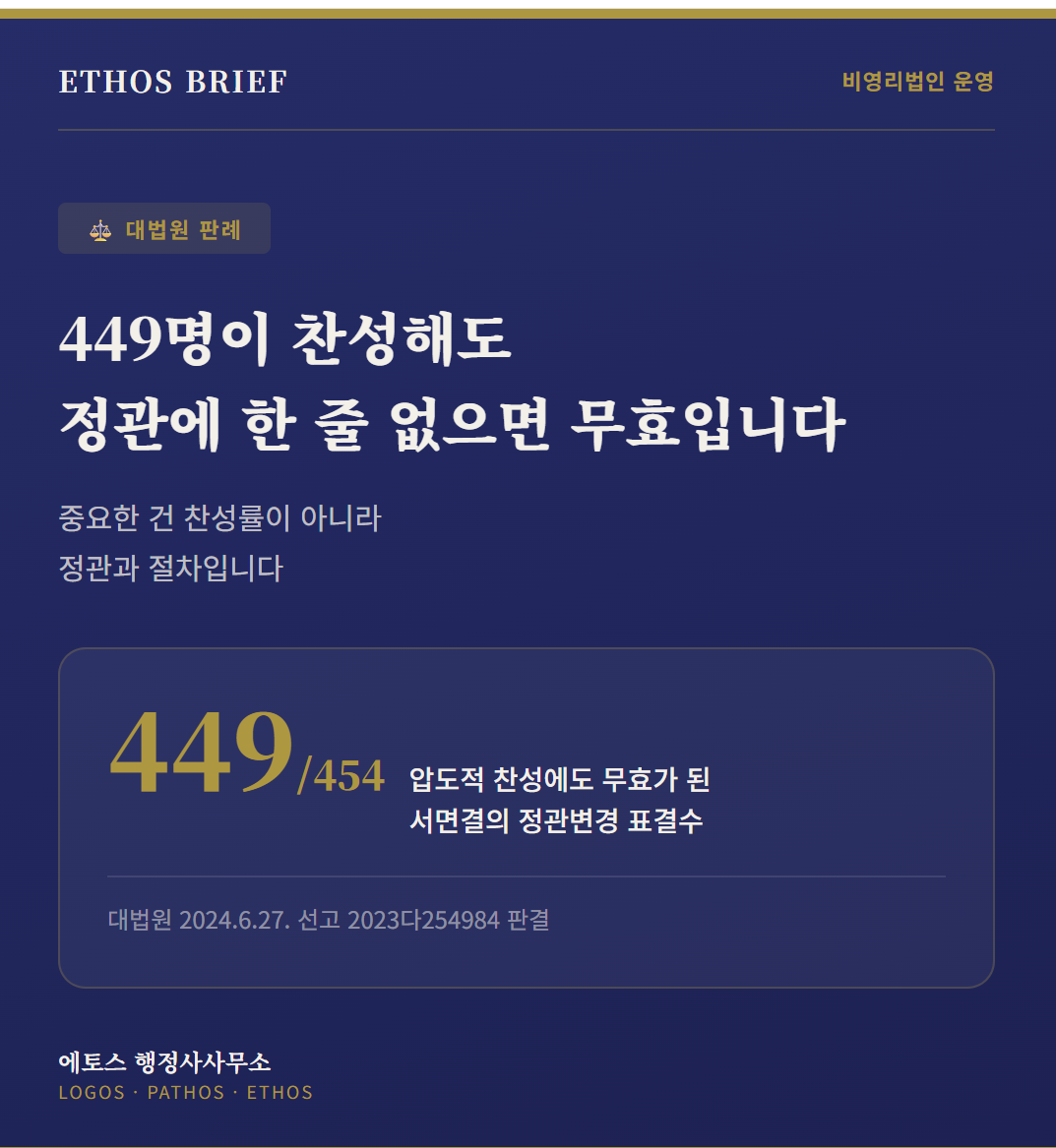
In one association, 449 out of 454 delegates approved a resolution.
By numbers alone, the approval was overwhelming.
But the Korean Supreme Court held that the resolution was invalid.
Why?
For one simple reason.
The bylaws did not contain a clause allowing written resolutions.
In 2020, the board of an incorporated association decided to hold an extraordinary delegates’ meeting.
The agenda was to delete the clause limiting consecutive terms for the association president.
Because of the COVID-19 situation, the association did not hold an in-person meeting. Instead, it collected written votes.
The result was 449 approvals.
The bylaws were amended, and the former president, who would not have been eligible under the old bylaws, was elected as the 9th president at an in-person meeting the following year.
However, on June 27, 2024, the Korean Supreme Court held that the bylaw amendment resolution was invalid from the beginning.
Because the bylaw amendment was invalid, the later president election based on the amended bylaws was also invalid.
Why was a resolution approved by 449 people invalid?
Because one necessary clause was missing from the bylaws.
In this article, we will look at what this case means for associations, academic societies, and nonprofit corporations, and why bylaws must be reviewed before holding general meetings or written votes.
Key Summary
| Category | Details | |---|---| | Case | Korean Supreme Court Decision 2023Da254984, June 27, 2024 | | Main Issue | Whether a bylaw amendment can be made by written resolution without a bylaw basis | | Holding | If the bylaws do not allow written resolutions, the general meeting resolution may be invalid | | Core Reason | As a rule, members should attend a duly convened general meeting and vote there | | Practical Risk | Invalid bylaw amendment → invalid president election → uncertainty in later contracts, appointments, and business decisions | | What to Check Now | Written resolution clauses, online meeting clauses, bylaw amendment procedure, competent authority approval |
How Did the Case Begin?
An incorporated association wanted to delete a clause limiting consecutive terms for its president.
Instead of holding an in-person extraordinary delegates’ meeting, it collected written votes due to COVID-19.
The result was overwhelming.
449 out of 454 delegates approved.
The bylaws were amended.
The former president, who had been restricted under the previous bylaws, was then elected as president the next year.
At first glance, this may look valid.
The approval rate was very high.
COVID-19 was also a special circumstance.
But the court did not focus on the approval number.
The court focused on the bylaws and the procedure.
Why Did the Supreme Court Find It Invalid?
The Supreme Court reaffirmed a basic principle.
For an incorporated association, a resolution of the general meeting should generally be made at a duly convened meeting where members attend and vote.
A written resolution is an exception.
Why?
Because written resolutions can restrict members’ rights to attend a meeting, ask questions, hear other members’ opinions, discuss the agenda, and form their own intent through deliberation.
These are not empty formalities.
They are connected to members’ rights in the association.
Therefore, a written resolution needs an express basis in law or in the bylaws.
In this case, the bylaws did not contain a clause allowing written resolutions of the general meeting.
For that reason, the Supreme Court held that the bylaw amendment resolution was invalid.
“But It Was During COVID-19. Still Invalid?”
The association argued that written voting was necessary because of the spread of COVID-19.
The Supreme Court did not accept that argument.
The Court considered the following points:
- It was not specifically proven that written resolution was unavoidable
- There was no sufficient urgency requiring the bylaw amendment at that time
- The bylaws did not expressly allow written resolutions
- The issue was a serious bylaw amendment affecting eligibility for president
In other words, “it was difficult to gather” was not enough.
If the bylaws do not provide a basis, even overwhelming approval may not save the resolution.
Why Are Bylaws So Important?
Many associations, academic societies, and nonprofit corporations treat bylaws as documents needed only for incorporation.
Once approval is received and registration is completed, the bylaws are often placed in a folder and forgotten.
But bylaws are not just incorporation documents.
They are the operating rules of the legal entity.
The following matters may depend on the bylaws:
- General meeting convocation
- Delegates’ meeting structure
- Written resolution
- Online meeting
- Board resolution
- Appointment and dismissal of officers
- Term limits for president
- Bylaw amendments
- Dissolution and remaining assets
- Quorum and voting requirements
- Rights and duties of members
If the bylaws do not match the actual operation, the corporation may face serious legal instability.
And often, the problem appears only after a dispute begins.
Can I Use AI-Drafted Bylaws As They Are?
These days, more organizations use AI to draft bylaws.
AI-drafted bylaws are not necessarily wrong.
The real question is whether those bylaws fit your organization’s actual governance structure.
Common risks include:
| Problem in Draft Bylaws | Practical Risk | |---|---| | Written resolution allowed only for the board, not the general meeting | General meeting written resolution may be invalid | | No online meeting clause | Validity of remote meetings may be disputed | | Delegates’ meeting basis is unclear | Delegates’ resolutions may be challenged | | President term limit is ambiguous | Election disputes may occur | | Member expulsion procedure is insufficient | Expulsion may be invalidated | | Bylaw amendment quorum conflicts with the Civil Act | Amendment validity issue | | Competent authority approval process omitted | Bylaw amendment may not become effective |
AI can produce general wording.
But designing bylaws that reflect the organization’s size, membership structure, meeting style, business purpose, competent authority practice, and future dispute risk is a different matter.
Bylaws are not documents to make the organization look formal.
They are the governance blueprint that protects the organization when conflict arises.
Why Are Written Resolutions Risky?
Written resolutions are convenient.
They are especially useful when members are located across the country, when the association is composed of busy professionals, or when some members live overseas.
But convenience alone is not enough.
Written resolutions may limit the following rights:
- Right to attend the meeting
- Right to receive explanation of the agenda
- Right to ask questions
- Right to deliberate
- Right to hear other members’ opinions
- Right to propose amendments or opposing views
That is why written resolutions of the general meeting require a clear basis in the bylaws.
This is especially important for major matters such as bylaw amendments, officer elections, dissolution, merger, and disposal of assets.
General Meeting and Board Meeting Must Be Checked Separately
A common practical mistake is this:
The bylaws contain a written resolution clause for the board, but not for the general meeting.
In that case, people often say:
“We have a written resolution clause in our bylaws.”
But a board clause applies only to the board.
A general meeting needs its own basis.
| Body | What to Check | |---|---| | General Meeting | Written resolution, electronic voting, online meeting basis | | Delegates’ Meeting | Authority and voting method for delegates | | Board of Directors | Written resolution, video meeting, electronic signature method | | Bylaw Amendment | Quorum and competent authority approval | | Officer Election | Candidate eligibility, term limits, election method |
Bylaws should not be reviewed one clause at a time.
General meeting, board, officers, and bylaw amendment clauses must work together.
Why Are Bylaw Amendments Especially Sensitive?
Article 42 of the Korean Civil Act sets important rules for bylaw amendments of incorporated associations.
Unless the bylaws provide otherwise, bylaw amendments require consent of at least two-thirds of all members.
In addition, bylaw amendments require approval from the competent authority to take effect.
In practice, the process generally includes:
- Check the quorum under the bylaws
- Convene the general meeting properly
- Vote through a legally valid method
- Prepare meeting minutes
- Apply for approval of bylaw amendment to the competent authority
- Complete follow-up procedures such as registration if needed
If any step is defective, the amendment may be challenged.
Especially if the resolution itself is invalid, even competent authority approval may not fully remove later dispute risk.
Competent authority approval does not automatically cure serious defects in the internal resolution process.
What This Decision Means for Your Organization
The impact of this decision is larger than it may seem.
If a bylaw amendment resolution is invalid, later resolutions based on the amended bylaws may also be affected.
For example:
| Potentially Invalid Procedure | Later Risk | |---|---| | Bylaw amendment resolution | Dispute over validity of amended bylaws | | President election | Representative authority may be challenged | | Director appointment | Legality of board composition may be challenged | | Contract execution | Contracts signed by disputed representative may be questioned | | Business approval | Grants, donations, and business execution may become unstable | | Member discipline | Expulsion or suspension may be challenged | | Membership fee imposition | Payment obligation may be disputed |
When one resolution is invalid, the problem does not necessarily stop there.
The governance structure built on that resolution may become unstable.
That is why bylaws should be reviewed regularly, not only at incorporation.
Five Things to Check Right Now
If you operate an association, academic society, or nonprofit corporation, check these five items now.
1. Does Your Bylaw Allow Written Resolutions of the General Meeting?
Check whether the bylaws expressly allow the general meeting to resolve matters in writing.
A board written resolution clause is not enough.
The general meeting and board are different bodies.
2. Does Your Bylaw Allow Online or Video Meetings?
Online meetings became common after COVID-19.
But if the bylaws do not provide a basis, the validity of online general meetings may be disputed.
Identity verification, attendance, voting method, and meeting minutes should be clearly structured.
3. Have You Used KakaoTalk, Email, or Written Votes for Resolutions?
In practice, many organizations use KakaoTalk group chats, email replies, Google Forms, or text messages to approve matters.
If there is no bylaw basis, the validity of those resolutions may be questioned.
Risk increases if the resolution involved officer appointment, bylaw amendment, budget approval, or member discipline.
4. Do You Need to Amend the Bylaws?
If you want to add written resolution or online meeting clauses, you need a bylaw amendment.
A bylaw amendment does not end with an internal resolution.
Approval from the competent authority is required.
The amendment process itself must be conducted properly.
5. Do Your Bylaws Match Actual Operation?
If the bylaws assume in-person meetings but the organization has been using written votes every year, there is a problem.
If only regular members have voting rights but supporting members have been allowed to vote, there is a problem.
If the board must approve a matter but the president has been deciding alone, there is a problem.
In nonprofit governance, “how we have always done it” is less important than “what the bylaws actually say.”
If You Are Preparing to Incorporate, This Matters Even More
For an existing corporation, changing bylaws requires another formal process.
A general meeting resolution is needed.
Competent authority approval is needed.
Time is required, and internal conflict may arise.
That is why the initial bylaw drafting stage is so important.
From the beginning, consider clauses on:
- General meeting convocation
- Written resolutions
- Online general meetings
- Electronic voting
- Delegates’ meetings
- Board written resolutions
- Officer terms and term limits
- Acting representative when the president is absent
- Member expulsion procedure
- Bylaw amendment procedure
- Dissolution and remaining assets
Bylaws are not just forms for incorporation approval.
They are the operating manual that helps the organization function without dispute for the next 5 or 10 years.
If the Corporation Already Exists, Review the Bylaws Now
If you already operate an incorporated association or foundation, bylaw review is especially recommended in the following situations.
| Situation | Why Review Is Needed | |---|---| | A written general meeting was recently held | Need to confirm written resolution basis | | An online general meeting is planned | Need basis for remote meeting and electronic voting | | President election is coming | Need to check eligibility, term, and term limits | | Bylaw amendment is planned | Need to check quorum and approval procedure | | Member expulsion or discipline occurred | Need to check procedure and opportunity to be heard | | Delegates’ meeting is used | Need to check authority and delegate selection basis | | Grants or public projects are being performed | Need stable representative authority and decision process | | Internal dispute is expected | Need to prevent validity challenges |
Once a dispute begins, options become limited.
Bylaws should be fixed while the organization is still calm.
How an Administrative Agent Can Help
An administrative agent does more than prepare incorporation documents.
For nonprofit governance, an administrative agent can support the following.
1. Designing Bylaws Before Incorporation
Bylaws can be designed according to the organization’s purpose, membership structure, meeting method, officer system, and competent authority practice.
Instead of using a template found online, the bylaws should reflect how the organization will actually operate.
2. Reviewing Existing Bylaw Risks
For existing corporations, bylaws can be reviewed for risks such as:
- Missing general meeting written resolution clause
- No online meeting basis
- Conflicting quorum provisions
- Ambiguous officer term limits
- Insufficient member discipline procedure
- Weak basis for delegates’ meeting
- Missing competent authority approval process
3. Supporting Bylaw Amendment Procedures
Bylaw amendment requires both internal resolution and competent authority approval.
An administrative agent can support amendment drafting, meeting procedure review, meeting minutes, and approval application documents.
4. Reviewing General Meeting and Board Procedures
Before holding a general meeting or board meeting, it is important to check the required quorum and voting method for each agenda.
This is especially important for high-risk matters such as officer election, bylaw amendment, dissolution, asset disposition, and member discipline.
5. Preventive Review Before Disputes
Once a dispute starts, there are fewer options.
If bylaws and meeting procedures are reviewed in advance, the risk of invalid resolutions can be reduced.
The best legal strategy is often not winning a lawsuit.
It is preventing the lawsuit from becoming necessary.
Frequently Asked Questions
Q. Can a resolution be invalid even if almost all members agreed?
Yes.
For important matters such as bylaw amendments, officer elections, and dissolution, the procedure required by law and bylaws must be followed.
A high approval rate does not automatically cure serious procedural defects.
Q. Can email or KakaoTalk approval count as a written resolution?
It depends on the case.
But the key issue is whether the bylaws allow that method.
If there is no bylaw basis for email, KakaoTalk, or Google Form voting, the validity of the resolution may be disputed.
Q. If the board can vote in writing, can the general meeting also vote in writing?
No.
The board and the general meeting are separate bodies.
A written resolution clause for the board does not automatically apply to the general meeting.
A separate basis for the general meeting must be checked.
Q. Does a bylaw amendment take effect immediately after the vote?
No.
Under Article 42 of the Korean Civil Act, an incorporated association’s bylaw amendment requires a valid resolution and approval from the competent authority.
Without competent authority approval, the amendment does not take effect.
Q. If the competent authority approved the amendment, are internal procedural defects cured?
Not necessarily.
Even if competent authority approval was obtained, serious defects in the internal general meeting resolution may still be challenged later.
The internal procedure must be valid from the beginning.
Bylaw Review Checklist
If any of the following are unclear, your bylaws should be reviewed.
- Is there a written resolution clause for the general meeting?
- Is it separate from the board written resolution clause?
- Is there a clause for online or video meetings?
- Is electronic voting or electronic exercise of voting rights clearly structured?
- Is the delegates’ meeting and delegate selection basis clear?
- Are officer terms and term limits clear?
- Is there an acting representative clause when the president is unavailable?
- Are member expulsion and discipline procedures specific?
- Does the bylaw amendment quorum comply with the Civil Act?
- Does the bylaw amendment process include competent authority approval?
- Do the bylaws match the organization’s actual operation?
One missing clause can invalidate an entire resolution.
Reviewing the bylaws now is the most practical way to prevent future disputes.
Closing
A resolution approved by 449 members can still be invalid.
The number of approvals is not enough.
The bylaws and procedures must be correct.
Associations, academic societies, and nonprofit corporations continue to hold general meetings, elect officers, amend bylaws, and approve projects after incorporation.
All of those activities begin with the bylaws.
If the organization resolves matters in a way not permitted by the bylaws, later disputes can destabilize many decisions made over time.
Bylaws are not documents to keep in a drawer.
They are practical governance documents that must reflect how the organization operates today and how it may face disputes tomorrow.
If you are preparing to incorporate, design them properly from the beginning.
If you already operate a corporation, review them now.
Consultation
If you need assistance with nonprofit incorporation, bylaw drafting, bylaw amendment, or general meeting and board procedure review, please contact us.