
Korean Nonprofit Donations Over KRW 10 Million? Check Your Articles of Incorporation Before Fundraising Registration
A nonprofit organization in Korea is preparing a new project.
The project requires approximately KRW 50 million.
The organization plans to publish a donation account on its website, promote a fundraising campaign on social media, and send sponsorship requests to companies.
Then someone asks:
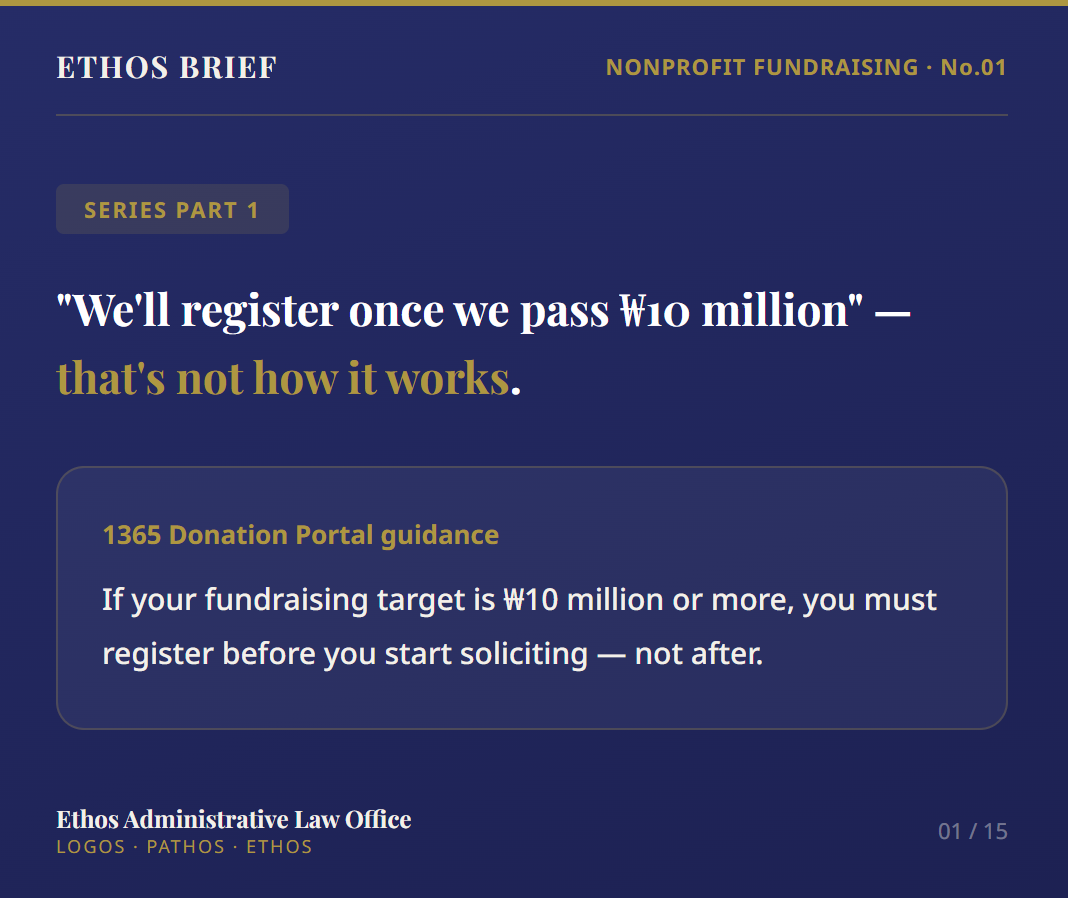
"Can we start fundraising first and register once the donations exceed KRW 10 million?"
The answer is no. That is not the correct order.
Donation collection registration is not a post-filing procedure that you complete after receiving KRW 10 million.
Korea's 1365 Donation Portal also explains that when a fundraising project is subject to registration and the target amount is KRW 10 million or more, the registration procedure must be completed before the fundraising begins. The standard processing period is generally 20 days.
But there is an even more important question to answer before looking at the KRW 10 million threshold.
What is the legal nature of the money your nonprofit intends to collect?
That is where the analysis should begin.
In practice, nonprofit fundraising in Korea should generally be reviewed in the following order:
Articles of Incorporation → nature of the payment → solicitation activity → fundraising target → registration → actual collection and use → post-fundraising reporting
This article begins with the first question:
Is the money your organization receives legally a donation under Korea's Donation Collection and Use Act?
Korea Already Recorded 326 Donation Collection Registrations in 2026
Donation collection registration is not a system used only by large charitable organizations.
According to Korea's 1365 Donation Portal, as of August 30, 2026, there were 326 registered donation collection campaigns, with a combined fundraising target of KRW 659.833 billion, or approximately KRW 659.8 billion.
For the full year of 2025, there were 352 registrations with a combined fundraising target of KRW 663.446 billion.
In other words, by the end of August 2026, the number of registrations had already reached approximately 93% of the entire 2025 total, while the combined fundraising target had reached approximately 99% of the previous year's total.
In Seoul alone, 161 registrations, from No. 2026-1 through No. 2026-161, had been publicly disclosed as of June 30, 2026.
This shows that when a nonprofit begins actively raising project funds from outside supporters, it may encounter Korea's donation collection regulations sooner than expected.
However, many organizations begin with the wrong question:
"Will we exceed KRW 10 million?"
The legal analysis actually starts one step earlier.
The First Question Is Not KRW 10 Million — It Is "What Kind of Money Is This?"
Korean donation law does not determine the nature of a payment solely by the label attached to it.
Under Article 2, Paragraph 2 of the current Act on Collection and Use of Donations and Promotion of Donation Culture, a donation generally refers to money, goods, or other property received without consideration, regardless of the name used.
However, not every payment received by a nonprofit falls within the statutory definition of a donation.
Under Article 2, Paragraph 2(a), payments collected by a corporation or organization from persons who have joined as members under its Articles of Incorporation, bylaws, or internal rules — including admission fees, lump-sum payments, membership fees, or money collected for the common interests of its members — are excluded from the statutory definition of donations.
Therefore, it is not enough to look at whether a bank transfer is labeled "membership fee" or "donation."
You must also determine whether the payer is actually a member under the organization's governing documents and in what legal relationship the payment was made.
This distinction is critical.
If the payment is misclassified at this stage, the analysis that follows may also change.
The KRW 10 million registration threshold, registration obligations, fundraising expense restrictions, and rules governing the use of funds all begin with the question of whether the money is legally a "donation" under the Act.
The Current Registration Threshold in 2026 Remains KRW 10 Million
For reference, legislation has been discussed in 2026 that would increase the donation collection registration threshold from KRW 10 million to KRW 30 million and relax certain other regulatory requirements, including the permitted period for using collected donations.
However, the law has not yet been amended.
Therefore, as of August 2026, organizations planning fundraising activities must still apply the current KRW 10 million threshold.
The Supreme Court Also Looked at the Membership Structure — Not Just the Name of the Payment
A 2023 Supreme Court decision illustrates this issue particularly well.
The case is Supreme Court Decision 2021Do16765, decided February 2, 2023.
A nonprofit organization regularly received membership fees or financial support from regular members and supporting members.
Prosecutors alleged that the organization had used excessive amounts for personnel and promotional expenses beyond the statutory fundraising expense limit and had used some funds for purposes different from the registered fundraising purpose.
The Supreme Court, however, first addressed a more fundamental question:
Were the payments made by those members legally "donations" in the first place?
The Court did not decide the issue simply because the individuals were called "supporting members."
Instead, it held that the classification should be determined by considering factors such as:
- the organization's internal rules;
- its purpose and actual operations;
- membership eligibility and admission procedures;
- the rights and obligations of members; and
- how membership fees were paid and managed.
In that case, the Supreme Court found it appropriate to exclude the amounts received from members from the statutory definition of donations.
The practical lesson is clear:
When reviewing nonprofit fundraising, the first document to examine may be the Articles of Incorporation — not the bank statement.
Does Calling Someone a "Supporting Member" Automatically Make the Payment a Membership Fee?
No.
The Supreme Court looked at the actual membership system, not merely the terminology used by the organization.
Consider the following example.
A nonprofit website contains a "Become a Supporting Member" button.
Anyone can enter their name and bank account information and automatically transfer KRW 30,000 every month.
However, the Articles of Incorporation do not recognize a category called "supporting members."
There is no membership approval procedure.
The supporters have no member rights, such as participation in the general meeting or access to organizational records, and they have no obligations under the Articles.
The organization simply refers to regular donors internally as "supporting members."
In such a structure, the fact that the organization uses the term "supporting member" would not necessarily be enough to classify those payments as membership fees.
The analysis may be different if the Articles and membership rules actually establish a membership category, prescribe an admission procedure, define rights and obligations, establish membership fee requirements, and the organization operates in accordance with those rules.
That is why the governing documents and actual operations should be consistent.
The solution is not to begin accepting donations first and later revise the terminology in the Articles.
The legal structure and the actual fundraising model should ideally be designed together from the beginning.
The Next Question Is Not "Did We Receive Money?" but "Are We Soliciting Donations?"
Once the nature of the payment has been classified, the second question is whether the organization is engaging in solicitation.
Under the current Donation Collection Act, solicitation includes requesting, encouraging, or asking another person to make a donation through letters, advertisements, telecommunications networks, or similar methods.
Applying that definition to actual nonprofit operations makes the issue easier to understand.
For example, an organization may:
- create a "Support Us" page on its website;
- promote a fundraising campaign through social media;
- send sponsorship requests to companies; or
- ask for donations at an event.
If the underlying payment qualifies as a donation under the Act, such activities may constitute "solicitation of donations."
Therefore, the analysis does not stop at how much money has actually entered the organization's bank account.
You must also examine whether the organization is actively requesting, encouraging, or asking third parties to contribute.
Only Then Does the KRW 10 Million Threshold Become Relevant
This is the third stage of the analysis.
If the money qualifies as a donation under the Act and the organization is engaging in solicitation, the next question is the fundraising target.
Under Article 4 of the current Act and guidance provided through the 1365 Donation Portal, an organization intending to collect KRW 10 million or more for a project subject to registration must prepare and submit a fundraising and use plan.
The registration authority depends on the fundraising target:
- KRW 10 million to KRW 1 billion: the relevant city or provincial government
- More than KRW 1 billion: the Ministry of the Interior and Safety
The important wording here is "intends to collect."
For example, assume a nonprofit plans a year-end campaign with a target of KRW 50 million.
Only KRW 3 million has actually entered the bank account so far.
That does not mean the organization should conclude:
"We have not reached KRW 10 million yet, so we can register later."
If the organization plans from the outset to raise KRW 50 million and the campaign falls within a category subject to registration, the registration issue should be addressed before the fundraising begins.
If Fundraising Has Already Started Without Registration, the Legal Question Changes
When an organization is still preparing a campaign, the key questions concern its fundraising plan and target amount.
Once fundraising has already begun without registration, the legal analysis becomes different.
At that stage, issues such as the actual amount collected, the fundraising period, and whether multiple fundraising activities were conducted under a single fundraising plan may become relevant when assessing the consequences of unregistered solicitation.
The Korean Supreme Court has addressed actual amounts collected and repeated fundraising activities conducted under a single plan in cases involving unregistered fundraising.
Accordingly, it would be incorrect to assume:
"There is no problem until the organization actually receives KRW 10 million."
The question of whether registration was required in advance and the question of what legal consequences may arise after unregistered fundraising has already occurred are separate issues.
Donation Collection Registration Is More Than Filing a Single Application Form
The fundraising and use plan required under Article 4 of the Act contains much more than basic organizational information.
It may include matters such as:
- purpose of the fundraising;
- type of donations to be collected;
- fundraising target;
- fundraising area;
- method of solicitation;
- fundraising period;
- method of safeguarding the funds;
- estimated fundraising expenses;
- method of financing fundraising expenses;
- method for using the donations;
- deadline for using the funds; and
- designated bank account.
Actual registration records disclosed through the 1365 Donation Portal also show that the process may involve documents such as the registration application, fundraising plan, use plan, officer list, representative information, and bank account documentation.
In substance, the organization is submitting an operational plan explaining:
"How will this money be collected, and how will it ultimately be used?"
That is why donation collection registration should not be viewed merely as filling in blanks on an application form.
Once Registered, Your Website and Social Media Also Become Part of the Compliance Structure
Article 4(6) of the current Act is also important.
A fundraiser or person participating in the solicitation must make certain information readily available to potential donors.
This may include information such as:
- information about the fundraiser;
- registration authority and registration number;
- purpose of the fundraising;
- whether the donation qualifies for tax benefits;
- proportion of fundraising expenses; and
- how donors can review the results of the fundraising and use of the donations.
In practice, this means that obtaining a registration certificate and placing it in a file cabinet is not the end of the process.
The donation page on the organization's website, social media fundraising posts, offline promotional materials, and the registered fundraising plan should all point in the same direction.
For example, if the registration documents state that the donations will be collected for Project A, while the organization's actual promotional materials also solicit donations for Project B, compliance issues may arise.
Article 10 of the Act provides that collecting donations in a manner inconsistent with the registered fundraising and use plan may constitute grounds for cancellation of the registration, and cancellation may also lead to issues concerning the return of collected donations.
For this reason, the fundraising plan should be realistic and executable from the registration stage.
If You Are Preparing to Fundraise, Check These Issues in This Order
If your organization has not yet begun fundraising, start by reviewing the Articles of Incorporation and membership rules.
Then compare those documents with the organization's actual funding structure.
Ask the following questions:
- Who legally qualifies as a member of the organization?
- What procedure is required to become a member?
- What rights and obligations do members have?
- Are recurring payments actually defined as membership fees under the governing documents?
- Is the organization requesting donations from outside parties through its website, social media, sponsorship letters, or other channels?
- What is the total fundraising target?
After answering these questions, if the activity constitutes solicitation of donations under the Act and the target amount is KRW 10 million or more, the organization should review whether donation collection registration is required.
In These Situations, Do Not Start by Filling Out the Registration Form
In particular, the structure should be reviewed before preparing an application if:
- regular members, supporting members, and general donors are not clearly distinguished;
- the Articles do not recognize a membership category even though regular donors are treated as "members";
- membership fees and general donations are deposited into the same account;
- the organization actively solicits donations from the general public through its website or social media;
- fundraising has already begun without registration; or
- the fundraising target is expected to exceed KRW 10 million.
In these situations, the first task is to determine which payments are legally donations.
If that classification is incorrect, it may affect not only registration but also the fundraising method, use plan, fundraising expenses, and post-fundraising reporting requirements.
Nonprofit Fundraising Does Not Begin with the KRW 10 Million Threshold
When searching for information about donation collection registration in Korea, the KRW 10 million threshold is usually one of the first things that appears.
But the legal analysis does not begin with that number.
Start with these questions:
What membership structure is established in the Articles of Incorporation?
In what legal capacity is each person making a payment?
Is the organization actively asking outside parties to contribute?
Only after those questions are answered should the organization determine the fundraising target and registration requirements.
And once registration is completed, the fundraising method, website language, designated account, use plan, and post-fundraising reporting should be managed as one connected compliance structure.
Therefore, the first question for a Korean nonprofit should not be:
"Do we have to register once we exceed KRW 10 million?"
A more accurate question is:
"What kind of money is our organization collecting, and under what legal and operational structure are we collecting it?"
If the organization has not yet begun public fundraising and its membership and fee structure is clearly established under its governing documents, it may begin by comparing those documents with its actual operations.
However, if the distinction between supporting members and general donors is unclear, public fundraising has already begun, or the fundraising target exceeds the registration threshold, it is better to review the Articles of Incorporation and actual fundraising structure together before simply preparing an application.
If a criminal investigation or prosecution is already involved, review by a Korean attorney may be necessary. If the primary issue concerns tax-deductible donation receipts or public-interest corporation taxation, separate tax advice may also be required.
If you are unsure whether your nonprofit's current Articles of Incorporation and fundraising structure require donation collection registration in Korea, the relevant documents can be reviewed first to confirm the available approach through a free preliminary review.