
Can a Korean Nonprofit Sell Its Building with Only a Board Resolution? — What to Check Before Disposing of Basic Assets
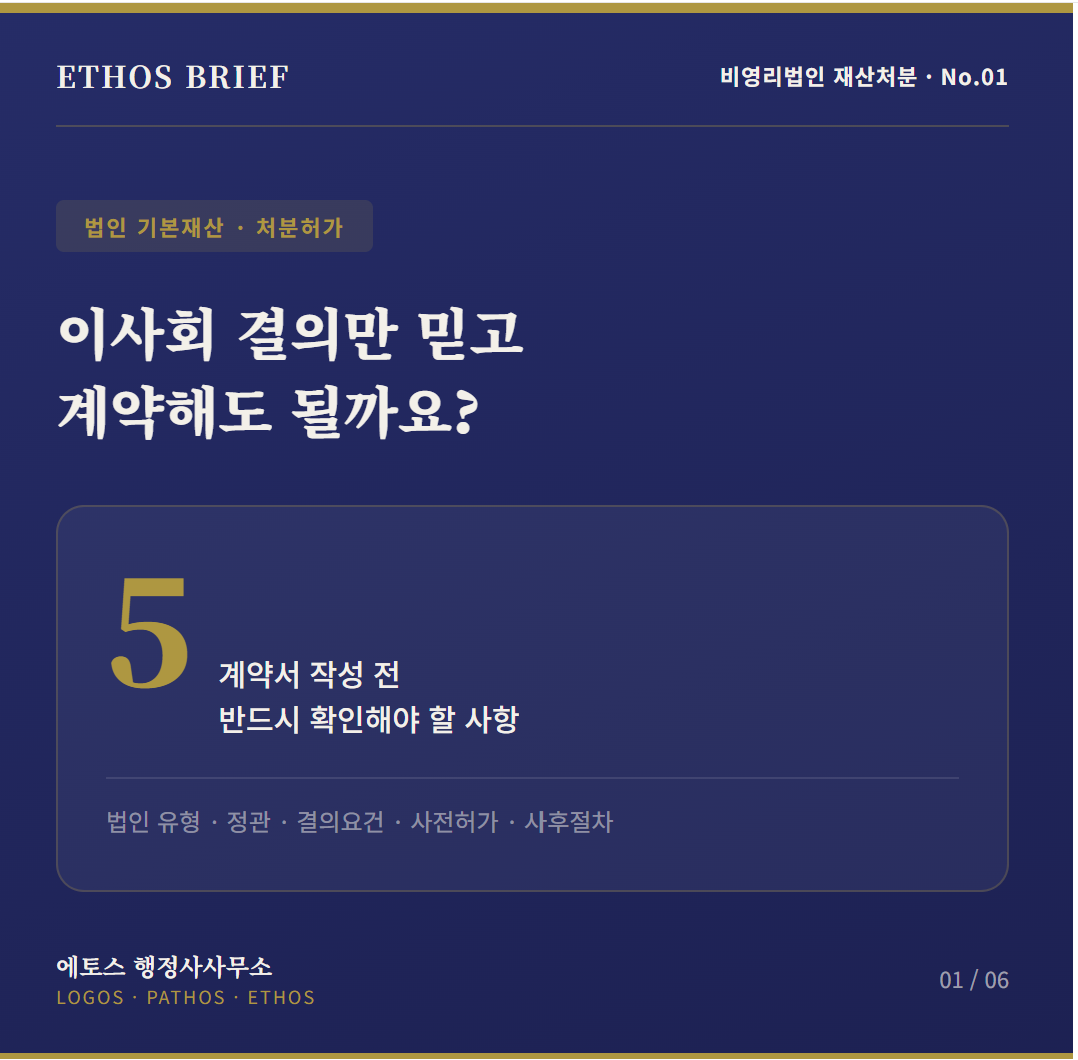
Hello, this is Jean, a Korean Administrative Attorney.
A buyer has appeared for a building owned by your nonprofit organization.
The price looks reasonable, and the board agrees that selling the property would be beneficial.
But before fixing the contract date, you open the organization's old Articles of Incorporation and discover that the building is listed as a basic asset (기본재산).
Can you simply rely on the board resolution and sign the sale agreement?
The short answer is: not always.
If the property is classified as a basic asset under the Articles of Incorporation, a board resolution alone may not be sufficient.
Depending on the legal type of the organization, disposal of the asset may require approval from the competent government authority, an amendment to the Articles of Incorporation, or both.
This is because the basic assets of a Korean nonprofit may not be treated in the same way as ordinary corporate assets that can be freely disposed of through internal management decisions.
If your organization is already discussing a closing schedule with a buyer, it is therefore advisable to check the administrative requirements before signing the contract.
When a building, land, deposit, securities, or other property is classified as a basic asset, the following should normally be reviewed:
- the exact legal type of the organization;
- the current Articles of Incorporation and basic-asset schedule;
- requirements for a board or general-meeting resolution;
- whether prior approval from the competent authority is required; and
- whether an amendment and post-transaction report will be required after disposal.
For Civil Act foundations in particular, disposal of basic assets may be closely connected to an amendment of the Articles of Incorporation.
If the required government approval is missing, the validity of the disposal itself may become an issue.
At the same time, it is also incorrect to assume that every transaction involving a basic asset always requires a new approval.
For example, where a mortgage was validly created with prior approval and the secured property is later sold through enforcement of that mortgage, the legal analysis can be different.
So the question cannot be reduced to either:
“Basic assets can never be sold.”
or:
“It belongs to our organization, so a board resolution is enough.”
The first thing to determine is not the market price of the building.
It is what kind of asset the property is, and what kind of nonprofit owns it.
First, Check Whether the Property Is Actually a Basic Asset
Not every asset held by a nonprofit organization is managed in the same way.
Suppose a scholarship foundation owns:
- a scholarship center building;
- a time deposit;
- an ordinary bank account used for program expenses; and
- a company vehicle.
If the building and time deposit are listed in the Articles of Incorporation as basic assets, disposing of or replacing them may involve more than ordinary asset management.
The asset structure stated in the Articles of Incorporation itself may change.
So before asking:
“Can we sell this building?”
the more important question is:
“Is this building currently registered as a basic asset under the Articles of Incorporation?”
For older organizations, the actual asset situation may not always match the basic-asset schedule attached to the current Articles of Incorporation.
That is why it may be necessary to review not only the real estate registry, but also the current Articles, previous amendment approvals, and past approvals involving acquisition, disposal, or reclassification of basic assets.
The Supreme Court Has Not Treated Changes to Basic Assets as Ordinary Asset Transactions
One important case is Supreme Court Decision 90Da8558, May 28, 1991.
The Supreme Court held that matters concerning the basic assets of a foundation are part of the contents of its Articles of Incorporation.
Accordingly, where a change in the basic assets results in an amendment of the Articles, approval from the competent government authority may be required.
The principle does not apply only when an existing basic asset is disposed of.
It may also apply when new property is incorporated into the organization's basic assets.
In other words, even where the total value of the organization's assets does not decrease — for example:
building → cash
or
deposit → real estate
— an administrative issue may still arise if the composition of the basic assets stated in the Articles changes.
Under the Korean Civil Act, amendments to the Articles of Incorporation require approval from the competent authority in the situations prescribed by law, and related provisions are applied to foundations.
Relevant provisions include Articles 40, 42, 43, and 45 of the Civil Act.
“Nonprofit Organization” Does Not Mean Every Entity Follows the Same Rules
This is one of the most important distinctions.
The broad category of Korean nonprofit entities includes organizations with different legal structures, such as:
- associations incorporated under the Civil Act;
- foundations incorporated under the Civil Act;
- public-interest corporations;
- social welfare corporations;
- school foundations; and
- medical corporations.
An ordinary Civil Act nonprofit is generally reviewed under the Civil Act, the relevant ministry's supervisory regulations, and its own Articles of Incorporation.
Public-interest corporations and social welfare corporations, however, are subject to additional statutes that contain separate rules governing their basic assets.
For example, Article 11 of the Act on the Establishment and Operation of Public Interest Corporations regulates transactions involving the basic assets of public-interest corporations.
Depending on the transaction, sale, gift, lease, exchange, change of use, or provision of basic assets as security may require approval from the competent authority.
Social welfare corporations are also subject to statutory approval requirements for certain sales, gifts, exchanges, leases, security interests, and changes in the use of basic assets.
The practical point is simple:
Two organizations may both call themselves “nonprofits,” but the applicable statute and approving authority may be different.
This is why a procedure found online for another nonprofit cannot automatically be applied to your own organization.
The Government Authority Looks Beyond Whether the Board Approved the Sale
A competent authority does not necessarily ask only:
“Did the board vote in favor?”
For example, under the rules governing certain nonprofits under the Ministry of Science and ICT and the Korea AeroSpace Administration, an application for approval of an amendment involving disposal of basic assets may require documents such as:
- a statement explaining the reason for the amendment;
- the revised Articles of Incorporation;
- a comparison between the old and new provisions;
- minutes of the general meeting or board meeting; and
- documents explaining the reason for disposal, the assets concerned, and the method of disposal.
The relevant regulations also provide a processing framework for approval or refusal of an amendment application.
For public-interest corporations, disposal or exchange of basic assets may also require materials such as:
- a detailed description of the property to be disposed of;
- valuation materials;
- board or general-meeting minutes; and
- documents explaining how the proceeds will be handled.
Relevant requirements can be found in Article 17 of the Enforcement Decree of the Act on the Establishment and Operation of Public Interest Corporations.
In practice, the authority may therefore want answers to questions such as:
- Why does this asset need to be sold now?
- How was the proposed price determined?
- Will the transaction be private or competitive?
- Where will the proceeds be kept or invested?
- Will replacement basic assets be acquired?
- Can the organization continue its statutory purpose after the transaction?
The disposal rationale, minutes, asset schedule, valuation materials, and business plan should therefore be consistent with one another.
Is a One-Line Board Resolution Enough?
For the disposal of basic assets, particularly in public-interest corporation practice, a one-line resolution may not sufficiently explain the transaction.
For example, suppose the minutes simply state:
Agenda Item 3
The board resolved to sell the corporation's OO Building.
This tells the authority that a vote took place.
But it does not explain:
- why the property needs to be sold;
- how the expected sale price was determined;
- how the proceeds will be used;
- whether replacement property will be acquired; or
- how the organization's financial base and public-interest activities will be maintained after the sale.
The Seoul Metropolitan Office of Education, for example, instructs organizations under its supervision to state the reasons and details of a basic-asset transaction specifically in the minutes of the board or general meeting.
If an aging building generates significant maintenance costs, that fact may need to be explained.
If the building is no longer being used directly for the organization's statutory activities, that may also be relevant.
If the proceeds will be converted into a time deposit or another piece of real estate, that plan should be reflected consistently across the application documents.
This is not simply a matter of making one board minute look more professional.
It is a matter of making multiple documents describe the same facts, purpose, and financial plan.
A 2012 Appeal Was Dismissed, While a 2026 Case Reached the Opposite Result
Administrative appeal decisions provide a useful illustration of what the authorities actually examine.
2012 Administrative Appeal No. 2012Haengsim37: Problems with Documents and Financial Soundness
A scholarship foundation applied for approval of an amendment involving the incorporation and disposal of basic assets.
The foundation argued that the transaction could increase the substantive value of its assets.
However, the appeal was dismissed.
The case involved several issues.
Some of the property to be incorporated into the basic assets was subject to provisional seizure and mortgage interests.
There were also issues concerning assets included in the disposal application that were not basic assets.
Certain debt-related documents requested by the competent authority were not submitted, and there were also circumstances involving failure to satisfy conditions attached to a previous approval.
The administrative appeals body examined matters including:
- the reasonableness of the proposed amendment;
- its objective justification;
- board resolution procedures; and
- the adequacy of the submitted documents.
It concluded that the authority's refusal did not constitute an abuse or excess of administrative discretion.
The case demonstrates an important point:
It may not be enough simply to argue that “the organization will not lose money.”
A 2026 Social Welfare Corporation Case: A Rejection Based on Abstract Concerns Was Revoked
A different result was reached in 2026.
A social welfare corporation wanted to purchase land owned by a local government that was being used as an access road to its welfare facility.
Because the corporation had been paying recurring land-use fees, it planned to terminate part of a deposit classified as a basic asset and use the money to purchase the land.
The competent authority returned or rejected the application, taking the view that ordinary assets should instead be used.
The corporation filed an administrative appeal in January 2026.
In March 2026, the Central Administrative Appeals Commission revoked the authority's decision.
The Commission considered several concrete factors.
The purchase price represented only a very small portion of the corporation's total basic assets.
Converting part of its cash assets into real estate was not expected to materially harm the corporation's financial condition.
Purchasing the land could also reduce the recurring cost of paying land-use fees.
There was insufficient concrete evidence that the corporation's future financial condition would significantly deteriorate.
The Commission therefore concluded that, in the circumstances of that case, the corporation's freedom to manage its finances and smoothly perform its statutory purposes could outweigh the more abstract concern of preserving financial stability.
The case was also reported on April 30, 2026, under the title “Central Administrative Appeals Commission: Property Disposal Should Be Approved Where There Is No Material Financial Impact on a Social Welfare Corporation.”
The difference between the 2012 and 2026 cases was not simply timing.
The factual quality of the transaction, the condition of the assets, the supporting documents, and the financial effect after disposal were materially different.
In the 2012 case, there were concrete concerns involving encumbrances, missing documents, and past compliance.
In the 2026 case, the asset was essentially being converted from one form to another, with a potential cost-saving effect and no sufficiently demonstrated material deterioration of financial stability.
That is why two cases involving the broad concept of “disposal of basic assets” could reach different results.
Review the Articles of Incorporation and Basic-Asset Schedule First
By reviewing the Articles, basic-asset schedule, legal type of the organization, and proposed transaction together, it may be possible to identify:
- whether approval is likely to be required;
- which authority has jurisdiction; and
- which documents need to be prepared before the application.
If the organization is already discussing a signing or closing date with a buyer, it is generally safer to complete this review before executing the agreement.
Using Sale Proceeds for Operating Expenses Can Raise a Different Issue
Selling a KRW 1 billion building and replacing it with another KRW 1 billion property or financial asset is not the same as selling the building and using part of the proceeds for salaries, rent, or ordinary operating expenses.
In the latter case, the organization's basic assets may actually decrease.
This can create what is effectively a reduction of basic assets.
For example, the Seoul Metropolitan Office of Education explains that, for public-interest corporations under its supervision, applications to reduce basic assets are generally not approved as a matter of principle.
Where reduction is unavoidable, the organization may be required to submit a future asset-preservation plan and business plan.
Therefore, simply explaining:
“The organization needs operating cash.”
may not be sufficient.
The organization may need to explain:
- why use of basic assets is unavoidable;
- whether alternative financing has been considered;
- whether its statutory activities can continue after the reduction; and
- how the reduced basic assets will be preserved or restored.
The issue becomes more sensitive because basic assets are intended to support the organization and its statutory purpose over the long term.
What Happens If the Contract Is Signed Before Approval?
Where disposal of the basic assets of a Civil Act foundation results in an amendment of the Articles of Incorporation, government approval may be more than a simple post-transaction reporting requirement.
The Supreme Court has repeatedly treated the relationship between basic assets, amendments to the Articles, and government approval as legally significant.
As a result, the following sequence can create unnecessary risk:
Find buyer → receive deposit → sign sale agreement → fix closing date → review Articles → discover basic-asset status → ask the government authority about approval
Depending on the organization and transaction, the sequence may need to be reversed.
The safer approach can be:
review the Articles and basic-asset schedule → identify the required administrative procedure → estimate the approval schedule → coordinate the contract and closing accordingly
Where necessary, the parties may also need legal advice on whether the sale agreement should contain a condition relating to government approval and what happens if approval is refused.
A Basic Asset Does Not Always Require a New Approval at Every Later Stage
It is equally important not to overstate the approval requirement.
A basic asset does not necessarily require a fresh government approval for every subsequent legal event.
In Supreme Court Decision 2018Ma800, February 28, 2019, a foundation had created a mortgage over basic property after obtaining the relevant approval.
The Supreme Court held that when the mortgage was later enforced and the property was sold through that enforcement process, an additional approval for the sale was not required.
Likewise, in Supreme Court Decision 2020Da289828, May 7, 2021, the Court held that where a leasehold right had already been incorporated into the basic assets with approval, a later notice terminating the leasehold did not itself require another separate approval.
The practical lesson is that the question is not simply:
“Does this involve a basic asset?”
It is:
“What legal act was previously approved, and is the current step merely the execution of that approved act or a separate disposal?”
Sale, Exchange, Security, and Lease Raise Different Issues
The required analysis may also depend on the form of transaction.
Sale
The basic asset is transferred directly to a third party.
The organization should first examine whether an amendment or administrative approval is required, whether the proposed price is reasonable, and how the sale proceeds will be handled.
Exchange
One building or asset is exchanged for another.
The authority may examine the value, profitability, and stability of both the existing and replacement assets.
Provision as Security
A mortgage or other security interest is created over the property.
The applicable statute, Articles of Incorporation, and any separate approval requirement should be checked together with the purpose of the borrowing and the repayment plan.
Lease
The organization uses the basic asset to generate rental income.
For certain public-interest corporations and social welfare corporations, leasing is expressly included among transactions subject to approval.
Separate requirements relating to profit-generating activities may also arise.
Enforcement of a Validly Created Security Interest
As shown by Supreme Court Decision 2018Ma800, where approval was properly obtained when the security interest was created, an additional disposal approval may not be required at the enforcement stage.
Terminating a Cash-Type Basic Asset to Acquire Real Estate
The 2026 administrative appeal illustrates a transaction in which the total assets were not necessarily reduced but were converted from cash into real estate.
In this type of case, the actual financial effect, need for acquisition, and potential cost savings can become important.
Special-Statute Corporations May Also Face Criminal Liability
The legal type of the organization matters even more where a special statute applies.
The Social Welfare Services Act requires approval from the relevant provincial or metropolitan authority for certain transactions involving the basic assets of a social welfare corporation.
A criminal case illustrates the potential consequences.
In Suwon District Court, Seongnam Branch Decision 2012Godan614, August 17, 2012, the representative director of a social welfare corporation leased part of a welfare facility classified as basic property without the required approval.
The leases generated a total of KRW 509,718,900 in rental income over seven occasions.
Under the law applicable at the time, the court imposed fines of KRW 7 million on both the representative director and the corporation.
This case should not be generalized to every Korean nonprofit.
Its significance is the opposite:
A corporation subject to a special statute must be analyzed under that statute, rather than treated like an ordinary Civil Act nonprofit.
A Civil Act corporation should not automatically be subjected to social-welfare corporation rules.
And a social welfare corporation should not be treated as though only the general Civil Act rules apply.
Approval May Be Followed by Reporting and Amendment Procedures
Obtaining approval for the disposal does not necessarily complete the administrative process.
For example, the Seoul Metropolitan Office of Education describes the basic-asset disposal process for public-interest corporations under its supervision as:
Application for disposal approval → Approval → Implementation of the approved transaction → Report on implementation → Amendment of the Articles of Incorporation
This is important because, after a building is sold or replaced with another asset, the organization's actual assets may no longer match the basic-asset schedule in the Articles.
If approval was obtained but the transaction was delayed because no buyer could be found, the organization should also confirm whether the old approval remains valid and whether an extension or new approval is required before relying on it.
Documents to Gather Before Applying
If your organization is considering disposal of basic assets, it is useful to gather the following materials first.
Corporate and Constitutional Documents
- current Articles of Incorporation;
- current basic-asset schedule;
- corporate registry documents;
- original establishment approval;
- previous approvals of amendments;
- previous approvals involving acquisition, disposal, or security over basic assets; and
- minutes of the board or general meeting.
Documents Concerning the Asset
- real estate registry documents;
- appraisal, official valuation, or other evidence supporting the proposed transaction price;
- explanation of why the sale, exchange, or provision of security is necessary; and
- expected price and transaction method.
Post-Transaction Plan
- plan for holding or managing the proceeds;
- plan for acquiring replacement basic assets;
- basic-asset preservation plan; and
- future program and income/expenditure plans.
If the basic assets stated in the Articles no longer match the organization's actual asset situation, it may be necessary to address the organization's constitutional and administrative records before proceeding with the transaction itself.
More Documents Do Not Automatically Mean a Better Application
Consistency is more important than volume.
Suppose the disposal rationale states:
“We are selling the aging building to reduce maintenance costs and improve financial stability.”
But the board minutes state:
“The building will be sold to finance operating expenses for a new program.”
Those are not necessarily the same explanation.
Likewise, if the business plan proposes a major expansion of activities while the organization's basic assets are being substantially reduced without a replacement plan, the authority may ask further questions.
The Articles, board minutes, disposal rationale, asset schedule, valuation materials, use-of-proceeds plan, and future business plan should all point toward the same conclusion.
The difficulty of this work is not simply the number of documents. It is proving one coherent administrative case through multiple documents.
If the Sale Agreement Has Already Been Signed, the Order of Review Changes
Suppose the organization has already signed the agreement and received a deposit before discovering that the building is a basic asset.
It may be too simple to say:
“Just apply for approval now.”
The organization may need to review:
- what law governs the entity;
- whether an amendment or separate disposal approval is required;
- whether the contract contains a condition precedent relating to government approval;
- whether a deposit or interim payment has already been made;
- when title transfer is scheduled;
- whether approval can realistically be obtained before closing; and
- what the agreement says will happen if approval is refused.
If questions arise concerning contractual validity, return of a deposit, damages, or other civil-law consequences, separate review by a Korean attorney may be required.
Real estate registration work should also be distinguished from the administrative procedure and handled within the scope of the appropriate licensed professional.
A Government Rejection Does Not Always End the Matter
The 2026 Central Administrative Appeals Commission case demonstrates that rejection by the competent authority is not necessarily the final word.
Government authorities may have discretion when deciding whether to approve disposal of basic assets.
But administrative discretion is not unlimited.
In the 2026 case, the Commission compared the authority's concern about financial deterioration with the corporation's actual financial position.
It considered that:
- the amount involved represented only a small proportion of total basic assets;
- conversion of part of the cash into real estate was not shown to materially damage the corporation's finances; and
- purchasing the land could reduce continuing land-use costs.
By contrast, in the 2012 case, concrete issues existed concerning the submitted materials, legal status of assets, previous approval conditions, and financial soundness.
Accordingly, where an application has been rejected or returned, it is useful to separate the reasons.
For example:
- Are required documents missing?
- Is there a problem with the value or legal status of the property?
- Was the internal decision-making procedure defective?
- Is the reduction of basic assets creating a genuine financial problem?
- Was the need for disposal insufficiently explained?
- Or is the authority relying mainly on an abstract concern without supporting evidence?
Whether the appropriate response is to supplement the application, file a new application with additional evidence, or consider an administrative appeal depends on the reason for the decision and the relevant deadlines.
A Board Resolution Is the Beginning, Not Necessarily the End
The basic assets belong to the nonprofit organization.
But that does not mean they can always be managed in the same way as the assets of an ordinary for-profit corporation.
For a proposed building sale, the overall process may involve:
Review current Articles of Incorporation
↓
Identify the legal type of the organization and applicable law
↓
Complete the required board or general-meeting resolution
↓
Determine whether disposal approval or an amendment is required
↓
Enter into and complete the transaction
↓
Submit the required implementation report
↓
Update the basic-asset schedule in the Articles of Incorporation
Not every Korean nonprofit will follow exactly the same sequence.
The legal type of the organization, applicable statute, Articles of Incorporation, type of asset, and method of disposal can change the required procedure.
For that reason, where a buyer has already appeared, it can be safer to determine what type of asset this is and what administrative procedure applies to your organization before treating the transaction as an ordinary real estate sale.
An organization can begin by reviewing its current Articles of Incorporation, basic-asset schedule, previous approvals, and proposed transaction plan on its own.
However, where the basic-asset classification is unclear, a special statute may apply, the agreement has already been signed, or the authority has issued a supplementation request, rejection, or refusal, professional review may be necessary.
Within the scope of a Korean Administrative Attorney's practice, administrative documents and procedures relating to applications for disposal approval and amendments to the Articles of Incorporation can be reviewed and prepared.
Real estate registration, tax treatment, contractual disputes, damages, and other matters reserved to attorneys, judicial scriveners, tax accountants, or other licensed professionals should be handled separately where required.
If your nonprofit is considering the sale, exchange, provision as security, or replacement of a basic asset, you can first have the Articles of Incorporation, basic-asset schedule, and proposed transaction reviewed to determine what administrative procedure may apply to your specific situation.