
What to Check First If Your Information Disclosure Request Was Denied
Hello, this is Jean, a licensed administrative agent.
Many people think information disclosure requests are mainly used by journalists or civic organizations.
But that is no longer the case.
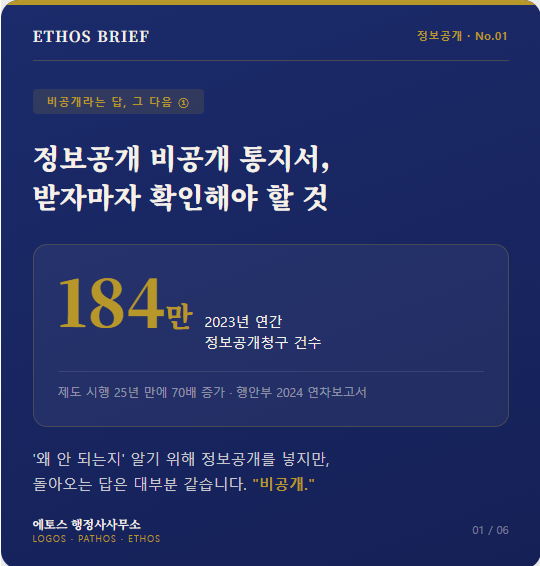
In 2023, the number of information disclosure requests in Korea reached 1.84 million per year, a 70-fold increase since the system was introduced 25 years ago. According to the Ministry of the Interior and Safety, much of this recent growth has been driven by individuals using the system to solve everyday problems, such as insurance claims or preparation for litigation.
(2024 Information Disclosure Annual Report)
The Ministry has even begun classifying these requests separately as information directly related to people’s livelihood.
For example:
- A foreign national whose visa was denied wants to see the review opinion explaining why.
- A business owner whose restaurant permit was rejected wants to check what was insufficient.
- A property owner whose building permit was returned wants to confirm the grounds for rejection.
- A student who failed an exam wants to review the grading criteria.
People file information disclosure requests because they want to understand why something was denied.
But many receive the same answer:
Non-disclosure
In fact, an analysis of information disclosure processing by central government agencies from 2019 to 2023 shows that the tendency toward non-disclosure has become stronger.
(Open Net Korea Information Disclosure Center, 2024.09.05., “The Trap Behind the 94.5% Disclosure Rate: Central Agencies With Rising Non-Disclosure Rates”)
So, if you received a non-disclosure notice, what should you check first?
It Starts With One Non-Disclosure Notice
Let’s take the example of Alex, who applied for a D-8 investment visa.
Alex deposited KRW 100 million into a corporate bank account.
He signed a lease for an office in Gangnam.
He prepared a 50-page business plan.
Then he waited for two months.
The result was denial.
The notice simply stated:
Requirements not satisfied.
KRW 100 million remained tied up in the corporate account, but Alex still did not know what was missing.
When he called the immigration office, the answer was:
We cannot disclose individual review results.
Without knowing the reason, he could not supplement the application.
Without being able to supplement it properly, any reapplication would be based on guesswork.
If the reapplication were denied again, his period of stay would become shorter, and the KRW 100 million would remain tied up.
So Alex filed an information disclosure request.
Please disclose the review opinion for my application.
Ten days later, he received a one-line response:
This information is non-disclosed under Article 9, Paragraph 1, Subparagraph 5 of the Official Information Disclosure Act.
There was no explanation of why Subparagraph 5 applied.
There was not a single word about which part of the review opinion was problematic.
This is not unique to Alex.
A business owner whose restaurant permit was rejected, a property owner whose building permit was returned, a daycare director whose authorization was revoked, or an examinee requesting regrading may all face the same situation.
When a person affected by an administrative decision tries to confirm the basis for that decision, they may be blocked by a single word: “non-disclosure.”
If you are reading this, you may be in a similar situation.
You received the notice, searched online for days, called the agency, and searched again.
But the agency only says, “A non-disclosure decision was made, so there is nothing we can do.”
Because you do not know the reason, you cannot move.
And while you cannot move, time keeps passing.
But there is a way to begin.
That way starts with the one notice you are holding in your hand, or the one sitting in your email inbox.
Please take out your notice now. Let’s read it together.
1. Is the Reason for Non-Disclosure Written Specifically?
Open the notice.
Around the middle, under “Decision Details,” you will likely see the reason for non-disclosure.
Look at the line below it.
It usually appears in one of two forms.
Type A
This information is non-disclosed under Article 9, Paragraph 1, Subparagraph 5 of the Official Information Disclosure Act.
Only this one line is written, and the notice then moves on to appeal instructions.
Type B
Among the requested information, the individual opinions of review committee members are currently part of an ongoing re-review process. If disclosed, they may significantly interfere with the fairness of the review, and are therefore non-disclosed under Subparagraph 5.
This type explains what information is being withheld, why it falls under the provision, and how the legal ground applies.
Is your notice Type A or Type B?
Regarding Type A notices, the Supreme Court has held that a public institution must specifically examine and review the content of the information, then assert and prove which part conflicts with which protected legal interest and which subparagraph of Article 9 applies. The Court also held that refusing disclosure based only on a general reason is not permitted.
(Supreme Court Decision 2001Du8827, Dec. 11, 2003, Cancellation of Refusal to Disclose Information)
In other words, if the notice only lists the legal provision without explaining which part of the requested information falls under that provision and why, it may be the kind of “general reason” that the Supreme Court has rejected.
By reading just one notice, you may already find the first clue for challenging the decision.
The first thing to do is place the non-disclosure reason next to the actual information you requested and compare them line by line:
“Does this reason specifically apply to this information?”
Many Type A notices leave blanks when reviewed this way.
If your notice is Type A, you may send a photo of the notice for review under this standard.
For an administrative appeal related to information disclosure, missing the 90-day deadline can be difficult to recover from.
2. If the Ground Is Subparagraph 5, Was an Expected Completion Date Provided?
Let’s return to the D-8 investment visa example.
Alex’s notice simply stated: “Subparagraph 5 applies, non-disclosure.”
Subparagraph 5 allows non-disclosure for matters that are in the process of decision-making or internal review.
But this provision has an important proviso.
Few people know about it, and few articles discuss it.
However, when information is withheld on the ground that it concerns a decision-making process or internal review process, the stage of the decision-making process and the expected completion date must be provided, and once the process is completed, the requester must be notified.
— Official Information Disclosure Act, Article 9, Paragraph 1, Subparagraph 5 proviso
Under this provision, the agency has two duties.
- Duty 1: The non-disclosure notice must state the current stage of the process and the expected completion date.
- Duty 2: Once the decision-making process is completed, the agency must notify the requester. This notice means that the requester may file another information disclosure request; it does not mean the information is automatically disclosed.
(Ministry of Government Legislation Interpretation, Dec. 24, 2025, No. 25-0970)
Here is the key point.
Once the decision-making process is over, the requirement that the information be “in the process” of decision-making or internal review no longer applies.
If the agency still wants to withhold the information, it must rely on a different ground, such as Subparagraph 6 concerning personal information.
Article 9, Paragraph 2 of the Official Information Disclosure Act also states that when the need for non-disclosure no longer exists, the information must be made subject to disclosure.
If the notice does not include an expected completion date, and the decision-making process has already ended, yet the agency still relies on Subparagraph 5, there may be two separate legal issues.
Alex missed this point.
Because the notice only said “Subparagraph 5,” he assumed it was legally valid.
He did not know there was a proviso.
He did not know the expected completion date had to be stated.
He did not know Subparagraph 5 may no longer apply once the decision is complete.
The difference between knowing and not knowing can change how long KRW 100 million remains tied up.
3. Is It Full Non-Disclosure or Partial Disclosure?
Does the notice say “non-disclosure”?
Or does it say “partial disclosure”?
If it says non-disclosure, you need to ask whether the entire requested information is truly subject to non-disclosure.
For example, suppose you requested materials on review criteria, and the materials include the names of other applicants.
The names of other applicants may be redacted as personal information under Subparagraph 6.
But that does not necessarily mean the review opinion itself must also be withheld.
Article 14 of the Official Information Disclosure Act is clear.
If the non-disclosable parts can be separated from the disclosable parts, the agency must disclose the remaining parts after excluding the non-disclosable portions.
This is not discretionary.
It is a legal duty.
If you received a full non-disclosure notice even though separable portions appear to exist, the agency may have failed to comply with its duty of partial disclosure.
After checking the non-disclosure reason, this is the next thing to examine.
If the notice says “full non-disclosure” but partial disclosure appears possible, Article 14 can become an important issue in an administrative appeal.
4. Can the Agency Refuse Disclosure Because the Information Is “Available Elsewhere”?
Agencies sometimes respond as follows:
Please check Hi Korea.
Please view it on Government24.
At first glance, this may sound reasonable.
However, the Supreme Court has directly rejected this logic.
The fact that information may be obtained by another method does not, by itself, justify non-disclosure.
(Supreme Court Decision 2022Du34562, May 26, 2022, Cancellation of Non-Disclosure Decision)
In immigration cases, if the agency says “check Hi Korea,” it is important to compare the Hi Korea screen with the information requested through disclosure and show that the scope is different.
Hi Korea may show the status of stay or whether permission was granted.
But it usually does not show why the application was denied.
5. Objection Within 30 Days, Administrative Appeal Within 90 Days
Whether the reason is too general, whether the Subparagraph 5 proviso was omitted, and whether partial disclosure was considered are all meaningful issues.
But all of this matters only if you act within the deadline.
After a non-disclosure decision, there are three main routes.
These are not necessarily sequential steps. They are options.
First: Objection
An objection is a request for the same agency to review the decision again.
It must be filed within 30 days from the date you received the notice.
The agency must then make a decision within 7 days.
(Official Information Disclosure Act, Article 18, Objection)
This route is faster than other procedures, but the same agency may still dismiss or reject the objection.
An analysis of approximately 124 cases in 2025 also showed that non-disclosure and partial disclosure outcomes were more common than full disclosure.
(Korean Association of Administrative Agents Newspaper, Apr. 14, 2026, “The Nature of Information Disclosure Requests and the Response Structure for Non-Disclosure and Partial Disclosure”)
Second: Administrative Appeal
An administrative appeal is a procedure in which a separate administrative appeals commission reviews whether the non-disclosure decision was lawful and appropriate.
It must be filed within 90 days from the date you became aware of the disposition.
You may file an administrative appeal directly without first filing an objection.
Administrative appeals review not only legality, meaning whether the decision was unlawful, but also appropriateness, meaning whether the decision was unreasonable or improper.
In the first half of 2025, the Central Administrative Appeals Commission received 9,504 cases, and the acceptance rate for general cases reached 27.4%, the highest rate for that period. Administrative appeal is therefore worth considering.
Third: Administrative Litigation
Administrative litigation is a court procedure.
Because it usually requires more time and cost, it is often considered after reviewing the urgency and other available options.
Can I Use Objection, Administrative Appeal, and Administrative Litigation All Together?
In short, yes, it may be possible to go through all of them.
The Supreme Court has held that when a requester receives the result of an objection from a public institution, the filing period for litigation begins from the date the requester receives the result of the objection.
(Supreme Court Decision 2022Du52980, Jul. 27, 2023, Cancellation of Refusal to Disclose Information)
Therefore, after filing an objection, the requester may proceed directly to administrative litigation, or may go through administrative appeal and then file administrative litigation.
However, the most important point is the deadline.
- An objection must be filed within 30 days from receipt of the notice.
- An administrative appeal or administrative lawsuit must generally be filed within 90 days from the date you became aware of the disposition.
You need to act quickly.
Non-Disclosure Notice Checklist
□ 1. Is the reason for non-disclosure specific?
If the notice only says “falls under Subparagraph ○” without explanation, it may be a non-disclosure decision based only on a general reason.
Under Supreme Court precedent, refusal based only on a general reason is not permitted.
□ 2. If the ground is Subparagraph 5, is the expected completion date written?
If there is no expected completion date, there may be a violation of the proviso to Subparagraph 5.
In particular, if the decision-making process has already ended, the requirement that the matter be in an ongoing decision-making or internal-review process may itself be questionable.
□ 3. Is it full non-disclosure? Are there separable parts?
If the agency issued a full non-disclosure decision without considering partial disclosure, Article 14 of the Official Information Disclosure Act may become an issue.
□ 4. Is “available elsewhere” the entire reason for non-disclosure?
The Supreme Court has held that the fact that information may be checked through another method does not by itself justify non-disclosure.
□ 5. How many days have passed since the non-disclosure decision?
You must observe the deadline: 30 days for objection, and generally 90 days for administrative appeal or litigation.
You may file an administrative appeal directly without first filing an objection.
If the deadline has already passed, the case may be dismissed for failure to satisfy procedural requirements.
Closing
We have reviewed the first points to check when responding to a non-disclosure decision after an information disclosure request.
There are three main response routes:
- objection,
- administrative appeal,
- administrative litigation.
You may proceed directly to administrative appeal without filing an objection first.
A non-disclosure decision based only on a general reason is not permitted under Supreme Court precedent.
When Subparagraph 5 is used as the ground for non-disclosure, providing the expected completion date is a legal duty.
If separable information exists, partial disclosure must also be reviewed.
However, some issues require case-by-case review.
Even under the same Subparagraph 5, the response may differ depending on the type of information, whether the decision-making process has ended, and when the request was filed.
Whether to challenge the decision through partial disclosure or seek cancellation of the full non-disclosure decision also depends on the original notice.
Whether to file an objection first or proceed directly to administrative appeal depends on the remaining deadline.
If even one item in the checklist applies to your case, send a photo of the notice.
I can help identify which part of the notice may be vulnerable, which route may be more favorable, and what should be done first within the deadline.