
Construction Business Suspension in Korea for Registration Deficiencies — What to Check First When Technical Personnel or Capital Requirements Are Questioned
Hello, I am Administrative Attorney Jean Ji.
Business suspension, suspension of operations, suspension of business activities, cancellation of registration, revocation of a permit.
The terminology differs depending on the industry, but from a business owner's perspective, they have one thing in common.
A single administrative disposition can bring an actual business operation to a halt.
However, an administrative disposition is not simply a matter of, “You violated the rules, so your business will be suspended for several months.”
The outcome may depend on whether the facts recognized by the administrative authority are correct, which statutes and sanction criteria were applied, and whether the case involves a repeat violation.
For that reason, the series Administrative Sanctions That Can Stop Your Business goes beyond simply listing suspension periods.
It focuses on what a business owner should examine first after receiving an actual administrative sanction notice, based on statutes, court decisions, and administrative appeal cases.
This second article looks at business suspension resulting from failure to meet construction business registration requirements in Korea.
Suppose your company receives an official notice from a city or district authority stating:
Proposed business suspension for failure to meet construction business registration requirements
The company may immediately think:
“But we have already hired another technical employee.”
“Our capital now meets the requirement.”
“There was no problem when we first registered.”
However, in a construction business registration case, the current situation is not the first thing to examine.
The first question is:
Did the company actually fail to meet the registration requirement at the time identified by the administrative authority?
If there was a deficiency, the next question is:
Was that deficiency legally subject to a business suspension?
If these two questions have not been resolved, it is premature to begin with mitigation.
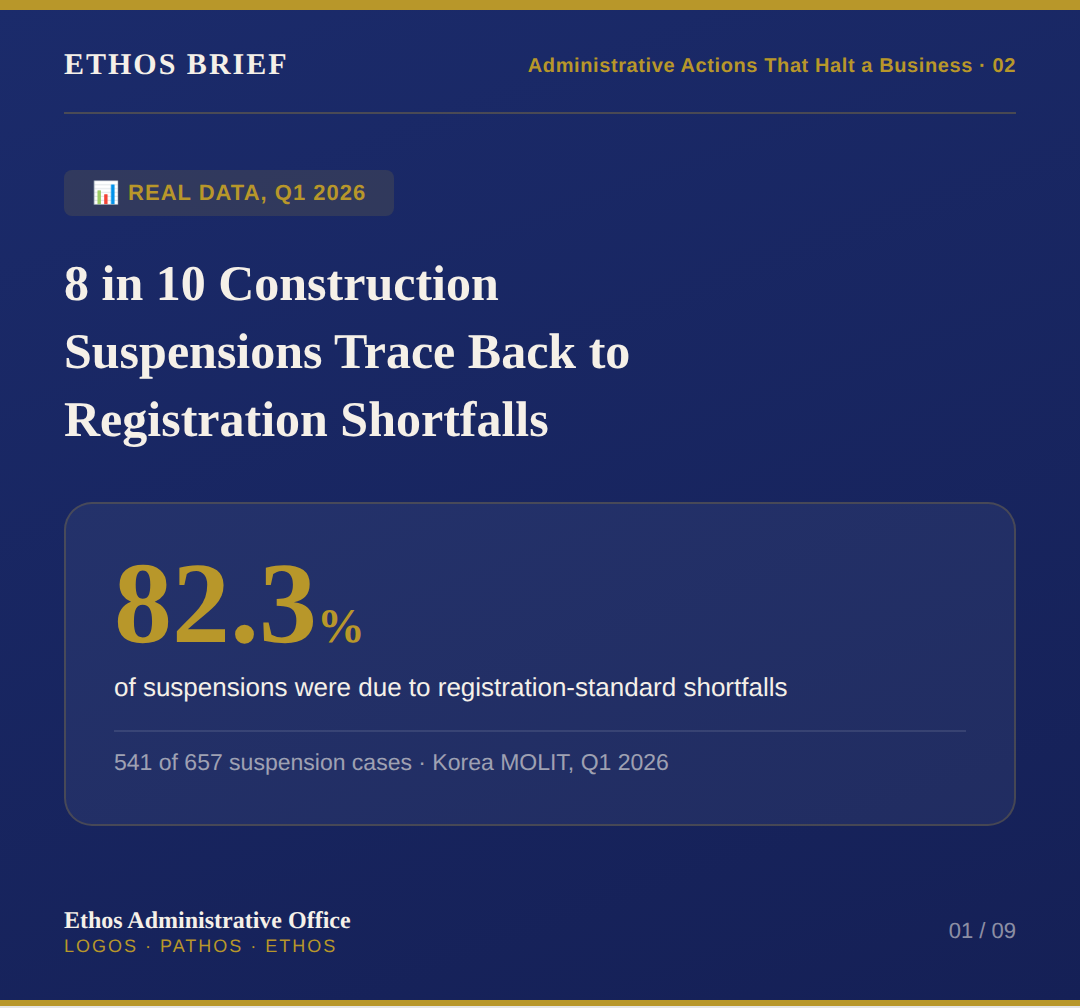
In Q1 2026, 541 of 657 Construction Business Suspensions Were Related to Registration Deficiencies
When people think of business suspension in the construction industry, they often first think of defective construction or unlawful subcontracting.
Recent sanction data shows a different picture.
According to 2026 reporting citing data from the Ministry of Land, Infrastructure and Transport, 657 business suspension dispositions were imposed on construction companies in the first quarter of 2026.
Of those, 541 were related to failure to meet registration requirements.
That represents approximately 82.3%.
In other words, more than eight out of ten construction business suspensions during that period were related to registration deficiencies.
A similar pattern can be seen in Seoul's inspections.
From 2020 through 2024, the Seoul Metropolitan Government reviewed the registration requirements of construction businesses ranked first in bid opening for public construction projects worth at least KRW 500 million.
Out of 1,265 inspections, 219 cases were referred for administrative sanctions.
Of the 193 cases in which dispositions were completed, 185 resulted in business suspension.
Construction business registration requirements are not conditions that only need to be satisfied on the day the company registers.
Failure to maintain them can become an ongoing administrative risk that leads directly to business suspension.
The More Important Number Is “Six Months”
If your company receives a prior notice for a registration deficiency, the applicable sanction criteria should be reviewed immediately.
Under Appendix 6 of the Enforcement Decree of the Framework Act on the Construction Industry, the standard sanction for failure to meet construction business registration requirements is six months of business suspension.
That means a registration deficiency does not begin with a minor warning.
The standard sanction is a six-month suspension.
The actual period may change depending on aggravating or mitigating factors provided under the applicable regulations.
However, the order of analysis remains clear.
First determine whether the registration deficiency actually exists. Only after the deficiency is established should the suspension period be examined.
That is why the first question should not be:
“How much can we reduce the six-month suspension?”
If the deficiency itself is not established, the issue is not mitigation.
It is whether the proposed disposition has a valid basis in the first place.
The Administrative Record Does Not Disappear When the Suspension Ends
This is particularly important in the construction industry.
Under Korea's construction business administration rules, administrative sanctions are publicly announced through the Construction Industry Knowledge Information System, commonly known as KISCON.
The publication periods include:
- Cancellation of registration: 5 years from the date of cancellation
- Business suspension: 3 years from the end of the suspension period
- Administrative fines, penalty surcharges, and corrective orders: 3 years from the date of disposition
Therefore, the administrative record does not disappear immediately when the suspension period ends.
In a construction business registration case, two separate periods should be considered:
The period during which the company is unable to conduct business
and
The period during which the sanction remains part of the company's administrative record.
For this reason, a registration-deficiency notice should not be treated simply as a problem that will disappear after several months.
1. First Identify Which Registration Requirement Is Allegedly Deficient
A notice stating “failure to meet construction business registration requirements” should not be treated as one generic type of case.
Construction business registration requirements may include technical personnel, capital, facilities and equipment, office requirements, and other industry-specific conditions.
The necessary evidence differs depending on which requirement is at issue.
If the Issue Is Technical Personnel
The key question is:
Did the required technical personnel actually work for the company on a regular basis?
If the Issue Is Capital
The key question is:
What amount of capital was legally recognizable at the time examined by the administrative authority?
If the Issue Is the Office or Facilities
The key question is:
Did the company actually possess and use the office, space, facilities, or equipment required for registration?
The first task is therefore to identify precisely:
Which registration requirement the authority considers deficient, during what period, and on the basis of which facts.
2. For Technical Personnel, Actual Employment Matters More Than a Name on a List
One recurring issue in technical-personnel cases is whether the person was actually employed on a regular basis.
An actual administrative appeal case illustrates this point.
A construction company received a four-month business suspension for allegedly failing to meet the technical personnel requirement.
The administrative authority found that one of the company's construction engineers was also registered as an auditor of another company and therefore refused to recognize that person as regularly employed technical personnel.
As a result, the company was deemed to lack the required number of technical personnel.
However, the actual employment relationship was different.
The engineer had joined the construction company, was performing work for the company, and was receiving salary payments.
The Administrative Appeals Commission ultimately cancelled the four-month suspension.
Anti-Corruption and Civil Rights Commission Case 2021-10415, decided April 22, 2022
This case shows that the technical personnel requirement should not be determined solely from names appearing in corporate or employment records.
The actual working relationship should be examined.
Relevant materials may include:
- Employment contracts
- Salary payment records
- National social insurance enrollment and termination records
- Employment and resignation dates
- Attendance and actual work records
- Employment or officer positions with other companies
If the authority's conclusion conflicts with the actual employment records, the case is not yet about mitigation.
The first question is whether the registration deficiency existed at all.
If a Technical Employee Resigned, Calculate the “50 Days” First
If a technical employee actually resigned, the analysis becomes more specific.
Under the current Enforcement Decree of the Framework Act on the Construction Industry, a temporary deficiency caused by the death, disappearance, or resignation of technical personnel may fall within an exception where the period of deficiency is 50 days or less.
Therefore, the fact that an engineer or other technical employee resigned does not automatically mean that a sanctionable registration deficiency occurred.
Two dates should be identified first:
The date the existing technical employee left
and
The date the replacement employee actually began qualifying employment
For example, if the existing employee resigned on March 1 and the replacement began work on April 10, the exact period of deficiency should be calculated first.
If the statutory period is exceeded, the same exception may no longer apply.
The key question in a technical personnel case is therefore not:
“Have we hired someone now?”
It is:
When did the deficiency begin, and when was the registration requirement restored?
3. For Capital Deficiencies, Look at the Relevant Period — Not Today's Bank Balance
There is another common misunderstanding in capital cases.
By the time the company receives a prior notice, it may already have restored the required level of capital.
The owner may then ask:
“Why is this a problem if we have enough capital now?”
But that is not the correct starting point.
The first issue is whether the company actually met the capital requirement at the time or fiscal period identified by the administrative authority.
The current position is secondary.
The better question is:
“How much qualifying capital did the company actually have during the fiscal year or reference date being examined?”
Relevant materials may include:
- Financial statements for the relevant fiscal year
- Financial condition diagnostic reports
- Deposit and banking records
- Evidence supporting receivables and other assets
- Accounting records as of the relevant reference date
- Details of assets excluded by the administrative authority
The key is to identify why the company's calculation and the authority's recognized amount are different.
A Four-Month Suspension Was Upheld Even After the Capital Deficiency Had Been Corrected
In Anti-Corruption and Civil Rights Commission Case 2016-03248, decided April 19, 2016, a civil engineering contractor was sanctioned for failing to meet the applicable capital requirement.
The company later corrected the deficiency.
The administrative authority also considered various circumstances and reduced the sanction from the then-applicable standard.
However, the Administrative Appeals Commission still upheld the four-month business suspension.
The reason was clear.
The capital deficiency existed during the period in question, and the case did not fall within a statutory exception.
This distinction is important.
“We have corrected the problem now”
and
“There was no violation at the relevant time”
are completely different arguments.
Correcting the capital deficiency may still matter.
But it does not automatically erase a past failure to meet the registration requirement.
How Should an Older Case Cancelling a Capital-Deficiency Suspension Be Read?
There is also a case with the opposite result.
In Seoul Administrative Appeals Commission Case 2016-84, decided May 2, 2016, a stonework contractor received a five-month business suspension for a capital deficiency, but the suspension was cancelled.
The important lesson is not that a small capital deficiency will always result in cancellation.
Rather, the case shows that a registration deficiency must be examined by reference to:
The law applicable at the relevant time, the reference date, and the specific nature of the alleged deficiency.
The legal framework applicable in 2016 should not automatically be applied to a current case.
A current case should be analyzed under the law currently in force and, where necessary, the law in force at the time of the alleged violation.
4. Only After the Deficiency Is Established Should the Six-Month Sanction Level Be Examined
Suppose the review shows that the registration deficiency actually existed and that no statutory exception applies.
Only then should the sanction level be examined.
Under the current Enforcement Decree, the standard business suspension for a registration deficiency is six months.
Article 80 of the Enforcement Decree also allows the authority, within the statutory range, to aggravate or mitigate the suspension based on matters such as the motive, nature, and frequency of the violation, as well as relevant characteristics of the construction work and procurement process.
The order is important.
First determine whether the deficiency exists. Then examine mitigation.
If the company prepares only mitigation materials from the beginning, it may unintentionally structure the case as though the registration deficiency itself has already been accepted.
That sequence should be avoided.
5. If the Company Has a Previous Sanction for the Same Requirement, Check Registration Cancellation First
This is one of the most serious risks in a construction business registration case.
Under the current Framework Act on the Construction Industry, if a company receives a business suspension for failure to meet a registration requirement and then fails to meet the same registration requirement again within three years, cancellation of the construction business registration may follow.
The phrase “same registration requirement” is critical.
Examples include:
- Technical personnel deficiency followed by another technical personnel deficiency within three years
- Capital deficiency followed by another capital deficiency within three years
If there is a prior sanction, the first question should therefore not be:
“How many months will this suspension be?”
The first question is:
“Does this case constitute another failure to meet the same registration requirement?”
At that point, the issue may no longer be limited to reducing a suspension.
The continued existence of the construction business registration itself may be at stake.
Registration cancellation may also become an issue if the company fails to correct the registration deficiency by the end of the suspension period.
That is why previous sanction documents should always be reviewed together with the new prior notice.
6. If the Company Holds Multiple Construction Licenses, Check Which License Is Actually Affected
A construction company may hold more than one construction business registration.
If the company holds multiple licenses, another question arises:
Does the registration deficiency affect every registered business category, or only a particular one?
Korean construction business administration rules generally require sanctions to be handled by reference to the business category connected to the relevant violation.
Where only some registered categories are deficient and the sanctionable category can be selected, the company's opinion may also need to be considered during the hearing process.
For companies holding multiple licenses, the scope stated in the prior notice should therefore be reviewed carefully.
The company should determine:
Which registration requirement is connected to which construction business category.
This analysis can differ significantly from a single-license case.
Comparing Three Administrative Appeal Cases Shows What Should Be Examined First
| Case | Requirement at Issue | Sanction | Result | Key Issue | | --- | --- | --- | --- | --- | | 2021-10415 | Technical personnel | 4-month suspension | Cancelled | Actual regular employment relationship | | Seoul 2016-84 | Capital | 5-month suspension | Cancelled | Applicable law and specific deficiency circumstances | | 2016-03248 | Capital | 4-month suspension | Appeal dismissed | Deficiency established, no statutory exception |
On the surface, all three are construction business registration-deficiency cases.
But the outcomes were different.
The difference came from:
Which registration requirement was deficient,
at what time,
for how long,
and for what reason.
The priority is therefore not to search for as many favorable precedents as possible.
The priority is to determine accurately whether your company's alleged registration deficiency actually exists.
These Cases Usually Have Greater Value for Individual Review
1. A Technical Employee Is Registered Elsewhere, but the Company Has Evidence of Actual Employment
The actual employment relationship may be the central issue.
2. A Replacement Technical Employee Was Hired Around the 50-Day Threshold
A difference of only a few days may affect whether a statutory temporary-deficiency exception applies.
3. The Authority's Capital Calculation Differs From the Company's Financial Records
The amount of the alleged deficiency itself should be verified.
4. The Company Has Corrected the Requirement, but the Historical Deficiency Period Is Unclear
The current position and the alleged past violation must be separated.
5. The Company Has Previously Been Suspended for the Same Registration Requirement
The risk of registration cancellation should be reviewed first.
6. The Company Holds Multiple Construction Licenses and Only Some Categories Appear to Be Affected
The scope of the sanction should be examined.
If any of these situations apply, the first step should be to identify exactly which type of case the company is dealing with.
Documents to Collect After Receiving a Prior Notice
If Technical Personnel Are at Issue
- Current and historical technical personnel records
- Employment contracts
- Salary payment records
- National social insurance enrollment and termination records
- Employment and resignation dates
- Actual work records
- Records showing employment or officer status with other companies
If Capital Is at Issue
- Financial statements for the relevant fiscal year
- Financial condition diagnostic reports
- Bank and financial transaction records
- Supporting documents for individual assets
- Accounting records as of the relevant reference date
- Details of assets rejected by the administrative authority
If the Office or Facilities Are at Issue
- Lease agreement
- Building register
- Photographs of the business premises
- Documents showing actual use
- Materials showing separation of space where premises are shared
Documents That Should Always Be Reviewed
- The entire current prior notice
- Previous construction business administrative dispositions
- Records of previous deficiencies involving the same registration requirement
- The deficiency period identified by the administrative authority
The general rule is simple.
Evidence showing the company's condition during the period challenged by the authority is more important than evidence showing only its current condition.
In the End, Registration-Deficiency Cases Fall Into Three Categories
First: There Was No Registration Deficiency in the First Place
For example, the authority may have incorrectly rejected a technical employee who was actually working regularly for the company.
In this type of case, the basis of the proposed disposition itself is the issue.
Second: A Deficiency Existed, but a Statutory Exception Applies
An example is a temporary technical personnel deficiency corrected within the legally permitted period.
The question is whether the deficiency is legally sanctionable.
Third: The Registration Deficiency Is Established
Only at this stage should the company examine aggravation or mitigation from the six-month standard, the timing of corrective action, and previous sanctions.
If these three categories are mixed together, the written submission may become longer while the core issue becomes less clear.
In a construction business registration case, the real value lies not in writing a longer document, but in correctly identifying which category the company falls into.
What the Company Can Check Internally and When Individual Review Becomes More Important
A company can usually begin by identifying the registration requirement at issue, the alleged deficiency period, the applicable provision, and previous sanctions, and then compare the notice with its technical personnel records, financial statements, and business premises documents.
However, where the dispute involves actual regular employment, recognition of particular assets in the capital calculation, application of a temporary-deficiency exception, determining the affected license among multiple construction registrations, or a repeat violation that could lead to cancellation of registration, the case cannot be resolved merely by showing that the company currently meets the requirements.
In particular, construction business suspension may affect not only the immediate suspension period but also KISCON publication and future repeat-violation risk.
For that reason, the first question should be whether the alleged registration deficiency actually exists, before asking how much the suspension can be reduced.
Based on the prior notice and supporting materials, a free initial review can help determine whether there is a viable issue to examine in your specific case.
References
- Framework Act on the Construction Industry, Articles 10, 83, and 84
- Enforcement Decree of the Framework Act on the Construction Industry, Articles 13, 79-2, and 80, Appendix 2 and Appendix 6
- Construction Business Administration Rules
- Anti-Corruption and Civil Rights Commission Case 2021-10415, April 22, 2022
- Seoul Administrative Appeals Commission Case 2016-84, May 2, 2016
- Anti-Corruption and Civil Rights Commission Case 2016-03248, April 19, 2016
- Seoul Metropolitan Government materials concerning construction business registration requirement inspections
- Ministry of Land, Infrastructure and Transport data regarding construction business suspensions in Q1 2026