
AI Services — One Business Code Can Determine Eligibility for Government Support
Hello, this is Administrative Agent Jean.
Over the weekend, on my way to Itaewon, I came across an unmanned tobacco store.
Near university areas, I also noticed more unmanned claw machine shops.
New forms of business are growing quickly: unmanned stores, drones, game development, AI services, pet businesses, and shared kitchens. At first glance, it is easy to think, “Business registration should be enough.” In reality, however, many of these businesses require separate registration, permission, or notification.
Licensing and permits are often called the heart of administrative agent work.
In this series, we are looking at licensing procedures that are easy to miss when starting a new type of business, and where an administrative agent can help.
- Unmanned stores — 3 licensing issues people often miss
- Drone business — 3 registration steps before business registration
- Game development — required registration before uploading to app stores
- AI services — one business code can determine eligibility for government support ← This article
- Pet businesses — why pet food may require food manufacturing registration
- Shared kitchens — licensing changes once the structure becomes outsourced
Read Part 1: https://blog.naver.com/attorney_jean/224335126223
Read Part 2: https://blog.naver.com/attorney_jean/224339040711
Read Part 3: https://blog.naver.com/attorney_jean/224346285490
A developed an AI chatbot service.
It is a B2B SaaS model that supplies AI chatbots to customer service departments of client companies. A goes to the tax office to register the business, but does not know which business code to choose.
So A asks a tax office employee.
“AI service? If it is information and communications, business code 722000, application software development and supply, seems right.”
A trusts the employee’s answer and registers under that code.
A was lucky.
Business code 722000 may fall under the eligible category for youth startup tax reduction.
But B, who built the same AI chatbot service, was guided by the tax office to register under “management consulting,” business code 715000. B also followed that guidance.
One year later, B applies for youth startup tax reduction.
The result is rejection.
The reason is that the registered business code does not fall under an eligible industry.
Same service, same revenue structure, but one code was different.
How much could that difference be worth?
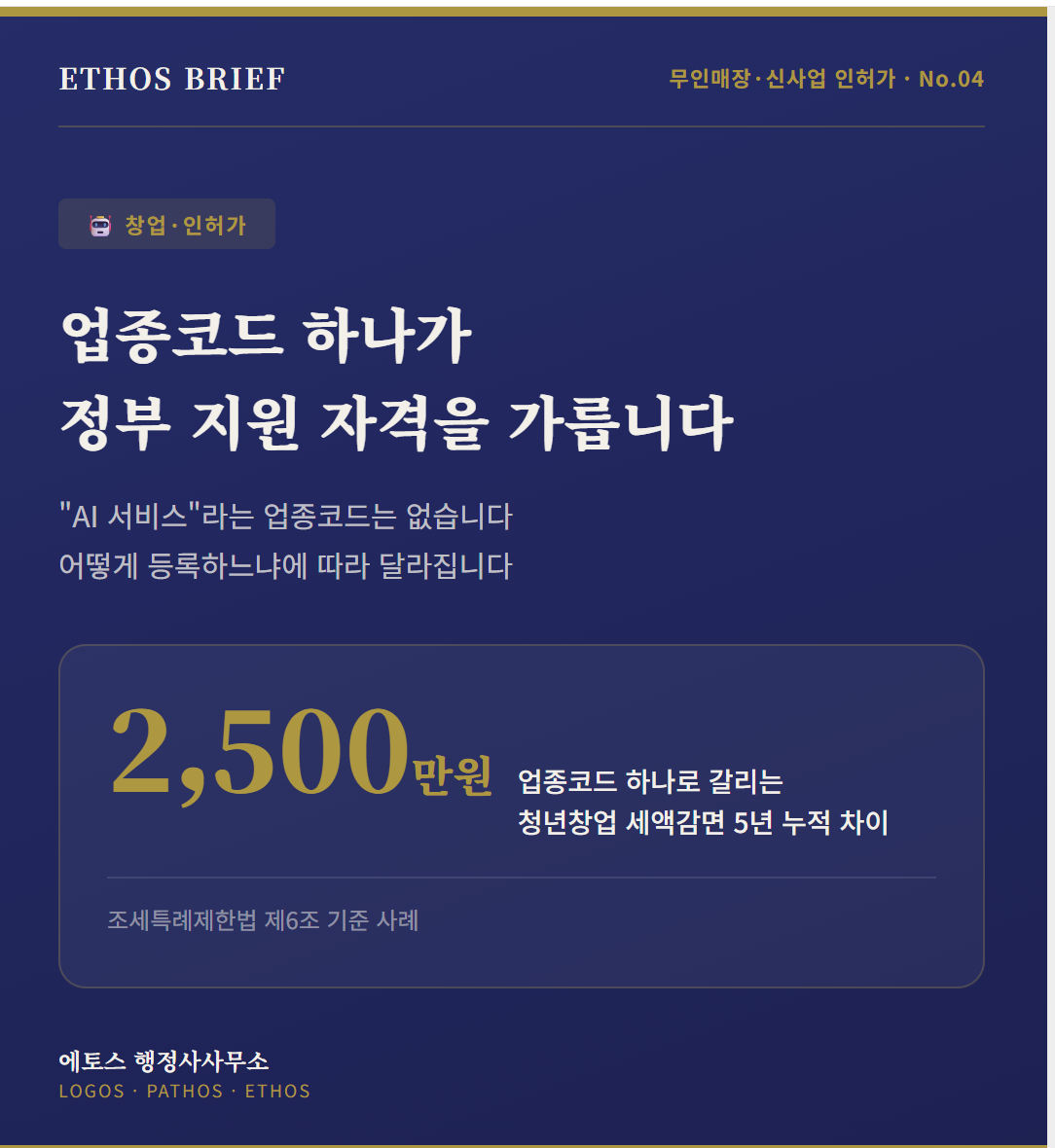
In one tax consulting case, a founder paid KRW 1 billion in corporate tax over five years without knowing about startup tax reduction, then received KRW 500 million back through a tax correction claim. Some analyses also suggest that for annual income of KRW 100 million, the difference may be around KRW 15 million in tax.
All of this can happen because of one code.
In 2024, Korea’s AI industry reached KRW 6.3 trillion in size. The industry employed 54,000 people, and the shortage rate of AI developers reached 57.6%.
(Ministry of Science and ICT; Software Policy & Research Institute, 2024 AI Industry Survey)
As of May 2024, Korea had 1,101 AI startups, and ranked first globally in AI patents per 100,000 people with 14.3 registrations.
(Stanford HAI, AI Index 2026)
Regulation is forming quickly as well. Korea is often mentioned as one of the leading countries in AI-related legislation, with 17 AI-related laws enacted or proposed, second only to the United States in some counts. Reported AI incident cases are also increasing. As the market grows, regulation is following quickly.
The 2026 budget for startup and small business support is around KRW 3.4 trillion, and AI and digital transformation account for a significant portion of that support.
Many founders do not know that eligibility for this support can depend on the business code selected at the time of business registration.
Today, let’s organize the difference into three points.
1. Why Does Tax Differ by Business Code for the Same AI Service?
When registering an AI service business, you must choose a business code.
But there is no separate business code called “AI service.”
AI is a technology, not an industry classification.
The code changes depending on how the AI service is provided.
AI service founders often consider the following business codes.
| Business Code | Business Type | Item | Core Activity | |---:|---|---|---| | 722000 | Information and communications | Application software development and supply | Directly developing and supplying AI software | | 722005 | Information and communications | Computer programming services | Programming according to client requests | | 721000 | Information and communications | Computer system integration consulting and construction services | Building AI systems for client companies | | 723000 | Information and communications | Data processing, hosting, portals, and other internet information mediation services | Hosting or mediating AI platforms |
Standard expense rates may also differ by business code.
A standard expense rate is a rate set by the National Tax Service that recognizes a certain percentage of revenue as expenses for a specific industry. When actual expenses cannot be fully documented, this rate can affect tax calculation.
For example, if you directly develop an AI chatbot and supply it to B2B clients, the core activity is close to “software development and supply.” In that case, 722000 may be appropriate.
On the other hand, if you do not directly develop AI models or software but connect existing AI platforms and provide hosting or mediation services to clients, 723000 may be closer.
Why is this distinction important?
First, the standard expense rate may differ.
When filing comprehensive income tax by estimation, deductible expenses may differ depending on the standard expense rate for each business code. The higher the expense rate, the lower the taxable income may become, and the lower the tax may be. One code can change the tax amount.
Second, VAT treatment may differ.
If AI development services are provided in a freelancer structure, registering under a personal service-related code such as 940926 may raise VAT exemption issues. In contrast, registering under 722000 generally creates a taxable business structure.
Even when one person performs similar work, VAT liability can differ depending on the actual contract structure and registered code. Tax Q&A sites repeatedly show questions such as, “Which is better, 722000 or 940926?”
Third, eligibility for youth startup tax reduction may differ.
722000 may be treated as an information and communications business, which can fall within eligible industries. But if the business is incorrectly registered as management consulting or miscellaneous services, it may fall outside the eligible category.
A tax office employee may say, “722000 should be fine.”
But the employee’s role is to receive the code, not to determine whether that code is most advantageous for you in terms of tax, government support, and permits.
2. Is It True That One Business Code Can Change Tens of Millions of Won Over Five Years?
Yes.
A representative example is youth startup small business tax reduction.
The legal basis is Article 6 of the Restriction of Special Taxation Act.
When reviewing youth startup tax reduction, the key requirements include the following:
- The business must be a small or medium-sized enterprise.
- The business must be founded in an eligible industry under Article 6(3) of the Restriction of Special Taxation Act.
- Information and communications business may be included as an eligible industry.
- The business must be founded on or before December 31, 2027.
- It must be a new startup.
- Comprehensive acquisition of an existing business or restarting the same type of business after closure may not qualify as a startup.
- The representative must meet the youth requirement at the time of founding.
- For corporations, the representative director must satisfy the controlling shareholder requirement.
- The reduction must be applied for when filing corporate tax or income tax.
- It is not automatically applied.
As of 2026, Article 6 of the Restriction of Special Taxation Act applies different reduction rates depending on founding date, region, and other factors.
| Startup Location | Youth Reduction Rate | General Reduction Rate | |---|---:|---:| | Non-metropolitan areas and population-decline areas in the metropolitan region | Up to 100% | Varies by requirement | | Outside overcrowding control areas in the metropolitan region | Reduction may apply depending on requirements | Varies by requirement | | Inside overcrowding control areas in the metropolitan region | Reduced or limited rate may apply | Varies by requirement |
The specific reduction rate can differ depending on founding date, location, industry, representative requirements, corporate status, and employment.
Let’s use an example.
Assume a 29-year-old founder establishes an AI service corporation in an overcrowding control area in Seoul, and the annual corporate tax base is KRW 50 million.
| Business Code | Business Type | Eligible for Reduction | Assumed Reduction Rate | 5-Year Effect | |---:|---|---|---:|---:| | 722000 | Information and communications | May be eligible | 50% assumed | Difference of around KRW 25 million possible | | 715000 | Management consulting | May be ineligible | 0% | KRW 0 |
Even with the same business, same revenue, and same founder, one code can make a difference of tens of millions of won over five years.
If the business is located in a region with a higher reduction rate, the difference can be even larger.
There is another important point.
Eligibility is not determined only by the business code on the registration certificate. It must also match the industry where actual income is generated.
If one company operates both information and communications business and management consulting business, income from the eligible industry and income from the non-eligible industry may need to be separated. Accurate business classification matters.
If You Already Missed the Reduction, Can You File a Tax Correction Claim?
It may be possible.
If you did not apply for the reduction because you did not know about it, you may be able to dispute past tax periods within a certain period through a tax correction claim under Article 45-2 of the Framework Act on National Taxes.
However, there is a deadline.
A correction claim is generally available only within five years after the statutory filing deadline.
Let’s look at a concrete situation.
B founded an AI chatbot service in 2022. But at the tax office, B registered under management consulting, business code 715000. B faithfully filed and paid comprehensive income tax every year.
In 2026, B happens to learn about youth startup tax reduction.
“There was a youth startup tax reduction?”
“If it is information and communications, tax can be reduced for five years.”
“My business is AI service. Isn’t that information and communications?”
If B’s actual business is AI software development and supply, business code 722000 may be more appropriate.
Then can B immediately ask for a refund?
Not quite.
In the National Tax Service system, B is registered as management consulting, 715000. Management consulting may not be an eligible industry for youth startup tax reduction. From the tax authority’s perspective, the question becomes: “You are registered as a consulting business. Why are you claiming an information and communications reduction?”
So the order becomes:
[Current Status of B]
Business code: 715000, management consulting
Not an eligible industry
→ File correction claim
→ Possible rejection due to industry mismatch
[Required Order]
-
Apply to change the business code at the tax office
715000 → 722000 or another code matching the actual business -
Complete code change
-
File correction claim
Argue that the actual business was information and communications and eligible for reduction -
National Tax Service review
-
Refund decision
Time matters here.
A correction claim is available only within five years from the statutory filing deadline.
| Tax Year | Filing Deadline | Correction Claim Deadline | |---:|---|---| | 2022 | May 2023 | May 2028 | | 2023 | May 2024 | May 2029 | | 2024 | May 2025 | May 2030 | | 2025 | May 2026 | May 2031 |
As of 2026, it may look like there is still enough time.
But changing the code, preparing correction claim documents, and going through tax authority review all take time. If you postpone it, the oldest year disappears first.
That is why the business code should be selected accurately from the beginning.
If it is already wrong, you should review correction as soon as possible.
It is not only about tax.
Government startup support eligibility works similarly.
For example, the following government support programs may check the business code on the business registration certificate at the application stage:
- Initial Startup Package
- Startup Leap Package
- TIPS
- AI Voucher Program
- Digital transformation support programs
- Small business and SME support programs
If an AI service is registered as miscellaneous services or management consulting, it may be disadvantaged or excluded at the document screening stage.
3. Are There Separate Permits for AI Services? Not Generally, But There Are Traps
Unmanned stores raise Food Sanitation Act issues.
Drone businesses raise Aviation Business Act issues.
Game development raises Game Industry Promotion Act issues.
Then does an AI service itself require a separate permit?
At present, there is generally no universal permit or registration system that applies simply because a service is an AI service.
The Act on Development of Artificial Intelligence and Establishment of Trust Foundation, commonly called the AI Basic Act, took effect on January 22, 2026. However, this Act is not structured as a system requiring all AI services to be registered or licensed.
But after the AI Basic Act, one question comes up often among startups:
“How do we know whether our service is high-impact AI?”
The AI Basic Act may impose additional obligations on high-impact AI.
The difficulty is that determining whether a specific service falls under high-impact AI is not always simple.
So does that mean AI services only need business registration?
No.
Even if there is no universal permit just for AI, separate permits may be required depending on the industry where AI is applied.
| AI Application Field | Applicable Laws | Permit or Review Issue | Risk if Violated | |---|---|---|---| | AI medical device | Medical Devices Act, Digital Medical Products Act | MFDS approval or certification, SaMD classification | Unauthorized medical device distribution issue | | AI financial service | Electronic Financial Transactions Act, Financial Investment Services and Capital Markets Act, etc. | Financial Services Commission registration or approval review | Unauthorized financial business issue | | AI education service | Act on the Establishment and Operation of Private Teaching Institutes, etc. | Education office registration or notification review | Unregistered academy issue | | AI legal automation service | Attorney-at-Law Act | Whether the service constitutes legal affairs | Unauthorized handling of legal affairs by non-attorney | | AI hiring assessment | Personal Information Protection Act, Fair Hiring Procedure Act, etc. | Personal information processing, automated decision-making, impact assessment | Administrative fines, damages, etc. |
Two fields deserve special attention.
AI Medical Devices
The Digital Medical Products Act took effect on January 24, 2025.
For medical products using AI and network-connected technologies, a full life-cycle regulatory system was introduced, including clinical trials, approval, and distribution management.
Even if you register under 722000 thinking, “I am just making software, so this should be information and communications,” the software may still fall under the Medical Devices Act or the Digital Medical Products Act as a medical device or digital medical product. If so, distributing it without MFDS approval may become a legal problem.
In this case, permit review comes before the business code.
The AI medical device market is growing quickly, and more founders are entering this field. That makes it especially important to check whether the product qualifies as a medical device at the beginning.
AI Legal Automation Services
Services such as “automatic contract review,” “automatic legal document drafting,” or “automatic litigation document generation” may raise issues under the Attorney-at-Law Act.
Article 109 of the Attorney-at-Law Act prohibits non-attorneys from handling legal affairs and can carry serious criminal penalties.
The fact that AI performs the task does not automatically place the service outside regulation.
However, the boundary between permissible AI legal automation and regulated legal affairs is still unclear in many respects. The more ambiguous the area, the more important prior review becomes.
There may be no universal permit for AI services as such.
But the permits and regulations of the industry where AI is applied still remain.
It is not safe to assume that “because it is AI, regulation will be light.”
Instead, existing industry regulations, high-impact AI obligations under the AI Basic Act, and automated decision-making rules under the Personal Information Protection Act may overlap.
Because this kind of combined review is required, choosing a business code is not only a tax issue.
First, you need to identify which industry laws apply to the AI service.
Then, if permits are required, those permits must be reviewed first.
Finally, the business code should be selected by considering tax, government support, and permits together.
This was also one of the most confusing points in lectures for foreign founders.
“Why is there so much to consider when choosing just one business code?”
Because in Korea’s business registration structure, business codes are connected to tax, support programs, and regulation.
Does This Apply to You?
If two or more of the following apply, you should review your business code and permit issues.
- You are developing or preparing to provide a paid AI service.
- You selected the business code based on a tax office employee’s recommendation.
- You have never applied for youth startup tax reduction.
- You do not know whether you are eligible for youth startup tax reduction.
- Your AI service is applied to medical, financial, education, or legal fields.
- You plan to apply for government startup support programs.
- You are preparing for Initial Startup Package, TIPS, or AI Voucher.
- You do not know whether a freelancer code or business code is more advantageous.
- You already registered the business but are not sure whether the code matches the actual business.
What Requires Individual Review?
Business code disputes often repeat in two directions.
First, whether the business falls under an eligible industry for tax reduction.
In actual tax tribunal cases, the industry classification itself can become the key issue. For example, a founder may argue that the business belongs to an eligible industry, while the tax authority refuses a correction claim because it disagrees with the classification.
Second, tax benefits can be clawed back when the actual business does not match the registered code.
Even if a company registers as information and communications and receives tax benefits, if the actual revenue comes from a completely different industry, the reduced tax may later be collected back.
In other words, choosing an advantageous code is not enough.
The actual business must match the code.
The following points require individual review:
- Whether the AI service is closer to 722000, 722005, 721000, or 723000
- Whether a freelancer structure or business structure is more tax-efficient
- Whether the AI service falls under medical device, finance, education, or legal fields
- Whether additional permits are required
- Whether the service may be high-impact AI
- Whether it satisfies business code requirements for each startup support program
- Whether location-based tax reduction differences apply
- Whether small-scale livelihood startup special rules or employment incentives may apply
- Whether actual revenue is generated from an eligible industry
- Whether revenue can be separated when multiple business types are operated
Where Do People Get Stuck When Preparing Alone?
Let’s return to A’s case.
A was lucky because A registered under 722000 based on the tax office employee’s recommendation.
But if the employee had recommended management consulting or miscellaneous services, A might have missed tens of millions of won in reductions over five years.
Tax Q&A sites repeatedly show questions such as:
“I registered under 722000. Am I eligible for youth startup tax reduction?”
“Which is better, 722000 or 940926?”
“I did not apply for reduction for three years. Can I file a correction claim now?”
These questions have one thing in common.
If the business code had been selected accurately at the time of business registration, many of these questions would not have been necessary later.
A tax office employee does not take responsibility for choosing the best code.
The tax office employee does not check:
- Whether the code is eligible for tax reduction
- Whether the code qualifies for startup support programs
- Whether the AI service is subject to medical device regulation
- Whether the service requires financial business approval
- Whether the service may be considered legal affairs under the Attorney-at-Law Act
- Whether a foreign founder’s visa status allows the business activity
That is not the employee’s job.
What an administrative agent does is different.
First, the actual business is reviewed to identify which industry laws apply. If permits are required, permit issues are reviewed first.
Then the business code is reviewed together with the tax structure, standard expense rate, VAT, youth startup tax reduction, and government support eligibility.
It may look like choosing one code, but in reality it is aligning three axes:
- Tax
- Government support
- Permits
If you already registered the business under the wrong code, it may still be possible to change it.
By reviewing business code correction and tax correction claims together, you may be able to recover part of the tax already paid in some cases.
However, correction claims have statutory deadlines.
Under Article 45-2 of the Framework Act on National Taxes, a correction claim is generally available only within five years after the statutory filing deadline.
For example, if you started a business in 2021 and incorrectly filed comprehensive income tax for that year, the correction claim deadline would generally be May 2027. For tax year 2022, it would be May 2028.
As each year passes, one more refundable year disappears.
“I’ll deal with it later” can become a structure where millions of won disappear each year.
Business code changes, correction claims, and permit reviews are all connected to documents submitted to administrative agencies.
Preparing and submitting documents to administrative agencies can fall within the scope of work of administrative agents under Article 2 of the Certified Administrative Agents Act.
Check first, for free, whether the business code for your AI service is correct.
Preparing an AI Startup?
For AI service startups, a business code is not just a number.
One code on the business registration certificate can connect to tax, support programs, permits, investment materials, and eligibility for government projects.
If you are preparing an AI chatbot, AI medical device, AI education service, AI legal automation service, AI hiring solution, or AI SaaS, check at least the following questions:
- What industry does my AI service actually fall under?
- Is it direct development and supply, client-customized development, system integration, or hosting and mediation?
- Does it fall under an eligible industry for youth startup tax reduction?
- Is the VAT structure taxable or exempt?
- Is the business code appropriate for government support applications?
- Are separate permits required in medical, finance, education, legal, or hiring fields?
- Could it qualify as high-impact AI under the AI Basic Act?
- Does the already registered business code match the actual business?
- Is there tax that can be recovered through a correction claim?
Business registration may be the starting point.
But for AI services, it is not the end.
Business codes, tax reductions, government support programs, and industry-specific permits must be reviewed together for the business to start safely.
The next article is Part 5: Pet Businesses — Why Does Pet Food Require Food Manufacturing Registration?
Did you know that when you register a business to make and sell pet treats, the Food Sanitation Act may apply instead of only the Feed Management Act?
In the next article, we will discuss why food-related laws may apply even when the product is not food for humans, and where the boundary lies.