
When Should You Apply for a Game Rating in South Korea? — CBT, Early Access, and Pre-Launch Compliance
Hello, I'm Jean Ji, a licensed administrative agent in South Korea.
In the previous article, we examined the difference between registering as a game production business and a game distribution business.
The registration requirements depend on what a company actually does: develops games, imports games from overseas, or supplies games to other businesses.
However, completing your business registration does not necessarily mean that you can immediately release your game.
Business registration and the rating of an individual game are separate legal procedures in South Korea.
This article is part of the Game and Digital Content Licensing: In-Depth Guide series, which examines the administrative procedures involved in establishing and operating a game business in Korea.
Game and Digital Content Licensing: In-Depth Guide
- Do You Need to Register as Both a Game Production Business and a Game Distribution Business?
- When Should You Apply for a Game Rating in South Korea? — This Article
- Does Every Game Have to Be Rated Directly by the Game Rating and Administration Committee?
- Do Game Updates Require a New Rating?
- What Must You Disclose When Offering Randomized In-Game Items?
- Who Handles Korean Regulatory Procedures for Games Developed Overseas?
- What Must You Do When Your Company’s Representative, Address, or Game Categories Change?
- Is Closing Your Business Registration Enough When You Stop Operating a Game Business?
- Can You Take Over an Existing Game Business Registration When Acquiring a Company or Business?
Your Release Date Is Fixed, but You Haven't Applied for a Korean Game Rating
Imagine that your game is nearly complete.
You have confirmed its Steam release date and signed an agreement with a publisher.
Your advertising campaign and pre-launch marketing schedule are also ready.
Then someone asks:
Have we obtained the Korean game rating?
If the application has not even been submitted, the release schedule may need to be reconsidered.
Game rating is generally a pre-release requirement, not an administrative formality to complete after launch.
Consider a reported case.
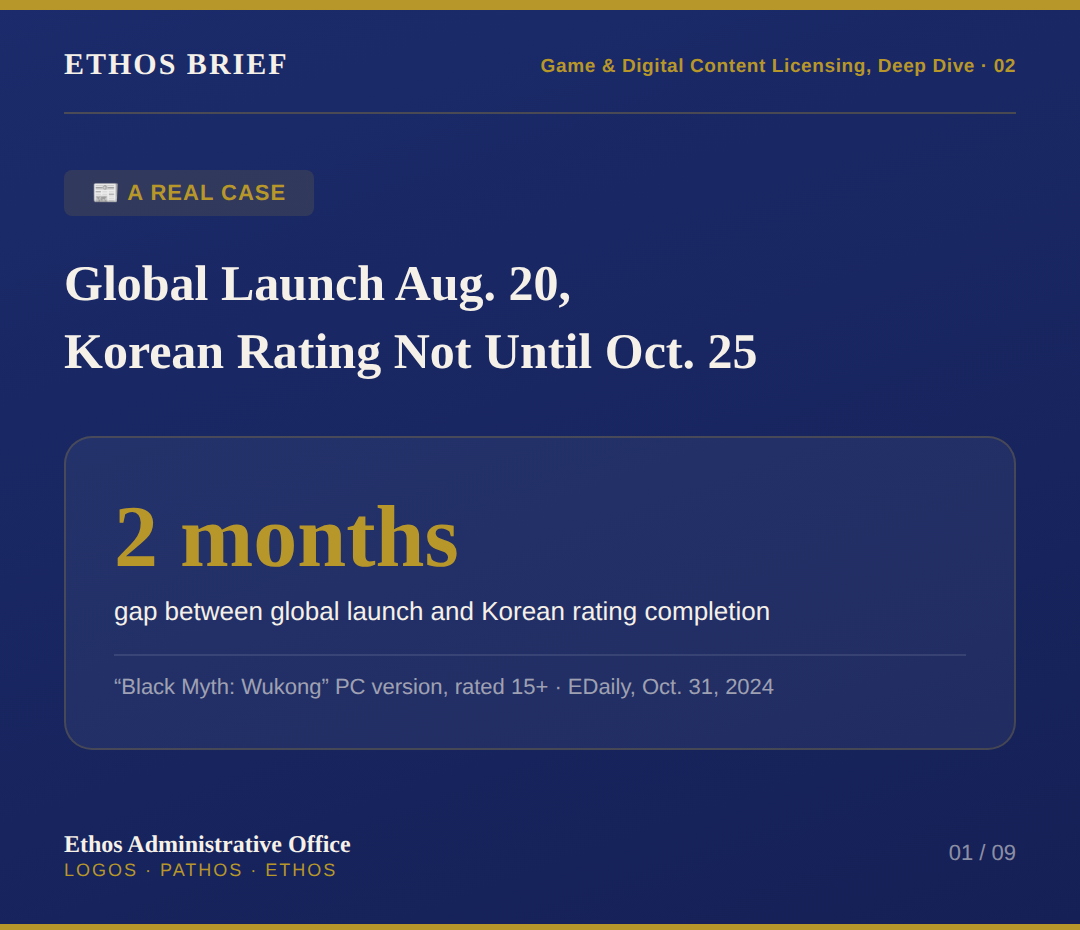
On October 31, 2024, the Korean news outlet Edaily reported that the PC version of Black Myth: Wukong had received a 15+ rating in South Korea on October 25, approximately two months after its August 20 release.
The reported dates alone do not establish a final determination of illegality or confirm that an administrative sanction was imposed.
Nevertheless, the case illustrates an important scheduling issue for game companies.
A global release date and the completion date of the applicable Korean rating process must be managed separately.
So when should you actually apply?
What if you plan to conduct a closed beta test (CBT) or open beta test (OBT) before launch?
Do free demos and Early Access releases follow the same rules?
Let's examine these questions according to the game's development and release stages.
1. When Should You Apply for a Korean Game Rating?
The practical answer is:
Once the game and supporting materials are ready for the applicable review process, proceed with the rating application and ensure that the required rating is completed before the formal release.
First, we need to distinguish the legal requirement from the practical application schedule.
Article 21(1) of the Korean Game Industry Promotion Act (게임산업진흥에 관한 법률) generally requires a person intending to produce or distribute a game for distribution or provision to users to obtain the applicable rating before production or distribution.
The Act also provides statutory exceptions, including certain qualifying test games.
In practice, the legal requirement must be considered alongside the need to prepare an executable game and materials sufficient for review.
Starting development does not automatically mean that your application materials are ready.
Conversely, it is not always necessary to wait until every development task and bug fix has been completed before preparing an application.
The key question is whether the content and materials required for the relevant rating procedure are available.
Consider the following situations.
Situation 1: Only the game design document is complete.
You should first prepare an executable game and the supporting materials required for review.
Situation 2: The core content and systems have been implemented.
Check whether the reviewing body can examine the game's essential content, then prepare the application.
Situation 3: You intend to conduct CBT or OBT before the formal release.
Determine whether the statutory framework for test games applies.
Situation 4: You intend to release a free demo or an Early Access version.
Assess the actual distribution method and whether the applicable rating requirement or a statutory exception applies.
Situation 5: You are approaching the formal launch.
Confirm that the required rating has been completed and that the final release version corresponds to the content reviewed.
For release planning, a game company should therefore track two separate dates.
The first is the date on which the game and application materials become ready for review.
The second is the date on which the applicable rating has been completed and the final release build has been checked.
Your release schedule should account for the completion of the second stage.
2. Is Applying 15 Days Before Launch Enough?
A common question is:
If the game rating process takes 15 days, can we simply apply 15 days before release?
Not necessarily.
Article 9(3) of the Enforcement Rule of the Game Industry Promotion Act generally provides a 15-day decision period for rating applications handled by the Game Rating and Administration Committee (GRAC).
However, where a decision cannot be made within that period for unavoidable reasons, the applicant may be notified of the reason and the expected review date.
GRAC's rating regulations also exclude the time required to supplement application materials from the processing period.
This creates an important distinction.
A 15-day processing period is not a guarantee that your game can be released 15 days after submitting an application.
If supporting materials are incomplete and the reviewing body requests additional information, the schedule may change.
Moreover, the 15-day provision should not automatically be applied to every rating route, including delegated rating bodies and self-rating systems.
When planning a launch, consider the entire process:
Prepare application materials → Submit the application → Review and respond to requests for supplementary materials → Confirm the rating decision → Check the final game build → Release the game
Let's apply this to a practical example.
Example: A Game Scheduled for Release on October 30
Company A plans to release a PC game on October 30.
Its Steam launch and advertising campaign need to follow the same timetable.
The company could establish the following internal schedule.
By late September, it identifies the applicable rating route and confirms that the game's principal content is implemented.
In early October, it prepares the executable game, game content description, and other required materials, with the aim of submitting the application.
During October, it monitors the review and responds to any requests for additional materials.
Once the rating is completed, it checks that the final release build corresponds to the reviewed content before proceeding with the launch.
This is an illustrative project-management schedule, not a statutory requirement to apply four weeks before release.
The actual timeframe can vary according to the game, the applicable rating route, and the completeness of the submitted materials.
Where a publishing agreement fixes the release date, or where a company is preparing a simultaneous global launch, it is particularly important to allow sufficient time to confirm completion of the Korean rating procedure.
Rather than fitting rating into whatever time remains before launch, verify that the required procedure can be completed before finalizing the release schedule.
3. Must Game Development Be 100% Complete Before You Apply?
Now consider the condition of the game itself.
Can we apply for a rating while we are still fixing bugs?
The important factor is not simply whether the development progress indicator says 100%.
What matters is whether the game and materials necessary for review are sufficiently prepared.
Article 9 of the Enforcement Rule of the Game Industry Promotion Act specifies application materials such as a game content description, videos or photographs showing the principal gameplay process, an executable game, and access credentials for online games.
Additional materials may also be requested when necessary for the review.
Consider three development scenarios.
Scenario A: Only the Design Document and Character Artwork Are Complete
The game's setting, characters, and principal systems have been defined.
However, there is no executable game yet.
In this situation, the company should first prepare the game and materials required for an ordinary rating application.
Completing the design document alone does not mean that the application is ready.
Scenario B: The Game Runs, but Important Content Is Missing
Users can log in and control a character.
However, essential combat sequences or core systems have not yet been implemented.
The company should determine whether the missing content is relevant to the rating assessment.
Otherwise, the materials reviewed may not accurately represent the game eventually released.
The mere existence of an executable file does not necessarily establish that the submission is ready.
Scenario C: Core Content Is Implemented, but Bug Fixes Remain
The reviewing body can examine the game's essential systems and principal gameplay process.
The company can also accurately describe the implemented content in its application materials.
At this stage, it may be appropriate to prepare the rating application.
However, subsequent changes to the game should be documented and assessed separately.
Before rushing to submit an application, verify that the game content and supporting descriptions accurately correspond to one another.
The significance of this relationship can also be seen in a Korean Supreme Court decision.
4. Why the Accuracy of the Game Content Description Matters
Consider the Supreme Court of Korea's decision of May 29, 2014, Case No. 2014Do12.
The case concerned an external device that automatically operated game buttons.
The legal issue was whether providing such a device amounted to providing a game that differed from its rated content.
The Supreme Court distinguished the content described in the rating application and accompanying game content description from the program's source code itself.
It also distinguished adding an important function not reflected in the description from providing a separate auxiliary device that did not change the game's actual content.
The Court concluded that the device in question did not itself alter the content of the game and remanded the case.
This decision did not establish that every game update requires a new rating.
Its relevance to the application process lies elsewhere.
The game described in the application must accurately reflect the content actually provided to users.
Before submitting an application, the development team and the person responsible for the rating procedure should check whether:
- The functions described in the application have actually been implemented.
- The principal gameplay and content are accurately reflected in the supporting materials.
- The submitted executable game and access credentials allow the relevant content to be reviewed.
- Important changes to the game have been documented.
A rating application involves more than completing a form.
It is a process of accurately presenting the game that the company intends to provide to users.
5. Can You Conduct CBT or OBT Without a Formal Game Rating?
Game companies frequently conduct external testing before a formal launch.
Closed beta tests and open beta tests may be used to evaluate server performance, identify bugs, or measure user satisfaction.
Korean law provides a separate framework for qualifying test games.
However, there is an important limitation.
Calling your release a CBT or OBT does not automatically exempt it from the ordinary rating requirement.
Article 21(1)(3) of the Game Industry Promotion Act provides an exception for certain qualifying test games used during development to evaluate performance, safety, or user satisfaction.
Article 11-4 of the Enforcement Decree establishes the relevant confirmation procedure.
A game production business or game distribution business intending to provide a qualifying test game must submit an application for confirmation.
The Game Rating and Administration Committee is required to examine the applicable requirements and issue a confirmation certificate within seven days of receiving the application, as provided by the decree.
Accordingly, the preparation sequence for conducting an external test under this framework is:
Determine the testing purpose → Check the test-game requirements → Apply for confirmation → Obtain the confirmation certificate → Conduct the test under the applicable conditions
The game must also be identified as a test game, with relevant information about its use and precautions provided to participants.
However, obtaining a confirmation certificate does not mean that every proposed testing arrangement is permitted.
Companies planning paid testing or the transfer of test-period items to the formal service need to examine the applicable operational conditions.
6. Can You Charge Users During CBT or Transfer Test Items to the Formal Service?
Imagine that Company A is preparing a CBT.
It has recruited participants and designed rewards for users who take part in the test.
The development and marketing teams then propose the following arrangements:
We will charge users to access the game during the testing period.
Items earned during CBT will remain available after the formal launch.
Can the company proceed with these arrangements under the test-game framework?
For the applicable PC, online, and mobile test-game category, these plans cannot simply be implemented as proposed.
Appendix 1 of the Enforcement Decree of the Game Industry Promotion Act establishes operational standards for this category.
The standards include:
- A testing period of no more than 60 days.
- A participant limit of 20,000 people.
- Participants who meet the age requirements corresponding to the applied-for rating.
- Free use of the game during testing.
- Restrictions preventing scores and game items obtained during testing from being used when the rated game is formally distributed.
These requirements have direct implications for product design and marketing.
Charging an Access Fee During CBT
If the company intends to charge users for access to a qualifying PC, online, or mobile test game, that arrangement must be revised to comply with the free-use requirement.
Plans involving separate purchases of in-game items or other monetization mechanisms should also be examined for consistency with the applicable free-use standard and testing purpose.
A confirmation certificate should not be treated as permission to implement an otherwise incompatible monetization plan.
Carrying CBT Items Over to the Formal Game
The company also needs to reconsider a plan to transfer items earned during testing directly into the formal service.
If a marketing campaign promises rewards for CBT participation, the company should distinguish between transferring items obtained during the test and providing separately designed rewards after the formal launch.
The precise structure of the rewards should be checked against the applicable testing conditions.
The same standards should not automatically be applied to every type of game.
Arcade test games are subject to separate conditions, including limits concerning the testing period, the number of game machines, and testing locations.
Test-game confirmation is therefore not merely a document-submission procedure. It can affect the testing period, participant management, monetization strategy, and post-launch item policy.
7. Are Free Demos and Early Access Releases Considered Tests?
A developer may make a game available on Steam or another platform before its formal release.
Common examples include free demos and paid Early Access.
From the developer's perspective, these releases may be intended to collect feedback while development continues.
However, the legal assessment depends on the actual distribution structure.
A game does not automatically qualify for an exemption merely because it is free or described as a test.
Consider three situations.
Situation A: A Closed Test for Selected Participants
The purpose is to assess performance and identify errors.
If the game satisfies the statutory test-game requirements and the necessary confirmation has been obtained, the test may proceed under the applicable conditions.
The company must comply with the conditions governing that test.
Situation B: A Free Demo Available to Everyone
The developer publishes a demo that anyone can download and play.
Does its free distribution eliminate the need for a rating?
No. Free distribution alone does not establish an exemption.
The Game Industry Promotion Act provides certain exceptions for qualifying games created by individuals or groups for simple, non-commercial disclosure.
However, a commercial game company preparing a formal release does not automatically fall within such an exception simply because its demo is offered free of charge.
The company should examine the demo's purpose and actual method of distribution to determine the applicable procedure.
Situation C: A Paid Early Access Release
Development is not yet complete.
Nevertheless, users can purchase the game and begin playing.
The label "Early Access" does not, by itself, eliminate the applicable rating obligations.
Where the game is actually being distributed and made available to users, the relevant Korean rating procedure must be considered in advance.
The decisive question is therefore not simply whether the game is free, paid, or described as a test.
It is how and for what purpose the game is actually being provided to users.
8. Does Registering a Game on Steam or an App Store Mean Its Korean Rating Is Complete?
A company may create its store page, upload game information, and announce a release date well before launch.
However, registering a game on a platform or opening a store page does not automatically establish that every applicable Korean rating requirement has been completed.
Publishing a page that introduces a game should also be distinguished from making the game itself available for download and play.
Before calculating the rating schedule, the company must identify the appropriate rating route.
South Korea has multiple rating arrangements, including procedures involving the Game Rating and Administration Committee, delegated rating organizations, and designated self-rating businesses.
The scope of delegated rating responsibilities also changed in 2025.
From November 1, 2025, the responsibilities of the Game Content Rating Board were expanded to include rating certain adult-only PC and console games.
Certain games with gambling-related characteristics were excluded from the additional delegation.
Consequently, it would be inaccurate to assume that every adult-only PC or console game must be submitted directly to GRAC under the arrangements applicable in 2026.
Before calculating the application timeline, identify the rating route that applies to the specific game and platform.
The institutional responsibilities and differences between rating systems require a separate examination.
9. What If the Rating Decision Is Delayed or Your Application Is Refused?
Imagine that your company has submitted its application and responded to requests for supplementary materials.
Despite this, no decision has been issued.
Alternatively, the company receives a refusal.
What should it do?
A Korean administrative appeal decision provides a relevant example.
Central Administrative Appeals Commission, August 6, 2013, Case No. 2013-07420.
In that case, an applicant sought ratings for two sports-related games.
One application resulted in a refusal, while a decision on the other was delayed.
The Central Administrative Appeals Commission examined the nature of the games, the applicable legal provisions, supporting evidence concerning rights, and the processing period.
It determined that the refusal and delay were unlawful or improper in the circumstances and ordered the relevant rating decisions to be made.
This was a decision concerning particular sports games and their specific facts under the rules applicable at the time.
It does not mean that every rating refusal is unlawful.
Nor does the expiry of a processing period mean that a rating is automatically granted.
The practical lesson is more specific.
Where a rating is refused or a decision is delayed, identify the grounds for the decision or delay before determining the appropriate response.
The company should organize the following information:
- The application date.
- Dates and details of requests for supplementary materials.
- Dates on which supplementary materials were submitted.
- Any notification of an expected review date.
- The specific reasons given for a refusal.
These records help distinguish an ordinary documentation issue from a processing delay or a situation requiring consideration of an administrative remedy.
10. What If You Release an Unrated Game or Change Its Content Before Launch?
Two further issues may arise immediately before release.
Releasing a Game Without the Required Rating
Article 32(1)(1) of the Game Industry Promotion Act prohibits certain acts involving the distribution or provision of games that have not received the required rating.
A violation falling within the relevant penal provisions of Article 44 may result in imprisonment of up to five years or a fine of up to KRW 50 million.
However, the consequences must be assessed against the specific facts.
It is necessary to determine whether the game is subject to the rating requirement, whether a statutory exception applies, and what distribution or provision actually took place.
A company should not treat a submitted application as equivalent to a completed rating simply because its release date is approaching.
Changing the Game After a Rating Has Been Obtained
A game may still change after receiving its rating.
Developers may fix bugs, change the user interface, add functions, or introduce new content shortly before launch.
Not every modification necessarily requires a new rating.
However, the existing rating should not be used as a reason to ignore changes that may affect the reviewed content.
Amendments to Article 21 of the Game Industry Promotion Act that took effect in October 2025 introduced procedures concerning advance notification or notification within 24 hours after certain content modifications.
Exceptions apply to specified minor changes that clearly do not affect the existing rating decision, although additional obligations may still need to be considered for particular categories of games.
Accordingly, where the release build differs from the version submitted for rating, the company should document the modifications and determine whether a content-modification notification or further rating procedure is required.
The detailed requirements for modified games warrant separate treatment.
For present purposes, the essential point is:
A pre-launch compliance check should confirm both completion of the applicable rating and consistency between the reviewed content and the final release version.
11. What Should You Do If the Release Date Is Approaching?
The appropriate action depends on the current status of your game.
If the Application Materials Are Not Ready
First, secure the executable game, game content description, and other required materials.
An approaching release date does not eliminate the need to prepare an application that accurately represents the game.
If the Application Has Been Submitted but No Decision Has Been Issued
Check the review status and determine whether supplementary materials have been requested.
Do not treat submission alone as confirmation that the game is ready for formal release.
If You Plan to Conduct CBT or OBT Before Launch
Examine the requirements and confirmation procedure for qualifying test games.
For relevant PC, online, and mobile games, also review the conditions concerning free use, participant management, and restrictions on carrying test-period items into the formal service.
If the Game Has Changed After Receiving Its Rating
Compare the modified content with the game previously reviewed.
Determine whether a content-modification notification or another procedure is necessary.
If the Rating Is Complete and the Final Build Has Been Checked
Confirm the required rating display and other applicable pre-release obligations before proceeding with the launch.
Ultimately, the decisive factor is not whether the application has been submitted.
It is whether the required procedure has been completed and the game that will actually be provided to users corresponds to the relevant rating decision.
12. What Can Your Company Prepare Internally, and When Is Professional Review Appropriate?
Where the game's principal content and systems are settled and the applicable rating route is clear, a company may be able to prepare the application directly by consulting the relevant official guidance and regulations.
The development team can secure an executable build.
The planning team can compare the game content description with the implemented game.
The business team can confirm the rating route and release schedule.
However, additional review may be necessary where the company intends to conduct CBT or OBT, offer a free demo, or launch an Early Access version before the formal release.
The applicable procedure depends on the actual manner of distribution and whether the conditions for a statutory exception are satisfied.
Where a company plans to monetize a test game or carry test-period items into its formal service, the testing framework should be examined together with its operational policies.
Additional complexity may also arise when an overseas developer and Korean publisher are separate entities, when a game is scheduled for simultaneous release on several platforms, or when significant features change after an application has been submitted.
If a rating decision is delayed or refused, the company should examine its application records, supplementary submissions, and reasons for the decision before determining the appropriate administrative response.
In such situations, identifying the correct procedure for the game's current development stage and actual release structure is more important than simply preparing an application form.
So, When Should You Apply for a Game Rating in South Korea?
Proceed with the applicable rating procedure once the game and supporting materials are ready for review, and complete the required rating before the formal release.
A 15-day processing period does not mean that submitting an application 15 days before launch will necessarily be sufficient.
If CBT or OBT is planned, examine the requirements and confirmation procedure for qualifying test games in advance.
Free demos and Early Access releases must also be assessed according to how they are actually distributed and made available to users.
After the rating is completed, confirm that the final release build corresponds to the content reviewed.
If you are preparing a game for release in South Korea, you can request a free initial review of the appropriate application timing, possible test-game exemptions, rating route, and additional procedures based on your game's development stage and launch schedule.