
Establishing a Nonprofit Corporation in Korea ① Finding the Competent Authority
This is the first article in a three-part series on establishing incorporated associations and foundations in Korea.
| Part | Topic | Main Point | |---|---|---| | Part 1 | Finding the competent authority | Where should the application be filed? | | Part 2 | Drafting bylaws | Why different officers request different revisions | | Part 3 | Post-establishment obligations | Annual checklist to avoid cancellation of approval |
Hello, this is Administrative Agent Jean.
When people decide to establish a nonprofit corporation in Korea and start searching online, they usually face the first wall immediately.
Which authority should I apply to?
This confusion is normal.
Establishing a nonprofit corporation in Korea is structurally complicated.
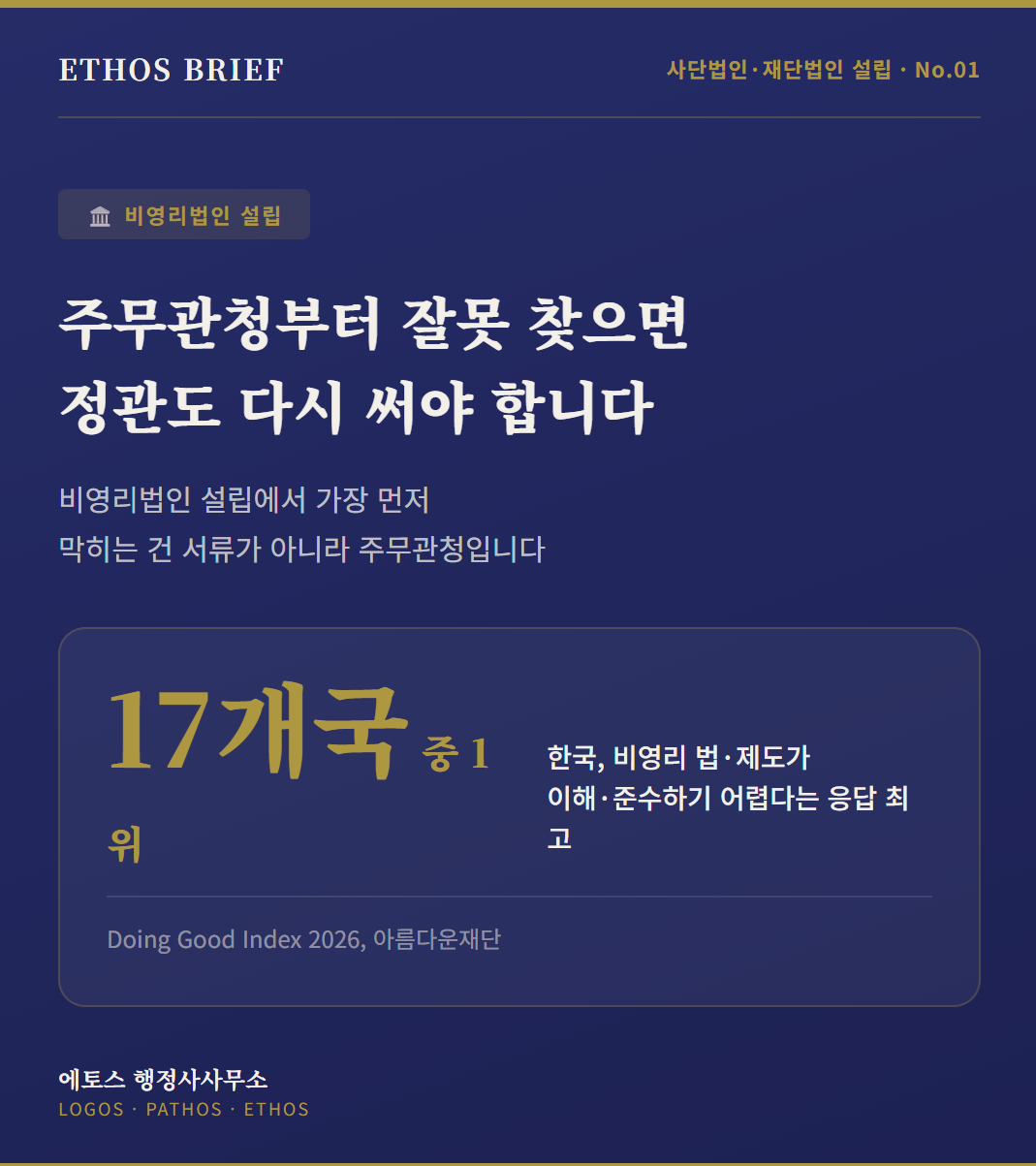
According to the Doing Good Index 2026 materials introduced by the Beautiful Foundation, Korea recorded the highest response rate among 17 Asian economies for difficulty in understanding and complying with nonprofit-related laws and regulations.
The perception that obtaining legal status is difficult was also above the Asian average.
During foreign startup lectures and OASIS programs, I often receive nonprofit incorporation questions alongside visa questions.
I want to establish an incorporated association in Korea. Where should I apply?
It would be nice if there were a one-line answer.
But in practice, the answer differs by organization.
The competent authority depends on the organization’s purpose, activity scope, foreign participation, and whether authority has been delegated to a local government.
Today, we will look at the first and most important step in establishing an incorporated association or foundation in Korea:
finding the competent authority.
Key Summary
| Category | Details | |---|---| | Legal Basis | Korean Civil Act Article 32 | | Formation Method | Approval from the competent authority is required before registration | | Competent Authority | The administrative authority responsible for the organization’s purpose activities | | Biggest Trap | Multiple purposes or unclear activity scope | | Practical Risk | If the authority is wrong, the bylaws and business plan may need to be rewritten | | Role of Administrative Agent | Purpose analysis, authority identification, bylaws and business plan structuring, approval application support | | Registration Stage | After approval, court registration is usually handled with a registration professional such as a judicial scrivener |
A Nonprofit Corporation Must First Receive Approval
Whether it is an incorporated association or an incorporated foundation, a nonprofit corporation under the Civil Act must obtain approval from the competent authority under Article 32.
A for-profit company such as a stock company focuses mainly on incorporation documents and registration.
A nonprofit corporation is different.
Before registration, it must pass an administrative approval stage.
The general process is as follows.
| Step | Procedure | Main Point | |---|---|---| | 1 | Preparation | Organize purpose, founders, and draft bylaws | | 2 | Inaugural General Meeting | Approve bylaws, officers, business plan, and budget | | 3 | Application to Competent Authority | File with the authority responsible for the purpose activities | | 4 | Review | Supplementation, interview, or site check may occur | | 5 | Approval | Receive approval certificate | | 6 | Registration | Register at the competent registry office | | 7 | Post-Approval Reporting | Report registration, asset transfer, and other follow-up matters |
The main area where an administrative agent can assist is from identifying the competent authority to preparing and filing the approval application.
Registration after approval is a separate registration procedure and is usually handled with a judicial scrivener or other registration professional.
What Is the Competent Authority?
The competent authority is the administrative body responsible for the nonprofit corporation’s purpose activities.
For example:
| Purpose Activity | Possible Competent Authority | |---|---| | Academic or educational activity | Ministry of Education, local education office | | Health or welfare | Ministry of Health and Welfare, relevant local government department | | Culture, arts, sports | Ministry of Culture, Sports and Tourism, local cultural or sports department | | Donation culture or volunteering | Ministry of the Interior and Safety, local civic cooperation department | | Environment | Ministry of Environment, local environmental department | | International exchange | Ministry of Foreign Affairs or other purpose-related central authority | | Youth activities | Ministry of Gender Equality and Family, education office, local youth department |
The table looks simple.
But actual cases are rarely that clean.
Many organizations do not have only one purpose.
For example, if an organization wants to support multicultural families, teach Korean language, provide youth mentoring, and promote cultural exchange, several administrative fields may overlap.
Before identifying the authority, you must distinguish the main purpose from secondary activities.
Even Complete Documents Do Not Guarantee Approval
Nonprofit incorporation is not a simple filing system.
It requires approval.
The Korean Supreme Court has held that whether to approve the establishment of a nonprofit corporation is generally left to the policy-based discretion of the competent authority, and if the reasoning process is rational, it may be difficult to find deviation or abuse of discretion.
In plain terms, submitting every listed document does not guarantee approval.
The competent authority may still find that:
- The purpose activities are not specific enough
- The organization lacks actual ability to conduct the activities
- The financial foundation is insufficient
- The activity scope exceeds the authority’s jurisdiction
- The purpose belongs to another competent authority
- The bylaws and business plan do not match
- The need for legal personality is not sufficiently explained
So before preparing documents, one question must come first.
Where should the application be filed, and what does that authority care about?
Trap 1. “We Want to Do Charity and Education” — The Authority May Split
A common phrase in nonprofit consultation is:
We want to do many good things.
The intention is good.
But bylaws require strategy.
For example, suppose an organization wants to include all of the following:
- Support for multicultural families
- Korean language education
- Youth mentoring
- Cultural exchange
The relevant administrative fields may be divided as follows.
| Activity | Possible Administrative Field | |---|---| | Support for multicultural families | Welfare, family, local administration | | Korean language education | Education, culture | | Youth mentoring | Youth, education | | Cultural exchange | Culture, international exchange |
Putting every good idea into the bylaws may look impressive.
But in practice, it can make the competent authority unclear and increase the risk of inter-agency consultation or rejection.
The first question should not be:
What are all the activities we want to do?
The better question is:
What is the organization’s primary purpose activity?
Once the primary purpose is clear, the competent authority becomes easier to identify.
Trap 2. Activity Scope Changes the Authority
Purpose alone is not enough.
Activity scope must also be reviewed.
Generally, if activities are nationwide, a central government ministry may be involved.
If activities are limited to a specific city or province, a local government may be considered.
However, a local government is not always the competent authority.
According to Seoul Metropolitan Government guidance, a local government may handle nonprofit incorporation approval only when authority has been delegated from the relevant central ministry.
Also, having an office in Seoul does not automatically mean that Seoul is the competent authority.
Seoul explains that “activity scope” does not simply mean office location. If an organization has an office in Seoul but conducts activities in other cities or provinces, Seoul may not be the proper authority.
The key factors are:
| Factor | What to Check | |---|---| | Office Location | Where the main office is located | | Activity Scope | Where the organization will actually conduct activities | | Purpose Activity | Which administrative field the activities belong to | | Delegation | Whether the central ministry delegated authority to local government | | International Activity | Whether overseas activities are included |
Overseas activity requires special caution.
A Ministry of Government Legislation interpretation has addressed cases where a nonprofit corporation expands its activity scope overseas and the competent authority becomes an issue.
If international exchange, overseas aid, foreign resident support, or overseas network projects are included, central authority review may be required.
Trap 3. The Authority May Say “This Is Not Our Jurisdiction”
Finding the competent authority itself can become a dispute.
In one case, an organization applied for incorporation approval, but the authority refused, saying it was not the competent authority.
The court found that the authority could be considered competent because it handled related affairs.
This shows one important point.
Finding the competent authority is not just a search task.
You must review purpose activities, legal jurisdiction, delegation rules, and the actual division of duties inside the administrative body.
If you apply to the wrong authority, the following problems may occur:
- Filing may be delayed
- Supplementary requests may repeat
- The application may be rejected as outside jurisdiction
- Bylaws may need to be rewritten
- Business plan and budget may need restructuring
- Inaugural meeting resolutions may need to be redone
- The entire schedule may be delayed by months
In nonprofit incorporation, the competent authority is the first button.
If the first button is wrong, the bylaws and business plan may also need to be redone.
How Do You Find the Competent Authority?
The competent authority should not be guessed.
It should be reviewed in order.
| Order | Material | What to Check | |---|---|---| | 1 | Purpose Activities | The organization’s actual core activities | | 2 | Government Organization Act | Which central authority handles the field | | 3 | Ministry Organization Rules | Which department within the ministry handles it | | 4 | Delegation and Entrustment Rules | Whether authority is delegated to local government or education office | | 5 | Ministry Nonprofit Corporation Rules | Approval standards and required documents | | 6 | Local or Ministry Guidance | Practical standards and responsible department | | 7 | Prior Inquiry | Confirm expected department using draft bylaws and business plan |
In Seoul, if it is difficult to identify the responsible department, applicants may request guidance using key materials such as draft bylaws, business plan, and officer list.
However, this type of guidance does not guarantee final approval.
Finding the Authority Is Only the Beginning
Once the competent authority is identified, the next step is satisfying the approval criteria.
The rules on establishment and supervision of nonprofit corporations generally review the following.
| Standard | Meaning | |---|---| | Feasibility of Purpose and Activities | Whether the stated purpose activities can realistically be carried out | | Ability and Financial Foundation | Whether the organization has the capacity and financial basis to conduct activities | | Name Duplication | Whether another corporation already uses the same or confusingly similar name |
The problem is that “financial foundation” is not specified as an exact amount in the law.
Unlike foundations, incorporated associations are not necessarily built around endowed assets.
But in practice, departments may still request evidence of a certain level of assets, membership dues, member scale, or business funding capacity.
Seoul guidance explains that membership numbers, contributed assets, and other review standards differ by responsible department and may change depending on policy.
So “there is no statutory minimum amount” does not mean “no financial basis is needed.”
The authority wants to see whether the organization can realistically conduct its stated activities.
Relevant materials may include financial plan, member scale, project budget, donation possibility, and office documents.
The Competent Authority Does Not Provide Consulting
Many people call the authority and ask:
“How should we draft the bylaws so approval will be granted?”
But according to Seoul guidance, the authority must neutrally review the documents submitted by founders and cannot intervene in consulting or document drafting.
In other words, the officer is a reviewer, not a designer.
This distinction matters.
| Role | Function | |---|---| | Competent Authority | Reviews submitted documents and decides approval | | Administrative Agent | Structures purpose, identifies authority, drafts bylaws and business plan | | Judicial Scrivener | Handles registration after approval | | Tax Accountant | Reviews tax, accounting, donation, and registration number issues |
Instead of asking the authority how to draft everything, it is more efficient to first structure the bylaws and business plan, then confirm jurisdiction and filing direction.
Can Foreigners Participate as Founders or Directors?
Nonprofit corporations involving foreigners are becoming more common.
Examples include:
- Multicultural family support organizations
- Foreign resident support organizations
- International exchange associations
- Overseas student networks
- Religious or cultural exchange groups
- Foreign founder communities
- Associations of residents from a specific country
In general, there is no blanket nationality restriction under the Civil Act preventing foreigners from participating as founders or directors of a nonprofit corporation.
However, in practice, the following must be reviewed.
| Item | What to Check | |---|---| | Identity | Passport, alien registration card, address proof | | Signature or Seal | Home-country signature method, seal, signature verification | | Translation | Translation and notarization of foreign documents | | Visa Status | Whether the person may engage in management activities under current visa | | Compensation | Whether the person receives salary or director compensation | | Actual Activity | Whether the person is only listed or actually operates the organization in Korea | | Tax and Labor | Payment structure for salary, service fee, or activity allowance |
The most important point is this:
Eligibility to participate in incorporation and permission to engage in activities under a visa are separate issues.
A foreigner may be able to serve as a director, but that does not automatically mean the person can operate the nonprofit or receive compensation under their current visa.
If foreigners participate in the nonprofit, incorporation and visa issues should be reviewed together.
Incorporated Association vs. Incorporated Foundation
Before finding the competent authority, the legal form must also be selected.
An incorporated association and an incorporated foundation are structurally different.
| Category | Incorporated Association | Incorporated Foundation | |---|---|---| | Core Element | People, members | Property, endowed assets | | Decision-Making | General meeting-centered | Board-centered | | Formation Basis | Members and purpose activities | Assets and purpose activities | | Best Fit | Associations, academic societies, membership groups, communities | Scholarship foundations, welfare foundations, research funds, public-interest asset management | | Key Documents | Member list, inaugural general meeting, bylaws, business plan | Endowed assets, board, bylaws, business plan | | Practical Risk | Member scale, general meeting operation, bylaw procedure | Asset amount, asset management, continuity of purpose |
If the organization is based on members gathering for activities, an incorporated association is usually natural.
If the organization is based on property dedicated to a public purpose, an incorporated foundation may be more appropriate.
If this choice is wrong, the competent authority, bylaws, and financial plan may all become unstable.
“Organization Deemed as Corporation” Is Different from a Nonprofit Corporation
Not every public-interest activity requires a Civil Act nonprofit corporation.
If the main goal is to open a bank account under the group’s name or obtain a tax identification number, approval as an “organization deemed as corporation” from the tax office may be more appropriate.
| Category | Organization Deemed as Corporation | Civil Act Nonprofit Corporation | |---|---|---| | Responsible Body | Tax office | Competent authority | | Main Purpose | Tax identification and accounting | Independent legal personality | | Procedure | Relatively simple | Approval and registration required | | Legal Personality | Not the same as Civil Act corporation | Has legal personality | | Supervision | Mainly tax-related | Supervision by competent authority | | Best Fit | Small group operations, bank account, accounting | Long-term public projects, contracts, property holding, public credibility |
A nonprofit corporation may improve credibility.
But it also creates obligations.
After establishment, the corporation may need to file annual reports, obtain approval for bylaw amendments, report officer changes, manage assets, keep accounting records, and remain under supervision.
So the first consultation question is often:
Do you really need legal personality?
Starting with incorporation without answering this question can make post-establishment management more burdensome than expected.
Pre-Application Checklist
If you are considering nonprofit incorporation, organize these points first.
| Question | Why It Matters | |---|---| | Association or foundation? | Determines whether the structure is member-based or asset-based | | What is the primary purpose? | Starting point for competent authority review | | What are secondary activities? | May create multiple authority issues | | What is the activity scope? | Determines central ministry or local authority | | Are overseas activities included? | May require central ministry review | | Are there enough members? | Important for association substance | | Is there financial foundation? | Shows feasibility of activities | | Is office space secured? | Shows actual operation capacity | | Are foreigners involved? | Identity, visa, translation, and compensation issues arise | | Is legal personality truly necessary? | A simpler structure may be more appropriate |
As you answer these questions, the competent authority becomes clearer.
If these questions cannot be answered, drafting bylaws first may lead to rewriting later.
How Ethos Administrative Office Reviews Nonprofit Incorporation
In nonprofit incorporation consultation, we do not begin by drafting bylaws immediately.
We first review the structure in this order.
- Separate the stated purpose from actual activities
- Identify primary and secondary purposes
- Decide whether association or foundation structure fits better
- Confirm whether the activity scope is national or local
- Review overseas activity or foreign participation
- Check the Government Organization Act, ministry organization rules, delegation rules, and relevant ministry rules
- Narrow down the likely competent authority and department
- Check public standards and practical requirements of the department
- Design the direction of bylaws and business plan
- Explain approval possibility, timeline, and risks
Nonprofit incorporation is not about writing documents quickly.
Getting the direction right at the beginning is the fastest route.
Frequently Asked Questions
Q. Where do I apply to establish a nonprofit corporation?
You apply to the competent authority responsible for the organization’s purpose activities.
Depending on the purpose and activity scope, this may be a central ministry, local government, or education office.
The competent authority should be identified before drafting bylaws.
Q. If the office is in Seoul, do I apply to Seoul Metropolitan Government?
Not always.
According to Seoul guidance, activity scope is not the same as office location.
Even if the office is in Seoul, nationwide or overseas activities may require central ministry review.
Q. What if the organization has several purposes?
The primary purpose must be identified first.
If the purposes fall under multiple ministries, it may become difficult to identify the competent authority, and inter-agency issues or rejection risk may increase.
Bylaws should be designed around the core purpose, not every activity the founders hope to do.
Q. Can foreigners be founders or directors?
Possibly, yes.
However, identity documents, address proof, signature method, translation, visa status, and compensation structure must be reviewed.
Participation in incorporation and permission to engage in activities under immigration law are separate issues.
Q. Does establishing a nonprofit corporation mean we can receive government grants?
No.
Nonprofit incorporation itself does not guarantee subsidies or grants.
After incorporation, supervision, reporting, accounting, and governance obligations also arise.
Incorporating only to receive grants should be approached carefully.
Q. Will the competent authority help draft the bylaws?
Generally, no.
The competent authority reviews submitted documents neutrally.
It does not normally provide consulting or drafting assistance.
The bylaws and business plan must be prepared by the applicant or with professional assistance.
Closing
Nonprofit incorporation in Korea is not completed by simply collecting documents.
The first task is to identify the correct competent authority.
If the authority is wrong, the bylaws, business plan, and inaugural meeting documents may all need to be revised.
Korea uses an approval system for nonprofit corporations.
The competent authority reviews the organization’s purpose, activity scope, financial foundation, and ability to conduct its activities.
That review involves discretion.
So the order matters.
First, clarify the purpose activities.
Second, identify the competent authority.
Third, draft the bylaws and business plan.
If you draft the bylaws first and find the authority later, you may need to start over.
If you are considering establishing an incorporated association or foundation, begin by confirming where the application should be filed.
Consultation
If you need assistance with incorporated association or foundation establishment, competent authority review, bylaw drafting, or approval application preparation, please contact us.
In a preliminary review, we first check the likely competent authority and possible direction based on your purpose activities and activity scope.