
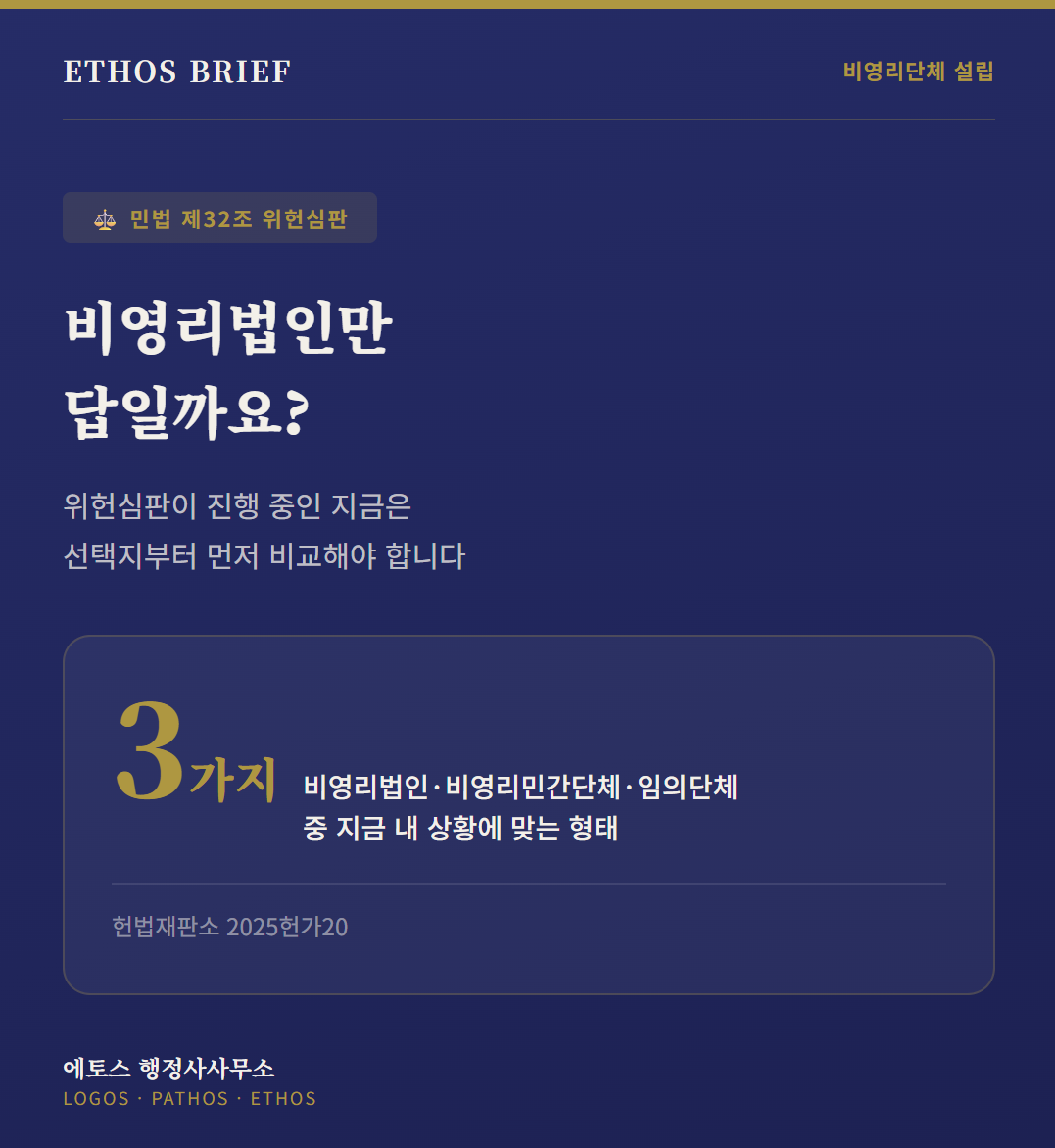
Is a Nonprofit Corporation the Only Answer? Civil Act Article 32 Constitutional Review and Nonprofit Entity Options in Korea
Hello, this is Administrative Agent Jean.
When nonprofit activities grow, there often comes a point where legal status becomes necessary.
You may need legal personality to apply for grants, enter into contracts under the organization’s name, open an official account, manage donated assets, or build long-term credibility with public institutions and corporate donors.
But here is the important question.
Does that mean you must immediately establish a nonprofit corporation?
Not always.
As of 2026, Korea’s nonprofit corporation approval system under Civil Act Article 32 is being reviewed by the Constitutional Court. At the same time, nonprofit organizations have several possible structures depending on their purpose, scale, funding plan, and operational needs.
This article explains what is currently happening with Civil Act Article 32, and how to choose among a nonprofit corporation, a registered non-profit private organization, and a voluntary association.
Key Summary
| Category | What to Check | |---|---| | Current issue | Civil Act Article 32 nonprofit approval system is under constitutional review | | Case number | Constitutional Court 2025Hun-Ga20 | | Main concern | No detailed statutory approval standards; broad discretion by competent authorities | | Practical question | Should you wait for the ruling, or proceed under the current system? | | Main options | Nonprofit corporation, registered non-profit private organization, voluntary association | | Practical criteria | Donors, grants, contracts, assets, activity scope, member count, timeline | | Administrative agent role | Structure selection, competent authority review, bylaws, approval documents, post-establishment compliance |
Why Is Civil Act Article 32 Being Questioned?
Civil Act Article 32 provides that a nonprofit association or foundation may become a legal entity with the permission of the competent authority.
The issue is not simply that approval is required.
The problem is that the law itself does not clearly state detailed standards for approval or refusal. In practice, each competent authority may apply different internal standards regarding financial foundation, activity scope, membership, organizational capacity, and public interest.
This creates a practical difficulty.
An organization may prepare documents, hold an inaugural meeting, draft bylaws, and submit an application, only to be told that the competent authority cannot approve the establishment because the group does not meet unclear or discretionary standards.
That uncertainty is now being tested before the Constitutional Court.
The Case That Triggered Constitutional Review
In Seoul Administrative Court case 2025A12945, a youth participation organization sought to establish a nonprofit corporation.
The competent ministry reportedly rejected the application multiple times, citing reasons such as insufficient nationwide activity capacity and an unclear financial foundation.
The Seoul Administrative Court referred the matter to the Constitutional Court, raising constitutional concerns over Civil Act Article 32.
The core arguments include:
- The approval system may restrict freedom of association.
- The law may delegate too much discretion without clear statutory standards.
- The lack of concrete criteria may conflict with the principle of parliamentary reservation.
- Similar organizations may be treated differently depending on the competent authority.
As of August 2026, no final Constitutional Court decision has been confirmed. Until a decision is issued, applications still proceed under the current approval-based system.
Should You Wait for the Constitutional Court Decision?
In practice, many organizations cannot simply wait.
Grant schedules, donor meetings, office leases, contracts, public project deadlines, and member recruitment plans may already be moving.
So the practical question is not only whether Civil Act Article 32 may change in the future.
The better question is:
Which structure fits your organization right now?
Three Main Options
| Structure | Legal Basis | Legal Personality | Main Use | Difficulty | |---|---|---|---|---| | Nonprofit corporation | Civil Act Article 32 | Yes | Long-term operation, contracts, assets, corporate credibility | High | | Registered non-profit private organization | Non-Profit Private Organization Support Act | No | Public interest activities, public subsidies, civic projects | Medium | | Voluntary association | Internal rules, tax office registration | No | Early-stage activity, small groups, pilot projects | Low |
There is no single best answer.
A nonprofit corporation may be necessary for one organization, while another may be better off starting as a voluntary association and later registering as a non-profit private organization.
The correct choice depends on the organization’s purpose, funding model, member structure, activity history, and timeline.
When a Nonprofit Corporation May Be Necessary
A nonprofit corporation is usually worth considering when the organization needs formal legal personality.
This may be important if:
- The organization must sign contracts under its own name.
- It needs to own or manage property.
- Corporate donors require a formal legal entity.
- Long-term institutional credibility is important.
- Leadership changes must be handled within a stable governance structure.
- The organization plans to manage substantial assets or funds.
- The organization wants to build a long-term donation and grant strategy.
However, nonprofit corporation establishment is not just a document submission process.
It requires approval from the competent authority, and the competent authority’s review standards may differ depending on the field, ministry, local government, and 담당 department.
When a Registered Non-Profit Private Organization May Fit Better
A registered non-profit private organization may be more practical when the group already has public interest activity experience but does not necessarily need legal personality.
Under the Non-Profit Private Organization Support Act, key requirements include:
- The organization’s main purpose must be nonprofit public interest activity.
- The direct beneficiaries must be unspecified and many.
- Profits must not be distributed among members.
- The organization must have at least 100 standing members.
- It must have at least one year of public interest activity experience.
- If it is not a legal entity, it must have a representative or manager.
This structure may fit groups that focus on civic participation, public campaigns, education, community support, or grant-linked activities.
However, registration does not make the organization a corporation. It does not automatically create legal personality.
When Starting as a Voluntary Association May Be Better
For early-stage groups, a voluntary association may be the most realistic starting point.
This may be suitable when:
- The organization is still testing its project model.
- Member numbers are small.
- The activity record is not yet sufficient.
- The organization does not yet need to own property.
- The group wants to build accounting records and activity history first.
- A future nonprofit corporation or registered organization application is planned.
In this stage, it is still important to prepare basic documents properly.
A voluntary association should organize:
- Internal rules or bylaws
- Representative appointment records
- Meeting minutes
- Member list
- Activity records
- Accounting records
- Tax office identification number, if needed
Starting simply does not mean starting carelessly.
The records created at this stage may later become supporting documents for registration or incorporation.
How to Choose the Right Structure
Ask these questions first.
1. Do you need corporate donors or institutional funding?
If corporate donors, foundations, or public institutions require a formal entity, a nonprofit corporation may be necessary.
2. Do you need to sign contracts or hold assets under the organization’s name?
If yes, legal personality becomes important.
3. Are you applying for public interest activity grants?
A registered non-profit private organization may be more relevant depending on the grant program.
4. Do you need legal status within three months?
If the timeline is short, it may be better to separate the short-term structure from the long-term incorporation strategy.
Where Organizations Commonly Get Stuck
Many nonprofit teams struggle not because they lack passion, but because the legal structure is chosen too late.
Common problems include:
- Applying to the wrong competent authority
- Drafting bylaws before confirming the competent authority
- Mixing too many purposes into one organization
- Failing to meet member requirements for non-profit private organization registration
- Assuming a tax office identification number creates legal personality
- Missing annual reports or post-establishment obligations
- Treating donation receipts as automatic
These issues can delay the process by months.
In some cases, the organization may need to rewrite its bylaws, revise its purpose, or restart consultation with another authority.
What the Constitutional Review Really Means
The constitutional review of Civil Act Article 32 is not only about whether the approval system is constitutional.
The deeper issue is whether the current system gives competent authorities too much discretion without clear statutory standards.
That matters because nonprofit establishment is connected to freedom of association.
If an organization cannot obtain legal personality due to unclear standards, its ability to operate, contract, receive support, and grow may be restricted.
Still, until the Constitutional Court issues a final decision, the current system remains in effect.
That means organizations preparing to establish a nonprofit corporation should still proceed carefully under the existing approval structure.
How Ethos Administrative Office Can Help
Ethos Administrative Office can assist with:
- Choosing the appropriate nonprofit structure
- Reviewing the competent authority
- Preparing bylaws and establishment documents
- Supporting nonprofit corporation approval applications
- Supporting registered non-profit private organization applications
- Organizing activity records and member documents
- Reviewing post-establishment compliance duties
The goal is not simply to submit documents.
The goal is to choose the right structure, prepare the right explanation, and reduce avoidable delays.
Frequently Asked Questions
Q. Is a nonprofit corporation always better?
No. A nonprofit corporation has legal personality, but the establishment process is more complex. For some groups, a registered non-profit private organization or voluntary association may be more practical.
Q. Is a registered non-profit private organization a corporation?
No. Registration under the Non-Profit Private Organization Support Act does not automatically create legal personality.
Q. Does a tax office identification number make a voluntary association a corporation?
No. It may help with tax and administrative handling, but it does not create legal personality.
Q. Can a nonprofit corporation issue donation receipts immediately?
Not automatically. Donation receipt eligibility and tax benefits require separate review under tax-related rules.
Q. Should we wait for the Constitutional Court decision?
It depends on your timeline. If you have grant deadlines, contracts, donors, or project schedules, you may need to proceed under the current system while monitoring the ruling.
Q. Can foreigners participate as founders or officers?
In principle, foreigners may participate. However, identity documents, residence status, compensation structure, and actual activities should be reviewed separately.
Pre-Consultation Checklist
Before consultation, please prepare the following:
- Purpose of the organization
- Main activities
- Expected beneficiaries
- Current member count
- Activity history
- Funding plan
- Whether donations will be accepted
- Whether grants will be pursued
- Whether contracts or property ownership are needed
- Whether foreign nationals will participate
- Desired timeline
With these items, it becomes much easier to decide whether a nonprofit corporation, registered non-profit private organization, or voluntary association is the right starting point.
Closing
A nonprofit corporation is a powerful structure, but it is not the only answer.
Before drafting bylaws or collecting documents, first decide what kind of legal and administrative structure your organization actually needs.
The current Civil Act Article 32 approval system may change in the future. But today, organizations still need to move under the system that exists now.
The safest approach is to compare the options first, then design the documents and application strategy accordingly.