
Worked Without a Contract in Korea and Did Not Get Paid? Wage Theft and Unpaid Freelance Fees Explained
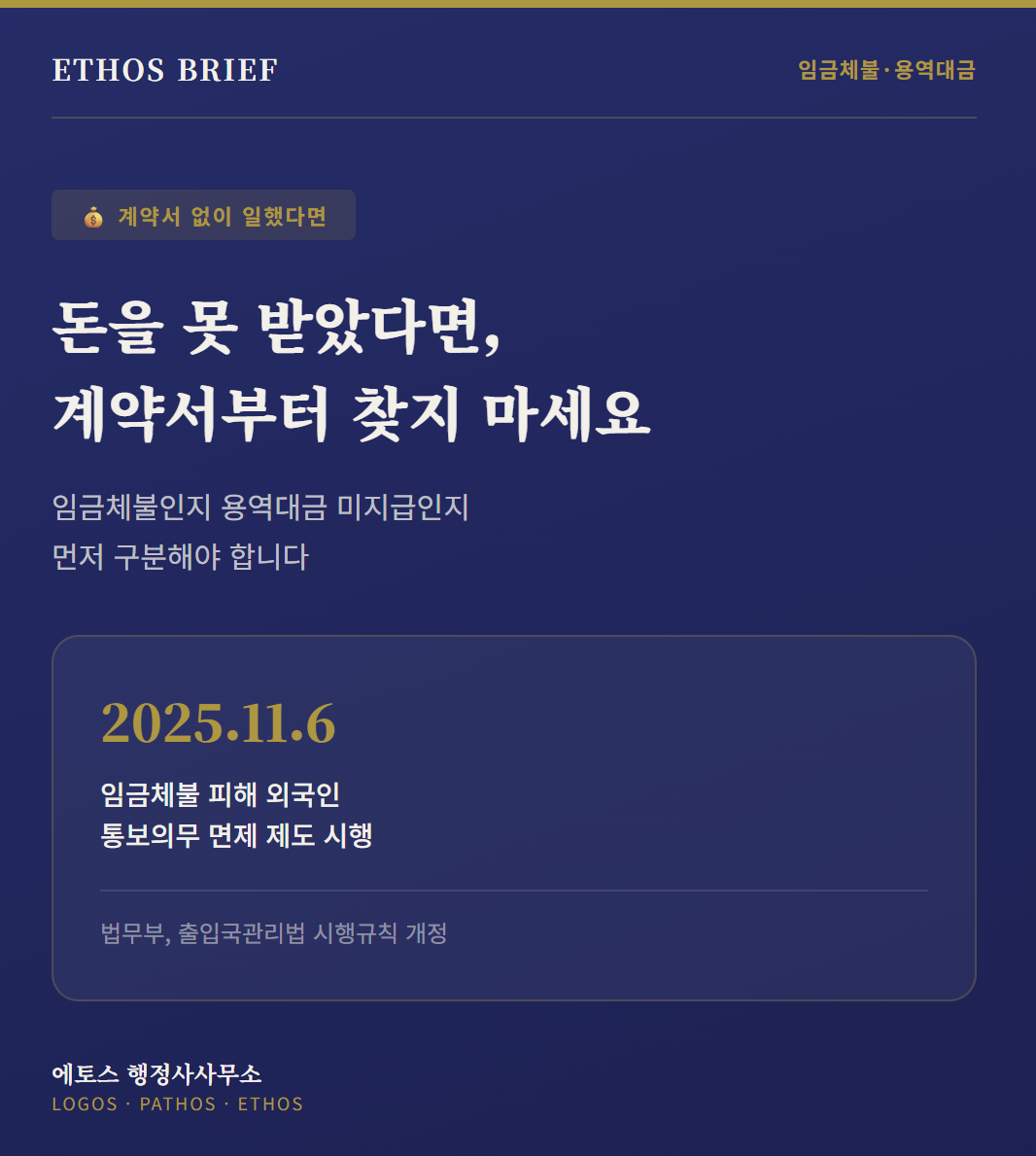
Hello, this is Administrative Agent Jean.
The number of foreign workers in Korea has now exceeded 1.1 million.
Many of them begin freelance or short-term work without a written contract.
“I’ll send the contract later.”
“We’ll pay you next month.”
“Since there was no contract, we cannot confirm anything.”
These are not rare stories.
A translator finishes the work but never receives payment.
A video editor delivers the final file, but the client stops replying.
An event staff member works for several days, only to be told that there was no formal agreement.
Many people assume that if there is no contract, there is no right to claim payment.
That is not true.
Even without a written contract, you may still be able to claim unpaid wages or unpaid service fees. The first question is not whether there was a contract. The first question is what kind of legal relationship actually existed.
Was it an employment relationship?
Or was it an independent service contract?
This distinction changes the entire response strategy.
Key Summary
| Issue | What To Check | Practical Meaning | |---|---|---| | Employee-like freelancer | Working hours, workplace, supervision, reporting structure | A wage theft complaint may be possible | | True freelancer / contractor | Project-based work, independent work method, delivery-based payment | A civil claim for unpaid service fees may be needed | | No written contract | KakaoTalk, emails, bank transfers, deliverables, work records | Evidence can still prove the agreement | | Foreign worker | Immigration status and wage theft facts | Wage theft victims may be protected from automatic immigration reporting | | Before starting new work | Written agreement, payment date, scope of work | Prevention is much easier than recovery |
First, Decide Whether This Is Wage Theft or Unpaid Service Fees
Not every unpaid freelancer case is treated as wage theft under Korean labor law.
If you were effectively working like an employee, the case may fall under unpaid wages.
For example:
- The company controlled your working hours
- You had to work at a fixed place
- You received direct instructions from a manager
- You reported attendance or daily work
- The company controlled how the work was done
- You were paid regularly by time, day, or month
In this kind of case, even if the contract says “freelancer,” the actual relationship may still be reviewed as an employment relationship.
On the other hand, if you independently completed a project and delivered a result, it may be closer to a service contract.
For example:
- Translation project
- Design project
- Video editing
- Marketing content delivery
- Event planning
- Consulting work
- Model or performance service
- One-time outsourced task
In these cases, the issue may be unpaid service fees rather than unpaid wages.
This distinction matters because the procedure changes.
If it is wage theft, the Ministry of Employment and Labor may be the first route.
If it is unpaid service fees, a demand letter, payment order, small claim, or civil procedure may be more appropriate.
“There Was No Contract.” Does That Mean There Is No Evidence?
No.
A written contract is important, but it is not the only evidence.
Even without a signed contract, the following materials can help prove the agreement and the work performed.
Evidence You Should Collect Immediately
| Evidence | Why It Matters | |---|---| | KakaoTalk, texts, emails | Shows work instructions, agreed fee, and payment promises | | Bank transfer records | Shows partial payment, deposit, or previous payment pattern | | Delivered files | Shows actual completion of work | | Work logs or attendance records | Shows when and how you worked | | Photos from the workplace | Helps prove actual work performance | | Third-party statements | Supports the fact that you worked | | Job posting or recruitment message | Shows the original work conditions | | Invoice or payment request | Shows the amount claimed and payment due date |
Before filing any complaint or claim, save screenshots and back up files to your own device.
Do not leave all evidence inside a company messenger, shared drive, or account that you may lose access to later.
If It Is Wage Theft: File a Complaint With the Ministry of Employment and Labor
If the facts show an employment relationship, you may file a wage theft complaint through the Ministry of Employment and Labor.
You can apply through the Labor Portal or visit the local labor office with jurisdiction over the workplace.
The general process is as follows.
Wage Theft Complaint Process
- Prepare evidence
Gather messages, payment promises, work records, attendance records, and bank transfer records.
- File a wage theft complaint
Submit the complaint through the Labor Portal or visit the competent local labor office.
- Investigation by a labor inspector
The labor inspector may summon the employer and worker to confirm the facts.
- Correction order
If unpaid wages are confirmed, the employer may be instructed to pay.
- Criminal process if unpaid
If the employer refuses to comply, the case may proceed toward criminal handling under the Labor Standards Act.
- Unpaid wages confirmation
If unpaid wages are confirmed, you may request a confirmation document for unpaid wages and employer information.
This confirmation document can be important for later legal aid or civil enforcement.
A Labor Complaint Does Not Always Mean Immediate Payment
This is important.
Even if the Ministry of Employment and Labor confirms unpaid wages, the employer may still refuse to pay.
In that case, the confirmation document can be used for further steps, including legal aid through the Korea Legal Aid Corporation or civil procedures.
If the unpaid amount is relatively small, a payment order or small claim procedure may be considered.
The practical goal is not only to “report” the employer.
The goal is to create a record that can actually lead to recovery.
If You Are a True Freelancer: Prepare an Unpaid Service Fee Claim
If you were not legally an employee, the Ministry of Employment and Labor route may not fit the case.
In that situation, you should organize the matter as an unpaid service fee dispute.
Start by preparing:
- The agreed work scope
- The agreed fee
- The delivery date
- The payment due date
- Evidence that the work was completed
- Messages showing payment promises
- A list of unpaid amounts
- A formal demand letter
For true freelance or outsourced work, the key is to prove that there was an agreement, that the work was completed, and that payment became due.
A written contract makes this much easier.
But even without one, messages, files, and payment records may still support the claim.
Foreign Workers: Can You Report Wage Theft If You Have Immigration Issues?
This is the part many foreign workers are most afraid of.
“What if I report unpaid wages and immigration finds out?”
From November 6, 2025, Korea began implementing a reporting-duty exemption system for foreign wage theft victims.
Under the previous structure, public officials who became aware of an immigration violation during their duties generally had to notify immigration authorities. Under the revised system, when a foreign worker reports wage theft, the reporting obligation may be exempted in that context.
In simple terms, foreign workers should not automatically give up wage theft claims because of fear of immigration reporting.
However, this does not mean every immigration issue disappears.
The exemption system must be reviewed based on the specific facts, the type of report, and the applicable procedure.
If you are a foreign worker with both wage theft and visa concerns, it is better to organize the wage facts and immigration facts separately before filing.
Prevention Is Stronger Than Recovery
A wage theft complaint is a right.
But it takes time.
And if there is no written contract, the worker often carries a heavier evidence burden.
That is why prevention matters.
Before starting work, a contract should clearly state:
- Scope of work
- Work period
- Delivery method
- Payment amount
- Payment date
- Payment method
- Inspection or revision process
- Delayed payment consequences
- Intellectual property ownership
- Confidentiality
- Termination
- Dispute resolution
A good contract is not just a form.
It is a map for what happens when things go wrong.
How Ethos Administrative Office Can Help
Ethos Administrative Office can assist with administrative document preparation and fact organization, including:
- Freelance service agreements
- Mandate agreements
- Work confirmation statements
- Evidence summary documents
- Unpaid amount tables
- Wage theft complaint drafting support
- Service fee demand letter drafts
- Foreign worker immigration fact summaries
- Document packages for administrative procedures
An administrative agent does not replace an attorney, labor attorney, tax accountant, notary, or court representative.
However, many disputes begin before court.
They begin with unclear documents, missing facts, and disorganized evidence.
That is where document preparation matters.
Before You Work Without a Contract Again
If payment has already been delayed, collect evidence first.
If you are about to start new work, ask for the contract first.
If the other side refuses to write even a simple agreement, that is already a warning sign.
The problem is not that you trusted someone.
The problem is that the agreement was never written in a way that could protect you later.
FAQ
Q. I never signed a contract. Can I still claim payment?
Yes, depending on the evidence.
Messages, emails, bank records, delivered files, and witness statements may prove that work was requested and completed.
Q. I am called a freelancer. Can I still file a wage theft complaint?
Possibly.
The title “freelancer” is not decisive. If the actual work relationship looks like employment, worker status may be reviewed.
Q. I am a foreign worker. Can I report unpaid wages?
Yes.
Foreign workers can report wage theft. Since November 6, 2025, Korea has implemented a reporting-duty exemption system for foreign wage theft victims, subject to case-specific review.
Q. What if I was a true independent contractor?
Then the case may be treated as unpaid service fees rather than unpaid wages. In that case, a demand letter, payment order, small claim, or civil claim may be considered.
Q. What should I prepare before consultation?
Prepare the following:
- Messages with the client or employer
- Work instructions
- Delivered files
- Payment agreement
- Bank records
- Work dates
- Amount unpaid
- Immigration status if you are a foreign worker
Closing
A missing contract does not erase your work.
But it can make proving your work much harder.
If you have already worked and were not paid, start with evidence.
If you are about to begin work, start with a written agreement.
Ethos Administrative Office can help organize the facts, prepare the documents, and reduce preventable disputes before they become bigger problems.