
Received a Korean Government Grant Repayment Notice? 5 Things to Check Before Writing a Response
Hello, this is Jean, a Korean Certified Administrative Agent.
During the 31st Cabinet Meeting broadcast on July 21, 2026, President Lee Jae-myung discussed government support programs and raised concerns about consulting firms performing work that may fall within the professional scope of certified administrative agents or attorneys.
The fact that government support programs were discussed at a Cabinet meeting reflects the growing attention being paid to the administration and compliance of these programs.
In the previous article, we looked at what companies should review before signing a government support agreement after being selected for a program.
This article addresses what happens next.
One day, a company participating in a Korean government support program receives an official notice.
Government grant repayment planned.
Or:
Prior notice of sanctions for breach of a funding agreement.
The document may state that KRW 30 million, KRW 50 million, or even more is subject to repayment.
The first reaction is usually:
“Do we really have to repay all of this?”
But before writing a long explanation, there is something more important to check.
Even when the same KRW 50 million repayment amount is stated, what you should do may differ depending on whether you received a prior notice or a final administrative disposition.
If you receive a government grant repayment or agreement-breach notice, review the matter in this order:
Stage of the document → Applicable rules → Alleged violation → Scope of repayment and sanctions → Supporting evidence
Why does this order matter?
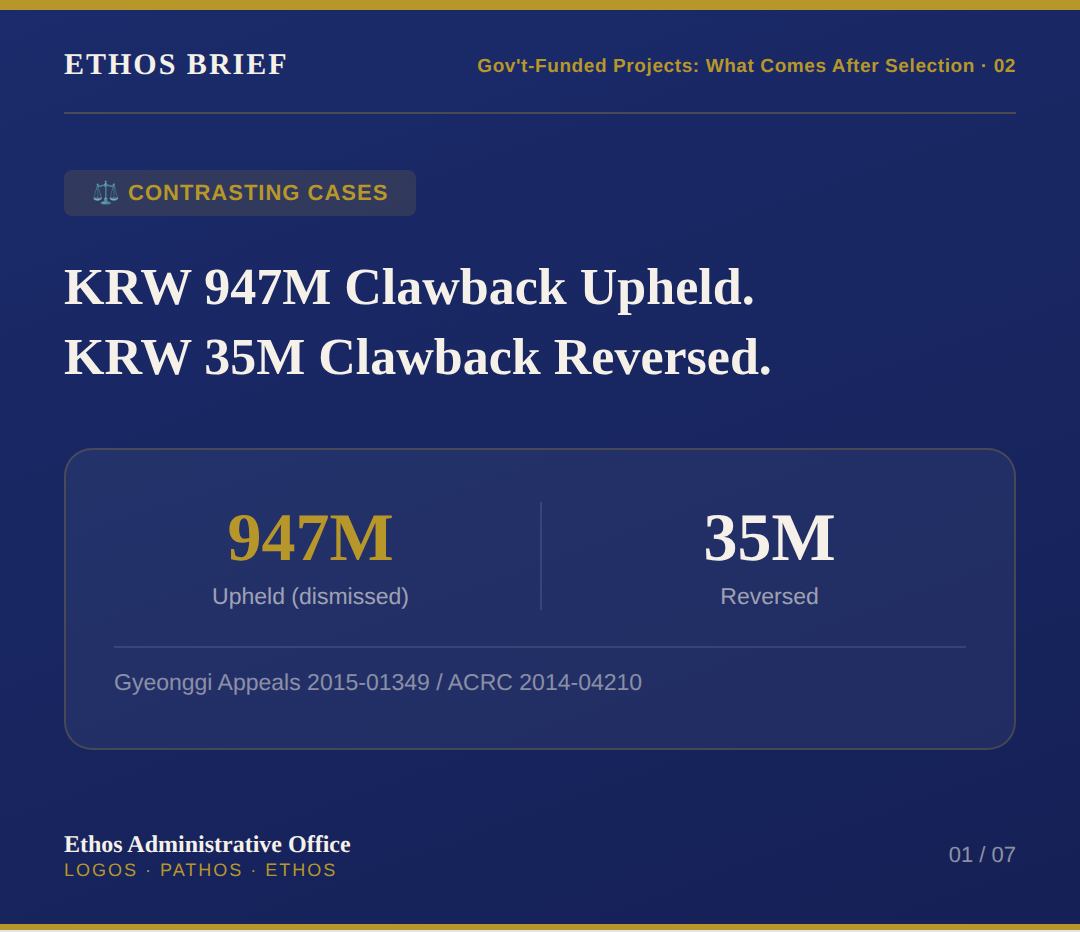
In one Korean administrative appeal, a full KRW 35 million subsidy repayment order was cancelled.
On the other hand, the Korean Supreme Court reviewed a case involving six government technology-development projects where bribery and misuse of government contributions were involved, and the combined participation restrictions amounted to 24 years. The Supreme Court reversed the lower court judgment that had found the sanctions to be an abuse of discretion.
In other words, a case involving “government grant repayment” does not automatically lead to one predetermined result.
The outcome depends on which program was involved, which rules applied, what actually happened, and whether the scope of the repayment or sanctions matches the facts of the case.
Government Support Programs: What Matters After Selection
- What should be reviewed before signing the agreement?
- What should you do after receiving a breach or repayment notice? — This article
1. What Stage Is the Document You Received?
If the document says KRW 50 million, it is natural for your attention to go straight to the amount.
But first, check the first and last pages of the document.
Determine whether it is:
- a prior notice of disposition;
- a request for submission of an opinion;
- a prior notice of sanctions;
- cancellation of a subsidy decision;
- a repayment order; or
- a final sanction decision.
The stage matters because the next step may be different.
This is particularly clear in Korean national R&D projects.
Article 33 of the current National Research and Development Innovation Act provides that, before imposing certain sanctions, the competent authority must first review the matter through a sanctions review panel and notify the target in advance of the intended sanction.
A person who disagrees with the prior notice may, in certain cases, submit an opinion requesting reconsideration within 20 days from the date of receiving the notice.
After receiving such an opinion, the competent central administrative authority generally determines the type and level of sanction within 30 days, taking into account the review process required by law.
Therefore, receiving a prior notice may mean that the key question is:
“What facts and documents should we submit before the authority makes its final decision?”
If a final repayment or sanction decision has already been issued, the situation is different.
You may need to separately review:
- the date of disposition;
- the payment deadline;
- the legal basis;
- the calculation of the repayment amount; and
- any available objection or appeal procedures and applicable deadlines.
Accordingly, the first question should not always be:
“How much do we have to repay?”
It should be:
“What stage of the administrative process are we currently in?”
2. Which Laws and Program Rules Apply?
Not all money received from the Korean government is recovered under the same legal framework.
The 2026 integrated startup-support announcement alone included 508 programs operated by 111 institutions.
The significance of this number is not simply that there are many programs.
Different programs may be governed by different statutes, operating guidelines, and agreement structures.
You should therefore first identify whether the program is:
- a national R&D project;
- a subsidy program governed by the Subsidy Management Act;
- a local-government support program;
- a program established under a specific statute; or
- a program governed by separate operating or management guidelines.
If you skip this step and simply search online for terms such as:
“government grant repayment response”
or
“subsidy repayment objection”
you may end up applying a procedure from a completely different type of program.
The word “repayment” may appear in both cases, but the legal basis and sanction structure can differ.
National R&D Projects May Involve More Than Repayment
If the matter concerns a national R&D project, it is important to read the entire notice.
Under Article 32 of the current National Research and Development Innovation Act, certain violations may lead to:
- restrictions on participation in national R&D activities for up to 10 years; or
- a penalty surcharge of up to five times the government R&D funds already paid.
Participation restrictions and penalty surcharges may be imposed together, and recovery of R&D funds related to the violation may also arise separately.
Suppose a company receives a notice stating:
“Planned repayment: KRW 50 million.”
The CEO may immediately ask:
“Can we reduce the KRW 50 million?”
But depending on the case, another question may be more important:
“Will our company or principal researcher still be able to participate in future national R&D projects?”
Certain serious sanctions may also involve public disclosure.
Under the current law, sanctions such as participation restrictions of five years or more or certain penalty surcharges reaching three times or more of the government-supported R&D funds already paid may, subject to statutory exceptions, be disclosed through the integrated information system.
This means that a national R&D case may involve three separate issues:
- How much money must be repaid?
- Can the company or researcher participate in future national R&D projects?
- Will the sanction information be publicly disclosed?
For that reason, the repayment amount alone does not necessarily show the full size of the problem.
3. What Exactly Does the Authority Say You Violated?
This is where the actual analysis begins.
After receiving a notice, many people immediately explain:
“There was no intent.”
“None of the money was used personally.”
“Everything was spent for the business.”
“We asked the program officer by phone.”
These explanations may be relevant depending on the case.
But if you start explaining before identifying exactly what the authority says was violated, the response may miss the actual issue.
Assume the notice says:
“The company outsourced part of the development work and spent KRW 40 million in project funds contrary to the approved project plan.”
That single sentence raises several questions.
- Did the final business plan actually require the work to be performed entirely in-house?
- Was outsourcing prohibited?
- Or was outsourcing permitted if a formal amendment procedure was completed?
- Was approval, consultation, or notification required?
- Did the company submit any amendment request or inquiry?
- Is the entire KRW 40 million actually connected to the alleged violation?
- Was the project output nevertheless completed?
Once the issue is broken down this way,
“KRW 40 million repayment”
becomes a more concrete question involving:
one sentence in the business plan, one amendment procedure, several emails, and several expenditure records.
This is where the logic of the response begins to take shape.
4. Even If a Violation Exists, Is the Scope of Repayment or Sanctions Appropriate?
A Korean administrative appeal decision illustrates this distinction.
The case was Anti-Corruption and Civil Rights Commission Decision 2014-04210, September 16, 2014.
In a government-supported SME contract-department program, a full KRW 35 million subsidy repayment order was imposed because certain students were found not to satisfy the required employment-period conditions.
However, the Central Administrative Appeals Commission cancelled the repayment order.
The decision considered factors including:
- the difficulty of determining eligibility under the rules in effect at the time;
- circumstances involving the managing authority's eligibility review;
- the fact that some students had already graduated or completed a substantial part of the program; and
- the purpose of the support program.
The Commission concluded that full repayment could not be justified solely by the identified problem when the disadvantages imposed on the recipient were compared with the public interest to be achieved.
This decision shows that, depending on the case, it may be necessary to examine:
- how clear the applicable rules were;
- the involvement of the administering authority;
- how much of the project was actually performed;
- how far the funding purpose was achieved; and
- whether full repayment is proportionate to the violation.
“Was there a violation?” and “How much may be recovered because of that violation?” may be separate questions.
A Large Sanction Is Not Automatically Excessive
The opposite type of case also exists.
In Supreme Court Decision 2022Du31822, July 28, 2022, the company participated in six SME technology-development projects between 2011 and 2015.
The company representative was convicted of criminal conduct involving bribery related to project selection and misuse of government contributions.
Participation restrictions and recovery measures were imposed for each project, and the combined participation restrictions reached 24 years.
The lower court found the sanctions to be an abuse of administrative discretion.
The Supreme Court reversed and remanded the case.
The Court held that administrative authorities have discretion in determining whether to impose participation restrictions and recovery measures, as well as their duration and amount.
It also held that detailed sanction standards contained in the relevant operating guidelines should generally be respected unless they conflict with superior law or have lost objective reasonableness.
Taken together, these two cases show that simply arguing:
“The repayment amount is too high.”
may not be enough.
The response should instead identify:
- whether the authority misunderstood any facts;
- which rules actually apply;
- how those rules determine the recoverable amount;
- the seriousness of the actual violation; and
- whether the sanction level is proportionate to those facts.
5. How Can You Prove What Actually Happened?
Build a Timeline Before Writing the Response
The purpose of a response or opinion letter is not simply to ask for leniency.
It should answer the issues the authority is required to decide.
Before drafting the letter, it is often useful to build a timeline.
For example:
Selection → Agreement → Project implementation → Need for change → Communication with authority → Change → Expenditure → Inspection → Request for explanation → Prior notice
Then connect documents to each stage.
If you receive a repayment or sanction notice, gather:
- the notice and all attachments;
- the original program announcement;
- the selection notice;
- the final submitted business plan;
- the funding agreement and subsidy conditions;
- the operating guidelines and expenditure rules in effect at the time of the issue;
- amendment requests;
- online-system amendment records;
- emails and official correspondence with the administering authority;
- contracts;
- tax invoices;
- bank records; and
- project outputs and inspection records.
One particularly important point is to check the rules that were in effect when the relevant event occurred, rather than relying only on the current version of the guidelines.
For national R&D matters, the current law requires the authority to consider factors such as:
- the seriousness of the sanctionable conduct;
- whether the conduct was intentional;
- the number of violations;
- the stage of the R&D project; and
- the degree of project progress.
Therefore, instead of simply stating:
“There was no intent.”
it may be more useful to show, with contemporaneous records:
- why the change occurred;
- which rules were reviewed at the time;
- what inquiries were made to the administering authority;
- where the project funds were actually spent;
- how much of the project objective was achieved; and
- what corrective action was taken after the issue was identified.
A useful structure is:
Authority's allegation → Actual facts → Applicable rule → Supporting document → What the document proves
This turns the response from a general explanation into a fact-based submission relevant to the authority's decision.
For example:
“We informed the program officer.”
may become:
April 3: Need for amendment identified → April 5: Email inquiry sent → April 7: Authority response received → April 15: Expenditure made
Once arranged this way, the case is supported by verifiable events rather than memory alone.
In government grant repayment matters, reconstructing the events from contemporaneous records is often more important than providing a long narrative from memory.
Which Stage Are You Currently In?
① Request for Documents or Explanation
If the authority has only requested additional materials or an explanation, first determine what facts it is trying to verify and what deadline applies.
You may be able to organize much of this internally if the facts and requested documents are clear.
② Prior Notice or Planned Sanction
If you have received a prior notice or planned sanction notice, review:
- the alleged violation;
- the legal basis;
- the proposed sanction; and
- the deadline for submitting an opinion or requesting reconsideration.
For national R&D matters, the 20-day reconsideration period discussed above may be particularly important.
③ Final Repayment or Sanction Decision
If a final repayment order, cancellation decision, or participation restriction has already been issued, separately review:
- the date of disposition;
- how the repayment amount was calculated;
- the payment deadline; and
- the available administrative or judicial review procedures.
The next step may differ significantly depending on which of these stages applies.
What Can You Handle Internally, and When Is Individual Review More Appropriate?
If you are still at a simple document-submission stage and the facts and applicable rules are clear, there may be a substantial amount that can be handled internally.
Start by summarizing the following on one page:
Current Stage / Alleged Violation / Applicable Rules / Deadline / Available Evidence
If the program announcement, agreement, business plan, and guidelines clearly show what the authority is asking for and which documents must be submitted, the company may be able to manage much of the response itself.
However, individual review becomes more important where:
- the facts stated by the authority differ from what actually happened;
- approval, consultation, or notification of a project amendment is disputed;
- emails, system records, or other communications with the authority must be interpreted together;
- it is unclear which portion of the government funding is subject to recovery;
- participation restrictions or penalty surcharges are proposed in addition to repayment;
- multiple projects or multiple years are connected;
- an opinion-submission or reconsideration deadline is already running.
A larger repayment amount does not necessarily mean the case is more complicated, and a smaller amount does not necessarily mean the case is simple.
Where multiple rules, amendment procedures, and communications with the administering authority are intertwined, the structure of the facts and applicable rules may matter more than the repayment amount itself.
If a final administrative disposition has already been issued and an administrative appeal or litigation must be considered, the applicable procedure and the legally authorized scope of professional representation should be reviewed separately.
How Can a Korean Certified Administrative Agent Assist?
Government grant repayment matters often require more than reading the funding agreement itself.
The program announcement, final business plan, agreement, operating guidelines, amendment records, expenditure documents, and official notices may need to be compared together to reconstruct the relevant facts.
At the prior-notice or explanation stage, the key is often not simply writing better prose.
It is determining whether the authority's allegation, the rules in effect at the time, and the company's supporting documents actually match one another.
Where the relevant facts are spread across multiple documents or a response deadline is already running, a document-by-document review may become more important.
Subject to matters restricted under other laws, Korean Certified Administrative Agents may provide services involving the preparation and submission of documents to administrative agencies, explanations of administrative laws and procedures, and organization of relevant facts and explanatory materials.
Receiving a Korean government grant repayment notice does not automatically mean the final result has already been determined.
At the same time, it is risky to assume:
“There was no intent, so it should be fine.”
In one administrative appeal, a full KRW 35 million repayment order was cancelled.
In another case, the Supreme Court did not uphold the lower court's conclusion that participation restrictions totaling 24 years and recovery measures involving six technology-development projects were necessarily an abuse of discretion.
The two cases point in different directions, but they illustrate the same principle.
The outcome of a government grant repayment case cannot be determined from the fact that government funds were received or that some rule was violated.
You need to identify:
- which program was involved;
- which rules applied;
- what facts the authority considers problematic;
- what actually happened;
- what level of repayment or sanctions may apply; and
- what can be proven with contemporaneous documents.
So when you receive the notice, the first step is not to write a long explanation.
Check the document title, deadline, and alleged violation, and then arrange the project records in chronological order.
That is where the response begins.
This concludes the series “Korean Government Support Programs: What Matters After Selection.”
※ This article is based on Korean statutes, court decisions, administrative appeal decisions, and government materials publicly available as of September 2026. The applicable laws, program guidelines, procedures, and available remedies may differ depending on the specific program and facts.
If you have received a Korean government grant repayment, agreement-breach, or sanction notice and are unsure whether it is a prior notice, what documents should be reviewed first, or whether your situation is suitable for individual review, you may request a free initial review to confirm whether further review is available in your case.