
Can You Use AI to Write a Business Plan in Korea? — What Foreign Entrepreneurs Should Know in 2026
Last May, while giving a lecture at a startup support program for foreign entrepreneurs in Korea, I was asked a question that is becoming increasingly difficult to answer with a simple yes or no.
“Can I use AI to write my business plan?”
The answer is more complicated than it may seem.
The Korean government is currently moving in two directions at the same time.
On one hand, it is developing systems that use AI to help businesses prepare draft business plans.
On the other hand, it is strengthening systems designed to detect business plans improperly written or submitted by third-party brokers using AI.
So what is actually allowed?
And more importantly for foreign entrepreneurs, there is another question that often matters even more:
Even if your business plan is approved, are you legally able to operate that business in Korea?
These are not the same issue.
Why is the Korean government supporting AI-written drafts while also detecting AI-assisted proxy applications?
The key distinction is this:
Using AI is not necessarily the same as having a third party improperly prepare or submit your application.
In November 2025, Korea's Ministry of SMEs and Startups (MSS) announced measures to improve the country's SME support system.
One of the initiatives was an AI-assisted business plan preparation system.
Under the proposed system, a company could enter information such as its business registration number, the support program it wishes to apply for, and key business-plan keywords.
AI would then use company information, application templates, and related support-program data to generate a customized draft.
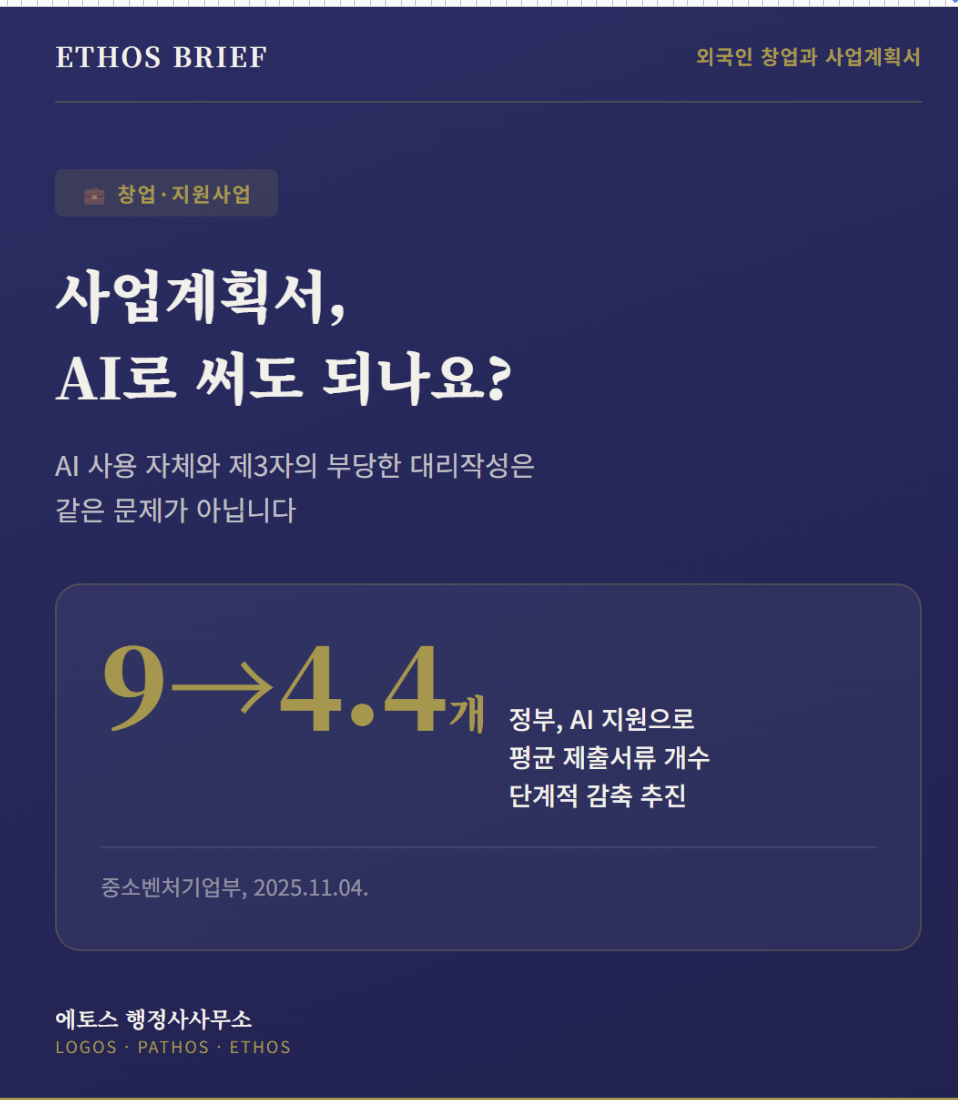
The government also announced plans to reduce the average number of documents that businesses must submit themselves from 9 to approximately 4.4.
At the same time, however, the government announced measures targeting improper third-party intervention by brokers and other intermediaries.
The issue, therefore, is not simply whether AI was used.
The more important questions are:
Who actually developed the business concept? Who is responsible for the information submitted? And how far did a third party become involved in preparing or submitting the application?
Does using AI automatically make a business plan problematic?
Based on the Korean government's publicly announced policies, the mere use of AI does not appear to make an application improper by itself.
The government is, after all, developing its own AI-based system to assist businesses with preparing business-plan drafts.
At the third meeting of the MSS task force on improper third-party intervention in February 2026, the ministry again stated that it planned to introduce AI-based assistance for the preparation of basic business-plan content during the second half of 2026.
This means the more relevant question is not simply:
“Did you use AI?”
It is closer to:
“Who created and verified the substance of the business, and who takes responsibility for the submitted information?”
There is one important caveat.
Individual government support programs may contain their own rules in their public notices, application forms, declarations, or agreements regarding third-party preparation or assistance.
Those program-specific rules should always be checked first.
How does the government plan to detect improper proxy applications?
The full detection criteria and AI models have not been publicly disclosed.
However, the government has revealed more about the direction of the system.
At the fifth meeting of the MSS task force in April 2026, the ministry announced that systems for identifying third-party proxy applications and document preparation would consider indicators such as:
- repeated applications submitted from the same IP address;
- similarities or duplication among business plans; and
- AI-based enhancement of existing detection systems.
The government has also indicated that these measures would be expanded across policy financing, R&D programs, and subsidy programs.
In other words, the system is not expected to look only at whether a document “sounds like AI.”
Application patterns and similarities between documents may also be examined.
There is another practical point.
Even a highly polished AI-generated business plan does not necessarily mean that the founder can explain the business during an evaluation.
MSS has already used education programs, mentoring, and in-depth interviews in certain startup support programs to assess the capabilities of founders.
If the applicant cannot explain the business model, target market, revenue structure, or implementation plan reflected in the submitted document, that can create a separate problem.
Foreign entrepreneurs need to check something before the business plan: their immigration status
For foreign entrepreneurs in Korea, there is an additional layer.
Your status of stay matters.
Being able to register a business and being permitted to engage in a particular business activity under Korean immigration law are not necessarily the same thing.
For example:
- E-7 (Specially Designated Activities) is tied to the scope of activities permitted under the relevant status.
- D-8 (Corporate Investment) requires separate consideration of investment and business-activity requirements.
- F-2 (Resident) may involve different employment or activity restrictions depending on the specific subcategory.
- F-5 (Permanent Resident) is, in principle, not subject to restrictions on activities based on the categories of status of stay.
This is why statements such as:
“Foreigners can operate this type of business.”
or
“I have an F visa, so I can run any business.”
can be too broad.
The exact subcategory of the person's status of stay and the actual activity to be conducted should be reviewed together.
AI may be able to describe a business idea convincingly.
It does not automatically determine whether that activity is permitted under the applicant's immigration status.
Receiving startup funding does not necessarily mean you can legally begin operating the business
This is one of the most important distinctions.
Being selected for a startup support program and being legally permitted to operate the business are separate administrative matters.
Depending on the industry, a business may require more than business registration.
It may also require a separate:
- permit;
- authorization;
- registration;
- report or notification;
- facility requirement; or
- approval from the relevant authority.
The permitted use of the building may also matter.
For foreign founders, immigration status must be considered as an additional layer.
Consider a foreign entrepreneur who submits a business plan involving the manufacture and sale of food products.
The business plan itself may receive a positive evaluation.
But what happens if the premises that the founder later leases do not satisfy the facility requirements for the relevant food business?
The startup funding decision does not automatically resolve that problem.
The actual business notification or licensing process may still be delayed or rejected.
This is why two questions should ideally be considered together from the beginning:
“Can this business qualify for the support program?”
and
“Can this business actually obtain the approvals necessary to operate?”
Why can inconsistencies between a business plan and licensing documents become a problem?
Another issue arises when the business described in the funding application differs from the business that is later presented to the licensing authority.
Suppose the original business plan describes Business A.
During preparation, the founder discovers that Business A cannot easily obtain the required permit at the selected premises, so the actual business model is changed to Business B.
At that point, the issue may no longer be limited to wording.
The approved business plan, the funding agreement, the intended use of the subsidy, and the business actually being operated may all be connected.
Whether a particular modification is merely a minor change or a substantive alteration must be considered case by case.
For that reason, at least four elements should be reviewed as one continuous process:
- Eligibility requirements for the government support program
- The foreign founder's immigration status and permitted activities
- Required permits, registrations, or notifications
- Consistency between the business plan and the documents later submitted to administrative authorities
AI can be extremely useful for preparing each individual document.
What it does not necessarily do is determine whether all of those documents fit together legally and administratively.
What can a Korean Administrative Attorney help with?
The boundary should be clear here as well.
Under Korea's Certified Administrative Agent Act (행정사법) and its Enforcement Decree, Korean Administrative Attorneys may, subject to restrictions imposed by other laws, perform work including:
- preparing documents to be submitted to administrative authorities;
- preparing certain documents concerning rights and obligations, including contracts and agreements; and
- representing clients in applications and notifications involving permits, licenses, authorizations, and approvals.
That does not mean that a professional should simply take over a founder's government-support application and write the underlying business plan on the founder's behalf.
This distinction has become even more important as the Korean government strengthens controls against improper third-party preparation and intervention.
The founder should remain responsible for the substance of the business plan and the information submitted.
The more appropriate administrative role is often to examine what comes next:
- whether the proposed activity is compatible with the founder's current status of stay;
- what permits, registrations, and notifications are required before the business begins;
- what documents must be submitted to administrative authorities;
- whether the business plan and actual licensing strategy are consistent; and
- in what order the administrative procedures should be completed.
In other words, the more important question may not be:
“Who can write my business plan for me?”
It may be:
“Can the business described in this plan actually be implemented under Korean immigration and administrative rules?”
In the AI era, consistency between documents may matter more than simply writing them well
AI will continue to make document preparation easier.
The Korean government itself is moving in that direction.
That means the value of professional assistance is also changing.
The important work is increasingly not just writing polished sentences.
It is determining whether:
- the proposed business is compatible with the founder's immigration status;
- the necessary permits can actually be obtained;
- the proposed premises satisfy the relevant requirements;
- the support-program application matches the actual business; and
- the documents submitted to different government authorities do not contradict one another.
For foreign entrepreneurs in Korea, the process can involve several connected layers:
Immigration status → Business structure → Business premises → Licensing and registration → Actual operation
Each step may appear acceptable when viewed separately.
The result can change when those steps are examined together.
Before finalizing an AI-assisted business plan, check these questions
If you are currently preparing a business plan for a Korean startup support program, it is worth checking the following before finalizing the document:
- Does your current status of stay permit the business activity you intend to conduct?
- Do you need to change your status of stay or obtain any additional permission?
- Does the business require a permit, registration, notification, or other administrative procedure in addition to business registration?
- Can the proposed business premises satisfy the requirements for that approval?
- Is the business described in the support-program application consistent with the business you will actually operate?
- Does the specific support program contain rules regarding third-party preparation or assistance?
Once these points are clear, AI can be a very effective drafting tool.
The problem arises when a ten-page business plan is generated first and the founder only later discovers that the underlying business cannot be implemented in the way the document describes.
At that point, instead of adapting the business plan to reality, the founder may find themselves trying to force reality to match the document.
A business plan is only one part of starting a business in Korea
Ethos Administrative Attorney Office does not provide services on the assumption that a government-support business plan should be improperly prepared on behalf of the applicant.
Instead, we review the administrative structure required to actually launch the business, including:
- immigration status;
- startup procedure planning;
- permits, registrations, and notifications;
- preparation of documents submitted to administrative authorities; and
- consistency between the proposed business and the administrative procedures required to operate it.
For foreign founders in particular, immigration status, the proposed business activity, the planned premises, and licensing requirements should not be reviewed independently.
They are part of the same process.
Before focusing on how well the business plan is written, it is worth asking a more fundamental question:
“Can this business actually be implemented in Korea as planned?”
Initial review: free · Consultation: paid · Consultation fee deducted upon engagement
References
- Ministry of SMEs and Startups, Measures to Improve the SME Support System, November 4, 2025.
- Ministry of SMEs and Startups, Measures to Ensure Capable Founders Can Receive Support Fairly, November 11, 2025.
- Ministry of SMEs and Startups, Third Meeting of the Task Force on Improper Third-Party Intervention, February 6, 2026.
- Ministry of SMEs and Startups, Fifth Meeting of the Task Force on Improper Third-Party Intervention, April 2026.
- Certified Administrative Agent Act (행정사법), Article 2.
- Enforcement Decree of the Certified Administrative Agent Act (행정사법 시행령), Article 2.
- Immigration Act (출입국관리법) and Enforcement Decree of the Immigration Act (출입국관리법 시행령).