
Same-Sex Couples in Korea: What You Can Protect Through Documents Even When Marriage Registration Is Not Available
Hello, this is Administrative Agent Jean.
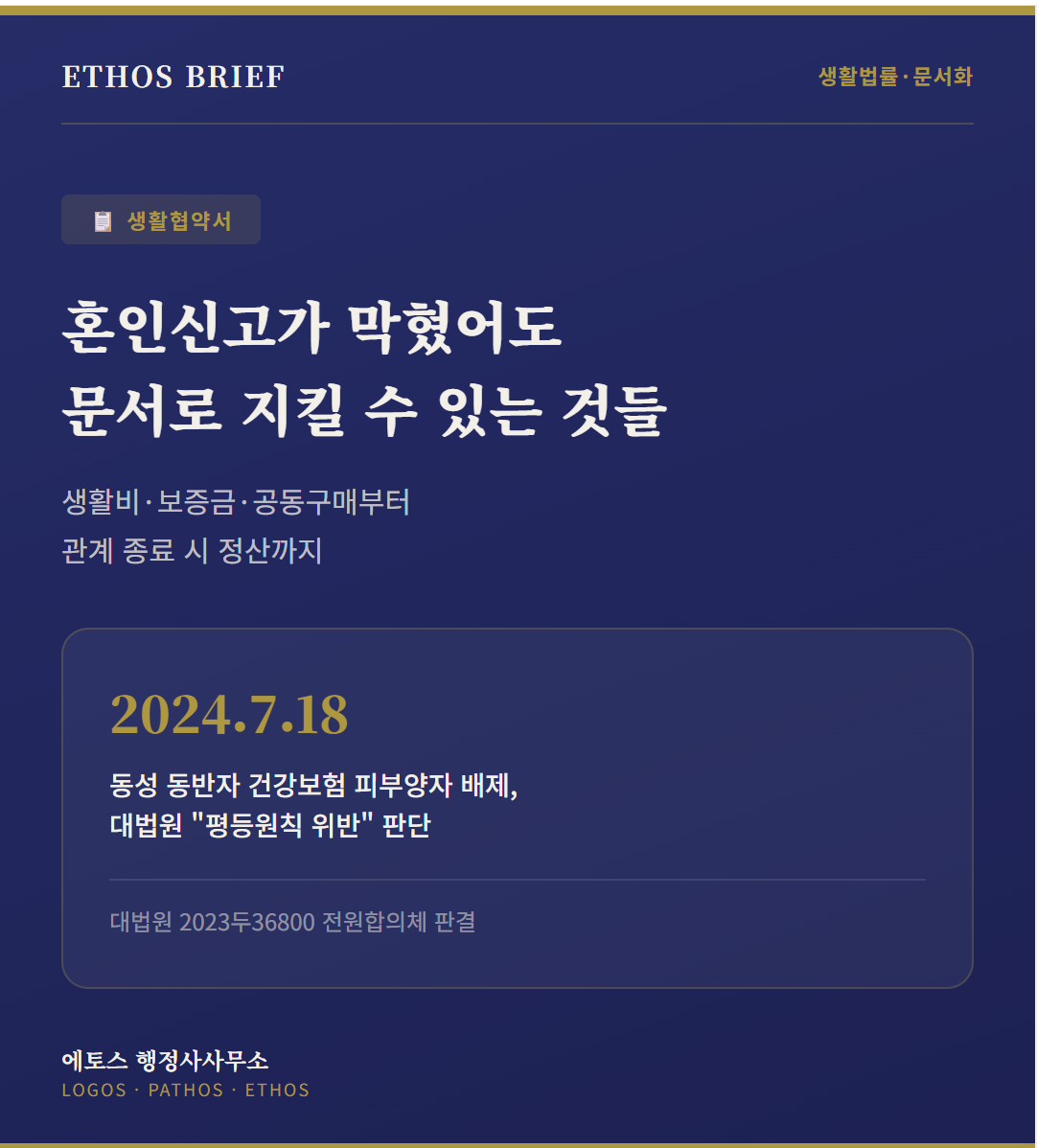
On July 18, 2024, the Supreme Court en banc held that excluding a same-sex partner from National Health Insurance dependent status was unlawful.
The issue was not simply whether same-sex couples are legally married.
The key question was whether there was a reasonable basis to treat a same-sex partner differently from a person in a de facto marital relationship.
The Supreme Court held that, in the context of National Health Insurance dependent status, excluding same-sex partners uniformly violated the principle of equality.
This decision is important.
But it must be read carefully.
The decision did not fully recognize same-sex marriage, nor did it allow same-sex marriage registration under the Civil Act.
So the practical question begins here.
If marriage registration is not available, what can a couple still organize and protect through documents?
This article explains what same-sex couples, unmarried cohabiting partners, and life partners who share a household can document under the current system.
Key Summary
| Category | Current Legal Position | Documents to Consider | |---|---|---| | Marriage registration | Same-sex marriage registration remains difficult under current practice | Cannot be replaced by a private agreement | | Health insurance dependent status | Supreme Court held uniform exclusion of same-sex partners unlawful | Evidence of cohabitation and financial dependency | | Living expenses | Civil Act rules for married spouses do not automatically apply | Expense-sharing agreement | | Rental deposit and lease | Contract holder and actual contributors may differ | Deposit contribution statement, co-residence agreement | | Joint purchases | Disputes may arise when the relationship ends | Property ownership and settlement agreement | | Inheritance | De facto spouses are generally not legal heirs | Will, insurance beneficiary designation, expert review | | External submissions | Each institution has its own criteria | Fact confirmation statement, purpose-specific explanation letter |
Why Is Same-Sex Marriage Registration Still Difficult in Korea?
As of August 2026, same-sex marriage registration remains difficult under Korea’s current family law framework.
In 2016, the Seoul Western District Court held that, under the ordinary interpretation of current law, a same-sex couple’s agreement could not be treated as a legally valid marriage agreement for marriage registration purposes.
The practical issue is this:
Even if two people live together, consider each other family, share housing costs, and maintain a real household, legal spouse status does not automatically arise unless marriage registration is accepted.
When marriage registration is valid, several legal effects follow under the Civil Act.
- Spouses owe each other duties of cohabitation, support, and cooperation.
- Spouses may have agency authority for daily household matters.
- Joint liability for daily household debts may arise.
- Living expenses for the shared household are jointly borne unless otherwise agreed.
- A legal spouse becomes an heir.
Without marriage registration, these effects do not automatically arise simply because two people live together.
That is why same-sex couples and unmarried cohabiting partners often have a real household life, but no automatic legal framework.
Documentation helps reduce that gap.
What the Supreme Court Health Insurance Decision Changed, and What It Did Not
The Supreme Court en banc decision of July 18, 2024 was a major ruling for same-sex partners.
The Court held that the National Health Insurance Service’s exclusion of a same-sex partner from dependent status violated the principle of equality.
The meaning is clear.
The substance of shared life and support cannot be completely ignored by institutions.
But the limits are also clear.
This was a National Health Insurance dependent-status case. It did not amend the marriage registration system or recognize same-sex marriage under the Civil Act.
Practically, this means:
- In some systems, such as health insurance, the substance of a same-sex partnership may be evaluated.
- Marriage registration, inheritance, family registration, and property relations are not automatically resolved.
- Each institution may apply different evidence requirements and recognition standards.
- Evidence of shared life should be organized in advance.
Time spent living together may not be enough by itself.
When the moment comes, documents and evidence matter.
Married Spouses vs. Same-Sex or Unmarried Cohabiting Partners
| Issue | Married Spouses | Same-Sex or Unmarried Cohabiting Partners | |---|---|---| | Living expenses | Civil Act rules on shared living expenses apply. | Expense ratios, settlement dates, and approval rules for major expenses should be agreed separately. | | Daily household matters | Daily household agency and joint liability may apply. | Agency authority is not presumed, so contracts, automatic payments, and payment records should be clear. | | Property ownership | Separate property and presumed co-ownership rules may be relevant. | If title holder and actual payer differ, a separate confirmation document may be needed. | | Inheritance | A legal spouse is an heir. | A de facto spouse is generally not an heir, so wills or beneficiary designations may be needed. | | Institutional recognition | Marriage certificate and family records can explain the relationship. | Cohabitation, shared expenses, and relationship continuity may need separate evidence. | | End of relationship | Divorce and property division systems exist. | Without settlement rules, deposit, property, and expense disputes may grow. |
Does This Mean There Is Nothing to Do?
No.
The fact that marriage registration is difficult does not mean nothing can be done.
Because a legal framework does not automatically arise, the parties should clarify more things themselves.
Documentation may be useful if:
- A same-sex couple lives together.
- An unmarried couple has been cohabiting long-term.
- Life partners share expenses without marriage or blood relationship.
- Rental deposit was paid jointly.
- One person is the leaseholder but the other contributed to deposit or living expenses.
- The couple jointly bought appliances, furniture, a vehicle, or pet-related services.
- Documents are needed for company benefits, insurance, hospital guardian status, mileage, housing, or institutional submissions.
The closer the relationship is emotionally, the harder it may feel to discuss documents.
But documents are not written because the relationship is distrusted.
They are written so that both people are less harmed if a dispute later arises.
How Can an Administrative Agent Help?
An administrative agent is not someone who can “make” same-sex marriage registration accepted.
That would be an overstatement.
However, under the current system, an administrative agent can help structure documents that organize shared life and factual relationships.
The Administrative Agent Act and its Enforcement Decree allow administrative agents, upon request, to prepare documents submitted to administrative agencies, documents concerning rights and obligations or fact certification, contracts, agreements, confirmations, and documents proving certain facts.
Within that scope, an administrative agent may assist with:
- Living expense-sharing agreement
- Co-residence fact confirmation statement
- Rental deposit contribution statement
- Joint purchase and property ownership statement
- Settlement agreement upon end of relationship
- Fact summary for external institutions
- Document organization for health insurance, company benefits, or housing matters
- Party statements
- Evidence list preparation
- Submission support where administrative submission is legally available
There are also limits.
- Acceptance of marriage registration cannot be guaranteed.
- Court litigation representation is handled by attorneys.
- If notarization is needed, a notary process should be reviewed separately.
- Wills, inheritance, trusts, insurance beneficiaries, and tax issues may require review by attorneys, judicial scriveners, tax professionals, or insurance specialists.
The role of an administrative agent is not to turn the relationship into a legal marriage.
The role is to document the current living arrangement and rights relationship as clearly as possible within the system that exists now.
What Should a Living Agreement Include?
A living agreement does not need to be grand or complicated.
It should clearly state how two people actually live together, how they share costs, and how they will settle matters if a problem arises.
The following items are especially important.
1. Living Expense Sharing
Start with recurring monthly expenses.
- Rent
- Maintenance fees
- Electricity, gas, and water
- Internet and phone bills
- Food
- Pet expenses
- Subscriptions
- Shared vehicle costs
- Household supplies
Expenses can be split equally or based on income ratio.
The important thing is to set a standard.
The most common dispute later is the difference in memory: “I paid more.”
Memory fades. Bank transfers remain.
2. Rental Deposit and Lease
The rental deposit is especially important.
Many couples live in a home where only one person is named on the lease, but both contributed to the deposit.
Without documents, later disputes may arise over:
- Who actually paid the deposit
- How much each person contributed
- Who receives the deposit when the lease ends
- When settlement happens if one person moves out
- What rights remain before the deposit is returned
Because deposits are often large, it is safer to document them in a living agreement or separate deposit contribution statement.
3. Major Purchases and Shared Property
People naturally buy large items when they live together.
- Refrigerator
- Washing machine
- Bed
- Sofa
- Television
- Computer
- Vehicle-related costs
- Pet medical expenses
- Interior costs
When the relationship is good, these items feel like “ours.”
When the relationship ends, the question becomes “whose?”
For items above a certain amount, it is helpful to specify:
- Who paid
- If both paid, the contribution ratio
- Who takes the item if the relationship ends
- How much is paid to the other person if one person keeps it
- Whether settlement is based on purchase price or used market value
These clauses may feel cold in ordinary times.
But when a dispute arises, they can become the kindest sentences in the document.
4. Settlement Rules When the Relationship Ends
This is the hardest part to write, but often the most important.
A living agreement should include rules for ending the shared household.
For example:
- Notice period if one person moves out first
- Timing for deposit settlement
- Cost allocation if one person leaves before lease termination
- Handling of remaining appliances and furniture
- Joint account balance settlement
- Unpaid utility bills
- Pet custody and expenses
- Cancellation of automatic payments under one person’s name
- Removal of jointly purchased items
When people break up, conversation often becomes difficult.
That is why the document should be written while conversation is still possible.
5. Shared Life Evidence Folder
For external submissions or dispute prevention, it is useful to organize evidence in one folder.
Examples include:
- Lease agreement
- Address or residence-related records
- Utility payment records
- Bank transfer records
- Rent and maintenance fee records
- Joint purchase receipts
- Delivery address records
- Family event participation records
- Travel, hospital, or insurance records
- Statements from people who know the relationship
- Joint account records
- Pet registration or medical records
For health insurance, company benefits, hospital guardian status, or housing-related explanations, these documents may help show the substance of the relationship.
However, whether they are accepted depends on the institution and purpose.
External-Use Documents Should Be Separate
Submitting the entire living agreement to an external institution may be uncomfortable.
It may contain too much private information.
In practice, it is often better to separate documents into two types.
1. Internal Living Agreement
This is the detailed agreement between the two people.
It may cover:
- Living expenses
- Rental deposit
- Joint purchases
- Settlement upon separation
- Pets
- Joint accounts
- Scope of responsibility
2. External-Use Fact Confirmation Statement
This document summarizes only the facts needed by the institution.
It may include:
- The fact that the two people live together
- Period of cohabitation
- Structure of shared living expenses or housing costs
- Purpose of submission
- List of attached evidence
For company benefits, insurance, health insurance, hospitals, mileage, or housing-related submissions, a concise fact confirmation statement may be more practical than submitting the full agreement.
Long documents are not always better.
The document should fit the purpose of submission.
Situations Where Documentation Is Especially Useful
| Situation | Why Documentation Helps | |---|---| | Leaseholder and deposit contributor differ | Prevents deposit return and settlement disputes | | One person pays most living expenses | Helps explain dependency and financial support | | Company benefits or insurance documents are needed | Organizes facts for institutional review | | Health insurance dependent materials are being prepared | Helps show shared life and support | | The relationship is difficult to explain to family | Clarifies property, deposit, and settlement issues | | A joint account is used | Clarifies purpose of deposits and withdrawals | | A pet is raised together | Clarifies caretaker, costs, and medical expenses | | The couple wants to prepare for separation | Sets rules for moving out, property, deposit, and unpaid costs |
Pre-Drafting Checklist
Before preparing documents, answer these questions.
- Since when have you lived together?
- Who is named on the lease?
- Who contributed how much to the rental deposit?
- How are rent and maintenance fees divided?
- Who is responsible for automatic utility payments?
- Is there a joint account?
- Who purchased major items?
- How will the deposit be divided if the relationship ends?
- What notice period applies if one person moves out first?
- If there is a pet, who will care for the pet and how will costs be divided?
- Is there an external institution requiring documents?
- Does the institution have a specific form?
- Is notarization or separate legal review needed?
Once these questions are answered, the necessary document type becomes clearer.
How Ethos Administrative Office Can Help
Ethos Administrative Office can assist same-sex couples and life partners with documentation in the following ways:
- Understanding the current shared household structure
- Organizing living expenses, deposits, and joint purchases
- Drafting an internal living agreement
- Preparing an external-use fact confirmation statement
- Creating an evidence list
- Structuring explanations by submission purpose
- Reviewing whether administrative submission support is available
- Referring to relevant professionals when notarization, inheritance, tax, or litigation issues arise
The goal is not to make the document look impressive.
The goal is to make the relationship and money flow understandable if a problem arises.
Frequently Asked Questions
Q. Does a living agreement have the same effect as marriage registration?
No. A living agreement does not replace marriage registration. It can help clarify living expenses, deposits, property, and settlement rules between the parties.
Q. Can a same-sex partner be recognized as a National Health Insurance dependent?
The Supreme Court held on July 18, 2024 that uniformly excluding a same-sex partner from dependent status was unlawful. However, actual recognition may depend on cohabitation, financial dependency, submitted evidence, and individual facts.
Q. Can a de facto spouse inherit?
In principle, a de facto spouse is not a legal heir. A long period of cohabitation does not automatically create legal spouse inheritance status. A will, beneficiary designation, or other planning may be needed.
Q. Does a living agreement need notarization?
Not always. However, if the amount is large or stronger evidentiary value is needed, notarization may be worth reviewing.
Q. Can an administrative agent resolve inheritance issues?
Inheritance disputes, validity of wills, and litigation are handled by attorneys and other qualified professionals. An administrative agent can assist with fact organization, confirmation statements, and submission documents within the permitted scope.
Q. Can roommates also use a living agreement?
Yes. Even when there is no romantic or family relationship, a document clarifying deposit, rent, utilities, property ownership, and move-out rules can help prevent disputes.
Closing
Same-sex couples already exist in daily life.
They live together, eat together, pay rent together, and often regard each other as protectors and family.
But the legal system does not automatically organize all of that life.
That is why the conversation should not stop at the difficulty of marriage registration.
The next step matters.
Who pays what? What evidence should be kept? How will settlement work if the relationship ends? What should be submitted to outside institutions?
This is where same-sex couples and administrative agents can meet.
An administrative agent does not solve marriage registration itself.
But an administrative agent can help organize shared life and rights relationships into documents that reduce uncertainty under the current system.
If you live together and do not know what document to prepare first, start with the living arrangement.
Money flow, housing structure, and the substance of the relationship should be documented.
That is the most realistic preparation available now.