
Administrative Appeal vs. BAI Review Petition in Korea: Which Route Should You Choose First?
When a person receives an adverse decision from a Korean administrative authority, one of the first remedies they usually encounter is an administrative appeal.
Administrative appeals are a representative means of challenging administrative measures such as business suspensions, administrative surcharges, permit cancellations, and other unfavorable decisions.
But before immediately filing an administrative appeal, there is another question worth asking.
An administrative appeal is not the only possible route for challenging an administrative decision in Korea.
Another important procedure is a review petition before the Board of Audit and Inspection of Korea (BAI) under Article 43 of the Board of Audit and Inspection Act.
Depending on the case, both an administrative appeal and a BAI review petition may need to be considered at the outset.
More importantly, the procedure you choose first may affect which options remain available later.
If I Lose an Administrative Appeal, Can I Then File a BAI Review Petition?
Suppose a business receives an order suspending operations.
After searching online, the owner learns that both an administrative appeal and a BAI review petition may be available.
A natural question follows:
“Why not file an administrative appeal first, and if that fails, try a BAI review petition?”
The problem is that these procedures do not operate like two consecutive attempts at the same dispute.
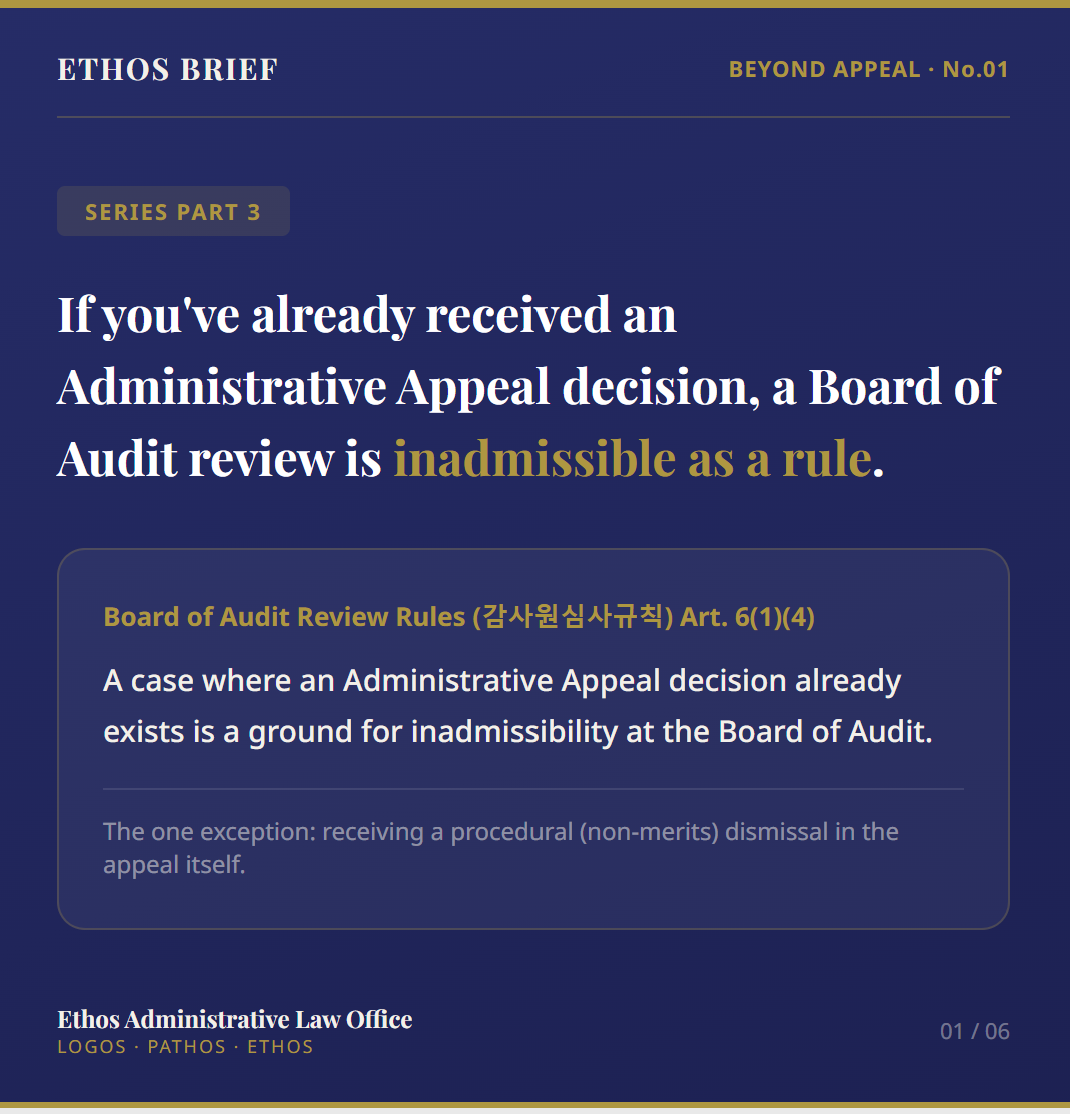
Under the current Rules on Review Petitions before the Board of Audit and Inspection, a matter for which an administrative appeal decision has already been issued is, in principle, subject to procedural dismissal by the BAI.
There is an exception where the earlier administrative appeal itself was dismissed without a decision on the merits.
A matter that has already become the subject of litigation may also raise a procedural bar to a BAI review petition.
So the real question is not simply:
“Which body is more likely to cancel the decision?”
A better question is:
“What remedy do I need now, and which procedure should I choose first without unnecessarily closing off a later option?”
There Is No Procedure That Is Always Better
Neither an administrative appeal nor a BAI review petition is automatically superior in every case.
An administrative appeal is a representative administrative remedy under the Administrative Appeals Act for challenging an unlawful or improper disposition or administrative inaction.
A BAI review petition, on the other hand, is a separate procedure under Article 43 of the Board of Audit and Inspection Act through which an interested party may request review of certain dispositions or acts related to the duties of persons and entities subject to BAI audit.
They may look similar at first.
In practice, however, the choice often depends on questions such as:
- What objection procedure is legally available for this particular decision?
- Does the decision need to be stopped immediately?
- Do I merely need cancellation, or do I need the authority to take affirmative action?
- Has an administrative appeal or lawsuit already been filed?
- Which procedure has precedents dealing with the same legal issue?
This is why the number of successful cases alone is not a reliable basis for choosing a procedure.
How Are an Administrative Appeal and a BAI Review Petition Different?
At a high level, the two procedures can be compared as follows.
| Issue | Administrative Appeal | BAI Review Petition | | --- | --- | --- | | Main legal basis | Administrative Appeals Act | Board of Audit and Inspection Act, Article 43 et seq. | | Decision-making body | Competent Administrative Appeals Commission | Board of Audit and Inspection | | Main subject | Administrative dispositions and inaction | Certain official dispositions and acts related to persons or entities subject to BAI audit | | Form of relief | Cancellation, modification, declaration of invalidity, mandatory performance | Corrective or other necessary measures requested of the relevant authority | | Urgent relief | Suspension of execution and provisional measures expressly provided | Requires separate examination depending on the case | | BAI review after substantive administrative appeal decision | Not applicable | Procedural dismissal may arise in principle | | Where litigation has been filed | Relationship with litigation requires separate review | Procedural dismissal may arise | | Main selection factors | Type of remedy and urgency | Eligibility, prior procedures, and legal issue |
The important point is not the name of the institution.
The first question should be:
“What legal result do I actually need in this case?”
Factor 1: Are Both Procedures Even Available?
Many people begin by asking:
“Which is better, an administrative appeal or a BAI review petition?”
But the first issue is usually the governing statute.
Not every administrative decision is challenged through the general Administrative Appeals Act.
Some statutes establish their own objection or review procedures.
Tax disputes are a familiar example.
The Framework Act on National Taxes establishes a separate objection structure for national tax dispositions rather than simply placing every tax dispute within the ordinary administrative appeal system.
This means that receiving a tax assessment does not automatically mean that the ordinary Administrative Appeals Commission is the correct forum.
Other statutes may likewise create special review or appeal procedures.
For that reason, when you receive a written disposition, one of the first items to check is the statute and article cited as the legal basis for the decision.
A notice may state, for example:
Legal basis: Article ○ of the ○○ Act
That single line may determine the first branch in the objection strategy.
Factor 2: What If the Business Suspension Starts Next Week?
Suppose a restaurant receives a 30-day suspension of business operations.
Winning the underlying case several months later may be important.
But the business owner may have a more urgent problem:
“The suspension begins next week. Can I stop enforcement before then?”
In that situation, the urgent-relief mechanisms available in an administrative appeal become particularly important.
Article 30 of the Administrative Appeals Act provides for suspension of execution where urgent action is needed to prevent serious harm caused by the enforcement of a disposition or the continuation of administrative procedures.
However, filing an administrative appeal does not automatically suspend the disposition.
The Administrative Appeals Act expressly provides that filing an appeal, by itself, does not affect the validity or enforcement of the disposition.
In an appropriate case, the applicant therefore needs to consider the merits of the administrative appeal and a separate application for suspension of execution.
The administrative appeal system also provides for provisional measures.
Where a disposition or inaction is strongly suspected to be unlawful or improper, and a temporary legal position is necessary to prevent imminent danger or serious disadvantage, provisional relief may be considered.
Where suspension of execution alone is sufficient, provisional measures are not used instead.
This distinction matters.
Ultimately overturning a disposition and preventing immediate harm while the case is pending are two different legal problems.
For cases involving business suspension, professional suspension, or another measure with an imminent enforcement date, it is useful to check:
- When does the disposition take effect?
- Will the person immediately be unable to operate a business or perform professional activities?
- Would enforcement cause harm that would be difficult to reverse even if the disposition were later cancelled?
- Is suspension of the disposition itself sufficient?
- Is a temporary legal status also required?
Factor 3: Is Cancellation Alone Enough?
Now consider a different situation.
An applicant applies for a permit, but the administrative authority refuses the application.
What does the applicant actually need?
It may not be enough to say:
“Please cancel the refusal.”
The applicant may ultimately need:
“Please issue the administrative disposition I applied for.”
The Administrative Appeals Act distinguishes between different forms of relief.
Representative types of administrative appeal include:
- Appeal for cancellation, seeking cancellation or modification of a disposition
- Appeal for declaration of invalidity, seeking confirmation of whether a disposition is valid or invalid
- Appeal for mandatory performance, seeking an order requiring an authority to issue a particular disposition following a refusal or administrative inaction
Where an appeal for mandatory performance is upheld, the Administrative Appeals Commission may issue the requested disposition itself or order the administrative authority to do so.
A BAI review petition follows a different structure.
Where the BAI finds the petition well-founded, it may require the relevant authority to take corrective or other necessary measures.
The relevant authority is then required to take measures in accordance with the decision.
The distinction is important because the procedural choice should reflect the result actually needed.
Before choosing a route, ask whether the objective is simply to eliminate an adverse disposition or whether an affirmative administrative action is required to resolve the problem.
Factor 4: A Substantive Administrative Appeal Decision May Make a Later BAI Petition Difficult
This is one of the most important procedural issues.
Consider the following sequence:
Administrative disposition
↓
Administrative appeal
↓
Decision rejecting the appeal on the merits
↓
BAI review petition
At first glance, this may seem like a natural progression.
However, Article 6(1)(4) of the current Rules on Review Petitions before the Board of Audit and Inspection provides that a matter for which an administrative appeal decision has already been issued may be subject to procedural dismissal.
This can also include decisions made through special administrative appeal procedures established under other statutes.
Accordingly, where an administrative appeal has already received a substantive decision on the merits, it may be difficult to use a BAI review petition as a simple “second round” concerning the same matter.
A Procedural Dismissal Is Different
The rules expressly distinguish cases where the earlier administrative appeal was itself dismissed on procedural grounds.
This makes the difference between a rejection on the merits and a procedural dismissal important.
Rejection on the merits
The reviewing body considered the substance of the claim but did not accept the claimant’s arguments.
Procedural dismissal
The reviewing body did not reach the merits because of a procedural issue, such as a filing-period problem or lack of an eligible subject matter.
Therefore, if an administrative appeal has already been completed, it is not enough to say:
“I lost the administrative appeal.”
The actual wording of the decision should be checked to determine whether it was a substantive rejection or a procedural dismissal.
That distinction may affect what options remain available.
“Why Not File Both at the Same Time?”
That is another understandable question.
But it is not necessarily a simple solution.
The BAI review-petition form itself requires the applicant to disclose whether an administrative appeal or lawsuit concerning the matter has already been filed and, if so, when it was filed.
More importantly, other proceedings may directly affect whether the BAI petition remains procedurally admissible.
A prior substantive administrative appeal decision may create a procedural dismissal issue.
A lawsuit concerning the same matter may likewise affect the admissibility of the BAI review petition.
For that reason, the better strategy is usually not:
“File every possible procedure at once.”
It is:
“Understand how the procedures interact before deciding their order.”
In administrative disputes, having more procedures does not automatically mean having more protection.
It can be important not to eliminate an option that may need to be preserved.
Factor 5: If Administrative Litigation Is Also Being Considered, Timing Matters Even More
A person pursuing a BAI review petition may also be considering administrative litigation.
But a matter in which litigation has already been filed may face a procedural dismissal issue in the BAI review process, including where the lawsuit is filed while the review petition is still under consideration.
At the same time, the Board of Audit and Inspection Act provides a structure under which administrative litigation may be filed after a BAI review decision within the applicable statutory period.
Accordingly, there is no universal sequence such as:
Administrative appeal → BAI review petition → administrative litigation
that applies to every administrative dispute.
The available route depends on the individual case.
This is one reason why the objection strategy should be considered when the administrative disposition is first received, rather than only after one procedure has already failed.
Factor 6: Look for the Same Legal Issue, Not Merely the Same Type of Disposition
Published BAI decisions include cases in which administrative dispositions were cancelled.
But that does not mean:
“The BAI has cancelled similar dispositions before, so a BAI review petition must be the better route.”
Even cases involving the same type of disposition can involve completely different legal questions.
For example, two acquisition-tax assessments may involve different issues.
One case may turn on eligibility for a tax reduction.
Another may involve the legal substance of a transaction.
A third may involve the calculation of the tax base or the interaction between multiple statutory provisions.
The same principle applies to administrative appeal precedents.
The important question is therefore not merely the name of the disposition.
It is:
“What legal question must be answered in order to overturn the disposition in my case?”
For example, this statement is too broad:
“The business suspension is unfair.”
A more useful legal issue might be:
“Did the authority exceed or abuse its discretionary power by determining the period of suspension without properly considering a statutory ground for mitigation?”
Once the issue is framed at that level, it becomes much easier to identify relevant administrative appeal decisions or BAI review decisions.
This is why the reasoning section of a precedent is often more useful than the simple fact that the petitioner won.
Which Procedure Should Be Considered First?
The earlier points can be applied to several common situations.
A. The Disposition Will Be Enforced Soon
Examples: business suspension, professional suspension
→ Suspension of execution or provisional measures under the administrative appeal system may require priority consideration.
B. A Permit or Registration Was Refused, and Cancellation Alone May Not Resolve the Problem
→ Determine whether simple cancellation is sufficient or whether mandatory performance is actually required.
The form of relief available through an administrative appeal may become particularly important.
C. A Special Statutory Objection Procedure Applies
Example: certain tax disputes
→ Do not immediately compare the ordinary administrative appeal system with the BAI review system.
First identify the objection structure established by the governing statute.
D. BAI Decisions Address the Same Legal Issue and There Is No Urgent Enforcement Problem
→ A BAI review petition may also be worth considering at an early stage.
However, eligibility for BAI review and the existence of earlier proceedings still need to be checked.
E. An Administrative Appeal Has Already Been Rejected on the Merits
→ A BAI review petition should not automatically be treated as the next stage.
The current BAI review rules may create a procedural dismissal issue.
F. Administrative Litigation Has Already Been Filed
→ This may directly affect whether a BAI review petition remains procedurally available.
Administrative Appeal vs. BAI Review Petition: A 30-Second Self-Check
Place the written disposition in front of you and ask the following questions.
1. When Will the Disposition Actually Be Enforced?
If immediate enforcement could cause difficult-to-reverse harm, urgent relief may need to be considered first.
2. What Result Do I Actually Need?
Do you need cancellation?
A declaration of invalidity?
Or do you need the authority to issue an affirmative disposition?
3. Have I Already Filed an Administrative Appeal or Another Special Objection?
If so, determine whether the result was a substantive rejection or a procedural dismissal.
4. Has Administrative Litigation Already Been Filed?
This may directly affect the availability of a BAI review petition.
5. What Statute Is Cited in the Disposition?
Check whether that statute establishes its own objection procedure.
6. Can I Explain the Core Legal Issue in One Sentence?
If not, it may be too early to decide which procedure is better.
The case itself may first need to be structured into a clear legal issue.
In Administrative Disputes, the Wrong Sequence Can Be as Dangerous as the Wrong Argument
When people think about administrative objections, they often focus first on what to write in the petition.
That is important.
But another question comes before drafting:
Which procedure should be used, in what order, and what legal result should be requested?
Even a strong legal argument may never reach substantive review if it is filed through a procedure that is unavailable for the case.
On the other hand, if immediate suspension of enforcement is necessary but only the final cancellation argument is prepared, the suspension period may already have run before the underlying dispute is resolved.
A substantive administrative appeal decision may also affect whether a later BAI review petition remains available.
For some administrative disputes, procedural design needs to come before petition drafting.
What Can You Check Yourself?
There is a substantial amount that a person can organize before seeking professional review.
Start with:
- The written disposition
- Evidence showing when the disposition was received
- The statute and article cited as its legal basis
- The scheduled enforcement date
- Any prior objection or administrative appeal
- The operative part of any earlier appeal decision
- Whether administrative litigation is already pending
Then try to complete this sentence:
“What exactly do I want to change about this administrative decision?”
That alone can clarify a significant part of the case.
When Is Individual Review More Important?
A general comparison cannot fully answer questions such as:
- Which objection procedure is available under the governing statute
- Whether the matter is eligible for a BAI review petition
- Whether suspension of execution or provisional measures should be considered
- How a prior administrative appeal affects later options
- How the procedure should be coordinated with possible administrative litigation
- Which administrative appeal decisions or BAI review decisions are genuinely comparable to the case
At that stage, the name of the disposition alone is not enough.
The legal basis, factual circumstances, enforcement date, previous proceedings, and the remedy actually sought need to be reviewed together.
Ethos Administrative Office reviews these materials to identify which administrative objection routes may be available, whether an earlier proceeding affects the remaining options, and which legal issues should be compared against published administrative appeal or BAI review decisions.
After Choosing the Procedure, the Next Question Is What to Write
Writing:
“This decision is unfair.”
at length is very different from explaining:
- what facts the authority relied on,
- how it applied the governing law,
- where that reasoning may be legally or factually incorrect, and
- what evidence supports the challenge.
Administrative objections therefore connect several stages:
procedure selection → issue identification → factual and legal analysis → evidence organization → petition drafting
Whether an administrative appeal or a BAI review petition may be available in your situation can be checked through a free initial review based on the written disposition and any documents from previous objection proceedings.