
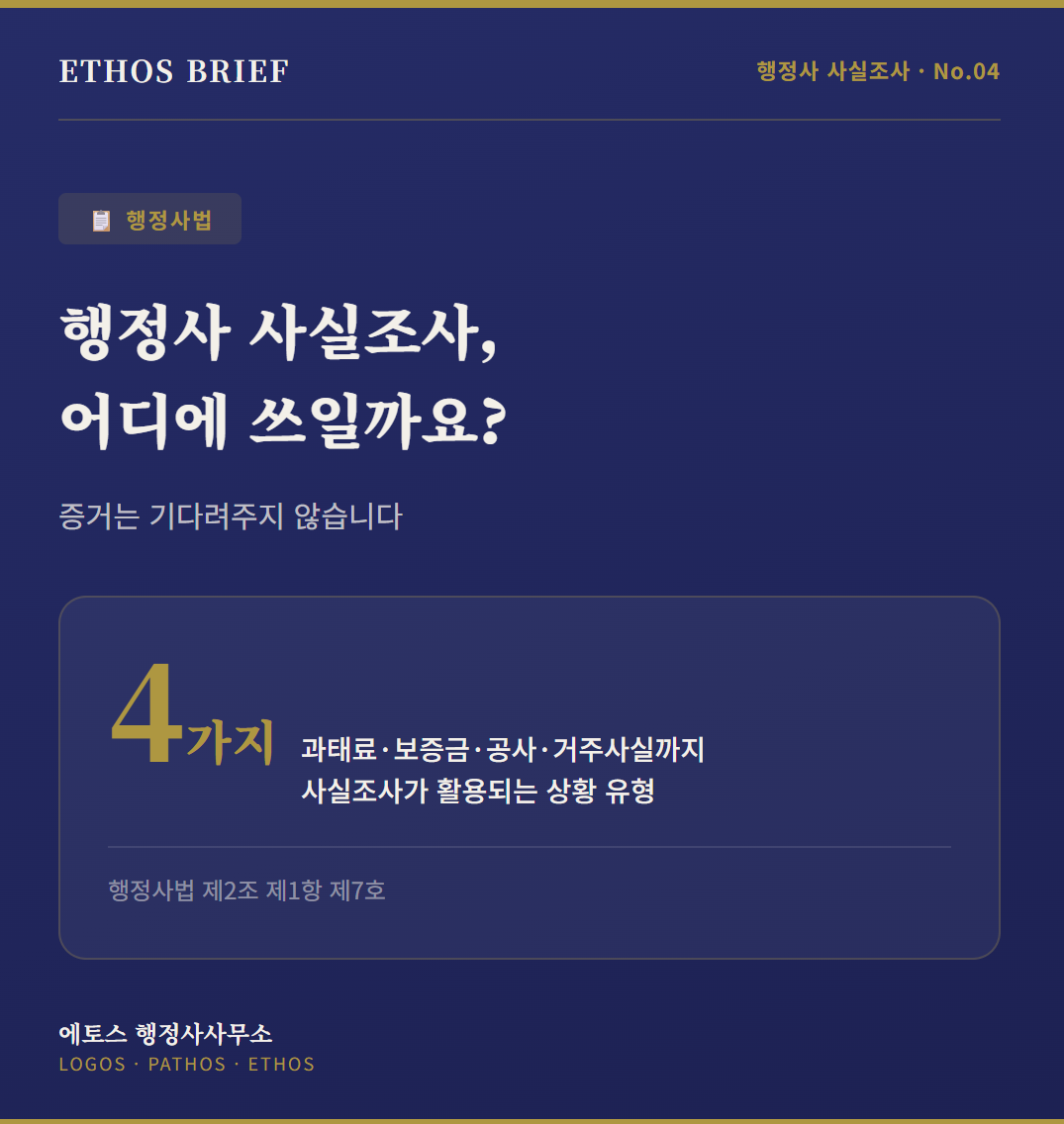
Where Is Administrative Agent Fact Investigation Used? Administrative Fines, Deposits, Construction, Delivery, and Residence Verification
Hello, this is Jean, Administrative Agent.
A store receives an unexpected inspection. A few days later, an administrative fine notice arrives.
But the inspection record is wrong.
It says the store was operating after 10 p.m., even though the store closed at 9:50 p.m.
The real question is this:
How do you prove it?
CCTV may be overwritten after a short period. POS data may not be stored forever. Employee statements may be treated as statements from interested parties.
What you need in this situation is not just an explanation.
You need a record of the facts as they existed at that time.
This is the fourth article in the “Administrative Agent and Fact Investigation” series.
Article 1: The True Scope of Fact Investigation Under the Administrative Agent Act
Article 2: Why Lawyers and Private Investigators Cannot Issue an Administrative Agent’s Fact Confirmation Certificate
Article 3: How Fact Confirmation Certificates Are Used in Practice
Article 4: Where Administrative Agent Fact Investigation Is Used
Article 5: Why Fact Investigation Matters More in the AI Era
Evidence Does Not Wait
You receive an administrative fine notice, but the inspection record is not accurate.
You move out of a commercial space, but the landlord refuses to return KRW 20 million in deposit, claiming that restoration was incomplete.
You start construction, and the neighboring building owner later claims that your construction caused cracks in their wall.
You complete delivery, but the other party claims the quantity was short.
Immigration asks you to explain actual residence or business operation status for a visa extension.
These situations all have one thing in common.
No one recorded the facts at the relevant time.
Administrative Agent fact investigation is used precisely in this gap.
Article 2(1)7 of the Administrative Agent Act allows administrative agents to conduct fact investigation and confirmation of matters entrusted under laws and regulations. The Enforcement Decree explains this as investigating or confirming facts and preparing a written result to submit to the person who entrusted the work.
In simple terms, if a Fact Confirmation Certificate is the final document, fact investigation is the process of checking the facts before that document is prepared.
Fact Confirmation Certificate vs. Fact Investigation
These two concepts are connected, but they are not the same.
| Category | Fact Confirmation Certificate | Fact Investigation | |---|---|---| | Legal basis | Administrative Agent Act Article 2(1)2 and Article 20 | Administrative Agent Act Article 2(1)7 | | Core function | Preparing a document proving facts | Investigating and confirming the facts themselves | | Output | Fact Confirmation Certificate, confirmation document, factual summary | Investigation report, site verification record | | Practical flow | Documenting confirmed facts | Checking the site, materials, and circumstances first | | Analogy | Medical certificate | Medical examination |
In practice, the process often works like this:
Fact investigation → document review → written investigation result → Fact Confirmation Certificate if needed
This is not about creating a document without checking anything.
It is about organizing the facts based on available materials, site conditions, and objectively confirmable information.
First, Which Situation Are You In?
| Type | Common Situations | Key Point | |---|---|---| | Administrative action response | Administrative fine, business suspension, permit cancellation, visa refusal | Deadline and evidence preservation | | Lease and construction disputes | Move-out restoration, deposit return, pre-construction condition | Recording the condition at a specific time | | Contract performance confirmation | Delivery, service performance, installation, handover | Comparing contract terms with actual performance | | Residence, business, and status verification | Actual residence, business operation, cohabitation | Supplementing facts not shown in official records |
As you read the examples below, check which one is closest to your situation.
Case 1. When the Facts in an Administrative Fine Notice Are Wrong
You run an unmanned store.
After a late-night inspection, you receive an administrative fine notice for operating after 10 p.m.
But the POS closing record shows 9:48 p.m. CCTV also shows customers leaving and the store being closed before the alleged violation time.
In this situation, simply saying “that is not true” is not enough.
You need to identify which part of the administrative authority’s stated facts is wrong and what evidence can explain the difference.
Administrative Agent fact investigation may proceed as follows:
- Review the violation time, location, and content stated in the fine notice.
- Compare CCTV timestamps and footage.
- Check POS closing records, card transaction records, access logs, and other objective materials.
- Organize the actual closing time based on confirmable evidence.
- Prepare a written investigation result and, if needed, a Fact Confirmation Certificate.
However, administrative fines and administrative appeals must be distinguished.
For administrative fines, under the Act on the Regulation of Violations of Public Order, a written objection may generally be filed with the relevant administrative agency within 60 days from receipt of the fine notice.
For business suspension, permit cancellation, visa refusal, and similar administrative dispositions, an administrative appeal may be available. In general, the filing period is 90 days from the date the person became aware of the disposition and 180 days from the date of the disposition itself.
So it is not correct to simply assume that every case follows a 90-day administrative appeal deadline.
First identify the type of action. Then determine the proper procedure and deadline.
Case 2. When a Landlord Refuses to Return the Deposit After Move-Out
A commercial lease ends.
The tenant completes restoration and moves out. Then the landlord says:
“Restoration was not completed, so I cannot return the KRW 20 million deposit.”
The tenant says the work was completed. The landlord says it was not.
The key issue is the condition of the property at the time of move-out.
If there is no objective record of the walls, floor, ceiling, equipment, signage, plumbing, and electrical facilities at the time of move-out, the dispute can become prolonged.
Even if photos were taken, they may not be enough if the time, location, and scope of the photos are unclear.
Administrative Agent fact investigation is especially useful at the time of move-out.
- Visit the site and check the condition of walls, floors, ceilings, and facilities by category.
- Organize photos and videos with location and time information.
- Compare the restoration scope in the lease agreement with the actual site condition.
- Prepare a handover checklist.
- Leave a written investigation record and prepare a Fact Confirmation Certificate if needed.
The key is not after move-out.
It is at the time of move-out.
Once the site changes, what an administrative agent can confirm becomes limited.
Case 3. When Pre-Construction Conditions Need to Be Recorded
You are about to begin remodeling or interior construction.
Before construction, everything appears normal. After construction begins, the neighboring building owner claims:
“Your construction caused cracks in our wall.”
But what if the cracks were already there before construction?
Without a pre-construction condition record, this becomes difficult to prove.
Administrative Agent fact investigation may be used as a preventive tool to reduce construction-related disputes.
- Check the interior and exterior condition before construction.
- Record cracks, water-leak traces, floor settlement, and facility conditions by category.
- To the extent possible, record the condition of neighboring areas that may later become disputed.
- Take photos and videos with location and timing information.
- Prepare a written pre-construction condition report.
There is an important boundary.
Statutory site investigation, inspection, and confirmation work related to building permits, building reports, and use approvals may fall under the role of architects under Korean building laws.
Administrative Agent fact investigation does not replace that legal role.
It should be understood as supplementary fact investigation for dispute prevention or factual organization, not as official building-permit inspection work.
Case 4. When Delivery or Service Performance Is Disputed
You deliver goods under a contract.
Then the other party says:
“The quantity was short.”
Or:
“The quality was different from what we agreed.”
Even if a delivery confirmation was signed, the other party may later claim that they signed without checking properly.
In contract performance disputes, the record at the time of delivery is crucial.
Important facts include:
- actual quantity delivered,
- item and specifications,
- external condition,
- visible defects,
- person who received the goods,
- time of receipt,
- consistency with the contract terms.
Administrative Agent fact investigation may be used to verify quantity, quality, and condition at the delivery site, compare them against the contract, and prepare a written record.
Saying “we delivered it” and having a record confirming delivery are very different.
Dispute prevention begins with site records.
Case 5. Actual Residence, Business Operation, and Cohabitation Verification
In immigration matters, applicants may be asked to prove actual residence.
A resident registration record or foreigner registration address may show the registered address.
But it may not fully prove that the person actually lived there.
Business operation is similar.
For investment visas or business-related residence status, a business registration certificate alone may not be enough to show that the business is actually operating.
Cohabitation verification follows the same logic.
For unmarried partners, including same-sex or non-marital couples, the relationship does not appear on a family relationship certificate. Shared residence, living expenses, utility payments, lease arrangements, and daily-life evidence may need to be organized separately.
Administrative Agent fact investigation may include:
- visiting the actual residence or business site,
- reviewing objective materials such as mail, utilities, household items, leases, and payment records,
- checking business operation traces such as employees, equipment, transactions, and sales records,
- organizing shared-life materials for cohabitation cases,
- preparing a written investigation result and Fact Confirmation Certificate within the confirmable scope.
Facts that do not appear in official registers must be organized separately.
The later you begin, the more scattered the evidence becomes.
The Common Rule: It Must Be Done at the Right Time
Fact investigation does not create the past after the fact.
It records confirmable facts at the time they can still be confirmed.
| Situation | Required Timing | |---|---| | Administrative fine or business suspension explanation | Before CCTV and records disappear | | Move-out restoration confirmation | At the time of move-out | | Pre-construction condition record | Before construction begins | | Delivery performance confirmation | At the time of delivery | | Actual residence verification | While the person is actually living there | | Business operation verification | While the business is operating |
If you ask for an investigation of what happened three months ago after the dispute has already begun, the administrative agent can only examine the materials and current facts that still remain.
That is why fact investigation is not only dispute response.
More accurately, it is dispute prevention.
What Can and Cannot Be Done?
It is important to know the boundary of Administrative Agent fact investigation.
Article 2(1) of the Administrative Agent Act allows administrative agents to perform certain duties, but it also states that duties restricted by other laws cannot be performed.
In other words, even if something looks like fact confirmation, an administrative agent cannot perform it if another law assigns that work to a specific licensed profession.
Common examples include:
| Area | Relevant Professional or System | Reason | |---|---|---| | Confirmation of damage occurrence and assessment of insurance money | Loss adjuster or registered loss adjusting business | Insurance Business Act | | Statutory site investigation, inspection, and confirmation related to building permits or use approval | Architect | Building laws and regulations | | Registration application work | Judicial scrivener or lawyer | Judicial Scrivener Act and related laws | | Litigation representation and legal strategy in court disputes | Lawyer | Attorney-at-Law Act | | Notarization | Notary | Notary system |
The Ministry of Government Legislation has also interpreted that administrative agents cannot perform loss adjustment work where the Insurance Business Act assigns confirmation of damage occurrence and assessment of loss or insurance money to loss adjusters or registered loss adjusting businesses.
On the other hand, where another law does not exclusively restrict the work to a specific profession and the matter falls within the scope of the Administrative Agent Act, there may be room for administrative agents to perform the work.
The key question is not whether the work is called “fact confirmation.”
The key question is which legal field that fact confirmation belongs to.
Quick Checklist
You may need fact investigation or a Fact Confirmation Certificate if any of the following applies:
- You received an administrative fine, business suspension, permit cancellation, or visa refusal notice.
- The violation time or facts stated in the notice are different from what actually happened.
- CCTV, POS data, access logs, electricity usage records, or other evidence may disappear.
- You are about to move out of a residential or commercial property.
- A lease deposit dispute may arise.
- You need to record the condition of a site before construction begins.
- Delivery or service performance may later be disputed.
- You need to explain actual residence, business operation, or cohabitation to an administrative authority.
If an administrative action is involved, check the deadline first.
If disappearing evidence is involved, preserve the evidence first.
If move-out, construction, or delivery is involved, prepare before the relevant moment passes.
How Ethos Administrative Office Can Help
Ethos Administrative Office can assist with:
- organizing factual records for administrative action response,
- preparing materials for administrative fine opinions or objections,
- preparing supporting materials for administrative appeals,
- recording move-out restoration conditions,
- preparing pre-construction condition records,
- organizing delivery and service performance confirmation materials,
- organizing actual residence, business operation, and cohabitation evidence,
- preparing Fact Confirmation Certificates,
- reviewing whether administrative document preparation or submission assistance is available.
Depending on the case, other professionals such as lawyers, judicial scriveners, architects, loss adjusters, or certified labor attorneys may also need to be involved.
The first step is to identify the proper professional boundary.
Conclusion
Administrative Agent fact investigation is not about winning an argument after a dispute begins.
It is about recording facts before they disappear, or within the deadline for responding to an administrative action.
CCTV is deleted.
Move-out conditions change.
Pre-construction cracks are hard to explain after construction begins.
Delivery quantity becomes a matter of memory if no one recorded it at the time.
Actual residence and business operation become harder to prove once evidence is scattered.
The key is timing.
Facts that can be recorded now should be recorded now.
If you send the notice, contract, site photos, move-out date, or construction start date, we can first check what direction may be available.