
What If a Neighbor or Artist Publicly Reveals My Apartment Unit Number or Private Life? How to Respond to Privacy Violations by Individuals
Hello, this is Jean, a licensed administrative agent.
What if a neighbor, an artist, or someone else records your apartment unit number, your reaction, or part of your daily life, and then displays it in an exhibition, posts it on social media, or includes it in a book?
It may feel like a clear invasion of privacy, but once you try to respond, the situation can become confusing.
Can I report a privacy violation even if the other party is an individual, not a government agency or company?
Where should I report it?
If it is an exhibition or artwork, is it difficult to challenge because of artistic freedom?
Even when an individual discloses information without your consent, issues of personal information protection and invasion of privacy may arise.
However, the appropriate response may differ depending on whether the other person qualifies as a personal information controller under the Personal Information Protection Act, whether the disclosed information constitutes personal information, whether consent was given, and whether the matter conflicts with freedom of art or expression.
In this article, we will look at possible response options and key issues to review when one individual discloses another person’s personal information or private life.
A Case Where Apartment Unit Numbers and Residents’ Reactions Were Disclosed as Artwork
Recently, a photographer conducted a project in an apartment complex in Bundang, where the artist lived, by visiting residents and asking:
“May I take a shower in your home?”
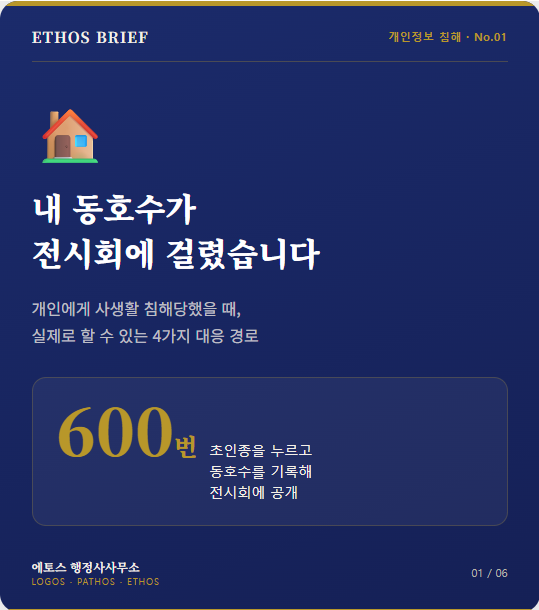
The artist reportedly rang approximately 600 doorbells and recorded the apartment building and unit numbers, along with residents’ reactions, in a notebook.
The project was presented as the photography project 〈Be Nu〉, produced with support from the Gyeonggi Cultural Foundation, and later included in the Seoul Photo Festival exhibition at the Seoul Museum of Photography.
One of the key issues was that the apartment building and unit numbers, along with residents’ reactions, were disclosed in the artwork.
If only the unit number is shown, the resident’s name may not be directly visible.
However, residents of the same apartment complex may know who lives in a particular unit.
If that information is combined with details such as:
- whether the resident allowed the shower request,
- whether the resident refused,
- how the resident reacted,
then a private act or response of a specific household may be exposed to others.
Although this example may seem like a special case involving an art project, similar issues can arise in everyday life.
For example:
- posting a specific apartment unit number and complaint details in an apartment community forum,
- revealing a neighbor’s unit number and noise dispute in a YouTube video,
- posting a tenant’s residence information and daily life on social media,
- using someone’s photo or information in artwork or promotional materials beyond the scope of their consent.
The fact that the other party is an individual does not mean there are no possible remedies.
Can an Apartment Building or Unit Number Be Personal Information?
It may constitute personal information if it can be easily combined with other information to identify a specific individual.
Article 2, Subparagraph 1 of Korea’s Personal Information Protection Act defines personal information as information relating to a living individual, including information that may not identify a specific individual by itself but can identify that individual when easily combined with other information.
A unit number alone may not reveal a person’s name.
But consider a different situation.
A resident of the same apartment complex sees the information.
That person may already know who lives in that unit.
Or the resident may be identified by combining the unit number with management records or other publicly available information.
In that case, what appeared to be a simple number may become linked to a specific person or household.
Therefore, it is difficult to simply conclude:
“There is no name, so it is not personal information.”
The key question is whether the information can realistically be connected to a specific individual.
Why Does It Become More Serious When Unit Numbers Are Disclosed Together With Behavioral Information?
There is a difference between disclosing only a unit number and disclosing a unit number together with a person’s behavior or reaction, such as:
“Building ○, Unit ○ — refused the shower request”
In the second case, not only the place of residence but also the person’s private reaction in a specific situation is disclosed to others.
If residents of the same apartment complex see the artwork or post, they may learn:
“That household accepted the request.”
“That household reacted in that way.”
In such cases, the issue may involve not only personal information protection but also separate rights such as the constitutional right to privacy and freedom of private life.
What Can I Do If an Individual Discloses My Information?
Depending on the situation, there are four main options to consider.
1. Filing a Personal Information Violation Report or Petition
If a violation of the Personal Information Protection Act is suspected, you may consider filing a report or petition through the relevant personal information protection procedures.
The purpose of this procedure is not necessarily to directly award damages to the victim.
Rather, it is closer to having the authorities investigate whether a violation occurred and take necessary corrective measures.
Therefore, the first question is not:
“How much compensation can I receive if I report it?”
but rather:
“Is the other party’s handling of personal information subject to the Personal Information Protection Act?”
If the other party is an ordinary individual, an important issue may be whether that person qualifies as a personal information controller under the Act.
2. Personal Information Dispute Mediation
If an actual dispute has arisen from the handling of personal information, you may consider filing for dispute mediation with the Personal Information Dispute Mediation Committee.
In dispute mediation, the following issues may be reviewed:
- whether personal information was disclosed,
- whether consent was given,
- whether damage occurred,
- emotional distress,
- necessary measures such as deletion or non-disclosure.
If mediation is successfully concluded, it has the legal effect prescribed by law.
Compared with litigation, it may also involve lower costs and procedural burden.
However, not every privacy dispute between individuals automatically falls under personal information dispute mediation.
It is necessary to first review whether the other party’s conduct constitutes personal information processing subject to the Personal Information Protection Act.
3. Raising the Issue With Exhibition Venues, Supporting Institutions, or Related Organizations
Even if the act was committed by an individual, if a public institution or publicly funded organization was involved in the activity, a separate administrative response may also be considered.
For example, this may apply if:
- a public museum is exhibiting the work,
- a public institution supported the project,
- a local government-affiliated organization hosted or sponsored the project.
In such cases, you may consider requesting or filing:
- fact-checking,
- de-identification of the information,
- improvement of the exhibition or posting method,
- a civil petition,
- a request for disclosure of public information.
The important point is that the personal information issue involving the individual artist and the question of how the public institution reviewed, supported, or exhibited the project may involve separate administrative procedures.
4. Civil Damages or Criminal Procedures
If damage occurred due to the disclosure of personal information, or if a separate tort is found to exist, civil damages may become an issue.
If the violation of the Personal Information Protection Act falls under a provision subject to criminal punishment, criminal procedures may also be considered separately.
However, civil litigation, criminal proceedings, injunctions, and other court or investigative procedures should be distinguished from the scope of work handled by administrative agents and may require an attorney.
Is It True That “It’s Fine Because It’s Art”?
The fact that artistic freedom is protected does not mean another person’s privacy or personal information may always be disclosed without restriction.
Article 22 of the Constitution of the Republic of Korea protects freedom of art.
At the same time, Article 17 protects the privacy and freedom of private life.
Therefore, in cases where artistic expression conflicts with personal privacy, it is difficult to say that one right automatically overrides the other in every case.
For example, imagine that resident A receives an intercom call asking:
“I am working on a photography project. May I take a shower in your home?”
A finds the request absurd and refuses.
Several months later, A discovers that the following record is displayed next to A’s apartment unit number in an exhibition:
“Refused”
If the artist did not explain that the unit number and response would be disclosed during the exhibition, A may view this as the public disclosure of both residence information and a private reaction.
In such a case, the issue does not end with the single statement:
“It was an artwork.”
It is necessary to review what information was collected, what was disclosed, whether the individual can be identified, and what consent was actually given.
If I Heard an Explanation Through the Intercom, Does That Mean I Consented to Disclosure?
Agreeing to or responding to a specific act is different from consenting to the later public disclosure of that information.
Suppose someone says:
“I am conducting a photography project.”
and then asks you to do something.
Even if the other person responds to the request, it does not necessarily mean that they also agreed to the following:
“You may later disclose my apartment unit number and my behavior in an exhibition.”
If consent is required under the Personal Information Protection Act, the specific scope of consent becomes important.
Relevant questions include:
- what information is being collected,
- why it is being collected,
- how it will be used,
- to whom and in what manner it will be disclosed or provided.
In particular, responding to a specific request and publicly disclosing the fact that the person responded in that way are not the same act.
Therefore, when reviewing a case, it is necessary to confirm what was actually explained and what was actually consented to.
Does the Personal Information Protection Act Not Apply If the Other Party Is an Individual?
An individual may also qualify as a personal information controller under the Personal Information Protection Act.
Article 2, Subparagraph 5 of the Act defines a personal information controller as a person or entity that processes personal information to operate a personal information file for business purposes, including:
- public institutions,
- corporations,
- organizations,
- individuals, etc.
The important phrase is “individuals, etc.”
Therefore, a natural person is not automatically excluded from the scope of the Act simply because they are an individual.
For example, if an artist systematically recorded and managed information about multiple people for a project, such as:
- apartment building and unit numbers,
- reactions,
- visit dates and times,
- photographs,
- interview content,
then it may be necessary to review the nature of that activity under the Personal Information Protection Act.
However, not every personal act of collecting information immediately qualifies as operating a personal information file as a personal information controller.
The assessment may differ depending on whether the activity was purely personal or whether the person was systematically processing personal information for business or project purposes.
What Should I Do First If I Discover a Privacy Violation?
The first thing to do is preserve evidence.
Online posts and exhibitions may disappear over time.
While the information is still available, it is advisable to secure the following materials:
- photos of the exhibition site,
- photos of the entire work and the problematic parts,
- exhibition catalogues,
- guide materials,
- online posts,
- social media posts,
- related news articles,
- dates and locations of disclosure,
- materials showing that the disclosed information can be linked to you,
- materials showing that you did not consent to disclosure,
- text messages, messenger chats, or emails exchanged with the other party,
- records of requests for deletion or non-disclosure.
If possible, rather than saving only a cropped portion of the screen, it is better to also preserve the full screen showing the poster, URL, posting date, and other context.
Which Should Come First: Reporting or Dispute Mediation?
The two procedures serve different purposes.
Personal Information Violation Report or Petition
This procedure addresses whether the other party’s conduct violated the Personal Information Protection Act and whether corrective measures are necessary.
Personal Information Dispute Mediation
This procedure is designed to resolve an actual dispute between the data subject and the personal information controller.
Specific remedies such as deletion, compensation, and recurrence prevention measures may be discussed.
Depending on the case, only one procedure may be used, or both may be considered separately according to their purposes.
However, in disputes between individuals, the first key issue may be whether the other party qualifies as a personal information controller under the Personal Information Protection Act.
Could My Situation Be a Personal Information Violation?
Check the following points.
- Was my apartment unit number or place of residence disclosed?
- Can I be identified from the disclosed information alone or by combining it with other information?
- Were my behavior, reactions, habits, or daily life also disclosed?
- Was the information disclosed in a place accessible to unspecified people, such as an exhibition, social media, book, or community forum?
- Was I informed in advance that the information would be disclosed?
- Did I expressly consent to the scope of disclosure?
- Did the other party systematically collect the information for their work or project?
- Is the post or exhibition still ongoing?
- Was a public institution or supporting organization involved in the exhibition or project?
If several of these points apply at the same time, the matter may require a concrete review of personal information processing and invasion of privacy, rather than being treated merely as an emotional dispute.
Three Key Issues to Distinguish in These Cases
1. Is It Personal Information?
Review whether the apartment unit number, photo, or life-related information can identify a specific individual when combined with other information.
2. Is the Other Party a Personal Information Controller?
Consider whether the activity was merely personal, or whether the person processed information by operating a personal information file for business or project purposes.
3. What Was the Scope of Consent?
Providing information or responding to a specific request may be different from consenting to the disclosure of that fact in an exhibition, publication, or social media post.
Clarifying these three points first can make it much easier to determine which response procedure is appropriate.
How Can an Administrative Agent Help?
Personal information cases may involve both administrative procedures and civil or criminal procedures.
Depending on the case, assistance with the following administrative documents and preparations may be considered:
- drafting petitions or civil complaints related to personal information protection,
- preparing documents for personal information dispute mediation,
- organizing facts and evidence in chronological order,
- drafting petitions to public institutions,
- preparing public information disclosure requests,
- organizing materials for administrative procedures.
On the other hand, the following matters should be distinguished as areas generally handled by attorneys:
- civil damages lawsuits,
- legal representation in criminal complaints,
- court procedures such as injunctions to suspend exhibitions.
Even in the same case, the materials to prepare may differ depending on which procedure is selected.
For example, when considering personal information dispute mediation, it may be more helpful to organize the case in the following sequence rather than simply stating:
“My personal information was disclosed.”
A clearer structure would be:
disclosed information
→ person identifiable from the information
→ how the information was collected
→ content of consent
→ actual method of disclosure
→ deletion request and response from the other party
→ damage suffered
The First Thing to Remember in Privacy Violations by Individuals
Do not assume that just because the other party is an individual:
“This has nothing to do with the Personal Information Protection Act.”
At the same time, it is also inaccurate to immediately conclude:
“My information was disclosed, so this is definitely a violation of the Personal Information Protection Act.”
In cases involving disclosure of information by individuals, the following should be reviewed together:
- whether the information is personal information,
- whether the other party qualifies as a personal information controller,
- whether consent was given and what the scope of that consent was,
- how privacy protection conflicts with other rights such as expression, art, or reporting.
Before making that legal assessment, however, there is one clear step you can take.
Preserve the evidence first.
Exhibitions may end, social media posts may be deleted, and online pages may be edited.
If the disclosure can still be confirmed, preserve the original materials first, such as photos, screenshots, exhibition catalogues, post URLs, and related records.
Those materials will become the starting point for reviewing a personal information violation report, dispute mediation, a petition to a public institution, or other legal procedures.
References
- Constitution of the Republic of Korea, Article 17 — Privacy and freedom of private life
- Constitution of the Republic of Korea, Article 22 — Freedom of learning and the arts
- Personal Information Protection Act, Article 2 — Definitions of personal information and personal information controller
- Personal Information Protection Act, Article 15 — Collection and use of personal information
- Personal Information Protection Act, Article 17 — Provision of personal information
- Personal Information Dispute Mediation Committee, 2022 Personal Information Dispute Mediation Casebook
- Relevant Daejeon District Court case concerning apartment building and unit numbers as personal information
- Publicly available court precedents and dispute mediation cases related to personal information protection