
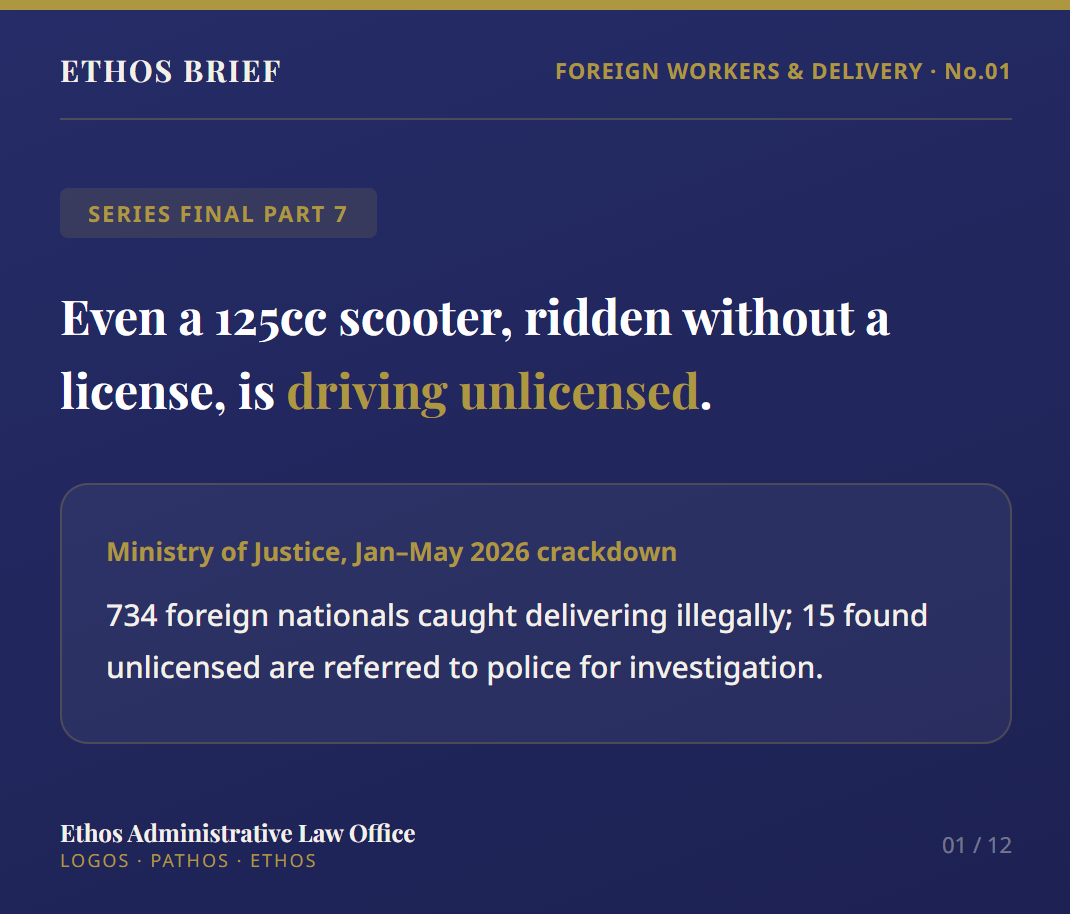
What Happens If a Foreign Delivery Rider in Korea Is Caught Without a License or Proper Insurance? — Even a 125cc Scooter Requires a Valid License
Hello, this is Administrative Agent Jean.
A foreign national starts doing motorcycle delivery work in Korea.
They have experience riding motorcycles in their home country and also hold a foreign driving license.
The scooter used for delivery is a small 125cc model.
The delivery app accepted the account, and they were told that the motorcycle was insured.
So they begin delivering, assuming there is no major problem.
Then one day, the police stop the rider during a delivery.
After checking the license, the police say the rider was driving without a valid license.
The insurance is checked next, and another problem appears: the motorcycle either does not have the required mandatory insurance or the existing policy does not properly match paid commercial delivery activity.
The conclusion is straightforward.
A motorcycle of 125cc or less still requires a valid driving license.
Having a driving license from your home country does not automatically allow you to drive in Korea.
A vehicle without mandatory insurance must not be operated on the road.
Even if an insurance policy exists, you should confirm whether it actually covers accidents occurring during paid delivery work.
Certified small-parcel delivery businesses and their branches are already required to verify riders’ driving qualifications, and from June 3, 2026, they must also verify required insurance or mutual-aid coverage.
This issue has already appeared in actual immigration enforcement.
From January to May 2026, Korea’s Ministry of Justice identified 734 foreign nationals engaged in unauthorized delivery work. Among them, 15 were also found to have been driving without a license and were subject to separate referral to the police for investigation.
In other words:
Unauthorized employment may be handled by immigration authorities, while unlicensed driving may be investigated separately by the police.
Once a foreign national actually begins riding a motorcycle for delivery, the issue is no longer only about immigration status.
Driving license, insurance, and traffic-accident liability become separate legal issues.
Can I Ride a 125cc Scooter Without a License?
No.
Under Korea’s Road Traffic Act, a two-wheeled vehicle with an engine displacement of 125cc or less is classified as a motorized bicycle.
For electrically powered two-wheeled vehicles, the relevant threshold is a maximum rated output of 11kW or less.
Therefore, the statement
“It is only 125cc, so I do not need a license.”
is incorrect.
You must hold a driving license that allows you to operate that vehicle.
However, this does not mean that the only possible license is one specifically named a “motorized bicycle license.”
Certain Korean driving licenses also include the authority to operate motorized bicycles.
By contrast, a motorcycle exceeding 125cc requires a Class 2 Small Motorcycle License.
The basic rule is therefore:
125cc or less
A valid license is required.
You must hold a Korean driving license that authorizes operation of a motorized bicycle.
Over 125cc
A Class 2 Small Motorcycle License is required.
So before borrowing or renting a delivery motorcycle, the first question should be:
“Does my license actually allow me to operate this vehicle?”
Driving a 125cc Motorcycle Without a License Can Also Lead to Criminal Penalties
A 125cc-or-less motorcycle should not be treated as if it were merely subject to a minor traffic rule.
Under Article 154 of the Road Traffic Act, a person who operates a motorized bicycle without a license that permits such operation may be subject to a fine of up to KRW 300,000 or detention.
For a motorcycle exceeding 125cc, driving without the required license may fall under Article 152 of the Road Traffic Act and may result in imprisonment for up to one year or a fine of up to KRW 3 million.
This means engine displacement is not merely a technical specification.
It directly affects what type of license is required and which unlicensed-driving provisions may apply.
“I Have a Driving License From My Home Country” — That Alone Is Not Enough
This is a common misunderstanding among foreign riders.
Suppose you obtained a driving license in your home country.
You brought the license with you to Korea.
Can you simply use it on Korean roads?
Not automatically.
Under Article 96 of Korea’s Road Traffic Act, a foreign national must hold a legally recognized International Driving Permit or mutually recognized foreign driving license in order to drive under the applicable foreign-license rules.
Even then, driving is generally permitted only for one year from the date of entry into Korea, and only for the classes of vehicles covered by that license.
So the correct question is not:
“Do I have a foreign driving license?”
It is:
“Is this license legally recognized in Korea, and does it authorize me to operate this specific type of motorcycle?”
A Foreign Driver With an International Driving Permit Still Went to the Supreme Court
There is an actual Supreme Court case on this point.
Supreme Court Decision 2010Do9067, June 14, 2012.
A Pakistani national drove a vehicle in Korea.
The person possessed an International Driving Permit issued in Pakistan.
At first glance, that may seem sufficient.
But there was a problem.
The document did not conform to the form required under the applicable international convention, and some required information was missing.
The Supreme Court held that a document should not automatically be treated as a valid International Driving Permit merely because it was issued abroad under that name.
The court explained that its actual validity under the relevant international convention had to be examined.
For foreign delivery riders, the lesson is clear.
Having a document titled “International Driving Permit” is not the end of the analysis.
The permit must actually be recognized in Korea,
it must still be within the legally valid period,
and it must authorize operation of the vehicle category you intend to drive.
“The Delivery App Accepted My Account” — App Registration and Driving Qualification Are Different Issues
Creating an account through a delivery platform or local branch does not create a legal driving qualification.
Under Korea’s Act on Development of the Living Logistics Service Industry, certified small-parcel delivery businesses and their branches are required to verify the driving qualifications of delivery workers.
If a rider lacks a valid driving qualification or the license is suspended, the business or branch must not enter into the relevant transport-consignment or employment agreement, or must terminate an existing agreement.
The enforcement rules also provide procedures for checking documents such as copies of driving licenses or driving-record certificates.
And from June 3, 2026, the law also requires verification of the rider’s insurance or mutual-aid coverage.
Therefore:
Being accepted by a delivery platform does not mean that you are legally qualified to ride a motorcycle on Korean roads.
New Delivery-Worker Safety Training Begins in December 2026
From December 3, 2026, certain persons who are newly becoming small-parcel delivery workers and entering into contracts with certified businesses or branches must complete traffic-safety education before entering into the contract.
The enforcement rules set the training period at three hours.
The curriculum includes matters such as:
- Relevant laws, including the Living Logistics Service Act and Road Traffic Act
- Traffic safety
- Small-parcel delivery procedures
- Safety measures for delivery vehicles
- Accident-response procedures
The regulatory structure is therefore moving increasingly toward:
Driving qualification → Insurance → Safety training → Delivery work
Simply registering on a platform does not by itself satisfy the legal requirements for actual motorcycle delivery work.
“No Insurance” Can Mean Two Different Things
When a delivery rider says,
“There is no insurance.”
two legally different situations may be involved.
1. There is no mandatory insurance at all
This is a failure to maintain mandatory insurance.
2. Insurance exists, but it is for personal or ordinary business use while the motorcycle is actually used for paid delivery
It would be inaccurate to call this automatically “uninsured,” because an insurance contract does exist.
However, a serious issue may arise as to whether the policy actually covers accidents occurring during paid commercial delivery.
Korea’s Financial Services Commission has previously identified the practice of using personal or ordinary-use motorcycle insurance for commercial delivery work as a problematic mismatch between the insured use and the actual use.
So the real question is not simply:
“Is there an insurance policy?”
It is:
“Does this insurance actually cover accidents that occur while I am being paid to make deliveries?”
A Motorcycle Without Mandatory Insurance Must Not Be Operated on the Road
Article 5 of Korea’s Act on Guarantee of Compensation for Loss Caused by Automobile requires vehicle holders to maintain liability insurance and other legally required coverage for bodily injury and property damage.
Article 8 further provides that:
A vehicle without the required mandatory insurance must not be operated on the road.
In addition, a vehicle holder who operates a vehicle without mandatory insurance may be subject to imprisonment for up to one year or a fine of up to KRW 10 million under Article 46.
The term vehicle holder is important.
If a motorcycle was borrowed from a friend or rented from a company, it does not automatically follow that every criminal provision applies to the rider in exactly the same way.
Responsibility under the Automobile Compensation Act may depend on the actual ownership and use relationship.
But one point is clear:
A motorcycle without mandatory insurance must not be operated on public roads.
Insurance Can Be Summarized Like This
No mandatory insurance at all
→ The motorcycle must not be operated on the road.
Mandatory insurance exists, but the motorcycle is insured for personal or ordinary use while actually being used for paid delivery
→ It is not automatically correct to call this “uninsured,” but coverage problems may arise for accidents during paid delivery work.
Insurance or mutual-aid coverage appropriate for actual paid delivery exists
→ The basic insurance requirement has been addressed.
No valid license, but insurance exists
→ Insurance does not eliminate the unlicensed-driving issue.
A valid license exists, but there is no mandatory insurance
→ A valid license does not eliminate the uninsured-vehicle issue.
License and insurance do not substitute for each other.
A license concerns whether you are legally authorized to operate the vehicle.
Insurance concerns how losses will be covered if an accident occurs.
From 2026, Certified Delivery Businesses Must Also Verify Insurance
From June 3, 2026, Article 19-5 of the Act on Development of the Living Logistics Service Industry requires certified small-parcel delivery businesses and their branches to verify whether delivery workers have the required insurance or mutual-aid coverage.
The required coverage must address losses arising from the operation of motorcycles and other delivery vehicles, including:
- Death or bodily injury to another person
- Property damage to another person
If the required insurance or mutual-aid coverage is not in place, the business or branch must not enter into the relevant transport-consignment or employment agreement, or must terminate an existing agreement.
In other words, the 2026 regulatory structure is no longer limited to the rider personally checking insurance.
Certain certified businesses and branches are also required to verify insurance coverage.
Accident Statistics Show Why Insurance Matters
Insurance should not be viewed only through the question:
“How much is the fine if I get caught?”
According to Korea Road Traffic Authority’s TAAS statistics for 2025, accidents involving motorcycles, four-wheeled ATVs, and motorized bicycles totaled 14,129 cases.
Those accidents resulted in 388 deaths and 18,047 injuries.
These figures do not represent delivery-rider accidents alone.
But they show why insurance matters.
The purpose is not merely to avoid a fine. It is to deal with the real financial consequences when a traffic accident occurs.
A Delivery-Motorcycle Accident Reached the Korean Supreme Court
There is also a recent Supreme Court case involving a motorcycle used for delivery.
Supreme Court Decision 2023Da310198, October 31, 2024.
A rental company supplied a motorcycle to a delivery agency.
A delivery rider operating the motorcycle struck and injured a pedestrian.
The insurance company paid the victim KRW 18,558,860 and later sought reimbursement from the motorcycle rental company.
The issue was:
“If the delivery rider directly caused the accident, can the rental company also bear responsibility under the Automobile Compensation Act?”
The Supreme Court explained that a person who operates a vehicle “for their own benefit” under the Act is not limited to the individual physically holding the handlebars.
A person who exercises control over the vehicle’s operation and receives the benefit of that operation may also fall within the relevant legal concept.
This decision matters because delivery motorcycles may be:
- Owned by the rider
- Borrowed from a friend or acquaintance
- Owned by a delivery agency
- Supplied by a rental company
After an accident, the matter may not end with:
“It was not my motorcycle.”
or
“I was not the person actually driving.”
Who controlled the use of the vehicle and who benefited from its operation may become relevant to civil liability.
When Unlicensed Driving, No Insurance, and an Accident Occur Together, the Case Splits Into Several Legal Issues
Consider a foreign student using a 125cc motorcycle for delivery.
The delivery activity itself is not permitted under the student’s immigration status.
The student does not hold a driving license recognized in Korea for the motorcycle.
The motorcycle also lacks mandatory insurance.
Then the student hits and injures a pedestrian.
The legal issues now divide into separate categories.
1. Unauthorized delivery employment
→ Immigration-law issue
2. Operating the motorcycle without a valid license
→ Unlicensed driving under the Road Traffic Act
3. Operating a vehicle without mandatory insurance
→ Automobile-compensation and insurance issue
4. Injuring another person in a traffic accident
→ Possible separate criminal liability and civil damages
One delivery incident can therefore create four different legal issues.
The 2026 Ministry of Justice enforcement operation illustrates this clearly.
Among the foreign nationals found to have engaged in unauthorized delivery work, 15 people identified as unlicensed drivers were separately referred to the police.
So it would be incorrect to assume that:
“The immigration violation absorbs the unlicensed-driving issue.”
or:
“Once I am punished for unlicensed driving, the immigration matter is over.”
Different laws and different authorities may proceed separately.
“I Drove Without a License, but There Was No Accident” — It Is Still Unlicensed Driving
The absence of an accident does not erase the unlicensed-driving issue.
Unlicensed driving is not prohibited only when an accident occurs.
It is prohibited because the person operated a vehicle without the legally required driving qualification.
Likewise:
“I only rode it once.”
“I made only three deliveries.”
“I stayed near my home.”
does not make unlicensed driving lawful.
A short period of activity and legal permission are different questions.
If You Receive a Fine for Failure to Maintain Mandatory Insurance, Should You Automatically File an Administrative Appeal?
No.
There is an actual administrative appeal decision on this issue.
Seoul Administrative Appeals Decision 2013-552, August 12, 2013.
A person who received an administrative fine for failure to maintain mandatory insurance filed an administrative appeal.
The case was not decided on whether the fine itself was substantively correct.
Instead, the appeal was dismissed as procedurally improper.
Why?
Because administrative fines are subject to the separate objection procedure established under Korea’s Act on the Regulation of Violations of Public Order.
As a general rule, a person who objects to an administrative-fine notice may submit a written objection to the relevant administrative authority within 60 days from receiving the notice.
The matter can then proceed to the competent court for an administrative-fine trial.
The decision shows one important principle:
Not every document issued by an administrative authority should be challenged through an administrative appeal.
Whether the document is:
- An administrative fine
- A departure order
- A deportation order
- A penalty notice
can determine which review or objection procedure applies.
If the Police Have Already Stopped You, the Questions Become Very Specific
Once the police have contacted you, the issue is no longer simply:
“Do I need a license for a 125cc scooter?”
The relevant documents should be divided into categories.
1. The actual vehicle
- Engine displacement
- Vehicle registration number
- Motorcycle-use registration documents
- Actual owner
2. Actual driving qualification
- Type of Korean driving license
- International Driving Permit
- Mutually recognized foreign driving license
- Date of entry into Korea
- License validity period
- Vehicle categories covered by the license
3. Insurance
- Whether mandatory insurance exists
- Insurance coverage period
- Declared use of the vehicle
- Whether paid delivery activity is covered
- For a rented vehicle, the rental agreement and policyholder information
4. Delivery and accident records
- Delivery-platform activity history
- Time of the accident
- Police investigation documents
- Traffic-accident records
5. Immigration
- Current status of stay
- Actual period of delivery activity
- Whether an immigration investigation has already started
- Documents received from immigration authorities
Separating the records this way makes it easier to see:
which issues belong to the traffic case and which belong to the immigration case.
If You Have Not Started Delivery Work Yet, Check the License and Insurance First
Before your first delivery, there is still a significant amount you can verify yourself.
Check the engine displacement of the motorcycle.
Confirm whether your Korean driving license, or a legally recognized International Driving Permit or mutually recognized foreign license, actually permits you to operate that vehicle.
Then check the insurance documents.
Confirm whether mandatory insurance is valid and whether the policy actually applies to paid delivery activity.
If these points are not confirmed,
do not operate the motorcycle.
That is the clearest answer.
If a Police Stop or Accident Has Already Occurred, Separate the Legal Issues
Once there has been a police stop or traffic accident, the matter may no longer be handled through a single procedure.
Criminal investigation and criminal proceedings involving unlicensed driving or traffic accidents require review by a lawyer.
Insurance-payment or damages disputes may require specialized review by an insurance professional, loss adjuster, or lawyer depending on the case.
Separately, if unauthorized employment or the traffic case affects the foreign national’s immigration status and leads to:
- Immigration investigation
- Extension-of-stay issues
- Departure order
- Deportation order
- Other immigration-related administrative procedures
then the immigration side should be reviewed independently based on the person’s immigration history and the actual documents issued by the authorities.
In Summary — Once Unlicensed Driving or Insurance Problems Are Added, This Is No Longer Only a Visa Issue
The conclusion is clear.
A motorcycle of 125cc or less still requires a valid driving license.
If a Korean driving license already authorizes operation of a motorized bicycle, a separate motorized-bicycle-only license is not necessarily required.
A motorcycle exceeding 125cc requires a Class 2 Small Motorcycle License.
A foreign driving license alone does not automatically authorize driving in Korea.
The person must hold a legally recognized International Driving Permit or mutually recognized foreign driving license, and the applicable period and vehicle category must also match.
A motorcycle without mandatory insurance must not be operated on the road.
Even where an insurance policy exists, use of a personal or ordinary business policy for paid delivery may create coverage problems after an accident.
Certified small-parcel delivery businesses and their branches are already required to verify riders’ driving qualifications, and from June 3, 2026, they are also required to verify insurance or mutual-aid coverage.
From December 3, 2026, certain new delivery workers must also complete three hours of traffic-safety education before entering into the relevant delivery contracts.
Most importantly, the legal issues should not be merged into one vague “delivery problem.”
Unauthorized delivery work → Immigration issue
Unlicensed driving → Road Traffic Act issue
Insurance and traffic accident → Insurance, damages, and possible separate criminal-liability issues
The 2026 Ministry of Justice enforcement operation already showed this structure in practice: foreign nationals found to have driven without a license were referred separately to the police in addition to immigration enforcement.
If a police stop or accident has already occurred, the practical question is no longer:
“Can a foreign national legally do delivery work in Korea?”
Instead, the motorcycle, driving license, insurance records, police investigation documents, and immigration records should be separated and reviewed according to the legal issue each one creates.
If unlicensed driving or insurance issues have already led to an immigration investigation or other immigration-related procedure, a free initial review can help determine what administrative options may remain available based on your current license, insurance, and immigration documents.