
Business Suspension Administrative Appeal Petition: What Must Be Included and What Must Not Be Missing
Hello, this is Administrative Agent Jean.
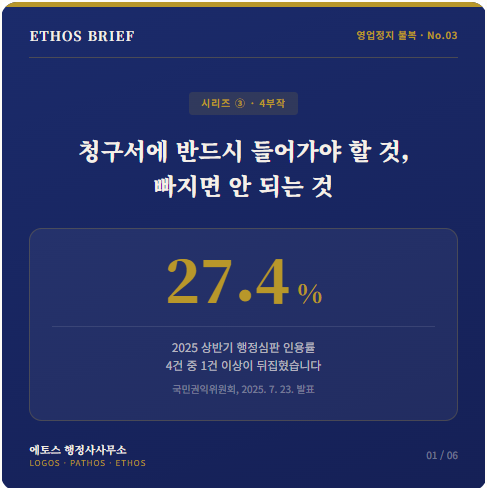
In the first half of 2025, the Central Administrative Appeals Commission recorded an acceptance rate of 27.4% for general cases.
This was an increase of 11.7 percentage points from 15.7% in the same period of the previous year.
At a briefing on administrative appeal issues on July 23, 2025, the Anti-Corruption and Civil Rights Commission stated that, along with the rise in the acceptance rate, it had identified many cases where dispositions were made based on inadequate investigations by the disposition authorities.
What matters in an administrative appeal is not simply saying:
This is unfair.
What matters is showing why the administrative agency’s disposition is unlawful or unfair through laws, facts, and evidence.
In Part ① of the business suspension appeal series, we looked at the dates, appeal guidance, and procedural defects that should be checked in a disposition notice.
In Part ②, we explained why suspension of execution should be considered together, because filing an administrative appeal does not automatically stop a business suspension.
This time, we will look at the actual administrative appeal petition.
Four-Part Series on Challenging Business Suspension
- Business Suspension Notice: When You See This Phrase, the 90-Day Countdown Begins
- Administrative Appeal and Suspension of Execution: Which Comes First?
- What Must Be Included in an Administrative Appeal Petition, and What Must Not Be Missing — this article
- After Receiving an Acceptance Decision — Why What Comes Next Matters More
The Content of an Administrative Appeal Petition Matters More Than the Form
The form of an administrative appeal petition itself is not complicated.
It can be prepared according to the prescribed format through the Online Administrative Appeals system and similar channels.
The problem is that because the form looks simple, it is easy to think:
Isn’t it just a matter of filling in the blanks?
That is not the case.
The Administrative Appeals Act specifies the matters required for an appeal petition, and if the petition has defects that can be corrected, the commission may request correction.
On the other hand, if the content of the claim itself cannot be identified and cannot be corrected, a problem may arise before the merits are even reviewed.
Therefore, an administrative appeal petition is not just an application form.
It is a document that creates one structure showing what you are asking to be revoked, why the disposition is wrong, and what evidence supports that argument.
What Must Be Included in an Administrative Appeal Petition?
Article 28 of the Administrative Appeals Act sets out the matters that must be stated in an appeal petition.
In a business suspension case, each item can be understood as follows.
① Who Is the Claimant?
The claimant is the person who is the other party to the administrative disposition.
For an individual business, this is generally written based on the information of the business operator who received the business suspension disposition. For a corporation, the corporate name, representative, and other necessary information must be accurately stated.
You should not treat basic personal information lightly.
This is because whether the other party to the disposition and the claimant match is connected to the party status issue in the administrative appeal.
Particular caution is needed if the business registration holder, food business report holder, and actual operator are different.
② Who Is the Respondent?
The respondent is the administrative agency that made the disposition.
For example, if the head of a district office issued the business suspension disposition, the respondent should be identified based on that disposition authority.
This is something business owners often confuse.
The respondent and the commission reviewing the administrative appeal are not the same institution.
The respondent is the administrative agency that made the disposition.
The Administrative Appeals Commission is the institution that reviews and decides whether the disposition is unlawful or unfair between the claimant and the respondent.
For example, if an autonomous district in Seoul issued a business suspension disposition, the competent administrative appeals commission for that case must be checked separately.
Writing the wrong respondent does not always immediately end the case.
The Administrative Appeals Act contains provisions on proper respondent status and correction of respondent designation.
However, writing it accurately from the beginning reduces unnecessary correction requests and loss of time.
③ You Must Accurately State Which Disposition You Are Challenging
In an administrative appeal, you must identify what you are challenging.
For example:
Business suspension disposition of 15 days dated ○○, 2026
The safest method is to use the disposition name and date written in the disposition notice.
If the disposition date is written incorrectly or mixed with another disposition, the object of the appeal may become unclear.
This requires particular caution if several administrative measures, such as an administrative fine, corrective order, and business suspension, were taken against one business operator at the same time.
④ You Must State When You Became Aware of the Disposition
This item is directly connected to the 90-day filing period discussed in Part ①.
Under Article 27 of the Administrative Appeals Act, an administrative appeal must generally be filed within 90 days from the date you became aware of the disposition.
Therefore, the petition must accurately state the date you became aware of the disposition.
If you received the disposition notice by registered mail, it is advisable to preserve related materials such as delivery records.
If a special method of service, such as service by public notice, is at issue, you should not judge only by the public notice date. You should review both when you actually became aware of the disposition and the period from the date of the disposition.
This one date can determine whether the appeal is legally admissible.
⑤ What Is the Difference Between the Claim Sought and the Reasons for the Claim?
This is the most important part of an administrative appeal petition.
The two concepts must be distinguished.
The Claim Sought Is the Desired Conclusion
Simply put, this section states:
What decision do you want the commission to make?
For example, if you are seeking revocation of a business suspension disposition, the structure may be:
The business suspension disposition of 15 days issued by the respondent to the claimant on ○○, 2026, shall be revoked.
If you are seeking modification of the disposition, the requested content must be specified accordingly.
The Reasons for the Claim Explain Why That Conclusion Should Be Reached
The reasons for the claim answer the question:
Why is this disposition unlawful or unfair?
This is also the more important part in actual administrative appeals.
Even for the same business suspension disposition, the reasons for the claim may differ completely depending on whether:
- Prior notice procedure was defective
- The violation itself did not exist
- The disposition standards were misapplied
- The number of violations was miscalculated
- There was deviation or abuse of discretion
- Statutory grounds for mitigation exist
If the claim sought and the reasons for the claim are mixed together, it becomes difficult to understand the result the claimant wants and the legal basis for it.
Can You Ask to Replace Business Suspension With an Administrative Surcharge?
Under the Food Sanitation Act, there is a system that allows an administrative surcharge to be imposed in place of business suspension in certain cases.
A representative basis is Article 82 of the Food Sanitation Act.
Simply put, when certain requirements are met, it may be possible to consider:
Paying an administrative surcharge instead of suspending business operations
However, this should not be understood as:
If the owner wants it, the business suspension can always be changed into money.
You must check whether the case is eligible for surcharge substitution, whether it falls under statutory exclusions, and what judgment the administrative agency or commission may make.
Therefore, when receiving a business suspension disposition, it is important not to fix only one response direction from the beginning.
Depending on the case, you may consider:
- Full revocation of the disposition
- Reduction of the disposition
- Possibility of substitution with an administrative surcharge
⑥ Check Whether You Received Notice About Administrative Appeal
At the bottom of a business suspension disposition notice, there is usually wording such as:
If you object to this disposition, you may file an administrative appeal within 90 days from the date you became aware of the disposition.
As explained in the previous article, the administrative agency’s notice of appeal methods may be connected to determining the filing period.
If the agency properly gave notice, check the content.
If there was no notice, or if the agency incorrectly notified a period longer than the statutory period, that fact should also be checked separately.
The Administrative Appeals Act contains separate period rules for cases involving incorrect notice or failure to give notice.
Therefore, the few lines at the bottom of the disposition notice should also be preserved as they are.
How Should the Reasons for the Claim Be Structured?
In business suspension cases, the disposition can generally be reviewed from three directions.
This does not mean that all three must be argued in every case.
You must select the issues that match the actual facts of the case.
Direction 1 — Was There a Problem With the Disposition Procedure?
The first is procedural illegality.
When an administrative agency makes a disadvantageous disposition against a citizen, it must follow the procedures set out in the Administrative Procedures Act.
Representative procedures include:
- Prior notice
- Hearing of opinions
- Statement of reasons
In Supreme Court Decision 2023Du39724, decided September 21, 2023, the Court confirmed that if an administrative agency makes an infringing administrative disposition without following the procedures required by the Administrative Procedures Act, the disposition may, in principle, become unlawful.
Therefore, when preparing the petition, it is advisable not to look only at the final disposition notice, but to compare:
Prior notice
→ submitted opinions
→ final disposition notice
For example, procedural defects may become an issue if prior notice was not received at all,
if there was no proper opportunity to submit opinions,
or if the disposition notice simply states:
Violation of the Food Sanitation Act
without making it possible to know specifically what was violated.
However, a disposition is not always unlawful merely because the reasons are short.
You must also check whether the party could substantially understand the facts and legal basis that caused the disposition in the overall process before and after the disposition.
Direction 2 — Did the Administrative Agency Misapply the Disposition Standards?
The second is substantive illegality, especially misapplication of disposition standards.
The Enforcement Rule of the Food Sanitation Act sets administrative disposition standards according to the type and frequency of violation.
Therefore, if the administrative agency:
- Treated what was actually a first violation as a second violation
- Applied the disposition standard for a different type of violation
- Failed to reflect mitigation factors provided by law
then the application of the disposition standards itself should be reviewed.
The important point is not to write only:
The disposition is too harsh.
You must place the exact disposition standard applicable to the case side by side with the actual disposition.
For example:
This case falls under a first violation under item ○ of attached table ○○, but the respondent judged it as a second violation.
This is a way to specifically show the inconsistency between the statutory standard and the actual disposition.
Direction 3 — Even If the Disposition Was Possible, Was It Excessive?
The third is violation of the principle of proportionality or deviation and abuse of discretion.
The violation itself may be acknowledged.
The disposition standards may also have been formally applied.
Even so, if the business suspension disposition is excessively harsh in the individual case, it may be necessary to review whether it exceeds the limits of discretion.
The Supreme Court has held that even where the administrative agency has discretion regarding the period of business suspension, if the disposition exceeds the limits of discretion in light of the comparison between public and private interests and the principle of proportionality, it may be unlawful.
However, it is not enough to simply argue:
This is too unfair.
Business is difficult.
Specific facts and materials are needed.
Examples include:
- Whether the business is the family’s primary means of livelihood
- Whether the violation was intentional
- Whether actual harm occurred due to the violation
- Whether the violation was immediately corrected
- Whether there is a history of the same violation
- What impact the business suspension will have on employees and business partners
These circumstances must be connected to materials such as sales data, family relationship documents, and correction materials.
The sentence “livelihood is difficult” is not a conclusion. It is a fact that must be proven.
Mitigation Provisions Must Be Checked Separately
Administrative disposition standards may contain provisions allowing reduction or exemption of a disposition under certain circumstances.
Therefore, when you receive a business suspension disposition, you should not stop after checking only the disposition standard table.
You must also check whether the general standards contain mitigation provisions.
For example, depending on statutory requirements, mitigation may become an issue where there was no intent in the violation, or where a suspension of sentence was issued in a related criminal procedure.
In cases involving provision of alcohol to minors, mitigation or exemption of administrative dispositions may arise depending on specific circumstances provided by law, such as:
- Forgery, alteration, or misuse of an ID
- Difficulty confirming age due to assault or threats
- Results of related criminal proceedings
Therefore, if there are police, prosecution, or court disposition results, you should not discard them as unrelated to the administrative appeal.
The result of a criminal procedure may become material for determining mitigation of an administrative disposition.
Actual Administrative Appeal Decision — A Case Where Revocation Was Denied but Business Suspension Was Changed to an Administrative Surcharge
Let’s look at Gyeonggi-do Administrative Appeals Commission Decision 2022GyeonggiHaengsim201, April 18, 2022, published on the National Law Information Center.
This was a case involving a business suspension disposition against a general restaurant.
How Did the Case Begin?
A general restaurant in Gyeonggi-do was found to have sold alcohol to two minors.
The competent administrative agency proceeded with a business suspension disposition procedure for violation of the Food Sanitation Act.
Later, in the related criminal proceedings, the court issued a suspension of sentence after considering various circumstances, and the administrative agency reflected this by reducing the originally planned business suspension period.
However, the business operator filed an administrative appeal even against the reduced business suspension disposition.
What Did the Claimant Argue?
The core arguments were twofold.
First, the restaurant was an important means of livelihood for the family, and the business suspension would cause significant economic hardship.
Second, the claimant requested that the business suspension be converted into an administrative surcharge.
The important point is that the claimant did not stop at simply saying:
It is difficult to make a living.
The claimant also presented the relevant administrative disposition standards and administrative surcharge provisions as grounds.
How Did the Commission Decide?
The commission found it difficult to say that the business suspension disposition itself was excessively harsh or unlawful.
In other words, revocation of the disposition itself was not accepted.
However, after considering the legal requirements related to administrative surcharge substitution, the commission changed the business suspension disposition into an administrative surcharge disposition.
As a result, the claimant was able to bear an administrative surcharge instead of suspending business operations.
What Can We Learn From This Decision?
First, Revocation Is Not the Only Possible Outcome
When people think of administrative appeals, many imagine only:
Completely eliminating the business suspension.
But in actual cases, depending on the law and the structure of the case, it may be possible to consider modification or another form of remedy in addition to revocation.
If you think only of revocation from the beginning, you may miss other options.
Second, You Must Clearly State the Desired Result
In this case, the claimant clearly expressed the request for substitution with an administrative surcharge.
When preparing an administrative appeal petition, you should not simply write:
Please show leniency.
Instead, you should clearly organize:
What disposition you want changed, and into what form.
Third, Emotion and Legal Grounds Are Different
The fact that business suspension seriously affects livelihood can be important material.
But that alone does not decide the conclusion.
If mitigation provisions or requirements for the administrative surcharge system exist, you must connect those laws with your own facts.
A good administrative appeal petition is not a document without emotion.
It is a document that turns circumstances into legal arguments.
Signature and Evidence Must Not Be Missing From the Petition
The administrative appeal petition must also meet formal requirements such as signatures and seals required by law.
Evidence also determines the persuasiveness of the reasons for the claim.
For example, if you argue procedural illegality but do not submit the prior notice or disposition notice, it will be difficult for the commission to confirm the facts.
If you argue violation of the principle of proportionality and only write:
Sales will decrease significantly.
without any sales data, the argument will also be weak.
The necessary materials differ depending on the reasons for the claim.
| Argument | Materials to Consider | |---|---| | Defect in prior notice procedure | Prior notice, service records | | Error in facts | CCTV, photos, POS records, receipts, employee statements | | Misapplication of disposition standards | Disposition notice, past disposition history, applicable law | | Livelihood and economic harm | Sales data, lease agreement, payroll records | | Immediate correction | Before-and-after correction photos, training materials, improvement materials | | Suspension of sentence or other mitigation | Court judgment, non-transfer or non-prosecution decisions, etc. |
Submitting many pieces of evidence does not automatically make the petition better.
You must connect which evidence proves which argument.
Common Mistakes in Administrative Appeal Petitions
1. Writing It Like a Complaint or Petition for Leniency
The Supreme Court has held that even if a document is not titled “Administrative Appeal Petition,” it may still be treated as an administrative appeal if the content allows the purpose and reasons for the appeal to be identified.
A representative case is Supreme Court Decision 98Du2621, decided June 9, 2000.
However, this does not mean that it is fine to prepare documents inaccurately from the beginning.
Having to later dispute:
Can this document be considered an administrative appeal?
is itself an unnecessary risk.
It is safer to prepare the document in the proper appeal structure from the beginning.
2. Writing Only Emotions in the Reasons for the Claim
This is too unfair.
My family will starve.
It was my first mistake.
This does not mean such circumstances have no meaning.
But these alone do not explain why the disposition is unlawful or unfair.
For example, if you argue:
This restaurant is the family’s only means of livelihood.
you must explain why that fact matters in the proportionality analysis of the disposition and attach objective materials.
Emotion can be part of the facts, but it is not legal reasoning by itself.
3. Failing to Check Mitigation Grounds Favorable to You
If you received results such as:
- Suspension of sentence
- Non-transfer to prosecution
- Non-prosecution
in a related criminal procedure,
or if there were special circumstances such as forgery or alteration of an ID during the violation, you must check what effect those circumstances have under the administrative disposition standards.
The end of the criminal case does not automatically end the administrative disposition.
Conversely, the result of the criminal procedure may become a ground for mitigation or exemption of the administrative disposition.
That is why related decisions or judgments should be reviewed together with the administrative appeal materials.
What Should You Check Last After Drafting the Petition?
At minimum, it is advisable to check the following one more time:
- Is the claimant accurate?
- Is the respondent accurate?
- Is the competent Administrative Appeals Commission correct?
- Did you accurately state the disposition name and date?
- Did you accurately state the date you became aware of the disposition?
- Does the 90-day filing period still remain?
- Are the claim sought and reasons for the claim separated?
- Did you check the legal basis and standards for the disposition?
- Did you review procedural defects?
- Were the disposition standards correctly applied?
- Are there mitigation or exemption provisions?
- Did you review the possibility of substitution with an administrative surcharge?
- Is there evidence corresponding to each argument?
- Are formal requirements such as necessary signatures and seals satisfied?
You do not need to make every argument in every case.
In fact, inserting many arguments that do not fit the facts can blur the key issues.
What matters is not the number of arguments, but accuracy.
Even the Same 15-Day Business Suspension Can Require Completely Different Petitions
The same business suspension period does not mean the reasons for the claim are the same.
Is it a case involving food past the consumption period?
Is it a case involving provision of alcohol to minors?
Is it a case involving facility or hygiene standards?
Each case has different applicable laws and disposition standards.
Even within cases involving provision of alcohol to minors, the response direction may differ depending on:
- Whether IDs were checked
- Whether forged IDs were used
- What the police or prosecution disposition result was
- Whether there was a prior violation history
That is why simply copying an appeal petition form found online has limits.
The core of an administrative appeal petition is not the form, but turning the facts of your own case into legal issues.
Next Article — If the Administrative Appeal Is Accepted, Is Everything Over?
When an administrative appeal is accepted, it may feel as if the case is over.
But in reality, there are still things to check afterward.
You need to examine how the disposition is handled,
what issues remain if part of the business suspension has already been executed,
and what the administrative agency must do according to the decision.
In the next article, I will explain what to check after receiving an acceptance decision in an administrative appeal.