
If You're a Foreigner Planning to Host on Airbnb in Korea, Check Your Visa First
Hello, this is Jean, a Korean Administrative Attorney.
If you watch travel YouTubers, you will often see them booking accommodation through Airbnb while traveling abroad.
That naturally makes many people think:
“Maybe I could make some extra money by renting out a spare room too.”
And when you hear that some hosts earn more than KRW 1 million a month, it can certainly look like an opportunity worth considering.
You finish planning the interior, choose the furniture, and assume that once you register the business, you can start immediately.
So you log into Hometax.
The business registration itself may take only a few minutes.
But six months after you start accepting guests, the district office conducts an on-site inspection.
The property is found to be operating as an unregistered accommodation business.
You may already have spent:
- KRW 5 million on interior work
- KRW 3 million on furniture and appliances
- KRW 10 million on the deposit
That is already KRW 18 million tied up before any penalty is added.
Your Airbnb listing may be removed, and you may not be able to register the same address again.
Revenue stops.
The investment remains tied up.
And penalties may follow.
This series was created to help prevent situations like this and explain what needs to be checked before operating an Airbnb business in Korea.
In this final article, we will look at whether a foreign national can operate an Airbnb in Korea and what changes when the host is not Korean.
- What happens if you operate without the required business registration?
- Did you know operating Airbnb from an officetel may create legal problems?
- Foreign hosts need to check their visa first — this article
Read Part 1
https://blog.naver.com/attorney_jean/224366542643
Read Part 2
https://blog.naver.com/attorney_jean/224379239830
In Parts 1 and 2, we looked at what kinds of properties may be used for Airbnb and how the Foreign Tourist Urban Homestay Business registration works.
Foreign nationals usually start from the same question as Korean hosts.
Can this property be registered?
What do I need to report to the district office?
Should I register the business first?
But if the host is a foreign national, there is one more issue that needs to be checked first, or at least at the same time.
Does my current visa allow me to operate this business?
Even if the property qualifies and the tourism-related registration is completed, immigration issues may remain if the activity is outside the scope permitted by your status of stay.
Why Does Airbnb Become a Visa Issue for Foreigners?
Let us imagine James, an international student attending university in Korea.
James actually lives in a house near his school.
He has checked the property classification and confirmed that the property may qualify for registration as a Foreign Tourist Urban Homestay Business.
He is now considering renting out a spare room to foreign visitors and earning income from it.
Based on what we discussed in Parts 1 and 2, he might think the process is simply:
Check the property → Register with the district office → Register the business → List on Airbnb
But for a foreign national, one more step needs to be added.
Check the permitted activities under the current status of stay.
Under Korea's Immigration Act, when a foreign national wishes to engage in an activity outside the scope of their current status of stay while continuing their existing activity, permission for activities outside the status of stay may become necessary.
That means Airbnb operation by a foreign national involves at least two separate legal questions:
- Can this accommodation business be legally operated under the Tourism Promotion Act?
- Can this particular foreign national engage in the activity under the Immigration Act?
These are not the same question.
Registration of the tourism business by the district office does not automatically mean that the foreign host is permitted to conduct that activity under immigration law.
Property, Business Registration, and Visa: All Three Need to Match
It may be easier to think of the issue in three levels.
Level 1 — Property
Can this property be legally used for a Foreign Tourist Urban Homestay Business?
Level 2 — Business Operation
Have the required tourism registration and related procedures been completed?
Level 3 — The Host
Does the host's current status of stay allow this type of business activity?
For a Korean national, the main focus is usually Levels 1 and 2.
For a foreign national, Level 3 is added.
That is why someone may reasonably ask:
“My Airbnb registration was completed. Why is there still a problem?”
Because tourism registration and immigration status are governed by different legal frameworks.
Can a D-2 Student Run Airbnb During School Holidays?
This is a question I often hear from D-2 students, and it is also an area where misunderstandings are common.
For foreign students holding D-2 student status or D-4 general training status, one of the main exceptions allowing income-generating activity is authorized part-time employment.
At first glance, it may sound like permission to work means permission to earn income through Airbnb as well.
But there is an important distinction.
Working at a restaurant under an employment contract for specified hours is structurally different from:
registering accommodation under your own name, receiving guests, and repeatedly earning revenue from the operation.
Therefore, a D-2 or D-4 holder should not simply assume:
“I can just get part-time work permission.”
The actual business structure needs to be reviewed separately.
The question is whether the current status of stay already permits the activity, whether permission for activities outside the status of stay could apply, or whether a different immigration status needs to be considered.
There Is a Case Where One Day of Work Led to a Departure Order
“It is not like I am earning a lot of money.”
“It is only for a short time during the school holiday.”
It is easy to think this way.
But administrative appeal decisions show that a short duration does not necessarily mean the immigration consequences will be minor.
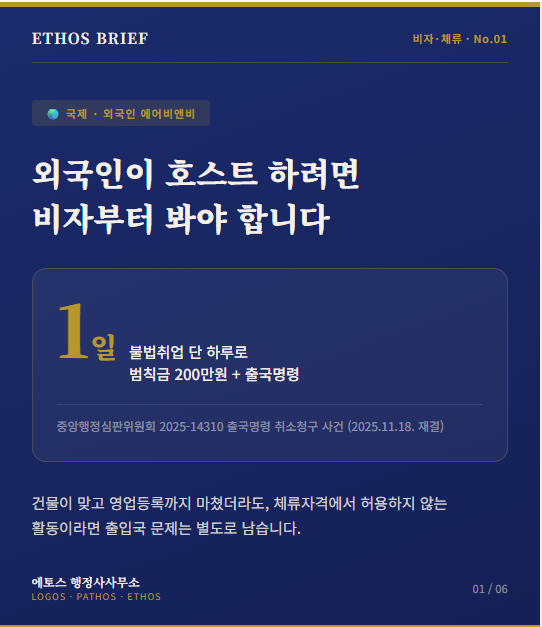
In Central Administrative Appeals Commission Case 2025-14310, decided on November 18, 2025, a foreign national holding D-2 student status was caught performing building demolition work on August 22, 2025.
The agreed daily wage was KRW 150,000.
The unauthorized employment lasted just one day.
The result was:
KRW 2 million in penalty and a separate departure order.
The applicant argued that only one semester remained before graduation and that the penalty had already been paid, so a departure order was excessive.
The Central Administrative Appeals Commission rejected the claim.
This was not an Airbnb case.
However, it demonstrates an important point in immigration matters:
“I only did it for a few days” or “I did not earn much money” does not necessarily mean there is no risk of a departure order.
Does Unauthorized Activity End With a Fine?
Not necessarily.
Violations of the Immigration Act can involve more than criminal punishment or monetary penalties.
Under Article 94 of the current Immigration Act, certain unauthorized employment-related violations may be subject to imprisonment for up to three years or a fine of up to KRW 30 million.
Depending on the circumstances, immigration consequences such as a departure order or deportation may also arise.
In the D-2 case discussed above, the matter did not end with the KRW 2 million penalty.
A departure order was also issued.
This is one of the important differences between ordinary business licensing issues and immigration violations.
The problem may not end with the business itself.
It may also affect whether the person can continue staying in Korea.
Which Visa Types May Allow Airbnb Operation?
It can be risky to look only at the first letter of a visa and conclude:
F visa means yes.
D visa means no.
The actual analysis needs to be more specific.
1) F-5 Permanent Resident
F-5 permanent residents generally have broad freedom in relation to employment activities.
Therefore, the immigration aspect is comparatively less restrictive.
However, freedom under immigration status does not mean that Airbnb business requirements are automatically satisfied.
The property and Foreign Tourist Urban Homestay Business requirements must still be reviewed separately.
2) F-6 Marriage Migrant
F-6 status is also generally not subject to employment activity restrictions, so the immigration side is comparatively straightforward.
However, tourism registration and property requirements still apply separately.
3) F-2 Resident
F-2 holders need to be particularly careful.
Not every F-2 status is treated the same way.
Article 23 of the Enforcement Decree of the Immigration Act and the relevant categories in Appendix 1-2 provide different activity scopes depending on the specific F-2 subcategory.
Therefore, simply seeing “F-2” on a Residence Card is not enough to conclude:
“You can operate a business.”
The exact F-2 subcategory needs to be checked.
4) F-4 Overseas Korean
F-4 status allows a relatively broad range of activities, but it is not completely unrestricted.
Certain types of employment, including some simple labor activities, remain restricted.
The actual business activity should therefore be compared against the applicable restrictions.
It is safer not to conclude that Airbnb is automatically permitted simply because the person holds F-4 status.
5) D-2, D-4, D-10, E-Series and Other Statuses
For these statuses, the first question is whether the purpose of the current status of stay is compatible with operating an Airbnb business.
In particular, part-time employment permission for D-2 or D-4 holders should not be treated as equivalent to operating an accommodation business under one's own name.
For E-series employment visas, whether the person can operate a separate accommodation business outside the currently authorized employment also needs to be reviewed separately.
“But I Already Have a Business Registration Certificate.”
This is one of the questions I encounter most often when discussing foreign entrepreneurship.
The short answer is:
Receiving a business registration certificate does not automatically resolve the immigration issue.
Business registration simply means that the person has been registered as a business operator for tax purposes.
Immigration authorities, on the other hand, look at a different question:
Is this foreign national permitted to engage in this activity under their current status of stay?
Tourism registration is again assessed under the Tourism Promotion Act.
In other words:
Business registration, tourism registration, and permission to engage in income-generating activity under immigration law are separate matters.
All three need to be aligned.
For that reason, when a foreign national is considering Airbnb operation in Korea, I recommend checking the issues in this order:
Visa → Property eligibility → Business operation requirements
It is safer to look at them together from the beginning than to prepare each part separately and try to reconcile them at the end.
If You Have Already Started Hosting, the Order of Review Changes
Someone who has not yet started operating Airbnb is not in the same situation as someone who has already accepted guests.
First, check which stage you are currently in.
- I have not signed a lease yet.
- I signed the lease but have not started interior work.
- I am preparing the Foreign Tourist Urban Homestay Business registration.
- I have already created the Airbnb listing.
- I have already hosted guests.
- I have already received accommodation payments.
If you fall within items 1 through 4, there may still be an opportunity to structure the process correctly before actual operation begins.
If you fall within items 5 or 6, however, the issue is not only:
“Can I do this from now on?”
You may also need to review whether the activities already carried out were within the permitted scope of your current status of stay.
What Do You Actually Need to Check First?
You do not need to prepare every document from the beginning.
The first things to review are relatively simple.
- Your exact status of stay and subcategory shown on your Residence Card
- Whether you have already started operating or are still in the planning stage
- Whether you actually reside in the property
- The property classification shown on the building register
- Whether you intend to register as a Foreign Tourist Urban Homestay Business
- Whether the business operator will be an individual or a corporation
With this information alone, it is often possible to narrow down which issue needs to be reviewed first.
If you have not started yet, it is usually better to check these points before spending money on the lease or interior work.
Even if you have already started operating, you do not need to prepare a long explanation before making an inquiry.
Start with your Residence Card, then review the current stage of operation and the property conditions step by step.
There is no need to postpone the review simply because you are not sure how to explain the situation.
Foreign Airbnb Hosts: Start With Your Current Status
We have now looked at the main issues a foreign national needs to consider before operating Airbnb in Korea.
Foreign nationals must engage in activities within the scope permitted by their status of stay.
If they wish to engage in an additional activity outside that scope, permission for activities outside the status of stay may become relevant.
The Foreign Tourist Urban Homestay Business is also subject to separate registration and operational requirements under Korea's tourism laws.
Part-time employment by D-2 and D-4 students is subject to permission and activity restrictions.
Unauthorized activity may lead not only to monetary or criminal penalties, but also to immigration consequences such as departure orders or deportation.
However, some issues still require individual review.
- The exact F-2 subcategory
- Whether F-4 activity restrictions apply
- Whether a D- or E-series holder may conduct the proposed business activity
- Whether the issue may be resolved through permission for activities outside the status of stay
- Whether a change of status should be considered
- How past activity should be assessed if the business has already started
So instead of asking:
“Can foreigners operate Airbnb in Korea?”
the more accurate question is:
“Can I operate this type of Airbnb business under my current status of stay?”
If this is the question you are facing, your current status of stay and the stage of the Airbnb operation can be reviewed first.
Initial review free · Consultation paid · Consultation fee deducted upon engagement
Request an Initial Review Online
With this article, we conclude the three-part series [Starting an Airbnb in Korea: What People Often Miss], covering the key issues you should check before beginning an Airbnb business.
In the next series, I will continue looking at other businesses that are common in everyday life but often involve unfamiliar licensing or administrative requirements when you actually try to start one.