
Airbnb in an Officetel — Did You Know It Can Be Illegal?
Hello, this is Administrative Agent Jean.
If you watch overseas travel YouTubers, you often see them booking and staying at Airbnbs.
Watching that, many people think, “Could I use an empty room and start an Airbnb business too?” And when people hear that many hosts earn more than KRW 1 million a month, it feels like an opportunity worth trying.
You finish planning the interior, choose furniture, and go to Hometax thinking that business registration is all you need.
Business registration takes about ten minutes.
But six months after you start receiving guests, the district office conducts an on-site inspection.
The result is detection as an unreported lodging business.
Interior work: KRW 5 million.
Furniture and appliances: KRW 3 million.
Deposit: KRW 10 million.
The KRW 18 million already spent may not be recoverable. The fine is separate.
Your listing may be removed from Airbnb, and re-registration at the same address may become difficult. Revenue drops to zero, your investment is stuck, and penalties go out separately.
This series explains how to avoid that situation and legally operate Airbnb-style accommodation in Korea.
In this article, we will look specifically at which buildings can be used for Airbnb.
- What happens if you do not file the required lodging registration?
- Did you know Airbnb in an officetel can be illegal? ← This article
- If a foreign national wants to host, the visa must be checked first
An Officetel Is Sitting Empty as an Investment Property
A, a 31-year-old office worker, was looking for a side business and heard that renting or buying an officetel and listing it on Airbnb could generate more than KRW 1 million per month.
A bought one officetel unit, listed it on Airbnb, and operated lodging for five months without filing any business notification or registration with the district office.
Eventually, A was booked for violation of the Public Health Control Act.
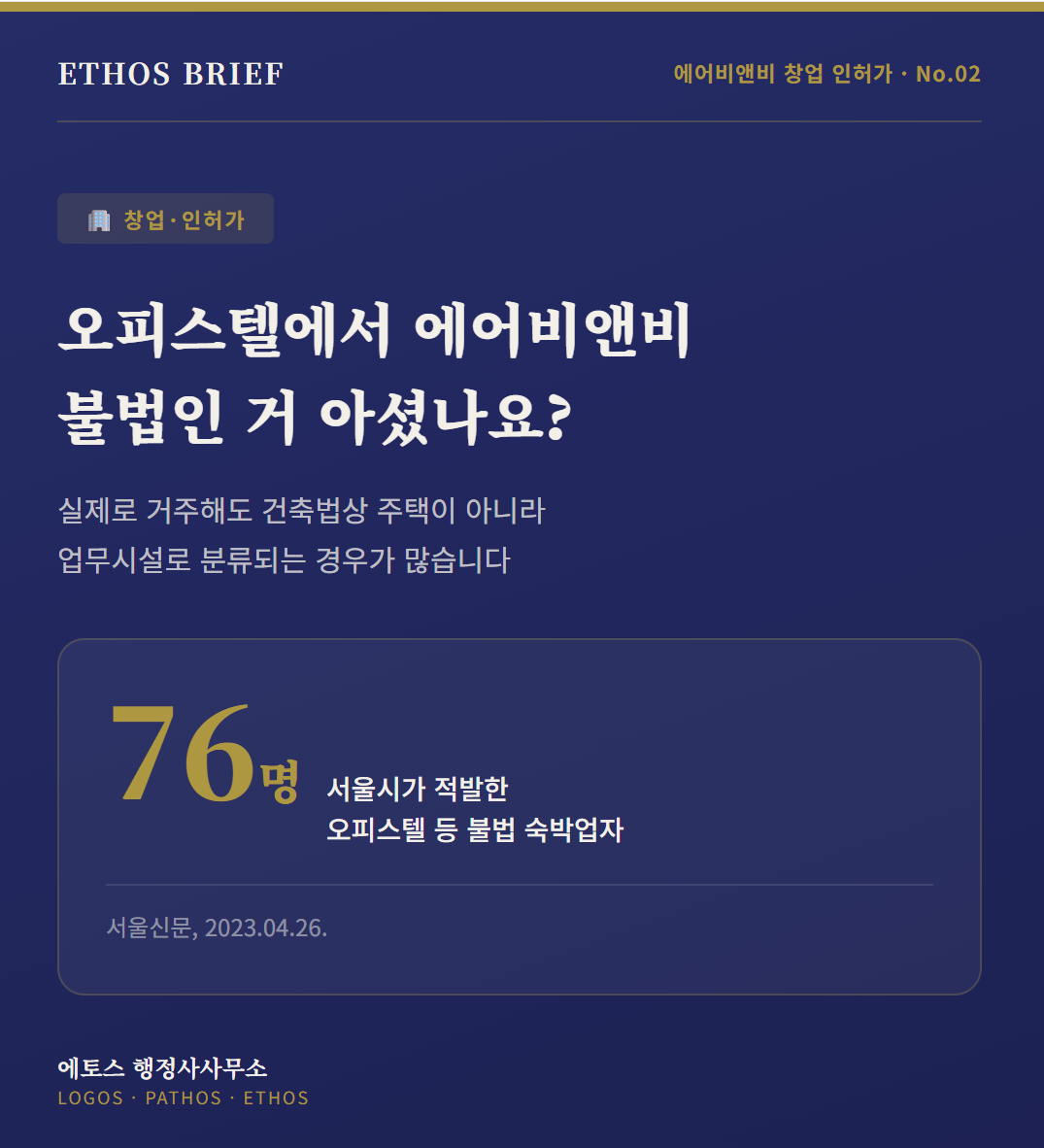
(Seoul Shinmun, April 26, 2023, “Lodging business in officetels”… Seoul detects 76 illegal lodging operators)
This is not just A’s story.
In Seoul, the number of unreported lodging businesses detected through online platforms has increased rapidly. Many of the detected illegal lodging businesses were officetels and goshiwons.
Then can’t you just change the building use?
It is much harder than it sounds.
The cost of change-of-use procedures alone can range from several million won to KRW 10 million. But in many cases, the change still fails because parking spaces or septic capacity do not meet the required standards.
To understand this structure accurately, we need to look at building use classifications under Korean building law.
The conclusion is this: foreign tourist urban homestay registration is generally reviewed only for housing under attached Table 1 of the Enforcement Decree of the Building Act.
Officetels are often classified as business facilities, so they may be excluded from foreign tourist urban homestay registration.
To change the use, Article 19 of the Building Act requires the building to meet all standards for the new intended use. If parking, septic, evacuation, or fire-prevention standards are not satisfied, change of use may be difficult.
Isn’t an Officetel a House?
Many people think it is housing because they actually live there.
You sleep there every day, wake up there, and may even have resident registration there. So why is it not housing?
Attached Table 1 of the Enforcement Decree of the Building Act classifies building uses. For Airbnb, the following three categories are especially important.
| Classification | Building Use | Included Buildings | |---|---|---| | Nos. 1–2 | Housing | Detached house, multi-household house, multi-family house, row house, apartment | | No. 14 | Business facility | Officetel, office, financial office, etc. | | No. 15 | Lodging facility | Hotel, motel, residence hotel, etc. |
Officetels are classified as buildings mainly used for business, with certain units allowing accommodation.
Because the term “accommodation” appears in the definition, it is easy to mistake them for housing.
But legally, officetels are generally classified as business facilities. Actually living there does not automatically change the building use to housing.
Foreign tourist urban homestay registration is based on a resident using the house where they live.
An officetel is not housing but a business facility, so foreign tourist urban homestay registration may be difficult.
The district office may refuse to accept the application or reject it during review.
“I Registered as a Leasing Business” Does Not Work
Some people argue, “I registered as a leasing business, so this is not lodging.”
But if the actual operation is lodging, the business category on the tax registration certificate does not protect you.
Imagine an operator who managed several officetel units and listed some vacant units on accommodation booking sites to fill vacancy.
The operator may argue, “I am in the leasing business, not lodging.”
But the deciding factor is not the name written on the business registration certificate. It is how the business is actually operated.
The following factors can make it likely to be treated as lodging:
- Daily pricing
- Check-in and check-out system
- Advertising through accommodation booking sites
- Provision of bedding and amenities
- Repeated short-term use
- Operation for unspecified guests
Simply put, no matter what the business registration certificate says, if you let people sleep there and charge money by the day, it may be treated as lodging.
The label “leasing business” is not a shield against the Public Health Control Act.
How Much Do You Lose If You Get Caught?
“Isn’t it just paying a fine?”
Actual cases show why that thinking is risky.
Case 1. Daejeon
An operator ran three unreported lodging properties for five years.
The nightly rate was KRW 120,000 to 130,000, and total revenue was about KRW 133 million.
The court imposed a criminal fine of KRW 6 million.
Case 2. Seoul and Jeju
An operator listed an officetel in Yeongdeungpo-gu, Seoul and a house in Jeju on Airbnb.
The nightly rate was KRW 280,000 to 350,000, and revenue was about KRW 100 million. But because the lodging was operated without proper reporting, the court imposed a criminal fine.
Case 3. Busan
An operator provided accommodation 518 times through a lodging-sharing site and received a KRW 7 million fine.
(Busan District Court, April 6, 2023, 2022Godan4217)
Compared to revenue, the fines may look like this.
| Case | Revenue | Fine | Ratio | |---|---:|---:|---:| | Daejeon | KRW 133 million | KRW 6 million | About 4.5% | | Seoul and Jeju | About KRW 100 million | KRW 6 million | About 6% | | Busan | Not disclosed | KRW 7 million | - |
At first glance, the fine may look like only a small percentage of revenue.
That is why some people think, “Can’t I just pay the fine and keep operating?”
But this calculation leaves out something important.
Administrative measures may proceed separately from criminal punishment.
- Business closure order
- Platform listing removal
- Restriction on re-listing the same address
- Revenue interruption
- Loss of interior cost
- Loss of furniture and appliance cost
- Criminal record risk
The statutory penalty for unreported lodging business can be imprisonment for up to two years or a fine of up to KRW 20 million.
Do not judge the risk by the fine amount alone.
Then Can’t I Just Change the Building Use?
If you hear “registration impossible” after finishing interior work, it is natural to want to save the project through change of use.
It is possible in theory.
Article 19 of the Building Act provides procedures for change of use.
Officetels and housing may fall within the same facility group under the Building Act, so in some cases the procedure may be processed as a change to the building register rather than a full permission or notification procedure. Procedurally, it may look relatively light.
But the real issue is Article 19(1) of the Building Act.
A building’s use may be changed only if it satisfies the building standards for the intended new use.
In other words, even if the paperwork looks simple, the change may fail if the physical building does not meet housing standards.
To change an officetel to housing, the following requirements must be checked.
Requirement 1. Parking Spaces
Housing may require more parking spaces per unit than an officetel.
For example, if a 50-unit officetel has only 30 parking spaces, changing it to housing may require many more spaces.
Unless adjacent land is acquired, this is often practically impossible.
Requirement 2. Septic or Wastewater Capacity
Under wastewater-related standards, housing may be calculated with a different expected wastewater generation volume than officetels.
Even with the same number of units, septic capacity may become insufficient. Expansion or replacement can cost several million to tens of millions of won.
Requirement 3. Evacuation and Fire Prevention Standards
Corridor width, stair structure, fire compartments, and evacuation routes must meet housing standards.
Changing these in an already-built building is not easy.
Requirement 4. Zoning
If the officetel is in a commercial area, restrictions on housing ratio or district unit plans may apply.
The standards vary by area, so individual review is required.
Requirement 5. Unit of Change
Even if you only want to change the use of one unit in a condominium-style building, the review may not be limited to that private unit.
Parking, evacuation, common areas, and building-wide legal standards may all need to be reviewed.
That means a single unit owner often cannot solve the issue alone.
In failed change-of-use cases, the most common barriers are parking shortage and insufficient septic capacity.
Design documents and permit review alone may cost several million to KRW 10 million. If parking or septic standards fail after spending that money, the cost is lost and the change still does not happen.
In short:
The procedure may look light, but the physical standards are heavy.
It is not just paperwork. The building itself must satisfy the standards.
In an already-built officetel, adding parking spaces or replacing septic systems is often practically impossible.
What About Residence Hotels?
Some people think, “If officetels do not work, what about a residence hotel?”
It has cooking facilities and is a lodging facility, so it may seem like foreign tourist urban homestay registration should work.
But residence hotels are classified as lodging facilities under attached Table 1 of the Enforcement Decree of the Building Act.
They are in the same broad category as hotels and motels.
They are different from officetels, but they are still not housing.
Foreign tourist urban homestay registration requires housing.
Therefore, foreign tourist urban homestay registration is difficult in a residence hotel.
There was once a special rule allowing residence hotels to convert to officetels, but that special period ended on October 14, 2024. The Ministry of Land, Infrastructure and Transport has stated that it is not reviewing an extension of that special conversion rule or recognition of residence hotels as quasi-housing.
The structure can be summarized as follows.
| Building Type | Building Act Classification | Foreign Tourist Urban Homestay Registration | |---|---|---| | Detached house, multi-household house, multi-family house, row house, apartment | Housing | Possible if requirements are met | | Officetel | Business facility | Not available | | Residence hotel | Lodging facility | Not available | | Neighborhood living facility or commercial unit | Neighborhood living facility | Not available |
Then Which Buildings Are Possible?
By this point, you may be wondering, “Does this mean my building cannot be used?”
There are definitely buildings where registration may be possible.
If the building register lists the use as housing, you may be able to move to the next step.
Representative building types where foreign tourist urban homestay registration may be reviewed include:
- Detached house
- Multi-household house
- Multi-family house
- Row house
- Apartment
However, even if the use is housing, additional checks are required.
- Whether the total floor area is under 230㎡
- Whether the host actually lives there
- Whether resident registration is made there
- Whether management rules prohibit homestay business
- Whether resident consent is required
- Whether fire and safety standards are met
- Whether foreign-language guidance can be prepared
Please refer to Part 1 for more details.
Check now.
Go to Government24 and view the building register.
If the use is listed as detached house, multi-household house, multi-family house, row house, or apartment, you can move to the next step.
If it says business facility, lodging facility, or neighborhood living facility, you should look for another route at this stage.
Check Your Current Situation
As you read this, you may have been asking, “Where does my building fall?”
Compare your situation with the list below.
- The building register lists the use as business facility or lodging facility.
- You are already operating or planning Airbnb in an officetel.
- You registered as a leasing business but receive guests on a daily basis.
- You are considering change of use but have not checked parking or septic requirements.
- You are trying to run foreign tourist urban homestay in a residence hotel.
- You have never checked the building register.
- The property is multi-unit housing, but you have not checked the management rules.
- You completed interior work and bought furniture before checking registration feasibility.
If even one applies, start by checking one screenshot of the building register.
That will help determine whether the building can be registered, whether change of use is realistic, and which route should be considered.
For building use review, one screenshot of the building register is enough to begin.
Summary
The reason Airbnb in officetels is difficult is not simply because district offices are strict.
It is because building use classification under the Building Act does not match the foreign tourist urban homestay registration standard under the Tourism Promotion Act.
The key points are:
- Foreign tourist urban homestay registration is generally reviewed for housing under the Building Act.
- Officetels are often classified as business facilities, making registration difficult.
- Even if tax office business registration says leasing business, the Public Health Control Act may apply if the actual operation is lodging.
- Change of use may look procedurally simple, but all building standards for the new use must be satisfied.
- If parking spaces, septic capacity, evacuation, or fire prevention standards do not match, change of use is difficult.
- Residence hotels are lodging facilities, not housing, so they are not eligible for foreign tourist urban homestay registration.
Some issues require individual review:
- Whether officetel change of use is possible
- Parking, septic, and evacuation conditions by building
- Whether multi-unit housing management rules prohibit homestay business
- Housing ratio restrictions in commercial areas
- District unit plans or local ordinance restrictions
- Whether actual residence requirements are met
- Whether the operating structure accepts only foreign tourists
Generally, if the building register lists the property as housing, registration may be possible.
But if it is listed as business facility or lodging facility, you must first check whether change of use is realistic.
This review starts with the building register.
For actual document design, district office registration applications, and change-of-use review, individual consultation is safer.
If any of the items above apply, start with one screenshot of the building register.
That will help determine which route is possible.
Before Choosing an Airbnb Property
When starting Airbnb in Korea, the first thing to check is not how nice the photos will look.
It is building use.
An officetel may look residential in practice, but legally it may not be housing. A residence hotel may be a lodging facility, but it is not housing for foreign tourist urban homestay purposes. Neighborhood living facilities and commercial units are similar.
Before signing a contract, renovating, or buying furniture, check at least the following:
- Is the building use listed as housing on the building register?
- Is it an officetel, business facility, lodging facility, or neighborhood living facility?
- Is the building eligible for foreign tourist urban homestay registration?
- Is the total floor area under 230㎡?
- Can actual residence and resident registration be satisfied?
- If it is multi-unit housing, are there restrictions in the management rules?
- If change of use is considered, are parking, septic, and evacuation standards satisfied?
- Even if change-of-use costs are paid, is the change actually realistic?
Business registration may be the starting point.
But for Airbnb, it is not the end.
Checking building use on the building register comes first.
In the third article, we will look at how foreign nationals should check visa status before hosting Airbnb in Korea.