
Unmanned Stores — 3 Licensing Issues People Often Miss
Hello, this is Administrative Agent Jean.
Over the weekend, on my way to Itaewon, I came across an unmanned tobacco store.
Near university areas, I also noticed more unmanned claw machine shops.
New types of businesses, including unmanned stores, are increasing quickly.
People often say that licensing and permits are the heart of administrative agent work.
In this series, I will look at new business models and where an administrative agent can help.
- Unmanned stores — 3 licensing issues people often miss ← This article
- Drone businesses — 3 registration steps before business registration
- Game development — required registration before uploading to app stores
- AI services — one business code can determine eligibility for government support
- Pet businesses — why pet food may require food manufacturing registration
- Shared kitchens — licensing changes once the structure becomes outsourced
Add this blog as a neighbor to receive updates faster.
A wants to open an unmanned ice cream store. A signs a franchise agreement and completes the lease for the shop. The next day, A goes to the tax office and registers the business under business code 564104, ice cream retail. Once the business registration certificate is issued, A fills the freezers, installs a kiosk, and starts operating.
Meanwhile, B wants to open an unmanned cafe in the shop next door. Like A, B first goes to the tax office. B registers the business as retail, installs a kiosk and coffee vending machine, and opens the store.
One month later, an officer from the district office’s hygiene department visits B’s store.
“Have you filed a business notification?”
B shows the business registration certificate.
“This is tax office registration. The district office business notification is separate. If the machine grinds coffee beans and makes drinks, you must first file a business notification for a restaurant-type business, such as a snack restaurant business, under Article 37 of the Food Sanitation Act.”
B had to stop operating that day. B then had to complete hygiene training, file the business notification with the district office, and change the business code to 521002, snack restaurant business. The process also required correcting the business registration that had already been issued.
A and B both operated unmanned stores. So why were the procedures different?
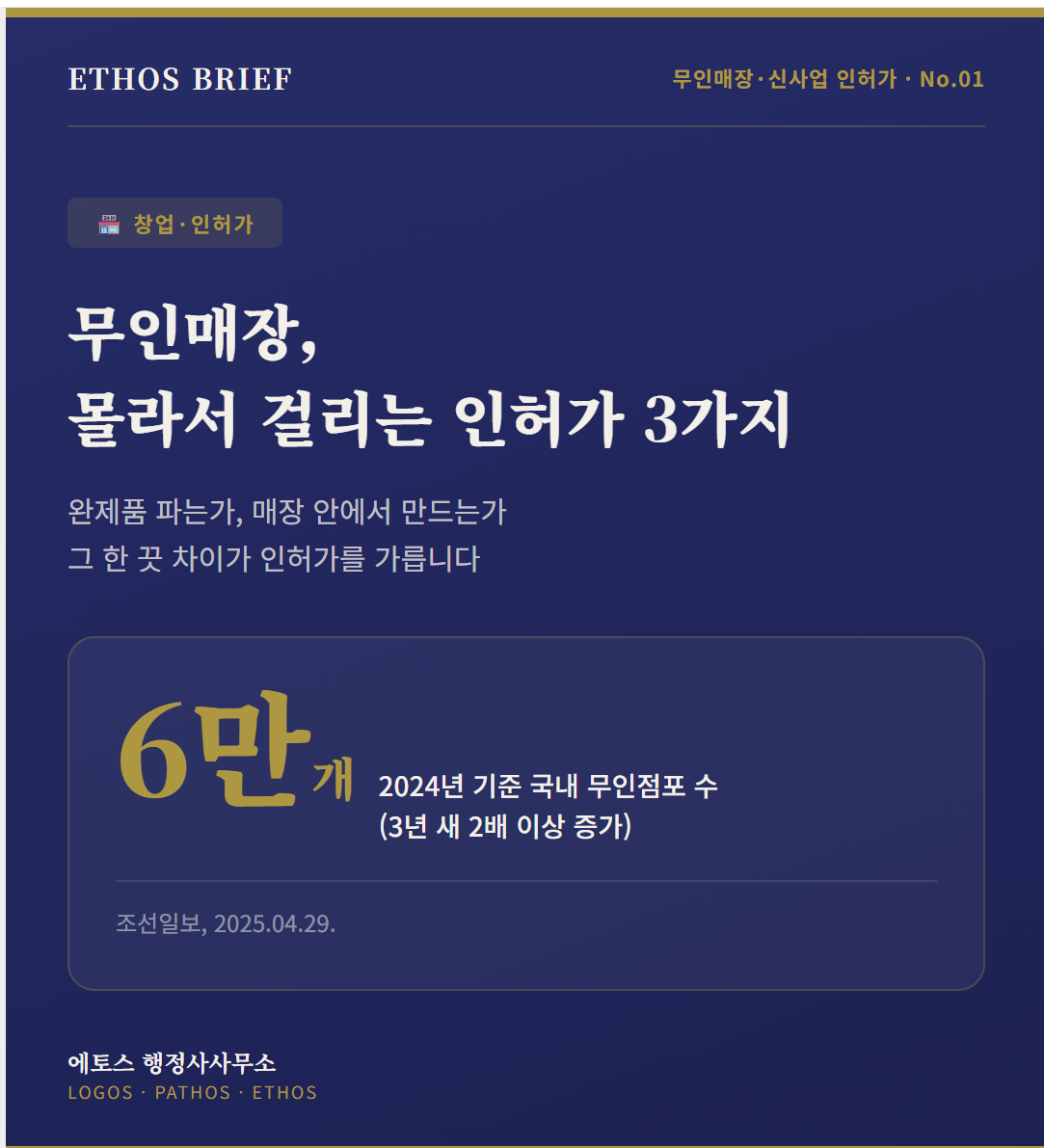
As of 2024, Korea had about 60,000 unmanned stores. The number more than doubled in three years.
(Chosun Ilbo, April 29, 2025, “Unmanned stores quadruple in five years… 30% of owners are in their 20s and 30s”)
As of December 31, 2025, there were 675 unmanned cafe franchises in Seoul alone.
(BizHankook, March 5, 2026, “[On-site] First-floor unmanned stores in a legal blind spot… 24-hour operation without fire extinguishers”)
The market is growing quickly, but many people start without understanding how licensing differs by business type.
Today, I will summarize the differences in three points.
1. Why do procedures differ even among unmanned stores?
There is one key standard.
Does the store “make” food inside the premises, or does it “sell” finished products?
Selling factory-packaged ice cream from a freezer and selling coffee extracted from beans by a machine are legally very different acts.
The former is generally a free business. Business registration at the tax office is enough.
The latter is a report-based business. Business notification to the district office comes first, and hygiene training is also required. Business registration comes after that.
Here is a practical summary.
1. Unmanned stores that can usually begin with tax office business registration only
| Business type | Business code | Standard | |---|---:|---| | Unmanned ice cream store | 564104 (ice cream retail) | Finished product sales | | Unmanned convenience store | 471201 (convenience store) | Finished product sales | | Unmanned stationery store | 478902 (stationery and office supplies retail) | Finished product sales | | Unmanned coin karaoke room | Free business | No food handling |
2. Unmanned stores that require district office business notification before business registration
| Business type | Type of notification | Agency | Additional requirement | |---|---|---|---| | Unmanned cafe (prepared drinks) | Snack restaurant business or food vending machine business | District office hygiene department | Hygiene training under Article 41 of the Food Sanitation Act | | Unmanned laundromat | Laundry business | District office | Laundry facility standards | | Unmanned instant food store (cup rice, ramen, etc.) | Instant food manufacturing and processing business | District office | Facility standards |
The most common problem is registering a vending-machine-style unmanned cafe as “retail.”
If a machine makes it, isn’t it not manufacturing?
The answer is no. Whether a machine or a person makes it, if there is a preparation process, it can be subject to notification.
Grinding coffee beans and passing water through them to extract a drink can constitute food cooking or processing under the Food Sanitation Act. The standard is not whether a human or machine performs the act. The standard is whether the item is a finished product or a prepared product.
Choosing the wrong business code does not end as a simple code error. It can affect VAT treatment and may cause disqualification from government support programs for small businesses. Later correction may require going back through both the tax office and the district office.
If you are unsure which category your unmanned store falls into, ask one question.
Is the customer taking a product exactly as packaged by the factory, or is something being made inside the store by a machine?
2. Adding Even One Tobacco Product Can Create Criminal Liability
As mentioned above, an unmanned convenience store is generally a free business. But the moment tobacco is added, a completely different regulatory structure applies.
Imagine this situation. You operate an unmanned convenience store. An adult-verification kiosk is installed. One day, a middle school student uses a parent’s ID to verify age and buys cigarettes. You are not physically present.
I installed the machine and had an age-verification process. Isn’t that enough?
Article 28(1) of the Youth Protection Act states:
No person shall sell tobacco to juveniles. This includes sales through automatic devices, unmanned sales devices, or communication devices.
The statute expressly includes “unmanned sales devices.” The argument that “I did not personally sell it, so I did not know” is difficult to sustain.
A violation is not merely an administrative fine. It can result in imprisonment for up to two years or a criminal fine of up to KRW 20 million.
(Article 59 subparagraph 6 of the same Act)
In other words, it is a criminal matter.
Here is a similar case.
Daegu District Court, Seobu Branch, 2020Gojeong134, judgment issued January 19, 2021. A convenience store employee sold cigarettes to a 14-year-old juvenile. The employee argued that the juvenile had presented a forged ID and appeared to be an adult. Although the case disputed intent, the important point is that prosecution occurred even though an ID had been checked.
The meaning for your business is simple. If a staffed store employee can be prosecuted despite visually checking an ID, a structure that relies only on a kiosk in an unmanned store carries even greater legal risk. If the system cannot detect another person’s ID being used, liability may fall on the business owner.
The National Health Promotion Act also applies. If a tobacco vending machine lacks an adult-verification device, administrative fines increase by violation count.
| Violation count | Fine | Legal basis | |---|---:|---| | 1st | KRW 750,000 | Article 34(2) of the National Health Promotion Act and attached Table 5 of the Enforcement Decree | | 2nd | KRW 1,500,000 | Article 34(2) of the National Health Promotion Act and attached Table 5 of the Enforcement Decree | | 3rd or more | KRW 3,000,000 | Article 34(2) of the National Health Promotion Act and attached Table 5 of the Enforcement Decree |
Licensing procedures for unmanned stores differ by business type. Check the requirements first through a free review.
3. You Install CCTV, Then Get Fined Because of the CCTV
CCTV is essential for unmanned stores. It helps prevent theft, monitor safety, and detect fire risks. But CCTV itself can become the starting point of a legal dispute.
Here is a recent case.
An unmanned ice cream store owner in Incheon checked CCTV footage and saw a child, B, leave without paying for one ice cream. The owner, A, posted a CCTV capture inside the store after applying a semi-transparent mosaic effect. A also reported the matter to the police.
From A’s perspective, this may have seemed natural. An item was missing, there was evidence, so A posted the image and gave the evidence to the police.
However, A was sentenced to a KRW 2 million fine for child abuse under the Child Welfare Act and defamation.
The first trial found A not guilty, but the appellate court reversed the decision.
According to the judgment, the court considered that B’s facial features were still identifiable despite the semi-transparent mosaic, and that A knew the parents’ contact information but chose to publicly post the image instead of contacting them directly, thereby applying psychological pressure. B’s father stated that the child woke up crying twice a day, and B was diagnosed with adjustment disorder.
(Incheon District Court, January 28, 2026, 2025No2329)
What does this case mean for you?
When theft occurs in an unmanned store, publicly posting CCTV footage can turn the victim into the defendant. If the other person is a child, child abuse allegations may be added. Even if you apply a mosaic effect, it is meaningless if the person remains identifiable. Theft response should stop at filing a police report and submitting the footage to the police. Do not post the footage inside the store.
There are also legal duties related to CCTV operation itself. Because unmanned stores do not have staff on site, these duties must be followed even more carefully.
One issue to watch carefully is audio recording. Many CCTV products for unmanned stores come with audio recording turned on by default. After installation, make sure to disable the recording function. If you do not, that itself can become a criminal offense. It is not just an administrative fine issue.
Signage is another common omission. If you install CCTV yourself instead of using a vendor, you may operate without a notice sign and later receive an administrative fine during inspection. There is no strict legal size or placement requirement for the sign, but it must be installed somewhere clearly visible, such as near the entrance.
What Is Clear and What Requires Individual Review
By this point, you can see that unmanned store licensing differs by business type.
When administrative rulings and court cases are collected and analyzed with AI, most administrative disposition cases involving unmanned stores arise because the owner “did not know.” In most cases, “I did not know” is not accepted as a defense.
Search results usually explain the “general case.” Actual notification and licensing requirements depend on your products and store structure. The following points must be checked:
- Cases where the store sits on the boundary between finished product sales and preparation
Examples: instant cup rice, vending-machine-style ramen - Building and fire safety requirements
Fire safety obligations vary by floor area, structure, and building use. - Local government notification procedures
Even for the same snack restaurant business notification, required documents may differ by district office. - Specific specifications for adult-verification systems when tobacco is handled
What Changes When You Work With an Administrative Agent?
Earlier, I mentioned B. B first registered the business as retail at the tax office, then later received a request from the district office hygiene department to file a business notification.
Here is what B had to go through.
- Stop operating.
- Complete six hours of hygiene training through the Korea Food Industry Association.
- File a snack restaurant business notification with the district office hygiene department. At this stage, the store must satisfy facility standards such as kitchen separation, water supply, and ventilation. If the standards are not met, the facilities must be fixed and the notification must be filed again.
- Once the business notification certificate is issued, go to the tax office and correct the existing business registration code from retail to 521002, snack restaurant business.
- Re-register card terminals and delivery platforms with the corrected business registration certificate.
It usually takes two to three weeks to stop and restart operations. During that period, rent and franchise fees that have already been paid continue to disappear.
What would have been different if B had checked with an administrative agent from the beginning?
Before opening, the agent would review the products handled and the store structure, then determine whether the business is a free business or a report-based business. If it is report-based, the business notification would be completed first, the correct business code would be selected, and then business registration would be filed. CCTV notice wording and the personal information processing policy would also be prepared before opening. If tobacco is handled, the adult-verification device requirements would be checked against legal standards.
It is simply a matter of getting the order right. But if the order is wrong, you may have to stop operating like B. If the order is right, you can start without interruption.
Not every unmanned store is complicated. If you only sell finished products, such as in an unmanned ice cream store, business registration may be enough.
Still, it is better to confirm which category your store falls into before you start. Fixing it later costs more time, money, and stress than getting it right from the beginning.
Check first, for free, which category your store falls into.
Get a Free Review Before Opening an Unmanned Store
In Part 2 of this series, Drone Businesses — 3 Registration Steps Before Business Registration, I will explain that once you start providing paid drone services, there may be a separate business registration requirement with the Ministry of Land, Infrastructure and Transport, apart from tax office business registration.