Do You Have to Report an Overseas Stake Under 10%
BySangjin Ji, Administrative Attorney3 years of embassy visa practiceLinkedIn
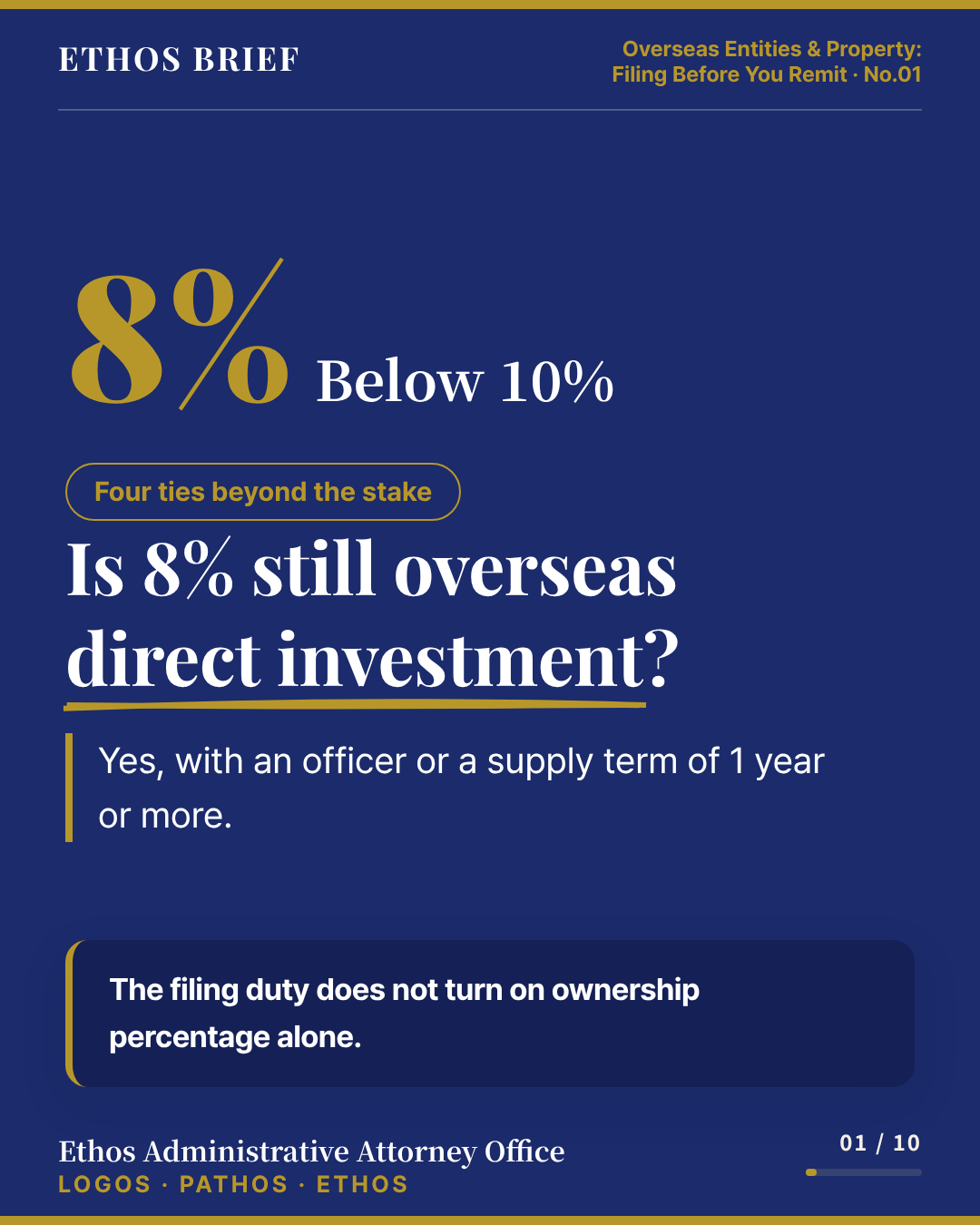
Junho runs a business that makes pet products. Next week he plans to sign a contract to buy 8% of a partner factory in Vietnam and wire the purchase price. He has bought from this factory for years, and he wants a stake to make the relationship more solid.
He underlines the ownership line and thinks, "It's under 10%, so I probably don't need to file anything." But two more lines sit on the back page of the contract. One says his company will send one employee to the factory as an officer. The other says his company will buy a set volume of the factory's products for the next two years. Before signing, both read like ordinary commercial terms.
So his questions are simple. Do you have to file a foreign exchange report for a stake under 10%? And can you wire the money first?
The answer is that this deal is overseas direct investment even at 8%. The ownership percentage did not make it reportable. The two clauses under the ownership line did. The Enforcement Decree of Korea's Foreign Exchange Transactions Act (「외국환거래법 시행령」) treats a stake under 10% as overseas direct investment when the investor forms any one of four ties with the foreign company: sending an officer, signing a goods or raw-material sale contract of one year or more, providing or receiving technology or doing joint R&D, or winning overseas construction or industrial plant work. Junho's contract contains two of the four. If a filing is required, the filing and its acceptance must be completed before the money is sent.
Missing this filing is not unusual. Korea's Financial Supervisory Service (FSS) announced in July 2026 that of 1,072 violations of the Act in the previous year, 478 (44.6%) involved overseas direct investment, the largest share, and individuals accounted for 441 (41.1%) of the violators (reported by Capital Market News, July 14, 2026).
Overseas direct investment is not decided by ownership alone
Article 3(1)(18) of the Foreign Exchange Transactions Act (「외국환거래법」) defines two kinds of acts by a resident as overseas direct investment.
The first is acquiring securities issued by a company established under foreign law (including a company still being established), or lending money to it, in order to build a lasting economic relationship with that company. Taking shares while setting up a new overseas company falls here too. The second is paying money to set up, expand, or run a business office abroad, or to carry on overseas business. In both cases, the Enforcement Decree sets the specific scope.
A resident here means an individual with a domicile or residence in Korea and a corporation whose main office is in Korea (Article 3(1)(14)). A Korean company like Junho's and an individual business owner living in Korea both qualify. This article does not cover when a foreigner living in Korea becomes a resident.
The basic test is a 10% ownership share. Under Article 8(1)(1) of the Enforcement Decree, shares or capital contributions acquired to take part in the management of a foreign company count as overseas direct investment if they are 10% or more of its issued shares or total capital. When several people acquire shares together, the combined ratio is used. A Korea-based individual who sets up a U.S. company and holds 100% of it is also making overseas direct investment.
Article 8 sets no minimum amount. The FSS has also said that even an investment of one U.S. dollar needs a prior filing or a report within three months. So to know whether your deal is overseas direct investment, look at the ownership share and at the ties described next.
Four ties that make a stake under 10% reportable
Junho's 8% is under 10%. But Article 8(1)(2) of the Decree says that even below 10%, the investment counts as overseas direct investment if you form any one of these ties with the foreign company:
- Sending an officer.
- Signing a sale contract for raw materials or products with a term of one year or more.
- Providing or receiving technology, or signing a joint research and development contract.
- Signing a contract to win overseas construction or industrial plant work.
Apply this to Junho's draft. The clause sending one employee as an officer of the factory is the first tie. The ownership line is at the front of the contract, while the officer clause sits in the section on board composition, so a reader who stops at the percentage can miss it.
The clause to buy set volumes for two years is the second tie. What matters is whether the contract term is one year or more. The same supply deal with a six-month term would not meet this item.
The third tie covers technology moving in either direction, or joint R&D. A clause handing the factory your product drawings and manufacturing methods, or one giving you a right to use the factory's technology, relates to it. The fourth covers a contractor or equipment maker that takes a small stake in a local company and also wins that company's construction or plant work.
So whether Junho holds 8% or 5%, the officer clause alone makes this deal overseas direct investment. If he bought 8% and none of the four ties existed, Article 8(1)(2) would not apply. In this provision, the ownership figure and the ties you form with the foreign company decide whether you must file.
If it is not overseas direct investment, is any procedure needed?
It is too early to say no. Even when a deal is not overseas direct investment, buying shares of a foreign company is an acquisition of securities, which is a capital transaction under the Act. Capital transactions must in principle be reported (Article 18(1)).
The Foreign Exchange Transactions Regulation (Article 7-31(1)) lists cases where no report is needed. One is investing in foreign securities under the procedure for foreign-currency securities investment, which assumes you buy and sell through an investment broker. But a proviso in the same paragraph sends any purchase of shares made to take part in the management of a foreign company back to the overseas direct investment rules. Even if a case fits a listed exception, a management purpose triggers that proviso.
For Junho, two things need checking:
- The route: whether he buys through a broker, or signs a share purchase agreement directly with the factory.
- The purpose: whether he is taking part in the factory's management to strengthen the business relationship.
Because he writes the contract himself and sends an officer, he should first test whether he fits any no-report exception at all.
Buying more shares or lending to a company you already invested in
People tend to think about filing only for the first investment. But Article 8(1) of the Decree treats later transactions as overseas direct investment too.
Item 3 covers acquiring additional shares or capital contributions in a foreign company in which you already invested under those tests. If Junho starts at 8% and buys another 7% a year later, that further purchase is also overseas direct investment.
Item 4 covers a resident who has made such an investment and then lends money to that company with a repayment term of one year or more. If the factory asks for a loan to expand its equipment and Junho lends it money repayable in two years, this item applies.
When there are no shares at all
You can make overseas direct investment without setting up a company or buying shares. Article 8(2) of the Decree covers payments of money for:
- Setup costs and operating funds for a branch or office.
- Setting up or running an unincorporated business abroad.
- Overseas resource development or infrastructure development projects, except survey funds for resource development and funds to buy overseas resources.
For example, suppose Junho opens only an office abroad for online sales, with no local company, and sends money for setup costs and operating funds. That can fall under the first category. Not having set up a company does not take the payment out of scope.
How early must the filing be finished?
Back to Junho's first question: can he wire the purchase price first? Under Article 18(2) of the Act, the filing and its acceptance must be completed before the remittance procedure.
Under paragraph 3, for overseas direct investment the competent minister can review the investor's eligibility and the appropriateness of the investment price and decide whether to accept the filing. So you cannot send money the day you submit the form. There is a review step to decide acceptance.
That is why you should work out whether a deal is reportable before you sign, and at the latest before you fill in the wire request. If you learn about the filing and review only after fixing the signing and wiring dates, you will have to rebuild the schedule.
Six things to mark in your own contract
Junho's contract had the ownership share at the front, the officer clause in the board section, and the supply term in a side agreement. Whether a deal is overseas direct investment is decided by gathering clauses scattered like this, not by one line in one document. If you are preparing a deal, open the contract, the shareholders' agreement, and any side agreements, and mark these six things:
- Ownership share: what percentage of the foreign company's issued shares or total capital you will hold, and whether anyone else acquires shares in the same deal.
- Officer dispatch: wording in the shareholders' agreement, articles of incorporation, or board clauses about sending your employee or representative as an officer.
- Sale contract of one year or more: whether a supply contract or side agreement for raw materials or products runs one year or more.
- Technology or joint research: whether a technology transfer, license, joint development agreement, or memorandum of understanding has you give or receive technology or do joint R&D.
- More shares or loans: whether a funding plan or loan agreement has you buying more shares of a company you already invested in, or lending money with a term of one year or more.
- Branch or office: whether an office plan or lease involves sending setup costs or operating funds.
If you are an individual with a domicile or residence in Korea, or a company whose main office is in Korea, and any of the six is marked, check before you wire whether the deal is reportable overseas direct investment. Note where in each document you found the clause, so you can show it quickly when you talk to the reporting bank or agency.
For Junho, the marks fall on two places, the officer clause and the two-year supply clause, not on the single 8% line. That lets him answer his first question: "It's under 10%, so do I have to file?" The answer is that the test looks at the ties with the foreign company, not at the ownership figure alone.
If you plan to buy shares of an overseas company or set up a local company or office, send us the draft share purchase agreement or letter of intent, the target company's ownership and officer details, and your planned wire date and amount before you sign, and Ethos Administrative Attorney Office will use a free preliminary review to find the ownership, officer, supply, and technology clauses scattered across the contract and side agreements, show which item of Article 8 of the Decree each one touches, and explain whether the deal looks reportable and in what order to prepare before wiring.
Three-line summary
① Even if your stake is under 10%, a tie with the foreign company such as sending an officer, a goods or raw-material sale contract of one year or more, providing or receiving technology or joint R&D, or winning overseas construction or industrial plant work makes it overseas direct investment.
② Acquiring 10% or more, buying more shares of a company you already invested in, lending to it for one year or more, and paying branch or office setup costs and operating funds are also overseas direct investment. Article 8 of the Decree sets no minimum investment amount.
③ The filing and its acceptance must be completed before you send money, so before you sign, mark the ownership share, officer, supply term, and technology clauses and see which item they fall under.