
Can a De Facto Spouse Inherit in Korea? Property Division, Survivor Pension, and Cohabitation Agreements
Hello, this is Administrative Agent Jean.
On January 4, 2024, the Supreme Court of Korea issued an important decision on the reference date for property division after dissolution of a de facto marriage.
The Court reaffirmed that, in property division based on the dissolution of a de facto marriage, the subject property and its value should be determined as of the date the de facto marriage ended.
The key question is this:
Can you prove when the de facto marriage ended?
People who have lived together for many years may think:
We were practically spouses. Why does one registration document matter so much?
In reality, it matters.
De facto couples, unmarried cohabiting couples, and middle-aged couples who postpone remarriage may be socially treated like spouses.
But legally, they are treated differently from legally married spouses in important moments.
The difference becomes most serious when one partner dies first.
This article explains inheritance, property division, survivor pensions, and how cohabitation agreements and fact confirmation documents can help reduce risk.
Key Summary
| Category | Legal Spouse | De Facto Spouse | |---|---|---| | Inheritance | Recognized as spouse under the Civil Act | Generally no inheritance right | | Property division if relationship ends during lifetime | Available upon divorce | May be available upon dissolution of de facto marriage | | Property division if relationship ends by death | Handled through inheritance system | Generally not recognized under precedent | | Survivor pension | Claimable as spouse | May be possible if de facto marriage is proven | | Evidence burden | Marriage certificate explains the relationship | Evidence of shared life, marriage-like intent, and economic community required | | Practical preparation | Optional in many cases | Close to essential |
Core of the 2024 Supreme Court Decision: The Reference Date Is the Date of Dissolution
The key point of Supreme Court Decision 2022Meu11027, rendered on January 4, 2024, is clear.
In property division following dissolution of a de facto marriage, the property subject to division and its value should be determined based on the date the de facto marriage ended.
For example:
Suppose the de facto relationship ended in 2020, but the property division case is litigated in 2024.
If real estate prices changed significantly between 2020 and 2024, which date should be used?
The Supreme Court held that, in principle, the date of dissolution of the de facto marriage should be used.
This matters in practice.
If you cannot prove when the de facto marriage ended, the reference date itself may become a dispute.
Was it the date one partner moved out?
The date living expenses stopped?
The date one person changed residence?
The date the lawsuit was filed?
In de facto relationships, the following materials can matter:
- Date cohabitation began
- Date separation began
- Date living expense transfers stopped
- Date lease agreement changed
- Date residence registration changed
- Bank transfers and shared living expense records
- Records showing intention to end the relationship
- Property management records after separation
Property division is about money.
And money often begins with dates.
What a De Facto Spouse May Lose
Some areas of law protect de facto spouses similarly to legal spouses.
But in major areas, protection is missing.
The clearest examples are inheritance and post-death property division.
1. A De Facto Spouse Generally Has No Inheritance Right
The “spouse” under Civil Act Article 1003(1) generally means a legally married spouse whose marriage has been registered.
Therefore, a de facto spouse is generally not an heir when the other partner dies.
This issue has been challenged before the Constitutional Court.
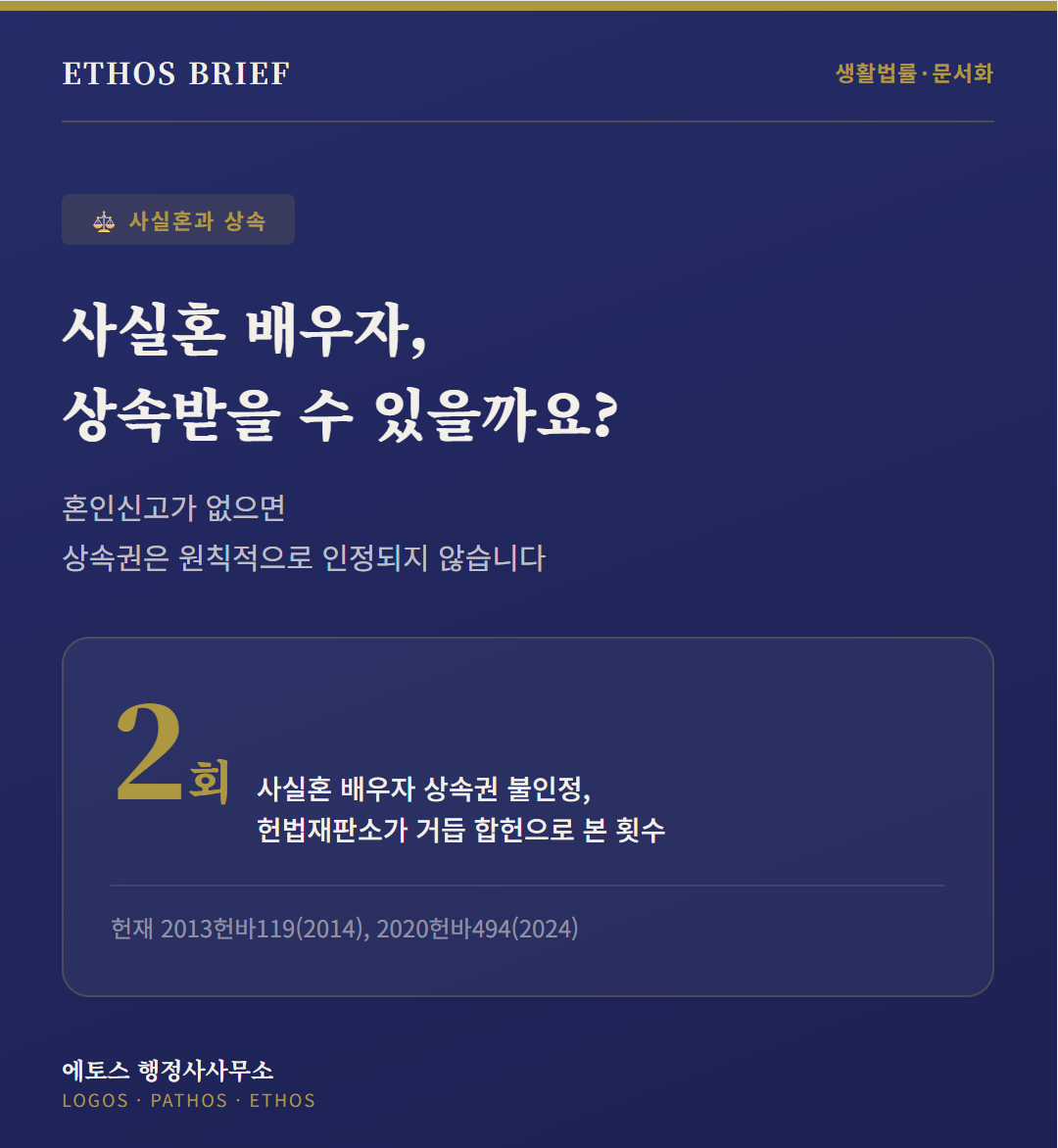
In its August 28, 2014 decision, 2013Hun-Ba119, the Constitutional Court held that excluding de facto spouses from inheritance rights under Civil Act Article 1003(1) was constitutional.
The reasoning was that inheritance relationships require objective clarity in order to prevent disputes and protect transaction safety.
On March 28, 2024, in decisions 2020Hun-Ba494 and 2021Hun-Ba22, the Constitutional Court again upheld the current structure that does not grant inheritance rights to de facto spouses.
This means that even if two people lived together for more than ten years, without marriage registration, the surviving partner is generally not recognized as a legal spouse-heir.
The difference is huge.
When one partner dies, the estate goes to legal heirs under the Civil Act.
Legal heirs are determined by statutory order, such as children, parents, and siblings.
A de facto spouse who lived together for many years and contributed to the formation of property does not automatically enter the list of heirs.
2. If the Relationship Ends by Death, Property Division Is Also Difficult
If a de facto marriage ends while both parties are alive, property division may be possible.
The Supreme Court has held that property division rules may apply by analogy to de facto marriages.
The reason is that property division is not merely compensation for emotional harm.
It is a system for liquidating property formed during the couple’s shared life.
But when a de facto marriage ends because one partner dies, the result is different.
In Supreme Court Decision 2005Du15595, rendered on March 24, 2006, the Court held that when a de facto marriage ends by the death of one party, the surviving de facto spouse cannot be recognized as having a property division claim.
As a result, the surviving de facto spouse may fall into a legal gap:
- No inheritance right
- Post-death property division generally unavailable
- Difficulty asserting direct rights over property titled under the deceased partner
- Increased risk of disputes with legal heirs
- Heavy burden to prove contribution after death
This is why advance documentation is so important.
3. Survivor Pension May Be Possible, But Proof Is the Problem
Unlike inheritance, some social security systems protect de facto spouses.
The National Pension Act includes persons in a de facto marital relationship within the concept of spouse for certain purposes. The Industrial Accident Compensation Insurance Act also includes a spouse in a de facto marital relationship within the scope of survivors.
Public employee pension and public employee accident compensation systems may also recognize de facto spouses in certain contexts.
So a de facto spouse may be able to receive survivor pension benefits.
But it is not automatic.
The biggest practical problem is proof.
The pension agency or relevant institution will ask whether the de facto marriage actually existed.
Useful evidence may include:
- Residence records showing cohabitation
- Lease agreement
- Joint title or shared contribution documents
- Living expense bank transfers
- Insurance beneficiary designation
- Family event participation records
- Hospital guardian records
- Statements from people who knew the relationship
- Photos, messages, and travel records
- Joint account or shared spending records
Collecting these materials after the other person has already died is extremely difficult.
That is why they should be organized during the relationship.
The Most Dangerous Moment: Dispute With Legal Heirs After Death
The difficulty of a de facto relationship often becomes clear only after death.
Consider this example.
Two people lived together for 15 years.
The home is titled under one partner’s name.
The surviving partner contributed part of the deposit and paid much of the living expenses.
Furniture, appliances, and vehicle costs were also shared.
Then the titled partner suddenly dies.
The legal heirs are the deceased partner’s siblings.
They may say:
The home was under the deceased’s name.
The bank account was also under the deceased’s name.
You were not a legal spouse, so you have no inheritance right.
At that point, the surviving partner must prove that the relationship was effectively marital.
But the other partner is no longer alive.
There is no one to confirm the shared understanding.
Documents become critical.
The surviving partner may need to prove:
- Who paid what
- What property was jointly formed
- Whether the relationship was a de facto marriage
- How living expenses were shared
- Who owns the rental deposit and household items
- What the deceased partner intended
All of this must be proven after death.
Cohabitation agreements, property ownership agreements, and fact confirmation statements help reduce that burden.
Why Does “Dissolution Before Death” Matter?
Supreme Court Decision 2008Seu105, issued on February 9, 2009, is often discussed in relation to de facto marriage dissolution and property division.
A de facto marriage may be dissolved by one party’s expression of intent. If the de facto marriage is dissolved before death, property division may be considered.
By contrast, if the relationship ends by death, property division is generally difficult under existing precedent.
This difference is significant.
- Dissolution during lifetime: property division may be possible
- Termination by death: no inheritance right and property division is difficult
This does not mean that couples should intentionally end their relationship.
The point is that property matters should be organized during both partners’ lifetime.
Accidents and illnesses do not always give warning.
Documents prepared while the relationship is stable may become the strongest protection in a crisis.
What Would a Cohabitation Agreement Change?
A cohabitation agreement does not replace marriage registration.
But in a de facto or unmarried cohabiting relationship, it can become important evidence.
A cohabitation agreement may document:
- When the couple began living together
- Whether they intended to live as a marriage-like household
- How rent and maintenance fees were shared
- Who contributed how much to the rental deposit
- Who owns jointly purchased property
- How property will be settled if the relationship ends
- What materials should be submitted if one partner dies or becomes seriously ill
- What evidence may support survivor pension or institutional applications
A cohabitation agreement alone does not solve everything.
But it can be a core document explaining the substance of the relationship.
It becomes more powerful when submitted with other evidence:
- Residence records
- Bank transfer records
- Photos of shared life
- Statements from family or friends
- Insurance beneficiary designation
- Lease agreement
- Utility payment records
The role of a cohabitation agreement is to organize scattered evidence into one clear structure.
Documents to Consider in a De Facto Relationship
| Document | Purpose | |---|---| | Cohabitation agreement | Shared life structure, living expenses, rental deposit, and settlement rules | | Living agreement | Daily rules, expense sharing, caregiving, and joint account use | | Property ownership agreement | Ownership and settlement rules for real estate, deposits, appliances, vehicles, accounts | | Deposit contribution statement | Separates lease title from actual deposit contribution | | Fact confirmation statement | Organizes de facto relationship, shared life, and economic community facts | | Statements from people who know the couple | Family, friends, neighbors, or acquaintances describe the shared life | | Survivor pension evidence summary | Organizes facts and evidence for pension agency submission | | Will review materials | Helps review lifetime transfer, bequest, or estate planning options | | Insurance beneficiary confirmation | Checks who will receive insurance proceeds upon death |
One important point:
A fact confirmation statement or agreement prepared by an administrative agent is not a notarization or court judgment.
It does not create inheritance rights by itself.
But it can organize facts, party intent, and supporting evidence in a way that reduces the burden of proof if a dispute arises.
If notarization, wills, inheritance, litigation, or tax issues are involved, attorneys, notaries, judicial scriveners, or tax professionals should be consulted.
How Can an Administrative Agent Help?
Under the Administrative Agent Act, administrative agents may prepare documents concerning rights, obligations, fact certification, contracts, agreements, confirmations, and factual statements within the permitted scope.
For de facto and unmarried cohabiting relationships, an administrative agent may assist with:
- Organizing the facts of shared life
- Reviewing living expenses, rental deposit, and shared property structure
- Drafting a cohabitation agreement or living agreement
- Preparing a draft property ownership agreement
- Preparing a fact confirmation statement
- Organizing evidence for survivor pension or institutional submission
- Preparing purpose-specific explanation documents
- Identifying when notarization, inheritance, litigation, or tax professionals should be involved
The following are not administrative agent services:
- Litigation representation
- Representation in inheritance property division proceedings
- Notarial will representation
- Tax filing or tax representation
- Registration filing representation
Those areas should be handled by attorneys, notaries, tax professionals, or judicial scriveners as applicable.
Checklist: What to Review Now
If you are in a de facto or unmarried cohabiting relationship, check the following:
- Do you have evidence showing when you began living together?
- Is the leaseholder the same person who contributed the rental deposit?
- Have you documented the deposit contribution ratio?
- Is the living expense-sharing method documented?
- Are there jointly purchased appliances, furniture, or vehicles?
- Is there property under one person’s name that both people helped form?
- Are insurance beneficiaries or pension-related beneficiaries designated?
- Have you organized family contacts, institutions, and documents needed if one partner dies?
- Should a will, lifetime gift, or insurance beneficiary designation be reviewed?
- Are there family or friends who can confirm the relationship?
- Do you have evidence showing when the relationship ended, if separation occurs?
If even one answer is “no” or “I am not sure,” it is worth organizing documents now.
Frequently Asked Questions
Q. Can a de facto spouse inherit?
In principle, spouse inheritance rights under the Civil Act are recognized for legally married spouses. A de facto spouse is generally not an heir. However, a will, bequest, insurance beneficiary designation, special relationship property distribution, or other mechanism may be reviewed depending on the case.
Q. Can a de facto spouse claim property division?
If the de facto relationship ends while both parties are alive, property division may be possible. The Supreme Court has recognized that property division rules may apply by analogy to de facto marriages.
Q. If the other partner dies, can the surviving de facto spouse claim property division?
Under current precedent, when a de facto marriage ends by death, the surviving de facto spouse is generally not recognized as having a property division claim. This is why lifetime documentation and planning are important.
Q. Can a de facto spouse receive survivor pension?
Depending on the system, a de facto spouse may qualify for survivor pension benefits. However, the relationship must be proven, and required documents may vary by institution.
Q. Does a cohabitation agreement create inheritance rights?
No. A cohabitation agreement does not create inheritance rights. It may help prove shared life, property contribution, living expense sharing, and settlement rules.
Q. Is a fact confirmation statement the same as notarization?
No. A fact confirmation statement prepared by an administrative agent is not the same as notarization or a court judgment. It can help organize facts and evidence, but notarization should be separately reviewed if stronger evidentiary value or enforceability is needed.
Closing
A de facto relationship may feel like marriage in daily life, but legal gaps remain.
If the couple separates during both parties’ lifetime, property division may be available.
But if one partner dies, the surviving de facto spouse generally has no inheritance right and may not be able to claim property division.
That difference is enormous.
So in a de facto relationship, relying only on “we trust each other” is not enough.
Documents should be prepared while the relationship is stable.
Who paid living expenses?
Who contributed to the deposit?
Who owns jointly formed property?
What happens if one partner dies or the relationship ends?
These questions should be written down.
Documents can reduce the gaps that the law does not fill.
A cohabitation agreement, property ownership agreement, fact confirmation statement, and evidence list are realistic safeguards for the time two people have built together.
Organizing the relationship before it becomes a dispute.
That is one of the most practical forms of preparation for de facto couples.