
If You Reduce Delivery and Focus on Dine-In Service, Do You Need to File a Change Report? Change Reports and Closure Procedures Restaurant Owners Often Find Confusing
Hello, this is Administrative Agent Jean.
On June 18, the Korea Fair Trade Commission rejected applications by Baedal Minjok and Coupang to initiate consent decree procedures.
As a result, the mutual cooperation measures proposed by Baedal Minjok, worth approximately KRW 300 billion, and by Coupang, worth approximately KRW 60 billion, will not be implemented through the consent decree procedure. The KFTC decided to continue the main deliberation of the related cases.
For restaurant owners who use delivery apps, however, there is a more practical issue.
How should the restaurant be operated in the meantime?
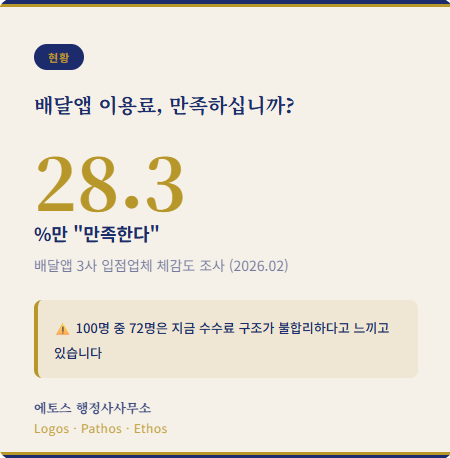
According to a survey by the Ministry of SMEs and Startups and the Korea Commission for Corporate Partnership, only 28.3% of businesses listed on delivery apps were satisfied with the fees. For restaurants with a high proportion of delivery sales, changes in the fee structure can directly affect the business model.
So restaurant owners may start thinking:
Should I reduce delivery altogether and focus on dine-in customers?
Should I reduce the menu and move to a smaller store?
Can I change the business into a different type instead of a general restaurant?
Would it be better to close and start again?
This is where administrative issues begin.
The important point is not whether you use delivery apps or not.
When changing your business model, you must check whether the details reported under the Food Sanitation Act are also changing.
If You Stop Using Delivery Apps or Reduce Delivery, Do You Need to File a Change Report?
You do not need to file a change report under the Food Sanitation Act simply because you cancel a delivery app or reduce the share of delivery sales.
Article 37(4) of the Food Sanitation Act requires a change report when important reported matters of the business are changed. Government24 also explains this procedure as a civil service application used when changing reported matters for an existing food-related business.
In other words, the following facts alone do not immediately require a change to the business report:
- You cancelled Baedal Minjok
- You no longer receive Coupang Eats orders
- You reduced delivery sales
- You increased the share of dine-in sales
The problem arises when, in that process, the reported matters themselves change, such as trade name, business area, or location.
If you change a matter subject to change reporting under the Enforcement Rule of the Food Sanitation Act, you must, in principle, file a report using attached Form No. 41 within 7 days from the date of change.
This distinction must be made first.
Then What Types of Changes Require a Change Report?
Representative items to check include:
- Name of the business operator or corporate representative
- Business name or trade name
- Location of the business place
- Business area
- Other matters designated by law as subject to change reporting
These major change items are also stated in the current food business report change application form.
For example, suppose a restaurant owner operated a 20-pyeong delivery-focused store, but due to fee burdens, reduced the kitchen size and transferred part of the space to another use.
What matters more than reducing delivery app use itself is the fact that the actual business area changed.
There are also administrative appeal cases where a 7-day business suspension became an issue because the business area was changed without filing a report.
Therefore, when changing the business structure, you should first ask:
Am I only changing the way I operate?
Or:
Am I changing the details already reported to the administrative agency?
These are completely different issues.
Can You Really Be Penalized for Not Filing a Change Report?
Reporting obligations under the Food Sanitation Act should not be taken lightly.
Article 97 of the Food Sanitation Act provides that a violation of Article 37(4) may be punished by imprisonment for up to 3 years or a fine of up to KRW 30 million.
Of course, this does not mean that every late report immediately leads to the maximum level of criminal punishment.
In actual cases, administrative disposition standards are also applied depending on the nature and degree of the violation.
The important point is that this is not merely an administrative correction issue.
Courts and administrative appeal decisions have treated cases where a business operated after changing the business area without filing a report as violations of the Food Sanitation Act.
Therefore, when changing the interior, reducing, or expanding a store, it is necessary to check both the area stated on the business report certificate and the actual business place.
If a General Restaurant Stops Selling Alcohol, Does It Become a Rest Restaurant?
No.
This is an especially common source of confusion.
The Enforcement Decree of the Food Sanitation Act defines rest restaurant business and general restaurant business as different types of business.
A rest restaurant prepares and sells food, but drinking alcohol is not permitted, while a general restaurant prepares and sells food and allows alcohol consumption as incidental to meals.
A common misunderstanding arises here.
Since my restaurant no longer sells alcohol, isn’t it now a rest restaurant?
That is not the case.
If a business reported as a general restaurant stops selling alcohol, the reported business type does not automatically change to a rest restaurant.
Conversely, if you intend to convert the business itself into a rest restaurant, you must separately check which business type should be reported and what facility standards apply, apart from simply removing alcohol from the menu.
In other words:
Changing the menu and changing the business type are not the same thing.
If You Move the Store, Is It Just a Matter of Changing the Address?
Formally, it is a change report procedure, but in practice there may be much more to check.
Government24 explains that a change of location for a food-related business is also handled through the change report procedure.
As of 2026, the fee is listed as KRW 26,500 for a change of location and KRW 9,300 for changes other than location. Applications can be submitted online, in person, or by mail.
But the important point is not the name of the form.
You must check whether restaurant business is actually possible at the new location.
Depending on the case, relocation may require checking the building register, land use plan, LPG facility-related materials, and other documents. The current change report form also separately lists items to be checked or attached for a change of location.
For example:
You decide to close the current store and move to a cheaper building with lower rent.
You sign the lease first and even start interior construction.
But at the reporting stage, problems are found with the building use or facility requirements.
In this case, the problem is not simply filling out one change report form.
You should have checked before signing the lease whether restaurant business was possible at the new location.
That is why restaurant relocation should not be considered separately from the real estate contract and business report.
Where Do You File a Change Report?
A food-related business report change can be handled through Government24 or the competent city, county, or district office.
The form used is Attached Form No. 41 under the Enforcement Rule of the Food Sanitation Act, “Business Report Change Form.”
Based on Government24, applications can be submitted online, in person, or by mail, and required documents vary depending on the content of the change.
The important point is not:
I just need to fill out the change report form.
Rather, depending on the change, facility standards and the condition of the building may also need to be checked.
Changing a trade name and moving the restaurant to another building cannot be the same level of administrative procedure.
If You Close the Business, Should You Go to the Tax Office First?
Even if you decide to close due to delivery fees or rent burdens, administrative procedures must also be organized.
A restaurant is not only a matter of general business registration.
This is because there are both the business report under the Food Sanitation Act and business registration under tax law.
Article 37(4) of the Food Sanitation Act also requires a business operator who has filed a report to report closure. Attached Form No. 42, “Business Closure Report,” separately exists.
Tax-related business registration closure procedures must also be handled.
The number that often causes confusion here is the 25th day.
The 25th day should not be understood as the deadline for the business registration closure report itself. It should be distinguished from the deadline for final VAT return and payment following closure.
The National Tax Service explains that VAT on transactions up to the closure date must be filed and paid by the 25th day of the month following the month in which the closure date falls.
Therefore, remembering:
I just need to report closure within 25 days.
may actually mix up the procedures.
Business closure under food sanitation rules, business registration closure, and VAT filing after closure must be distinguished from each other.
If You Report Closure to the Tax Office, Does the Restaurant Business Report Automatically Disappear?
Article 37(7) of the Food Sanitation Act provides a basis for the administrative agency to cancel the relevant business report or registration ex officio if the business operator reports closure to the competent tax office or if the business registration is cancelled.
However, this should not be understood to mean:
If I close at the tax office, I do not need to care about the restaurant permit or report.
When ending a business, it is safer to also confirm whether the business status under the Food Sanitation Act has been properly closed.
This becomes especially important when an administrative disposition is already pending.
Can You Avoid a Disposition by Closing After Receiving a Business Suspension?
Not always.
Article 37(8) of the Food Sanitation Act restricts the filing of a closure report during certain administrative sanction periods, such as a business suspension.
The current law goes further and also restricts closure reporting during the period when procedures for certain administrative sanctions are underway. Specifically, the period from the prior notice of disposition under Article 21 of the Administrative Procedures Act until the disposition becomes final may become an issue.
This point is very important in restaurant closure.
For example, a violation is found during a hygiene inspection.
A few days later, you receive a prior notice of business suspension.
Business conditions are also not good, so you may think:
If I just close now, doesn’t the disposition end too?
However, if the administrative sanction procedure defined by law is already underway, filing a closure report may be restricted.
Therefore, closure of a restaurant where a violation has been detected should not be approached in the same way as ordinary closure.
First, you need to distinguish whether the current status is:
- A simple inspection stage
- A stage where the violation has been confirmed
- A state where prior notice of disposition has been received
- The opinion submission stage
- A state where the business suspension disposition has become final
This one stage can change whether closure is possible and how to respond afterward.
What Should You Check Before Changing the Restaurant’s Operating Method?
If you are changing the delivery structure or preparing to close or reorganize the store, check the following questions first.
| Item to Check | Meaning | |---|---| | Are you only cancelling delivery apps? | This alone may not be directly connected to a business report change | | Is the trade name changing? | Check whether a change report is required | | Are you reducing or increasing the business area? | May be subject to a change report | | Are you moving to another address? | Check location change report and facility/building requirements at the new place | | Are you changing the business type itself? | Separately check the requirements for the existing report and the new business type | | Is a hygiene inspection or administrative disposition procedure currently underway? | Check the current legal status first before closure or change |
The last question is especially important.
Something that would normally be a simple change or closure can become a completely different issue after an administrative disposition procedure has started.
Why Are Delivery App Fees Connected to Restaurant Permits and Reports?
We will have to wait and see how the KFTC ultimately concludes the delivery app issue.
But restaurant owners’ rent, labor costs, and delivery fees continue to arise until that conclusion is reached.
So business owners change their structure first.
They reduce delivery.
They shrink the store.
They change the trade name.
They move to a cheaper place.
They redesign the business type.
Or they close the business.
The point where administrative problems arise is not the moment you decide to change the business, but the moment the actual operation changes while the reported status remains the same.
Typical examples include:
The actual business area changed, but the business report certificate remains as before.
You already received prior notice of disposition but attempt closure first.
You signed a lease for a new store without checking whether restaurant business is possible at that location.
Therefore, when changing the business structure, it is safer to check in this order:
Confirm current business report → identify changing items → review requirements for the new location or business type → prepare contract and facilities → file change report
rather than automatically proceeding in this order:
Business decision → contract → interior construction → report
Closing
Reducing delivery apps does not necessarily mean you must change your business report.
Conversely, even if you think you only “slightly changed the operating method,” a change report under the Food Sanitation Act may be required.
The key issue is not whether you deliver.
It is whether the details reported to the administrative agency and the actual business status have changed.
If reported matters such as trade name, area, or location have changed, you should check whether a change report is required.
If you intend to change the business type, such as from a general restaurant to a rest restaurant, you should review the legal scope and facility standards of each business type.
If you are relocating the store, it is important to check before signing the contract whether business can be conducted at the new location.
If you choose closure, you must distinguish between closure under the Food Sanitation Act and business registration and tax issues.
Above all, if a hygiene inspection or administrative disposition has already begun, the priority is to check the current disposition stage before filing closure first.
It is natural to redesign your business structure when delivery structures change.
However, changing the business while leaving the administrative report in the old state may create separate risks.
, rest restaurant, business area change, business suspension, administrative disposition, administrative agent, Ethos Administrative Agent Office, Administrative Agent Jean, consent decree