
What Documents Are Required to Register an Entertainment Agency in Korea? — From Experience Verification to the Final Application
Hello, I’m Jean, a Korean administrative attorney.
Suppose you have already determined that your business falls within Korea’s Popular Culture and Arts Planning Business registration system.
You also believe that you satisfy the experience or education requirement.
At that point, it may seem that all you need to do is complete the application form and submit your business documents.
In practice, however, another question often appears:
“Can you prove that you actually performed qualifying entertainment-management work during those years?”
You may have worked at an entertainment company for three years.
Your health insurance record may clearly show three years of employment.
But the record may not show whether you managed actors, handled appearance contracts, negotiated terms, coordinated schedules, or instead worked in accounting or general administration.
A freelance manager may have several years of real experience but no standard employment certificate or social insurance history.
A former agency may already have closed.
Your experience may also be divided across several agencies or may have been earned overseas.
For that reason, registration is not simply a matter of asking:
“Which documents do I need?”
The more important question is:
“How can I prove, with the documents I currently have, that I satisfy the statutory registration requirements?”
This article explains the required documents, experience verification, freelance and overseas experience, closed former agencies, corporate officers, office documentation, and the practical timeline for registration.
What documents are required for Popular Culture and Arts Planning Business registration?
The basic document list is not particularly complicated.
Under Article 26 of Korea’s Popular Culture and Arts Industry Development Act, an applicant must submit the registration application together with documents relating to the business entity and the statutory registration requirements.
Depending on the structure, the application may require:
- the Popular Culture and Arts Planning Business registration application,
- business registration documents,
- corporate registration documents for a corporation,
- evidence of qualifying industry experience or completion of the required education program,
- and evidence showing the legal right to use the principal office.
For an individual business, the applicant must generally satisfy either the qualifying experience route or the prescribed education route.
For a corporation, at least one corporate officer must satisfy the relevant experience or education requirement.
Where the applicant relies on experience, documents showing income earned while engaging in Popular Culture and Arts Planning Business activities become important.
If that material alone cannot establish the relevant experience, a separate experience-certification document issued through the designated system may also be required.
The official processing period for the main registration application is 15 days, and the standard new-registration fee is KRW 25,000.
The document list itself looks simple.
The difficult part is usually proving the experience.
Is “I worked at an entertainment company for three years” enough?
Not necessarily.
The Enforcement Decree does not simply ask for a generic employment certificate.
For the experience route, the system focuses on whether the applicant can show that they actually engaged in Popular Culture and Arts Planning Business activities and earned income from that work.
This distinction matters.
Suppose Applicant A worked at an entertainment company for three years.
A health insurance record may prove the employment period.
But it does not necessarily establish whether A handled artist management, appearance arrangements, contracts, negotiations, or scheduling.
The law is concerned with experience in the relevant planning and management business, not merely employment at a company operating in the entertainment industry.
It is therefore useful to separate two questions:
Did you work at that company?
and
Did you actually perform qualifying Popular Culture and Arts Planning Business work there?
These are different questions.
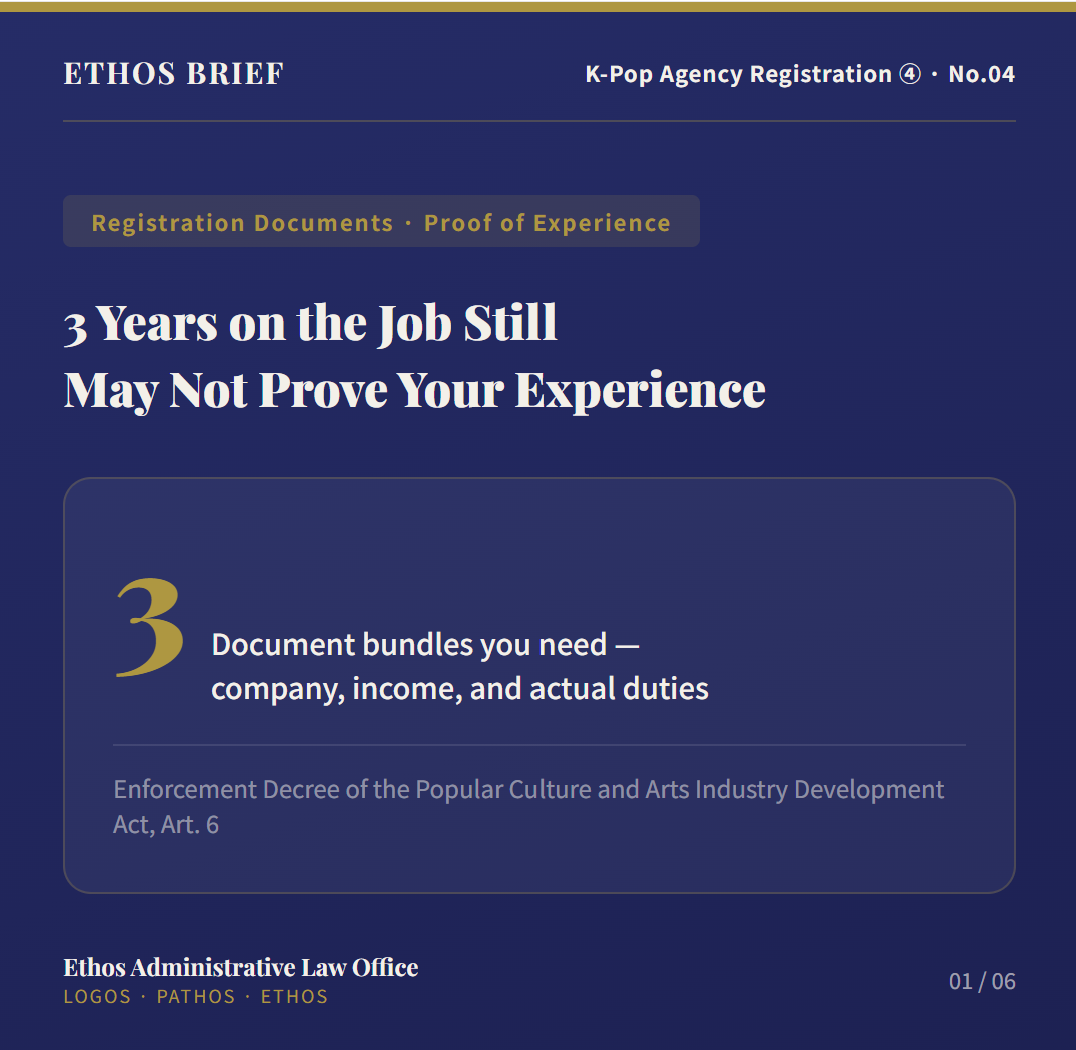
Experience evidence can be understood as “Company + Income + Actual Work”
A practical way to organize experience evidence is to divide it into three categories.
1. Company — Where did you work?
These documents help establish the identity and existence of the business where the experience was earned.
Examples may include:
- business registration records,
- corporate registry records,
- and, where the company has closed, official closure or tax records.
2. Income — Were you actually paid for work during that period?
These records help establish that there was genuine economic activity during the claimed period.
Depending on the case, this may include:
- health insurance records,
- national pension records,
- tax records,
- bank records showing salary payments,
- or bank records showing management-related income.
3. Actual Work — What did you actually do?
This is often the most important part.
The applicant may need to show that the work actually involved Popular Culture and Arts Planning Business activities.
KOCCA’s published experience-certification rules identify examples such as:
- media articles concerning artists the applicant managed,
- film, drama, or music credits,
- exclusive management agreements,
- appearance contracts,
- professional emails,
- business-related messages,
- and certain forms of confirmation for oral agreements.
The important point is that no single document necessarily proves everything.
The strongest file is often a group of documents that point to the same company, period, and actual duties.
KOCCA’s application form also asks about the applicant’s actual duties
The structure of KOCCA’s Popular Culture and Arts Planning Business Experience Certificate Application reflects this approach.
The form does not merely ask for the company name and employment dates.
For each period of experience, applicants are asked to provide information such as:
- period of engagement,
- number of months,
- name of the business,
- and actual duties performed.
Where the applicant has experience from several businesses, the periods can be listed separately and the total months calculated.
This means the system is not structured only around one uninterrupted period at a single company.
However, it also does not mean that different periods can simply be added together without further analysis.
Each period still needs to qualify as relevant Popular Culture and Arts Planning Business experience and be supported by evidence.
You may have worked for three years and still need to check the former company’s registration status
There is another important issue.
KOCCA’s published rules contain restrictions on experience earned after July 29, 2015 at businesses that were not themselves properly registered as Popular Culture and Arts Planning Businesses.
Suppose Applicant B worked as a manager from 2018 to 2021.
B managed actors and received salary throughout that period.
But the company itself had not completed the required registration.
In that situation, it may be risky to assume:
“I worked there for three years, so I clearly satisfy the two-year requirement.”
The former company’s registration status during the relevant period should be checked first.
Actual years worked and legally recognizable qualifying experience are not always the same thing.
This is one of the issues that should be checked before spending time collecting the rest of the documents.
How can a freelance manager prove experience?
Freelance experience creates a different problem.
A freelance manager may not have the documents normally associated with employment.
Suppose Manager C independently managed two actors for three years.
There is no employment contract.
There is no employee social insurance history.
There is no standard employment certificate from an agency.
That does not automatically mean that the experience never existed.
There may still be:
- contracts with the artists,
- emails with production companies,
- records of management commissions,
- film or drama credits,
- media reports,
- or other documents showing the actual management work.
KOCCA’s published rules expressly recognize various forms of contracts, financial records, credits, reports, emails, and messages as examples of evidence that may be relevant to experience verification.
For a freelancer, the better starting question is therefore not:
“I do not have an employment certificate, so is my experience useless?”
but:
“What existing documents can establish the company or client relationship, the income, and the actual work?”
What if the work was based only on an oral agreement?
KOCCA’s system also contains a form for confirming certain oral agreements.
The published form asks for information about the applicant, the artist, the contract period, the nature of the arrangement, and the duties performed.
However, it is not simply a matter of writing:
“We worked together several years ago.”
Additional supporting material is required.
Depending on the procedure, this may include the artist’s seal, a recently issued seal certificate, and evidence showing the applicant’s actual duties during the claimed period.
Where an oral-agreement confirmation form is used, original-document submission requirements may also apply.
So an oral arrangement is not necessarily excluded, but other evidence of the actual work remains important.
What if the former entertainment company has already closed?
A closed company does not automatically erase the experience.
KOCCA’s experience rules include official tax or closure records as examples of documents that may establish the former business.
Suppose Applicant D worked at an agency from 2019 to 2022, but the agency has since closed.
It may no longer be possible to obtain a new employment certificate from the former representative.
In that case, the applicant may need to reconstruct the experience using existing objective materials.
These may include:
- official closure records,
- social insurance records,
- salary payments,
- contracts,
- credits,
- media reports,
- emails,
- and other records from the relevant period.
In this type of case, the real question becomes:
“Can the experience still be reconstructed objectively several years later?”
For that reason, people considering future registration should be careful about deleting old contracts, work emails, income records, or project documentation too early.
Can overseas entertainment-industry experience be used?
Overseas experience may also be reviewed.
KOCCA’s published rules include certain documents issued by foreign governments as possible evidence of the foreign business and the applicant’s income.
However, overseas documents create additional questions.
Applicants may need to consider:
- whether the foreign company can be formally identified,
- how the income can be proved,
- whether the duties performed correspond to qualifying Popular Culture and Arts Planning Business work under Korean law,
- and whether the foreign-language documents have been prepared in a form acceptable for Korean administrative use.
Depending on the document, confirmation by a Korean diplomatic mission and notarized translation may become relevant.
Overseas experience is therefore not necessarily excluded.
But both the substance of the experience and the form of the foreign documents need to be considered.
“The official processing period is 15 days, so can I start next month?”
This is another common misunderstanding.
The official processing period for the main registration application is 15 days.
But those 15 days are not the entire preparation period.
If the applicant cannot establish the required experience directly and needs separate KOCCA experience certification first, an additional step may be required before the main registration application.
KOCCA’s experience-certificate application states a processing period of 30 days, and additional time may be required where the submitted evidence needs supplementation.
This means that:
“The registration takes 15 days, so I can apply two weeks before signing an artist.”
may not be a safe schedule for a complex experience case.
If an artist contract, corporate launch, or business-opening date has already been fixed, the timeline may need to begin with experience verification, not the final registration application.
Is the education route much simpler?
Where the applicant uses the prescribed education route instead of qualifying industry experience, proof of completion of the relevant education program is submitted.
However, an education-completion certificate is not itself the Popular Culture and Arts Planning Business registration certificate.
The applicant still needs to satisfy and document the remaining parts of the registration structure, including the business entity, corporate structure where applicable, office requirements, and other statutory conditions.
The education route solves one part of the qualification issue.
It does not replace the registration process itself.
Does a corporation have to use the CEO’s experience?
No.
Under Article 26(2) of the Act, a corporation must have at least one corporate officer who satisfies the relevant experience or education requirement.
The law does not limit this to the representative director.
Therefore, where the CEO has no entertainment-industry experience, another registered corporate officer may potentially satisfy the qualification requirement.
On the other hand, an experienced employee who is not a corporate officer is a different issue.
For that reason, before collecting experience documents for a corporation, it is useful to check the corporate registry first.
The key question is:
“Which corporate officer will be used to satisfy the experience or education requirement?”
Only after that question is answered does it make sense to prepare that person’s qualification evidence.
Be careful with outdated information saying shared offices are prohibited
The office requirement changed on September 26, 2025.
Previously, the law referred to an “independent office.”
The word “independent” was removed, and the current application framework allows applicants to establish their right to use the principal office through documents showing lawful use of the premises.
The Ministry of Culture, Sports and Tourism explained that this amendment was intended to permit shared-office use and reduce the registration burden on smaller businesses.
This means that using a shared office does not automatically make registration impossible.
However, it also does not mean that any mailing address is sufficient.
The applicant still needs evidence establishing the legal right to use the principal office.
If you are considering registration, check old records before ordering new documents
Where the experience route may be used, it is often better to search for historical materials before downloading every possible government certificate.
In particular, consider preserving or locating:
- old employment or service contracts,
- salary or commission payment records,
- artist-related contracts,
- appearance-contract materials,
- film, drama, or music credits,
- emails exchanged with production companies,
- messages showing actual work,
- and media or project records describing the applicant’s role.
Government certificates can often be reissued later.
Old project emails, contracts, and work records may not be recoverable once deleted.
Because KOCCA’s experience rules expressly identify contracts, credits, media reports, emails, and messages as examples of actual-work evidence, preserving historical work records can itself become part of registration preparation.
Why has registration documentation become more important?
The number of registered Popular Culture and Arts Planning Businesses has increased significantly.
The Ministry of Culture, Sports and Tourism operated a nationwide registration guidance period for previously unregistered businesses from September 18 through December 31, 2025.
In an official explanation issued in March 2026, the Ministry stated that new registrations during the period increased by approximately 50% compared with the same period of the previous year.
Media reports also stated that the number of registered businesses reached 6,153 as of December 31, 2025.
This reflects a change in the questions being asked by the industry.
The earlier question was often:
“Does my company need registration?”
The next question is increasingly:
“I know registration is required, but can I actually register with the experience and documents I have?”
That is why document and evidence planning deserves separate attention.
The National Assembly has also raised concerns about how experience requirements are verified
Applicants are not the only ones finding the system difficult.
On December 18, 2025, Korea’s National Assembly Research Service published NARS Current Issues Analysis No. 377, titled:
“The Popular Culture and Arts Planning Business Registration System in Need of Fundamental Redesign.”
The report discussed issues including:
- a registration system functioning in practice like a notification system,
- formalization of the experience requirement and weak verification mechanisms,
- and a gap between registration requirements and actual industry conditions.
It also identified stronger and more substantive experience and education requirements as an area for reform.
This does not mean that current applicants can submit weak or incomplete evidence.
Rather, it shows that how experience should be verified in an industry increasingly shaped by freelancers, one-person agencies, and diverse employment structures is itself a policy issue.
The Ministry of Government Legislation has officially interpreted this registration application as work that can be handled by an administrative attorney
On December 17, 2025, Korea’s Ministry of Government Legislation issued Interpretation 25-0910 concerning this exact registration process.
The question was whether representation in an application for Popular Culture and Arts Planning Business registration under Article 26 falls within the statutory scope of work of a Korean administrative attorney.
The Ministry concluded that it does.
The interpretation also explained that this registration is not merely private document submission.
The administrative authority reviews whether the statutory requirements have been satisfied and issues a registration certificate, and the registration produces public-law effects.
In practical terms, this means that the process should not be understood simply as:
“Fill in the form and attach the business registration certificate.”
The applicant must satisfy the statutory requirements and present evidence that explains how those requirements are met.
What should you prepare first?
A practical order is as follows.
1. Decide whether you will use the experience route or the education route
If the applicant is a corporation, also identify which corporate officer will satisfy the qualification requirement.
2. If using experience, check the former business’s registration status
Before collecting everything else, confirm whether the former business was properly registered during the claimed period.
If there is a problem here, the calculation of qualifying experience may need to change.
3. Divide the evidence into Company + Income + Actual Work
Do not expect a single document to establish every fact.
Identify what each document proves.
4. Separate any non-standard experience periods
Examples include:
- freelance work,
- experience at a closed company,
- experience divided across several employers,
- overseas experience,
- and periods where standard employment documentation does not exist.
These periods may require additional experience-verification analysis.
5. Check the corporate and office structure
For a corporation, confirm that the qualifying person is actually a corporate officer.
For the office, identify what document can establish the right to use the premises.
6. Prepare the main registration application last
For applicants who need prior experience verification, the preparation and certification process may affect the overall schedule more than the official 15-day main-registration processing period.
Preparing the steps in the wrong order can result in all of the corporate and application documents being ready while the experience evidence still needs to be rebuilt from the beginning.
What can you prepare yourself, and when is individual review more useful?
Where an applicant worked continuously for more than two years at a properly registered agency, has clear income records, and has documents showing the relevant duties, it may be possible to prepare the application directly using the current law and the competent authority’s guidance.
The same may be true where the education route is used and the corporate and office structures are straightforward.
Individual review becomes more important where the case involves:
- freelance experience only,
- a former company that has closed,
- experience divided across several agencies,
- overseas entertainment-industry experience,
- uncertainty about whether the former employer was properly registered,
- a corporation relying on the qualifications of an officer other than the CEO,
- or a shared-office arrangement with non-standard use documentation.
In these cases, the issue is no longer simply knowing the names of the required documents.
It is necessary to determine which evidence proves the company, which proves the income, which proves the actual work, and whether missing parts can be supported by other records.
Where the experience or corporate structure is complicated, it can be more efficient to review the documents already available before ordering every possible certificate.