
Does a One-Person Entertainment Agency or Freelance Manager Need Registration in Korea? — Why Business Structure Matters More Than Company Size
Hello, I’m Jean, a Korean administrative attorney.
The Korean entertainment industry is no longer dominated only by large companies such as JYP Entertainment.
Artists increasingly establish their own companies after leaving established agencies. Some operate with only one artist, while others work with a family member as CEO or hire just one or two managers. Small management businesses representing only a few models, actors, or creators are also becoming more common.
Suppose an actor leaves a major agency and decides to become independent.
There is no plan to build a company like JYP or HYBE. The actor is the only affiliated artist, and perhaps a family member serves as CEO while one or two managers handle the day-to-day work.
A natural question follows:
“I am the only artist in the company. Is this really an entertainment agency that needs registration?”
A freelance manager may ask a different version of the same question:
“I do not run a large agency. I independently manage only a few actors. Do I also need to register as a Popular Culture and Arts Planning Business?”
The answer cannot be determined simply by calling the business a “one-person agency” or calling yourself a “freelance manager.”
What matters is not primarily the size of the company or the number of employees.
You need to look at:
- who the business operator is,
- whose entertainment activities are being managed,
- who signs the contracts,
- where appearance fees and other revenue are paid,
- and who actually handles casting, negotiation, scheduling, and management.
Two businesses may both be described as “one-person agencies” while having very different legal and administrative structures.
Unregistered one-person agencies remain an issue in 2026
On July 14, 2026, Korean broadcaster Park Na-rae was referred to prosecutors over allegations that she operated a one-person entertainment agency without the required Popular Culture and Arts Planning Business registration.
According to media reports, Park, her mother, and the corporate entity were all referred in connection with the matter. The company was reportedly operated with her mother serving as its representative.
Source: Yonhap News Agency, July 14, 2026, report on the referral of the Park Na-rae unregistered agency case.
Two days later, on July 16, media reported that prosecutors had issued a suspension of indictment in a separate case involving actress Lee Ha-nee, her one-person agency Hope Project, and her spouse, who served as the company’s representative director.
A suspension of indictment is a non-prosecution disposition in which the prosecutor recognizes the alleged offense but decides not to bring the case to court after considering the surrounding circumstances.
The company reportedly completed its registration in October 2025 after the registration issue was raised.
Source: YTN, July 16, 2026, report on the Lee Ha-nee unregistered agency case.
The important point here is not that these cases necessarily have the same legal outcome.
The important point is that even a company representing only one artist may involve several legally distinct parties:
- the artist,
- a parent,
- a spouse,
- and a separate corporate entity.
This is why the label “one-person agency” alone does not explain the actual business structure.
Korean law does not create a separate registration category called a “one-person agency”
Article 2(6) of Korea’s Popular Culture and Arts Industry Development Act defines a Popular Culture and Arts Planning Business as a business that provides or arranges popular culture and arts services of artists, or provides training, guidance, counselling, or similar services for those activities.
Article 26(1) of the same Act requires a person or entity intending to engage in a Popular Culture and Arts Planning Business to register.
The legal question therefore is not simply whether the company represents one artist or ten.
The core question is:
Is the business actually engaging in Popular Culture and Arts Planning Business activities?
Having only two employees, representing only one artist, or describing the entity as a “personal company” does not automatically remove the registration issue.
“One-person agency” describes the size or operating model of a business.
It is not, by itself, a statutory exemption from registration.
One-person agencies are becoming more common
The Korean government is also paying closer attention to the growing number of one-person agencies.
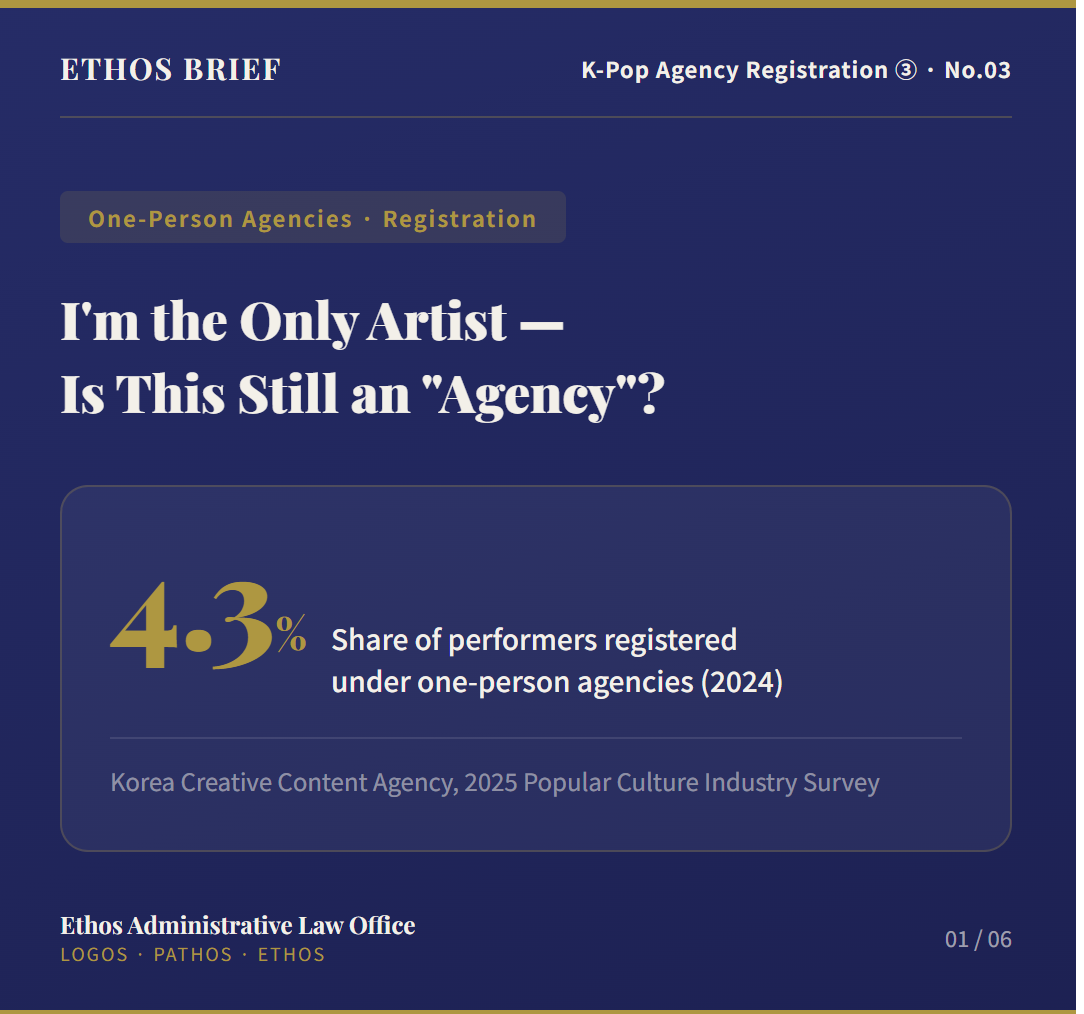
According to data cited from KOCCA’s 2025 Popular Culture and Arts Industry Survey, published in January 2026, the proportion of popular culture artists affiliated with one-person agencies was reported at 4.3% in 2024.
As a sample survey, the figure has limitations. Still, it reflects a broader trend in which artists increasingly choose independent business structures rather than remaining exclusively within traditional large or mid-sized agencies.
Source: Chosun Biz, January 31, 2026.
During the government’s guidance period for previously unregistered entertainment planning businesses between September and December 2025, new registrations reportedly increased by approximately 50% compared with the same period of the previous year.
Source: NewsPim, March 25, 2026.
In April 2026, the Korea Creative Content Agency, or KOCCA, commissioned a separate research project titled:
“Analysis of One-Person Agencies and Measures for Improving the Legal and Regulatory Framework.”
The Ministry of Culture, Sports and Tourism also stated in an official explanatory release dated March 25, 2026 that it was conducting a survey of unregistered businesses and considering medium- to long-term reforms that would take one-person agencies into account.
The issue is therefore no longer simply:
“An artist created a personal company and forgot to register it.”
The broader policy question is how Korea’s existing registration system should apply to increasingly diverse one-person and small-scale entertainment business structures.
However, the fact that regulatory reform is being studied does not mean that the current registration rules have disappeared.
As of August 2026, existing businesses still need to be assessed under the law and administrative guidance currently in force.
If the structure is unclear, follow the contracts and the money
One of the easiest ways to understand a one-person agency is to look beyond the company name and follow the contractual and financial flow.
Suppose Actor A owns a personal corporation.
An advertising company approaches the actor.
Now ask the following questions:
- Is the advertising contract signed by Actor A personally or by Actor A’s corporation?
- Who negotiates the appearance conditions and advertising fee?
- Into whose bank account is the payment made?
- Does Actor A manage the schedule and contract directly, or does an external management company handle it?
- Does Actor A’s corporation merely manage revenue, or does it actively arrange, negotiate, contract, and manage entertainment activities?
Even if both structures are described as “Actor A’s one-person agency,” the actual business may be very different depending on the answers.
For that reason, in some cases several recent advertising, broadcasting, or performance contracts can reveal more about the structure than the business registration certificate alone.
Type 1: The artist operates an individual business only for their own activities
This is the first structure that should be distinguished from the others.
Suppose Singer B leaves an established agency.
Singer B personally becomes the representative of an individual business.
There are no other affiliated singers, actors, or entertainers.
The business deals only with Singer B’s own performances, broadcasts, and advertising activities.
KOCCA has provided important guidance on this type of structure.
In certain support program notices related to Popular Culture and Arts Planning Business registration, KOCCA has stated that registration is not required where:
the popular culture artist is personally the representative of the individual business and there are no other affiliated artists.
Accordingly, a business may fall within this guidance where both of the following are true:
- the artist personally represents the individual business, and
- there are no other affiliated popular culture artists.
The key point is not merely that there is only one artist.
The fact that the artist personally operates the individual business is also important.
Type 2: What if the artist creates a separate one-person corporation?
From the outside, this structure may look almost identical.
Suppose Actor C establishes a corporation.
Actor C is the shareholder.
Actor C is also the company’s only affiliated artist.
The company has only one manager.
It is easy to think:
“What is the difference from operating as an individual business? I am still the only artist.”
Administratively, however, there is an important distinction.
The KOCCA guidance described above specifically refers to a situation where the artist is the representative of an individual business.
A separate corporation is not legally the same business operator as the artist personally.
Therefore, the fact that the artist owns all shares and is the company’s only artist does not necessarily mean that guidance for an individual business automatically applies to the corporation.
Instead, the actual activities of the corporation need to be examined.
If the corporation:
- signs appearance contracts with broadcasters,
- negotiates advertising terms,
- receives appearance fees,
- employs managers,
- and manages the artist’s schedule,
then the nature of the corporation’s actual business activities should be considered when determining whether Popular Culture and Arts Planning Business registration is required.
The first major distinction is therefore not:
“Is there only one artist?”
but rather:
“Is the business operator the artist personally, or is it a separate corporation?”
Type 3: What if a family member is the representative of the agency?
Now the structure becomes more complicated.
Suppose Broadcaster D has a corporation.
D’s mother serves as the representative director.
D is the only affiliated popular culture artist.
The company enters into D’s advertising contracts, receives appearance fees, hires a manager, and manages D’s schedule.
It may feel natural to say:
“My mother is the CEO, but this is essentially just my family company.”
However, the family relationship itself is not an automatic exemption from registration.
A separate corporate business entity exists, and the relevant question is what that entity actually does.
The July 2026 Park Na-rae case is useful as an illustration of why the structure matters. Media reports stated that not only the artist but also her mother and the corporate entity were referred over alleged violations of the Popular Culture and Arts Industry Development Act.
A referral to prosecutors does not, of course, constitute a final finding of guilt.
The point is that the analysis does not stop simply because a family member serves as representative.
You need to determine whether the corporation itself is functioning as the actual management business operator.
Type 4: What if the artist has a personal company but another agency handles the actual management?
This is one of the more difficult structures.
Suppose Actor E owns a personal corporation.
However, broadcasting arrangements, filming schedules, advertising negotiations, and other day-to-day management work are handled by F Entertainment, which is already registered as a Popular Culture and Arts Planning Business.
Does Actor E’s personal corporation also need registration?
The answer cannot be determined merely from the existence of the corporation.
The actual division of responsibilities needs to be examined.
For example, F Entertainment may negotiate the advertising conditions while Actor E’s personal corporation is named as the contracting party.
In another arrangement, F Entertainment may sign the contracts while Actor E’s corporation exists only for separate business purposes.
A third structure may involve the personal corporation directly managing certain advertising contracts while F Entertainment handles broadcasting activities.
In these cases, follow the sequence:
contracting party → arranging and negotiating party → payment recipient → actual management party
Once multiple entities perform different functions, deciding whether a business is or is not a “one-person agency” based only on its name becomes much more difficult.
Type 5: What if the artist originally managed only themselves but later signs another artist?
A business that originally fell within the individual-business guidance may change as it grows.
Suppose Singer G initially operated an individual business solely for their own entertainment activities.
Later, the business begins managing a younger singer.
It arranges performances, negotiates appearance fees, manages schedules, and earns management revenue from that artist’s activities.
At this point, relying only on the original conclusion—
“I was told registration was unnecessary when I first started the business.”
—may no longer accurately describe the current situation.
KOCCA’s individual-business guidance refers to a situation where there are no other affiliated artists.
If the nature of the business changes, the current business activities should be reviewed again.
This is an issue that can easily be overlooked when a one-person agency begins to expand.
Type 6: Does an employed manager at a registered agency need individual registration?
Now consider the manager’s side.
Manager H is an employee of an entertainment company that is already registered as a Popular Culture and Arts Planning Business.
H coordinates filming schedules, accompanies actors to production sites, and communicates with production companies.
Does H personally need a separate Popular Culture and Arts Planning Business registration simply because their job title is “manager”?
Not necessarily.
Article 26 of the Popular Culture and Arts Industry Development Act does not require every individual whose job title is “manager” to register personally.
The registration system applies to the business operator engaging in Popular Culture and Arts Planning Business activities.
An employee performing duties within a registered company should therefore be distinguished from a person independently operating a management business.
However, if the same employee also establishes a separate business and independently manages other artists outside the company, that additional activity may need to be reviewed separately.
Type 7: What if the contract says “freelance manager”?
This is particularly important for independent managers.
Suppose Manager J is not employed by any entertainment company.
J contracts directly with two actors.
When a production company proposes a role, J coordinates with the actor, negotiates the appearance fee, arranges advertising or event appearances, and receives an agreed commission when the contract is concluded.
The business card says:
“Freelance Manager.”
Does the word “freelance” remove the registration issue?
The label alone does not answer the question.
KOCCA has identified business categories associated with Popular Culture and Arts Planning Business activities, including entertainment management, artist representation, manager services, model agencies, casting directors, and performance arrangement businesses.
What matters is therefore not merely the title “freelance manager.”
The more important issue is what the person actually does as an independent business operator and what they are paid for.
Two “freelance service agreements” can describe very different businesses
Consider two freelance managers.
The first contracts with a registered entertainment agency.
The agency handles all appearance contracts and compensation negotiations.
The freelance manager performs only on-site support, schedule communication, and similar operational tasks.
The second freelance manager contracts directly with an actor.
This manager receives casting inquiries from production companies, negotiates the actor’s appearance fee, connects the artist with advertisements and events, and receives a percentage-based commission when contracts are concluded.
Both agreements may be titled:
“Freelance Service Agreement.”
But the actual business activities are very different.
For an independent manager, it is useful to follow this sequence:
Who contracted with me? → Who pays me? → Who signs the artist’s appearance contract? → Who negotiates the terms? → Am I independently connecting the artist with the market?
The answers to these questions often matter more than the word “freelance.”
The most difficult cases involve two or more business entities
This is where the analysis usually becomes more complicated.
Suppose Actor K has a personal corporation and is also represented by a separately registered management company.
The management company handles broadcasting arrangements.
Some advertising contracts are signed in the name of Actor K’s personal corporation.
The manager is employed by the management company, while accounting and expense settlement are handled by the personal corporation.
Appearance fees are paid to different entities depending on the contract.
In this situation, it is difficult to conclude immediately:
“The management company is already registered, so my corporation is irrelevant.”
But it is equally premature to say:
“I have a personal corporation, so that corporation must automatically be a Popular Culture and Arts Planning Business.”
Instead of examining the companies in isolation, follow one entertainment activity from the initial arrangement through the final payment.
Ask:
- Who secured the opportunity?
- Who negotiated the terms?
- Who is named as the contracting party?
- Who receives the payment?
- What service is each company actually being compensated for?
Following that flow usually reveals the actual roles.
This is one of the most common structures in which a simple online search is not enough to determine the registration issue.
If you are changing your company structure, that is a good time to review the issue
Registration questions do not arise only after a company has already been established.
In many cases, reviewing the issue when the business structure changes makes the analysis easier.
Examples include:
- changing from an individual business to a corporation,
- appointing a family member as representative director,
- leaving an existing management agency and beginning to contract directly,
- assigning contract and casting work to a freelance manager,
- or signing an additional artist.
These changes may appear minor from a business perspective.
But from a regulatory perspective, they may alter who is actually performing the Popular Culture and Arts Planning Business activities.
A useful time to review the registration issue is therefore not only after a problem arises.
It can also be before changing the contractual or corporate structure.
Which structure is closest to your one-person agency?
Instead of using a table, the following categories can be used as a practical checklist.
Artist-operated individual business + only the artist’s own activities
Check first: Whether the structure falls within KOCCA’s guidance for an artist-operated individual business.
Review again if: The business begins managing another artist.
Artist-owned one-person corporation
Check first: Whether the corporation itself performs contracting, arranging, negotiation, or management functions.
Review again if: The corporation is being treated as though it were legally identical to the artist’s individual business.
Corporation represented by a family member
Check first: Whether the corporation is the actual management business operator.
Review again if: The family relationship is being treated as though it automatically makes the corporation equivalent to the artist’s personal business.
Artist’s corporation + external registered management agency
Check first: How the two companies divide the actual management functions.
Review again if: Contracting, arranging, and payment functions are split across different entities.
The artist originally managed only themselves but later signs another artist
Check first: When the actual business activities changed.
Review again if: The original “registration not required” conclusion is still being relied upon after the structure changed.
Employee manager of a registered agency
Check first: Whether the person is performing duties within the company or independently operating another business.
Review again if: The manager separately manages other artists outside the employer’s business.
Independent freelance manager
Check first: Who the manager contracts with and what services the manager is paid to perform.
Review again if: It is unclear whether the work is merely outsourced operational support or independent artist representation and arrangement.
The purpose of these categories is not to mechanically label each case as “registration required” or “registration not required.”
The purpose is to identify where further review becomes necessary.
What matters more than the word “one-person” is who actually does the work
The central point is simple.
For Popular Culture and Arts Planning Business registration, the number “one” matters less than the actual business structure and activities.
Even where there is only one affiliated artist, the analysis may differ depending on whether the business is:
- an individual business,
- a separate corporation,
- a family-run company,
- a company working alongside another management agency,
- or a business involving an independent manager.
Likewise, having no employees or operating on a small scale does not automatically remove the business from the registration framework.
Instead of asking:
“How many people are in my company?”
the more useful question is:
“Who is managing whose entertainment activities, under what contractual structure, and through which revenue flow?”
What you can check yourself — and when individual review becomes necessary
Some parts can be checked without professional assistance.
Start with the business registration certificate and corporate registry documents to determine whether the business is operated individually or through a corporation.
Review recent advertising, broadcasting, and performance contracts to identify the contracting party.
You can also identify:
- which business receives the appearance fees,
- who actually negotiates and arranges the work,
- whether the artist is the only affiliated artist,
- and whether the manager is an employee or an independent business operator.
These are matters you can initially organize yourself.
Individual review becomes more important where:
- the artist’s own corporation and an external management agency are both involved,
- a family member serves as representative,
- freelance outsourcing and management functions overlap,
- several companies divide the contracting, arranging, or settlement functions,
- or an individual business that originally managed only the artist later begins managing other artists.
In these structures, looking only at the business registration certificate may not be enough.
The actual contractual relationships, revenue flow, and management activities should be reviewed together.
If registration is ultimately required, the next step is to examine the application documents, corporate or business records, and the evidence needed to establish the relevant registration requirements.