
5 Toxic Contract Clauses You Should Check Before Signing in Korea
Hello, this is Administrative Agent Jean.
Have you ever read a contract carefully before signing it?
Many people say this when they receive a contract:
“I asked AI, and it said the contract looked fine.”
AI can read the words in a contract.
But whether a clause will actually work in a dispute, which sentence will bind you later, and which wording can become a weapon for the other side are different questions.
AI does not sign the contract.
You do.
And the responsibility usually returns to the person who signed.
This article is the first part of a three-part series on toxic contract clauses.
Part 1: 5 Toxic Contract Clauses You Should Check Before Signing
Part 2: 3 Ways to Challenge Toxic Clauses
Part 3: How to Check Whether Your Contract Contains a Hidden Risk
47 Clauses Were Corrected
In November 2024, the Korea Fair Trade Commission reviewed the terms of service used by AliExpress and Temu and corrected 47 unfair clauses across 13 categories.
The problematic clauses included:
- Clauses excessively excluding platform liability
- Clauses allowing unfair collection or use of personal information
- Jurisdiction clauses unfavorable to consumers
- Clauses excessively restricting user rights
Many users had agreed to those terms.
But very few probably read them to the end.
This is not only a story about AliExpress and Temu.
The same kind of risk can appear in freelance contracts, lease special clauses, service agreements, cohabitation agreements, and outsourcing contracts.
The difference is simple.
Either the Fair Trade Commission reviews the contract, or you discover the clause yourself only after a dispute begins.
Contracts Work When Things Go Wrong
When people sign a contract, the relationship is usually still good.
The work has not started yet.
The lease is about to begin.
The business partnership still feels promising.
So people often think:
- The other side is a big company, so it should be fine
- Everyone uses this form, so it must be safe
- This does not seem serious enough to ask a lawyer
- I can sign first and fix things later
But the person who drafted the contract often already knows which clauses are favorable to them.
They know which sentence they can rely on if a dispute arises.
They know which wording is vague enough to be interpreted in their favor.
A contract is quiet when things are peaceful.
But once a dispute starts, it is usually the first document opened.
Standard Terms and Individual Contracts Are Not the Same
There is an important distinction.
Platform terms of service used repeatedly for many users may be subject to Korea’s Act on the Regulation of Terms and Conditions. If a clause is unfair, it may be easier to challenge.
But individually drafted contracts are different.
Freelance service agreements, lease special clauses, partnership agreements, and outsourcing contracts may not always be treated the same way as standard terms.
In those cases, you often have to rely on the Civil Act, specific statutes, and court precedents.
That makes things harder after signing.
This is why toxic clauses in everyday contracts can be more dangerous.
What Is a Toxic Clause?
A toxic clause is a contract provision that is unfairly disadvantageous to one party.
The problem is that toxic clauses do not always look dramatic.
They often look ordinary.
For example:
- If Party A deems necessary
- All costs shall be borne by Party B
- For any reason whatsoever
- Even after termination of this contract
- All rights shall belong to Party A
These phrases can become the starting point of a dispute.
After signing, “I did not know” is usually not enough.
The strongest fact in contract disputes is often simple:
You signed it.
5 Toxic Clauses to Check Before Signing
1. “Revisions Shall Continue Until Party A Is Satisfied” — Unlimited Revision Clause
This clause often appears in freelance service agreements, design contracts, video production contracts, and development contracts.
A problematic clause may look like this:
Revisions to the deliverables shall continue until Party A is satisfied.
Once this sentence enters the contract, the completion standard disappears.
“Satisfaction” is subjective.
A client may request changes because their preference changed.
They may revise the entire plan.
A new manager may request a different direction.
And the freelancer may have no clear basis to charge additional fees.
The freelancer may believe the work is complete, while the client claims it is still unfinished.
In a dispute, the decision-maker will look for the completion standard in the contract.
If there is no standard, the dispute becomes longer.
Better Wording
The contract should include:
- Revisions limited to a specific number, such as two rounds after initial delivery
- Distinction between minor corrections and major changes
- Separate fees for changes in concept, scope, pages, or functions
- Deemed acceptance if no objection is raised within a set period
- Delivery format and completion criteria
Warning Signs
Be careful if you see:
- Until Party A is satisfied
- If Party A deems necessary
- Unlimited revisions until final approval
- Revisions without additional cost
- Party B shall reflect all changes requested by Party A
2. “All Repairs Shall Be Borne by the Tenant” — Repair-Cost Shifting Clause
This clause often appears in residential leases, commercial leases, and office leases.
A problematic clause may look like this:
All repair and maintenance costs arising during the lease term shall be borne by the tenant.
This is one of the most common sources of lease disputes.
Article 623 of the Korean Civil Act provides that the lessor must maintain the leased property in a condition suitable for use and profit.
In other words, the landlord generally has a duty to keep the property usable.
But in practice, special clauses often shift all repair responsibility to the tenant.
This can include:
- Boiler failure
- Water leakage
- Ceiling cracks
- Pipe problems
- Window or door deterioration
- Electrical facility defects
When a problem occurs, the landlord may point to the clause and say, “All repairs are the tenant’s responsibility.”
This is especially dangerous for foreign tenants who sign Korean lease contracts without fully understanding the special terms.
They often discover the clause only when the landlord tries to deduct repair costs from the deposit.
Better Wording
Repair responsibility should be divided by cause and category.
- Ordinary wear and tear should be borne by the landlord
- Damage caused by the tenant’s intentional or negligent act may be borne by the tenant
- Consumable replacements may be borne by the tenant
- Main facilities such as structure, pipes, leakage, and boiler body should generally be the landlord’s responsibility
- Notice and estimate review procedures should be specified
Warning Signs
Review carefully if you see:
- All repairs shall be borne by the tenant
- Restoration costs upon move-out shall be fully borne by the tenant
- The tenant is deemed to have confirmed all facility defects
- The landlord bears no responsibility whatsoever
- The landlord may deduct costs from the deposit at their discretion
3. “Non-Compete After Contract Termination” — Excessive Non-Compete Clause
This clause often appears in freelance contracts, employment contracts, outsourcing agreements, instructor agreements, beauty, cafe, fitness, and service industry contracts.
A problematic clause may look like this:
For two years after termination of this contract, Party B shall not engage in the same or similar business within a 5 km radius.
A non-compete clause is not always invalid.
It may be recognized within a reasonable scope if there is a need to protect trade secrets, customer information, core technology, or special know-how.
But if the period, location, or business scope is too broad, it may become problematic.
The Korean Supreme Court considers factors such as:
- Whether the employer has a protectable interest
- The worker’s position before leaving
- The duration of the non-compete restriction
- The geographic scope
- The scope of restricted work
- Whether compensation was provided
- The reason for leaving and public interest
So the answer is not “valid because it is in the contract” or “invalid because there is freedom of occupation.”
The problem is that once a dispute begins, waiting for a court decision costs time and money.
Better Wording
A non-compete clause should be narrow and specific.
- Limit the duration to what is necessary
- Limit the geographic scope to the actual business area
- Define restricted work narrowly
- Avoid banning all related employment
- State the purpose, such as trade secret or customer information protection
- Review whether compensation is provided
Warning Signs
Be careful if you see:
- Prohibition from working in the same industry nationwide
- Non-compete period of three years or more
- Ban on all related industries
- No compensation for the restriction
- All revenue must be paid as damages
- Mere contact with customers is deemed a violation
4. “For Any Reason, Party B Pays the Penalty” — One-Sided Penalty Clause
This clause often appears in service agreements, agency contracts, exclusive contracts, and outsourcing agreements.
A problematic clause may look like this:
If this contract is terminated for any reason, Party B shall pay 30% of the remaining contract amount as a penalty.
The key phrase is “for any reason.”
Even if Party A breaches first, delays materials, refuses review, or causes the termination, the wording may still appear to impose the penalty on Party B.
Penalty clauses can be powerful in real disputes.
Under Article 398(2) of the Korean Civil Act, a court may reduce a liquidated damages amount if it is unreasonably excessive.
But reduction is not automatic.
You may have to go to court to argue it.
It is much safer to fix the clause before signing.
Better Wording
A penalty clause should be balanced.
- The party at fault should bear responsibility
- Party B should have termination rights if Party A delays materials, review, or payment
- The penalty formula should be proportionate to actual damage
- Fees for work already performed should be separately settled
- Grounds for termination should be clearly separated
- The relationship between penalty and damages should be clarified
Warning Signs
Review carefully if you see:
- For any reason, Party B shall pay a penalty
- Party A may terminate at any time
- Party B shall compensate the entire remaining contract amount
- Party A determines the amount of damages
- Party B may not raise objections
- Paid amounts are non-refundable under any circumstances
5. “All Copyrights Belong to Party A Immediately” — Blanket Copyright Assignment Clause
This clause often appears in content production contracts, design contracts, video production contracts, webtoon and web novel contracts, and advertising production contracts.
A problematic clause may look like this:
All rights, including copyrights and moral rights, in all deliverables produced by Party B under this contract shall belong to Party A immediately upon execution of this contract.
This clause may include legally impossible wording.
Article 14 of the Korean Copyright Act provides that moral rights belong exclusively to the author.
In other words, moral rights cannot be assigned by contract.
But if the contract says “all rights including moral rights are assigned,” the other party may later use that clause as pressure during negotiation.
Economic copyrights can be assigned.
But “all copyrights” is too broad.
It may raise questions about:
- Derivative work rights
- Overseas use rights
- Merchandising rights
- Adaptation into video or drama
- AI training use
- Platform resale rights
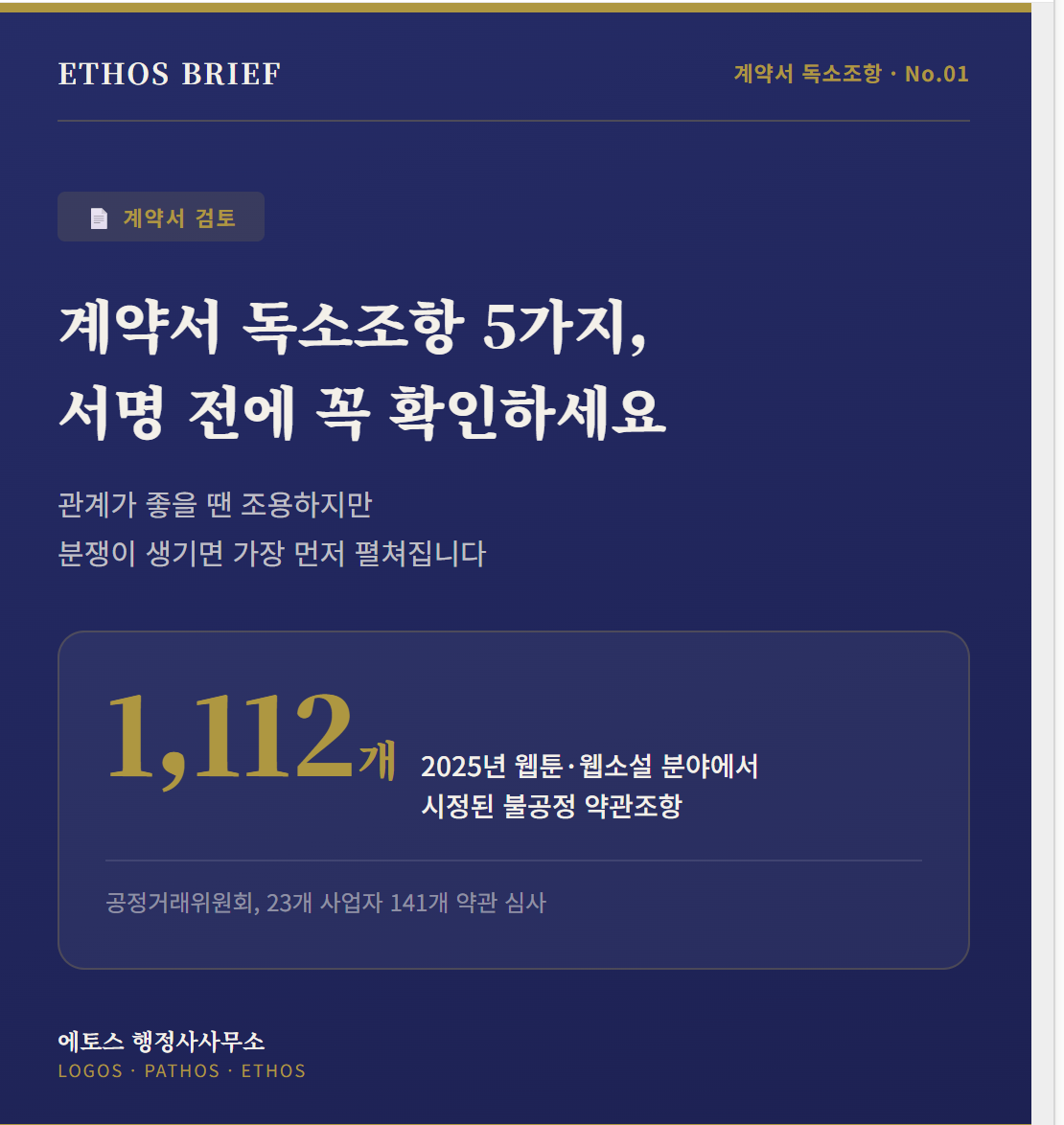
In 2025, the Korea Fair Trade Commission reviewed 141 terms used by 23 webtoon and web novel businesses and corrected 1,112 unfair clauses. These included clauses broadly granting derivative work rights to businesses and clauses raising concerns about moral rights.
This is not only a platform problem.
The same structure appears in small freelance contracts.
Better Wording
Copyright clauses should be divided by right and use.
- Clarify whether the agreement is assignment or license
- Specify duration of use
- Specify territory
- Specify media and channels
- Treat derivative work rights as a separate matter
- Clarify whether source files must be delivered
- Clarify whether portfolio use is allowed
- Draft based on the principle that moral rights are not assignable
Warning Signs
Be careful if you see:
- All copyrights belong to Party A
- All rights including moral rights are assigned
- Party B shall not exercise moral rights
- Derivative work rights belong to Party A
- Party A may freely modify or transform the work
- Party B may not use the work in a portfolio
- Source files must be provided for free
Toxic Clause Checklist
| Type | Dangerous Phrase | Main Problem | Better Direction | |---|---|---|---| | Unlimited revision | Until Party A is satisfied | No completion standard | Limit number, scope, and review process | | Repair-cost shifting | All repairs borne by tenant | Tenant may pay for age-related defects | Separate negligence from ordinary wear | | Non-compete | No same-industry work after termination | Excessive limit on future work | Limit duration, area, scope, and compensation | | One-sided penalty | Party B pays for any termination | Party B may pay even if Party A caused the problem | Responsibility should follow fault | | Copyright assignment | All rights including moral rights assigned | Includes non-assignable or overly broad rights | Separate rights, media, duration, territory |
When Should a Contract Be Reviewed?
The answer is simple.
Before signing.
After a dispute begins, the question becomes:
- Can this clause be invalidated?
- Can the penalty be reduced?
- Can the clause be interpreted differently?
- What evidence supports my position?
That process costs time and money.
Before signing, one sentence can be revised.
Contract review is not about winning a dispute.
It is about preventing one.
How an Administrative Agent Can Help
Under the Administrative Agent Act, administrative agents may prepare documents concerning rights, obligations, and factual matters within the permitted scope of practice.
Ethos Administrative Office can assist with:
- Freelance contract review
- Service agreement drafting
- Cohabitation agreement drafting
- Mandate agreements, settlement agreements, and undertakings
- Lease special clause review
- Toxic clause summary
- Contract condition comparison tables
- Fact confirmation statements
- Administrative submission documents
However, litigation representation, legal dispute representation, notarization, registration, and tax filing are handled by the relevant licensed professionals.
An administrative agent’s role is to organize the contract and factual structure before a dispute becomes bigger.
What To Prepare Before Consultation
For faster review, prepare:
- Contract original or draft
- Emails or messenger exchanges from the other party
- Actual scope of work
- Contract amount and payment schedule
- Contract period
- Deliverables or expected result
- Clauses emphasized by the other party
- Clauses you are worried about
- Any previous revision requests
A contract cannot be reviewed properly from wording alone.
The actual transaction structure must be reviewed together.
FAQ
Q. Should I still review a contract that AI already checked?
Yes, if the contract matters.
AI can explain wording, but it does not take responsibility for transaction structure, party relationship, industry practice, dispute risk, or administrative submission requirements.
AI review can be a useful reference, but final review before signing should be done by a person.
Q. If a contract contains a toxic clause, is it automatically invalid?
No.
A clause that looks unfair is not automatically invalid.
The result depends on whether it is a standard term, whether it was individually negotiated, how unfair the clause is, and how statutes and precedents apply.
Q. Can I review a contract after signing?
Yes.
But there are fewer options than before signing.
After signing, the review must focus on interpretation, invalidity arguments, penalty reduction, termination procedure, and evidence organization.
Q. Do freelancers really need written contracts?
Yes.
At minimum, freelancers should document scope of work, revision limit, delivery standard, payment date, copyright ownership, and termination conditions.
Q. Can foreign clients review Korean contracts?
Yes.
Foreign tenants, freelancers, and entrepreneurs often sign Korean contracts without fully understanding the special clauses.
It is also important to check whether the contract terms conflict with immigration status or permitted business activities.
Closing
A contract is not a formality.
It is the first document opened when a dispute begins.
One unlimited revision clause can make delivery endless.
One repair clause can reduce your housing deposit.
One non-compete clause can restrict your next job.
One copyright clause can transfer your creative work far beyond what you expected.
Before signing, it is one sentence.
After signing, it may become a dispute.
Before you sign, at least know where the dangerous clauses are.
Ethos Administrative Office can help review the contract structure and identify toxic clauses before they become a problem.