
「Advanced Guide to Game & Digital Content Licensing」① Do You Need Both Game Production and Game Distribution Registration in Korea?
Hello, I’m Administrative Agent Jisang Jin.
If your company develops a game directly, is game production business registration the only registration you need?
If a separate publisher is involved, which company should register as a game distributor?
What if your company has acquired the Korean service rights to an overseas game, or outsourced the entire development process?
These are common questions for companies preparing to launch games in Korea.
The answer should not be based simply on how a company describes itself—as a developer, publisher, or IP holder.
What matters under Korean law is the actual role each company performs in planning, producing, importing, managing rights to, and supplying the game.
This article explains the legal distinction between game production and game distribution businesses and applies it to six common structures: in-house development, outsourced development, domestic publishing, overseas game imports, IP ownership, and direct app-market launches.
The key point is simple: the company’s actual business activities matter more than its title.
※ This article is based on Korean laws and regulations in force as of September 15, 2026. Whether a specific company must register depends on its contracts, actual business activities, and overall business structure, so individual cases may require separate review.
Start with the basic answer
Under Korea’s Game Industry Promotion Act, game production and game distribution businesses are distinguished by the actual business activities being performed, not by the name of the company.
The basic rules can be summarized as follows.
If a company directly plans and produces a game, game production business registration should be reviewed first.
Whether the company has its own in-house development team is not the decisive point. What matters is who actually performs the planning and production activities.
If a company brings a game developed overseas into Korea, game distribution business registration should be reviewed first.
In this structure, the Korean service rights, the importing entity, the party supplying the game, and the authority granted under the contract become important.
If a company owns or manages game copyrights and supplies the game to other game businesses, game distribution business registration should also be reviewed.
Mere ownership of IP is not necessarily enough. The practical question is whether the company actually manages those rights and operates a business supplying the game.
If one company both produces games and performs distribution activities, both registrations may need to be reviewed separately.
A single company can conduct more than one type of regulated business.
On the other hand, a company does not automatically become a game distributor simply because it calls itself a publisher.
If the company only handles advertising, marketing, community management, or customer support, that title alone does not determine its legal status. Its actual rights and supply authority must be examined.
The same principle applies to outsourced development.
The fact that coding has been outsourced does not, by itself, determine which company is the game producer. Planning, production responsibility, delivery obligations, control over development, and ownership of the final result should all be reviewed.
In short, three questions provide the best starting point.
- Who actually plans and produces the game?
- Who imports the game into Korea?
- Who owns or manages the rights and supplies the game to other game businesses?
If one company performs more than one of these functions, more than one registration may need to be considered.
Article 2 of the current Game Industry Promotion Act defines a game production business as a business that plans or reproduces games for production.
It defines a game distribution business as a business that imports games, or owns or manages the copyrights to games while supplying those games to game service providers or other game businesses.
The registration requirement is set out in Article 25 of the same Act.
Let us now apply those rules to actual business structures.
What is the legal difference between game production and game distribution?
The statutory distinction is relatively clear.
Under Article 2 of the Game Industry Promotion Act, a game production business means:
A business that plans or reproduces games for production.
A game distribution business means:
A business that imports games, or owns or manages the copyrights to games while supplying them to persons operating game service businesses or other game-related businesses.
In simple terms, game production is primarily about planning and making games, while game distribution is more closely connected to importing games or managing rights and supplying games to other game businesses.
However, you should not decide who is the producer or distributor merely by looking at company names.
One company may handle planning, development, rights management, and supply from beginning to end.
In another project, those roles may be divided among a developer, IP owner, publisher, and service operator.
This is especially important in outsourced or co-development projects, where the company that actually writes the code may be different from the company directing the overall planning and production.
A practical review usually begins with the following questions.
- What work does each company actually perform?
- Who plans and produces the game?
- If the game was developed overseas, who imports it into Korea?
- Who owns and manages the copyrights?
- Who supplies the completed game to other game businesses?
- Do the roles described in the contracts match what the companies actually do?
Case 1. Your company develops the game directly
This is the simplest structure.
The company plans the game internally, develops it, and takes the lead in the actual production process.
In this case, game production business registration should generally be reviewed first.
The reason is straightforward. Korean law defines game production business by reference to planning or producing games as a business, and a person intending to operate such a business is, in principle, required to register with the competent local authority.
A common misunderstanding is:
We are an IT company.
We are a startup.
Software development is already listed on our business registration certificate.
Those facts do not automatically remove the need to review game production business registration.
General business registration for tax purposes and game production business registration under the Game Industry Promotion Act are separate procedures with different legal bases and purposes.
Even if software development is listed on the company’s business registration certificate, a company that actually plans and produces games as a business should separately review whether game production business registration applies.
Another common assumption is that registration can be considered later because the game has not yet been launched.
However, the relevant timing may depend on the company’s actual commercialization stage and business activities.
Rather than waiting until the launch date has already been fixed, it is generally more practical to review the registration schedule together with incorporation, office leasing, development agreements, and preparations for game rating procedures.
Article 25 also provides certain statutory exceptions, including specific production activities by the State, local governments, and certain educational or training institutions.
Whether an exception applies should be reviewed based on the specific entity and purpose of the production activity.
Key point for this case
What matters is not the name of the internal development team, but whether the company is actually conducting game planning and production as a business.
Case 2. Your company develops the game and another company publishes it
Now assume that the developer and publisher are separate companies.
Company A directly plans and develops the game, while Company C handles domestic publishing.
If Company A actually conducts the planning and production of the game as a business, game production business registration should be reviewed first for Company A.
But does Company C automatically become a game distributor simply because it is called the publisher?
Not necessarily.
You need to examine what rights and responsibilities Company C actually has.
If Company C only runs advertising campaigns, manages the game community, provides customer support, and receives a fixed marketing fee, the title publisher alone is not enough to conclude that it operates a game distribution business under Korean law.
Marketing, advertising, and customer support may be important publishing functions, but those activities alone do not necessarily satisfy the statutory elements involving importation, ownership or management of rights, and supply of games.
By contrast, if Company C owns or manages game copyrights, manages contractual rights to the game, and supplies the game to other game businesses, game distribution business registration becomes more relevant.
If Company C also brings an overseas game into Korea, the identity of the importing party should be examined as well.
In practice, the following contractual provisions can be important:
- Exclusive service rights in Korea or another territory
- Rights to supply the game or sublicense it
- Rights to provide the game to third-party platforms or businesses
- Ownership of copyright and derivative-work rights
- Decision-making authority over updates, localization, and operations
- Revenue settlement structure and the actual supplying entity
Key point for this case
Do not focus on the word “publisher.” Focus on the company’s actual rights-management and game-supply authority.
Case 3. Your company has acquired Korean service rights to an overseas game
Now consider a game developed outside Korea.
Suppose Company A in Japan developed the game, and Company B in Korea acquires exclusive Korean service rights and prepares for a domestic launch.
Company B did not develop the game itself.
A common assumption is:
We are not the developer, so neither game production nor game distribution registration should apply to us.
However, in this structure, game distribution business registration should be reviewed first.
This is because the statutory definition of game distribution business expressly includes the importation of games.
When a game developed overseas is brought into Korea and supplied as part of a business, the more important question is not Did we develop the game?
It is:
Who imports the game into Korea and who supplies it domestically?
The company holding the Korean service rights, the company operating the app-market account, the entity contracting with Korean users under the terms of service, and the company receiving the revenue may all be different.
If so, each role should be identified separately.
The phrase exclusive Korean service rights does not answer every legal question by itself.
You should also examine whether the exclusive right is merely a marketing right, whether it includes domestic supply and sublicensing authority, and whether the overseas developer supplies the game directly through an app market while the Korean company only handles local operations.
Even if substantial translation and localization work is performed in Korea, the original game production function should still be distinguished from the domestic import and supply function.
If the localization process involves substantive production of game content, additional review of game production business registration may also become necessary.
Key point for this case
Focus on which company imports and supplies the game in Korea and what contractual authority that company actually holds.
Case 4. Does an IP-holding company automatically become a game distributor?
Suppose Company A develops the game, Company B owns the game IP, and Company C operates the service.
Does Company B automatically become a game distributor simply because it owns the IP?
Not necessarily.
The statutory definition of game distribution business refers not only to ownership or management of copyrights but also to the business of supplying games to game service providers and other game businesses.
If Company B merely holds the IP as an asset and does not participate in rights management or game supply, IP ownership alone may not be enough to classify it as a game distributor.
By contrast, if Company B actively manages the copyright, supplies the game to Company C or other game businesses, enters into licensing arrangements, and operates that supply structure as a continuing business, the need to review game distribution business registration becomes stronger.
The word management also needs to be examined in practical terms.
Simply recording an IP asset in a company’s books is different from determining licensing territories, selecting licensees, collecting royalties, controlling sublicensing, and recovering rights after a contract ends.
Useful documents to review include:
- Copyright assignment agreements or license agreements
- Game supply agreements between the IP owner and service operator
- Territory-specific and platform-specific service rights
- Sublicensing rights
- Royalty and revenue-sharing structures
- Approval rights over updates and derivative content
Key point for this case
Do not ask only who owns the IP. Ask whether that company actually manages the IP and supplies the game to other game businesses as part of its business.
Case 5. Your company outsourced the entire game development process
Suppose startup Company A has the original game idea.
Company A determines the world, game systems, monetization model, character concepts, and overall production direction, but does not have its own development team.
Programming and graphics production are outsourced to development company B.
It may be tempting to conclude:
Company B wrote the code, so only Company B is the game producer.
However, the statutory definition of game production business includes not only technical production but also planning a game.
The fact that an outsourcing agreement exists does not automatically exclude either Company A or Company B from review.
If Company B operates as an independent game development business that produces and delivers completed games, Company B may need to review game production business registration.
At the same time, Company A also needs to be examined.
Is Company A merely financing the project and purchasing a finished product?
Or does Company A, as the business principal, determine the core concept, production direction, specifications, development schedule, and approval process?
These are materially different structures.
For example, one case may involve Company A providing only a basic world setting and general concept while Company B independently handles detailed system design and development.
Another case may involve Company A preparing detailed specifications, controlling the development schedule, continuously directing production, and approving each stage of the work.
In a co-development structure, the activities performed by each company need to be separated more carefully.
At minimum, the development agreement should clarify:
- Who is responsible for game planning
- Who determines detailed functions and production direction
- Who bears responsibility for development schedules and completion
- Who directs testing, review, and revisions
- Who owns the completed deliverables and source code
- Whether subcontracting to third parties is permitted
- Who is responsible for launch and supply
If the contractual roles differ from the actual development process, the actual business activities should also be documented.
Key point for this case
Do not ask only who wrote the code. Review planning, production control, delivery obligations, and ownership of the final work together.
Case 6. Your company develops the game and launches it directly through an app market
Suppose Company A develops the game itself, owns the IP, and launches it through its own account on the Apple App Store or Google Play.
This is a common structure for indie developers and startups.
In this case, game production business registration should be reviewed first because Company A is directly planning and producing the game as a business.
But does Company A automatically need game distribution business registration as well?
This requires an additional step of analysis.
The statutory definition of game distribution business is not simply:
providing your own game directly to end users.
Instead, the definition focuses on importing games, or owning or managing copyrights while supplying games to game service providers or other game businesses.
Therefore, the fact that a company directly launches its own game through an app market does not, by itself, justify a blanket conclusion that game distribution business registration is always required.
The app-market agreement, the party receiving the game, the service operator, the rights-management structure, and any separate distribution or supply arrangement should be examined.
The need to review game distribution business registration becomes stronger in structures such as:
- Supplying the company’s own game to other game businesses or platforms
- Licensing the game to multiple businesses or territories
- Importing and supplying third-party games in addition to the company’s own game
- Having a separate entity manage the IP and supply the game to the service company
- Operating a B2B game-supply business in addition to a direct app-market launch
By contrast, if a company simply develops its own game and directly provides it to users within its own service structure, a reasonable review sequence is to confirm the game production registration first and then determine whether any separate import, rights-management, or supply activity falls within the statutory definition of game distribution.
Key point for this case
If you develop the game directly, review game production registration first. Review game distribution separately by examining whether there is an additional import, rights-management, or supply structure.
When should both registrations be reviewed?
If one company performs activities that fall within both game production and game distribution, both registrations should be reviewed separately.
For example, suppose Company A directly plans and produces a game.
At the same time, it owns and manages the copyright and supplies the game to other game businesses as part of its business.
Company A is then performing both a production role and a distribution role.
Another example is a company that produces its own games while also importing games developed by overseas companies and supplying them in Korea.
The important question is not:
Why would one company need two registrations?
The correct question is:
Is one company carrying out two different categories of business that Korean law regulates separately?
At the same time, a company does not need both registrations merely because it performs several game-related functions.
Advertising, community management, customer support, translation, and server management are all important business activities, but whether they fall within the legal definitions of game production or game distribution must be examined separately.
What if three different companies are involved in one game?
Consider a more realistic structure:
- Company A: Directly plans and develops the game
- Company B: Owns the game IP
- Company C: Handles the Korean service
Simply labeling Company A as the developer, Company B as the IP company, and Company C as the publisher does not provide a complete answer.
The legal definitions need to be applied to what each company actually does.
Company A
If Company A actually plans and produces the game as a business, game production business registration should be reviewed.
The fact that Company B owns the IP does not eliminate Company A’s production role.
Company B
If Company B merely holds the IP, IP ownership alone does not necessarily make it a game distributor.
However, if Company B manages the copyright and supplies the game to Company C or other game businesses, game distribution business registration should be reviewed.
The license agreement, supply rights, sublicensing authority, and actual revenue structure may become important evidence.
Company C
If Company C only handles marketing, advertising, and customer support, the title “publisher” alone does not automatically make it a game distributor.
If Company C imports an overseas game, manages relevant rights, or supplies the game to game businesses, game distribution business registration should be reviewed.
Even when the final conclusion differs from one project to another, the core questions remain the same.
Who plans and produces the game?
Who imports the overseas game into Korea?
Who owns or manages the copyright and supplies the game to other game businesses?
Answering these questions for each company and then comparing the answers with the contracts and actual operations makes the registration structure much clearer.
Why licensing issues should be reviewed together with the publishing agreement
Game companies often develop the game first, find a publisher, sign the publishing agreement, and only then begin checking registrations and rating procedures shortly before launch.
When the developer and publisher have separate roles, however, postponing the regulatory review until after the contract has been signed may not be the best sequence.
Publishing agreements commonly address matters such as:
- Ownership of game IP and copyright
- Countries and territories covered by the service
- Exclusive or non-exclusive service rights
- Game supply rights
- Rights to supply or sublicense to third parties
- Ownership of app-market and platform accounts
- The actual service operator and customer-support entity
- Revenue collection and settlement
- Decision-making authority over updates and localization
- Rights and responsibilities after termination
These provisions do more than determine how revenue is divided.
They can also be important when identifying which company actually performs the game distribution business.
A more organized sequence is:
Business structure → allocation of roles → contract terms → required registrations → rating and launch preparation
For example, suppose the agreement gives Company C all Korean supply and sublicensing rights, while the regulatory explanation describes Company C merely as an advertising agency.
The contract and the actual business structure may need to be reconciled.
Conversely, if Company C only performs advertising and customer support in practice but the agreement broadly grants all publishing rights as a matter of drafting convention, the contract itself may create unnecessary ambiguity.
If these issues are discovered only after the launch schedule and contractual structure have already been fixed, they may require amendments to agreements or a reallocation of business roles.
For that reason, it is preferable to review the licensing structure while the business model is still being designed.
The required documents also differ between production and distribution businesses
Game production and game distribution businesses are registered separately.
Under Article 25 of the Game Industry Promotion Act, a person intending to operate either business must, in principle, register with the competent Special Self-Governing City Mayor, Special Self-Governing Province Governor, mayor, county governor, or district head.
The actual receiving authority and department may vary depending on the location of the business premises, so the latest guidance from the relevant local government should also be checked.
The application documents under the Enforcement Rule are different for the two business types.
For a game production business, documents generally include the game production business registration application and information on production facilities and equipment.
For a game distribution business, documents generally include the game distribution business registration application and a business plan.
If the business premises are leased, a copy of the lease agreement may also be required.
Depending on the latest administrative procedure, certain corporate registration or business registration information may be checked through administrative data-sharing systems rather than submitted separately.
Before preparing the application, the more important question is therefore:
Does the company actually operate a production business, a distribution business, or both?
The paperwork comes after that determination.
Business registration and game rating are separate procedures
Game production and game distribution registration concern the company’s business activities.
Game rating procedures concern the individual game that will be released.
This distinction is important.
Obtaining game production business registration does not mean that every game can immediately be released.
Likewise, completing the rating procedure for a particular game does not automatically resolve the company’s game production or distribution business registration issues.
In simple terms:
Business registration asks what kind of game-related business the company operates.
Game rating asks what procedure applies to the specific game being released.
Managing these as separate compliance tracks helps reduce the risk of missing a required step before launch.
What happens if a business operates without a required registration?
Game production and game distribution registration should not be treated as a purely formal administrative step.
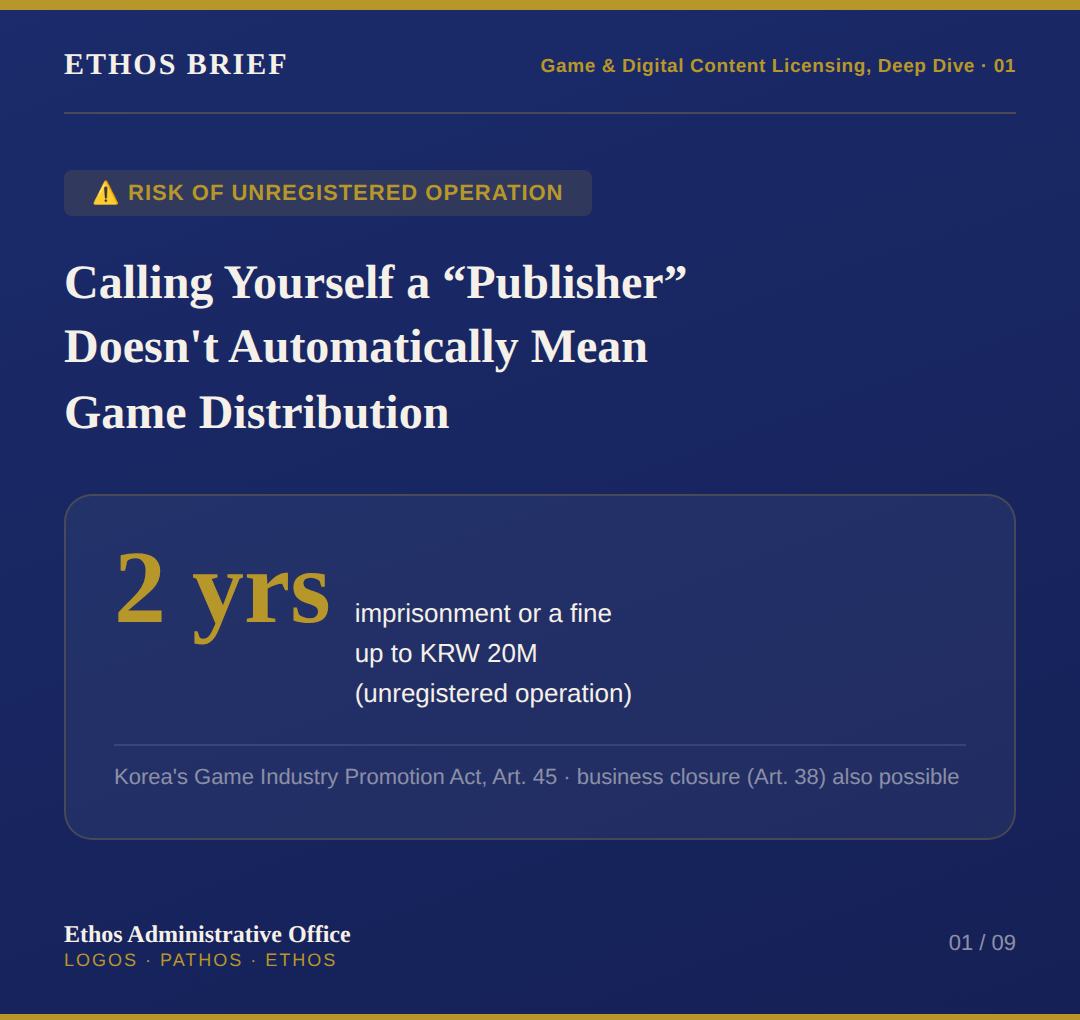
Under Article 45 of the Game Industry Promotion Act, operating a game production or game distribution business without the registration required under Article 25(1) may be subject to imprisonment for up to two years or a fine of up to KRW 20 million.
Measures relating to closure of an unregistered business may also become relevant under Article 38.
This does not mean that every company involved in a game project is automatically subject to those penalties.
The first questions are whether the actual business falls within the statutory definition of game production or distribution, whether an exception applies, and what activities were actually conducted.
However, if the business structure clearly falls within a registration requirement, a strategy of:
Launch first and register later.
can create unnecessary risk.
If the issue is discovered after development costs have been incurred, advertising has been booked, and the app-market launch date has been fixed, the solution may involve more than simply filing an additional registration.
The contractual roles, app-market account structure, supply chain, and even the entity responsible for rating-related procedures may need to be reconsidered.
For that reason, it is generally preferable to identify the registration structure while the project is still being organized.
Changes after registration may also require administrative action
A game company’s business structure may change after the initial registration.
The representative director may change.
The company may move to a new office.
The production location or the types of games being produced or distributed may also change.
The current Enforcement Rule provides for amendment procedures when certain registered matters change.
Where an applicable change occurs, the relevant amendment procedure should generally be completed within 30 days from the date of the change.
Accordingly, a game business registration is not something that should simply be obtained once and then stored away.
It needs to be managed together with changes in the company’s actual business structure.
The existing registration should be reviewed when, for example:
- The corporate representative changes
- The business premises move
- The production location or other registered details change
- The categories of games produced change
- The categories of games distributed change
- A business transfer, corporate merger, or succession occurs
- The business is suspended or closed
Amendment registration, business succession, suspension, and closure are separate procedures and may require different documents, so the reason for the change should be identified first.
When can a company prepare the registration itself, and when is separate review useful?
If one company directly plans and produces its own game and there are no complicated rights relationships with other companies, it may be possible to review the statutory definition of game production business and the competent authority’s filing guidance and prepare the registration internally.
Likewise, where a company clearly imports overseas games or manages game copyrights and supplies games to other businesses, the general direction of the game distribution registration may be relatively straightforward.
More detailed review becomes useful when:
- The developer and IP owner are different companies
- The entire game development process has been outsourced
- Several co-developers divide planning and production responsibilities
- The overseas developer, Korean publisher, and IP owner are all different entities
- Service rights and supply rights are divided among multiple companies
- A company directly services its own game while also operating a separate B2B distribution structure
- The contractual roles differ from the actual app-market, payment, or operational structure
In these situations, the central issue is not how to fill in the application form.
It is identifying which parts of the developer’s, IP owner’s, and publisher’s actual roles fall within the statutory definitions of game production or game distribution.
Only after those roles are separated can the proper registration entity, required documents, possible contract revisions, and pre-launch compliance steps be organized.
If you are unsure which company in your current game project should review game production or game distribution registration, it is useful to organize the following materials first:
- The roles of the developer, IP owner, and publisher
- Development, publishing, and license agreements
- Service territories and supply routes
- Ownership of app-market or platform accounts
- Copyright ownership and sublicensing authority
- Revenue collection and settlement structure
If it is still unclear which entity should review which registration, you can confirm the appropriate direction through a free initial review based on the actual development, IP, and publishing structure of your project.