
Before Starting an Airbnb or Lodging Business in Korea, Check Whether Business Notification Is Possible: Officetel and Apartment Illegal Lodging Risks
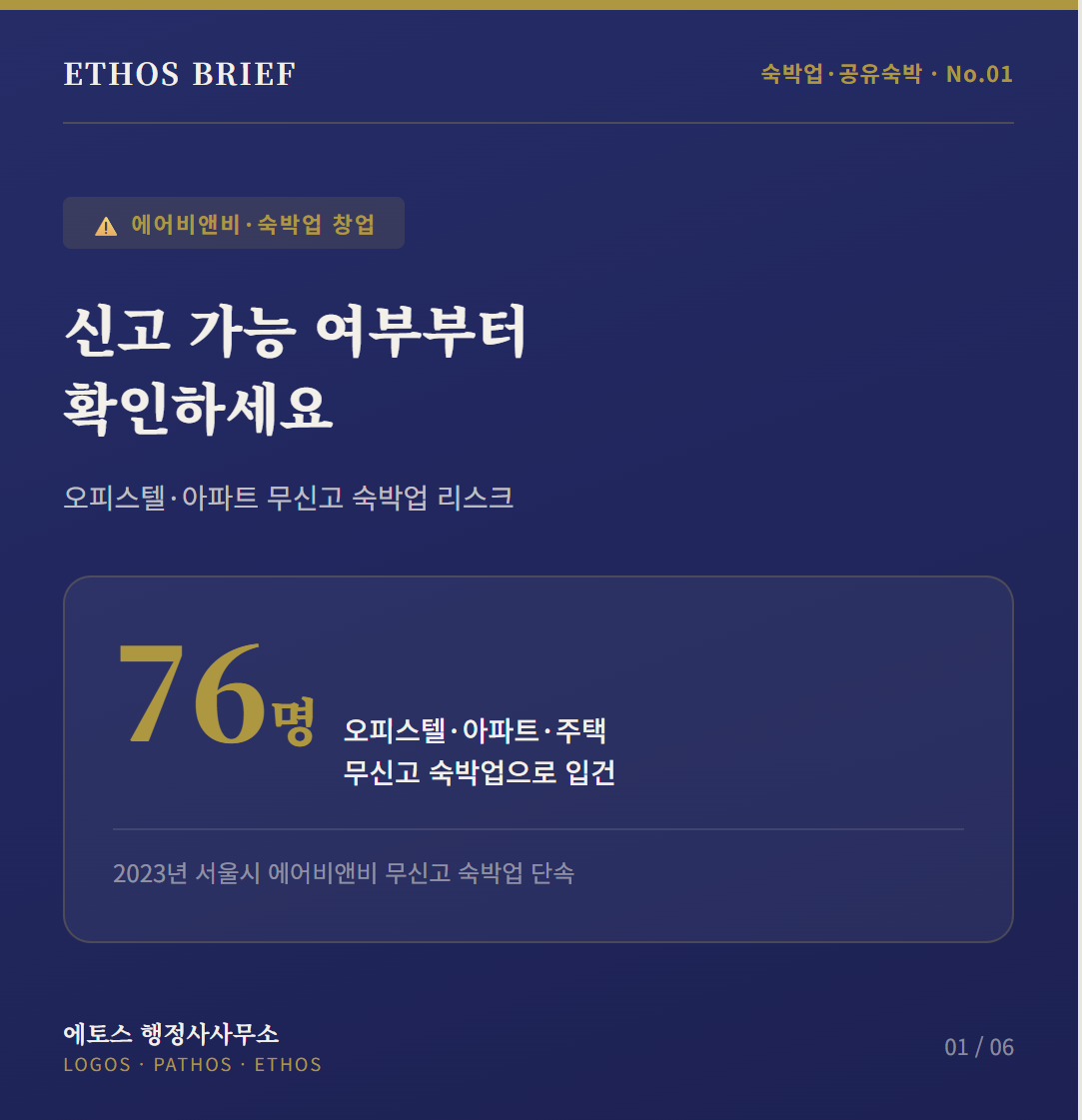
In 2023, the Seoul Metropolitan Government booked 76 operators who ran unreported lodging businesses through platforms such as Airbnb in officetels, apartments, and houses.
According to the city’s announcement, many of the detected cases involved operators leasing officetels and running them like lodging facilities.
The key issue is not simply whether the unit was listed on Airbnb.
The more important question is:
“Is this location a building and structure where lodging business notification is possible under the Public Health Control Act?”
People preparing lodging businesses or shared accommodation operations often misunderstand this point.
They may think, “If it looks like a short-term rental, it should be fine,” “An officetel can be used for lodging, right?” or “Let’s list it first and report it later if there is a problem.”
But if the actual operation provides facilities and services for guests to sleep and stay, lodging business notification may become an issue.
And if the building cannot be notified as a lodging business, the operation may create unreported or illegal lodging business risk.
This article summarizes what founders and operators of lodging businesses, bathhouse businesses, and laundry businesses should check before signing a lease, before interior work, before platform listing, and if already operating.
Bottom Line: Lodging Is a Notification Business, but It Should Be Prepared Like a Permit
In practice, people sometimes refer to public hygiene businesses as “public hygiene business permits.”
However, under the law, the basic structure is notification.
The Public Health Control Act requires a person who intends to operate a public hygiene business to prepare facilities and equipment by business type and notify the mayor, county head, or district head.
But it should not be treated lightly.
For lodging businesses in particular, if the following conditions do not fit, the notification may be blocked or enforcement risk may arise during operation:
- Building use
- Business place independence
- Guestroom structure
- Sanitary facilities
- Fire, electrical, and gas-related matters
- Whether there are multiple operating right holders
- Separation from facilities used for purposes other than public hygiene business
- Actual operating method
- Platform advertising wording
- Continuous and repeated business operation
In short, lodging is a notification business, but it is safer to prepare it like a permit.
Before filling out the notification form, first check whether the location can be notified.
The Money Is Usually Spent Before the Contract Risk Is Checked
For lodging or shared accommodation operations, costs arise before notification.
For example:
- Lease deposit
- Monthly rent
- Key money
- Brokerage fee
- Interior costs
- Beds, furniture, and appliances
- Door locks, CCTV, and access control devices
- Cleaning and laundry operation costs
- Platform photography
- Airbnb or OTA listing preparation
- Advertising costs
Now imagine one of the following problems appears later:
- Lodging business notification is difficult because the unit is an officetel.
- The apartment or house cannot be notified as a lodging business under the Public Health Control Act.
- The building use is unsuitable.
- The business place is not independent.
- Multiple guestroom operating right holders make the management structure unclear.
- Fire, electrical, or gas standards are difficult to satisfy.
- Platform advertising and actual operation are treated as lodging business.
- The operation is reported or investigated as unreported lodging business.
At that point, the money already spent may be difficult to recover.
For lodging businesses, pre-contract review is the lowest-cost risk management.
What Is a Public Hygiene Business?
The Public Health Control Act treats public hygiene businesses as businesses that provide hygiene management services to the public.
Representative categories include:
| Category | Basic Meaning | Practical Key Point | |---|---|---| | Lodging business | Providing facilities and equipment services so guests can sleep and stay | Building use, guestroom structure, business place independence, fire and hygiene standards | | Bathhouse business | Providing bathing or sweating services with water | Actual bathing or sweating service, facility scale, advertising, repeated provision | | Laundry business | Laundering clothing, textile products, leather products, etc. | Work area structure, drainage, laundry storage, hygiene flow |
Although the business names differ, the starting point is the same.
First confirm the business type, then check whether the location and facility standards fit that business, and only then file notification.
Why Do Lodging Businesses Often Get Blocked?
Lodging businesses often run into problems with location and building use.
The 2023 Seoul enforcement cases also involved illegal lodging operations using officetels, apartments, and houses.
The important point is not whether the operation “looked like a short-term rental.”
If guests are repeatedly received to sleep and stay, lodging business notification should be reviewed.
Particular caution is needed for:
- Officetels
- Apartments
- Multi-family or multi-household housing
- General houses
- One-room units
- Individually sold guestroom-style units
- Shared accommodation structures
- Structures where each guestroom has a different operator
Whether lodging business notification is possible is not determined simply by whether there is a room.
Building use, business place independence, operating party, and facility standards must all fit together.
Why Is Officetel or Apartment Airbnb Operation Risky?
Leasing an officetel or apartment and listing it on Airbnb may look like a short-term rental.
But if the actual operation looks like the following, it may be treated as lodging business:
- Receiving unspecified guests
- Repeatedly providing one-night or short-term stays
- Providing bedding, cleaning, check-in guidance, and lodging-related services
- Advertising on platforms for lodging purposes
- Managing the unit like a guestroom
- Earning repeated revenue
- Using the space mainly for lodging rather than residence
The problem is that officetels, apartments, and houses may not match the building use generally required for lodging business notification.
So the first question is not “Can I list it on the platform?”
The first question is:
“Can lodging business notification be filed for this building?”
A platform listing may be technically possible.
But whether the operation is administratively lawful is a separate issue.
7 Things to Check Before Lodging Business Notification
If you are preparing a lodging business, at least the following seven items should be checked before contracting.
1. Building Use
The first issue in lodging business notification is the building.
Check whether the building register use is suitable for lodging operation.
If change of use is required, feasibility, cost, and timeline should be reviewed before signing.
2. Business Place Independence
A public hygiene business place should generally be an independent place or separated from facilities used for non-public-hygiene business purposes.
Shared spaces, mixed-use spaces, or floors with divided operating rights require particular caution.
3. Guestroom Operation Structure
If guestroom owners or operators differ by room, management responsibility may become unclear.
Confirm who the notification holder is, who actually operates the rooms, and who controls the guestrooms.
4. Fire, Electrical, and Gas Standards
Lodging businesses involve people sleeping on the premises.
Fire, evacuation, electrical, and gas standards are important.
If checked only after interior work, correction costs may increase.
5. Sanitary Facilities and Cleaning/Laundry Flow
Guestroom cleaning, bedding management, laundry storage, and waste disposal routes are connected to the operating structure.
Actual operation should be reviewed together with facility standards.
6. Platform Advertising Wording
Airbnb, OTA, SNS, and blog advertising wording matters.
Terms such as “lodging,” “one night,” “check-in,” “guestroom,” and “guest” may become evidence when combined with actual operation.
7. Continuous and Repeated Operation
One-time use and continuous repeated business are different.
If guests are repeatedly received and revenue is earned, business nature becomes stronger.
If You Are Already Operating on Airbnb, Should You Delete the Listing First?
If you are worried about unreported lodging business, immediately deleting posts or organizing materials without review should be approached carefully.
First, check whether the current operation actually qualifies as lodging business, whether notification is possible for the building, whether simple suspension is needed, or whether a lawful conversion structure is possible.
The following information may be important in explaining the facts later:
- Actual operating period
- Number of reservations and stay periods
- Lodging fee receipt records
- Platform listing content
- Check-in guidance method
- Cleaning and laundry management method
- Whether complaints or enforcement contact occurred
- Building register use
- Purpose of use under the lease agreement
Unreported lodging business risk should not be handled emotionally.
It is important to organize the facts and building conditions first.
Bathhouse Business Is Judged by Actual Operation, Not the Signboard
Bathhouse business is similar.
Calling it a “gym sauna,” “sweat room,” “steam room,” or “spa facility” does not automatically mean it is not a bathhouse business.
The Supreme Court held that whether bathing or sweating services provided in a place attached to a sports facility are subject to bathhouse business notification should be judged comprehensively by factors such as:
- Content of bathing or sweating facilities
- Facility scale
- Proportion within the overall facility
- Advertising and promotion
- Continuous and repeated provision
- Purpose of the Public Health Control Act and facility/hygiene management standards
In other words, substance matters more than the name.
If bathing or sweating services are continuously provided and advertised, review may be needed to determine whether separate notification is required.
Laundry Business Depends on Work Area Structure and Hygiene Flow
Laundry businesses may seem less complex than lodging or bathhouse businesses.
But in practice, issues often arise with:
- Separation between work area and customer waiting area
- Storage of laundry before and after cleaning
- Flow of contaminated laundry and completed laundry
- Drainage facilities
- Ventilation
- Machine layout
- Chemical substance use
- Feasibility in apartment buildings or mixed-use commercial buildings
- Noise and odor complaints
Laundry business is not just a matter of placing washing machines.
The work area structure and hygiene flow should match the notification content.
Where Each Business Type Often Gets Blocked
| Category | Legal Starting Point | Common Practical Blockage | What to Check Before Contract | |---|---|---|---| | Lodging business | Business providing facilities and equipment so guests can sleep and stay | Use of officetels, apartments, houses; multiple operator structure; lack of independent business place | Building use, independent business structure, guestroom operation | | Bathhouse business | Business providing bathing or sweating services with water | Treated as an auxiliary facility but actually judged as bathhouse business | Facility scale, advertising wording, continuous and repeated operation | | Laundry business | Business laundering clothing, textile, leather products, etc. | Late review of work area structure, drainage, hygiene flow | Work area separation, equipment layout, laundry storage flow |
In table form, it looks simple.
But on site, the order is often reversed.
People sign a lease before confirming the business type, review construction estimates before facility standards, and ask about notification only at the end.
That order increases costs.
Typical Public Hygiene Business Notification Procedure
The details differ by business type, but the basic flow is:
- Confirm actual business type
- Check building register and building use
- Check business place independence and separation
- Review facility and equipment standards
- Check whether fire, electrical, gas, or related documents are required
- Prepare facility and equipment overview
- Prepare lease and rights-related documents
- File business notification with the city, county, or district office
- Receive business notification certificate
- Respond to site confirmation if required
- Complete tax business registration and begin operation
The statute may look short.
But in practice, many things must be prepared before notification.
That is why location and facility review before filing is often more important than the filing counter itself.
What Happens If You Operate Without Notification?
Operating a public hygiene business without notification may create criminal and administrative risk.
For lodging businesses in particular, enforcement and complaints are common.
If the following records exist, it may be difficult to explain the operation as a simple private rental or test operation:
- Airbnb or other platform listing
- Guest reviews
- Repeated reservation records
- Check-in guide messages
- Lodging fee receipt records
- Cleaning and laundry operation records
- SNS advertising
- Map listing
- Neighbor complaints
A lodging business is a place where people sleep, so hygiene and safety issues are directly connected.
What begins as a simple side income can become an unreported lodging business investigation.
Pre-Contract Checklist
If three or more of the following are unclear, review is recommended before signing a lease or listing on a platform:
- You have not confirmed whether the business is lodging, bathhouse, laundry, or another public hygiene business.
- You have not checked the building register use.
- You are considering Airbnb operation in an officetel or apartment.
- You plan to use a house for short-term lodging.
- You do not know the difference between serviced residence and general lodging business.
- You are unsure whether the business place is independent.
- There are multiple owners or operators by guestroom.
- You have not checked fire, electrical, or gas standards.
- You already prepared lodging platform advertising wording.
- You plan to operate bathing or sweating facilities as an auxiliary service.
- You have not reviewed laundry work flow and drainage.
- You already signed a lease but notification feasibility is unclear.
- You have received complaints or enforcement contact related to unreported lodging.
After signing the contract, your options become narrower.
For public hygiene businesses, the location and business type should be matched before contracting.
Frequently Asked Questions
Q. Is listing on Airbnb automatically illegal?
Not automatically.
However, if the actual operation qualifies as lodging business and the location cannot be notified as lodging business, unreported lodging issues may arise.
Platform listing feasibility and administrative legality are separate questions.
Q. Can lodging business notification be filed for an officetel?
Great caution is needed.
The answer may vary depending on building use, site structure, and local government interpretation, but there are many enforcement cases involving officetels operated like lodging facilities.
Check with the local district office before signing.
Q. Is short-term rental of an apartment or house not lodging business?
The period or contract form alone does not decide the issue.
If services for sleeping and staying are repeatedly provided to unspecified persons, the operation may be judged as lodging business.
Even if it looks like a housing lease, the actual operation matters.
Q. Can serviced residence always be operated as lodging business?
No.
Even for serviced residence facilities, lodging business notification, building use, operation method, entrusted operation structure, and guestroom management should be reviewed together.
Q. Does a sauna inside a gym require bathhouse business notification?
It may, depending on the case.
Facility scale, advertising, continuous and repeated provision, and the proportion of the overall facility should be reviewed comprehensively.
Q. Can laundry business be notified simply by installing washing machines?
No.
Work area structure, drainage, ventilation, laundry storage flow, and hygiene management standards should be reviewed together.
If You Are Already Operating or Received Enforcement Contact
If you are already operating through Airbnb or another lodging platform, first check:
- Whether the actual operation qualifies as lodging business
- Whether lodging business notification is possible for the building
- Whether the operation may be viewed as unreported business
- What platform advertising and reservation records show
- Whether the district office or special judicial police contacted you
- Whether complaints have occurred
- Whether suspension, conversion, or notification is realistically possible
Unreported lodging business issues do not resolve themselves over time.
It is important to identify realistic response options and decide the order of communication with the authorities.
When a Pre-Contract First Review Is Needed
Ethos Administrative Office does not review public hygiene business notification simply as “possible” or “impossible.”
Based on the current address and operating method, we review:
- Whether the business is lodging, bathhouse, laundry, or another category
- Whether the building use is suitable for notification
- Whether the business place is independent
- Whether separation from non-public-hygiene facilities is possible
- Whether the lodging guestroom operation structure matches notification standards
- Whether officetel, apartment, or house operation creates risk
- Whether fire, electrical, or gas-related review is needed
- Whether the facility and equipment overview matches the actual site
- Whether platform advertising and actual operation create unreported lodging risk
- In what order to contact or file with the local district office
Lodging, shared accommodation, bathhouse, and laundry businesses are notification businesses, but there are many structures to prepare before notification.
If you are considering a building or already operating a space, check notification feasibility before signing, listing, or renovating.
For consultation, please contact us through the consultation channel.
How Ethos Administrative Office Can Help
Ethos Administrative Office helps review public hygiene business notification procedures and administrative risks for lodging, bathhouse, and laundry businesses.
We can assist with matters such as:
- Lodging business notification feasibility review
- Airbnb and shared accommodation operation risk review
- Officetel, apartment, and house lodging risk review
- Serviced residence operation structure review
- Bathhouse business applicability review
- Laundry business notification procedure review
- Building use and business place independence review
- Facility and equipment overview preparation
- Public hygiene business change notification review
- Response direction for unreported lodging enforcement or complaints
- Administrative procedures for foreign founders entering lodging or public hygiene businesses
For public hygiene businesses, the actual operation matters more than the name.
The business category and location should be correct before the notification form is prepared.
Ethos Administrative Office can help organize lodging business notification, public hygiene business notification, and unreported lodging risk.
For consultation, please contact us through the consultation channel.
References
- Seoul Metropolitan Government: Unreported Lodging Business Materials
- Supreme Court Decision 2017Do2793: Criteria for Bathhouse Business Notification Duty
- Korea Law Information Center: Lodging Business Notification Acceptance Cancellation Case
- Korea Law Information Center: Public Health Control Act Enforcement Rule Materials on Notification Documents and Change Notification