What Must a Cosmetics Distributor Do After Registration in Korea?
BySangjin Ji, Administrative Attorney3 years of embassy visa practiceLinkedIn
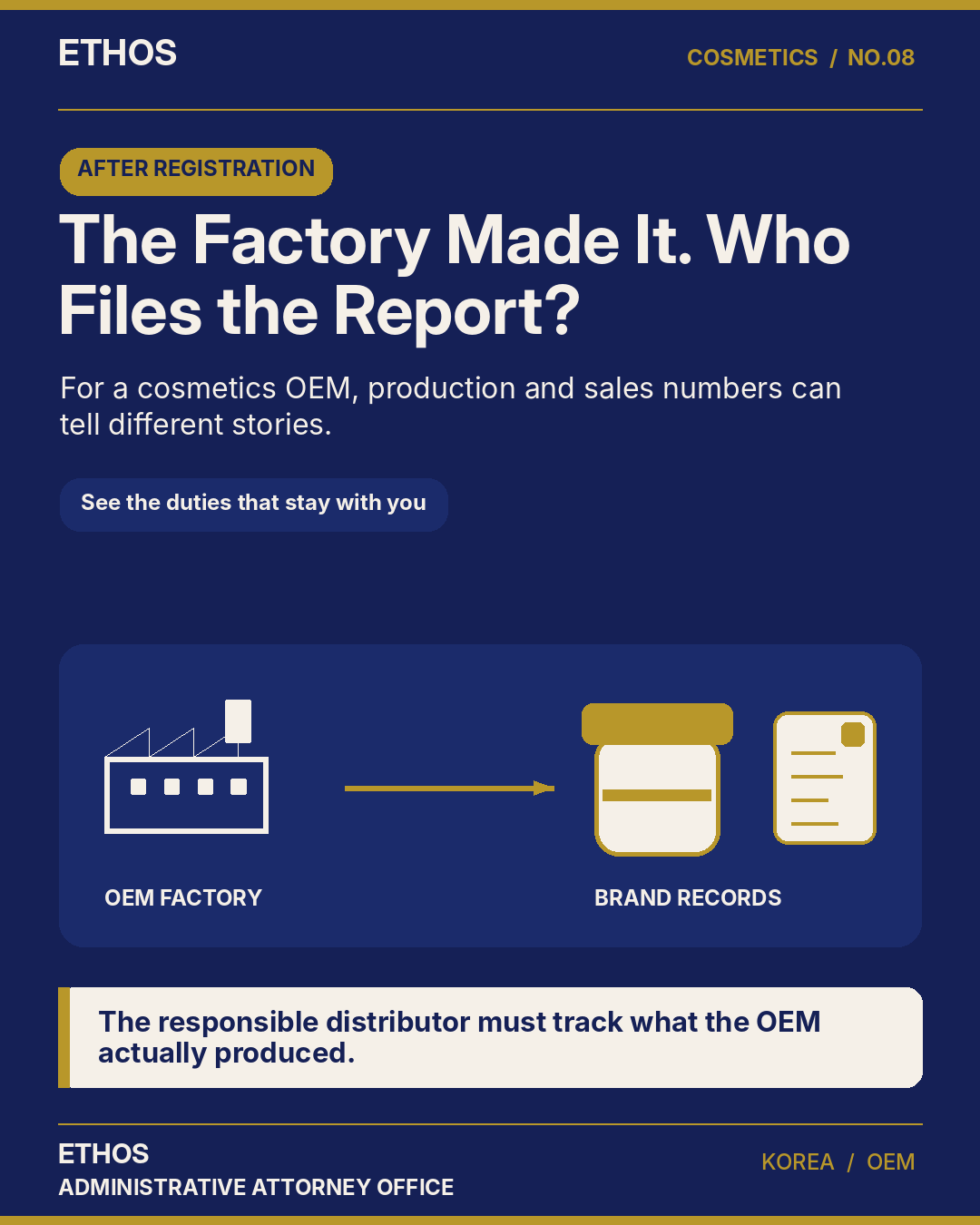
A cosmetics brand has finished registering its responsible distribution business in South Korea and has outsourced the manufacture of its moisturizing cream to a domestic OEM factory. With the product ready for sale, it might seem that the factory will take care of production reporting as well. After all, the factory is the one making the cream.
That assumption needs a closer look. When a registered cosmetics responsible distributor markets domestically manufactured cosmetics under its own responsibility, the distributor has the obligation to report the production results. Hiring an OEM manufacturer does not, by itself, transfer that reporting obligation to the factory. Sales records or quantities delivered to the warehouse may not show how many finished products were actually manufactured during the reporting year.
Production reporting is also not the only obligation that continues after registration. The company needs to check whether its registered responsible sales manager has completed the required training, assess safety information received from customers, and determine whether a change of address or manager requires an amendment to its registration.
These obligations arise in the course of running the same cosmetics business, but they rely on different records and different dates. Production reporting starts with the year in which the goods were actually made. For certain safety reports, the decisive date is when the company became aware of information that falls within the legally defined reporting category. A domestic OEM moisturizing cream provides a useful way to see how those distinctions work.
If the OEM Factory Makes the Product, Who Reports Its Production?
Article 5(5) of Korea's Cosmetics Act, Article 13 of its Enforcement Rule, and the rules governing reporting of cosmetics production and import results and ingredient lists provide the basis for the production reporting obligation. A cosmetics responsible distributor handling domestically manufactured cosmetics reports the preceding year's production results through the Korea Cosmetic Association's ingredient-list and production-reporting system.
For cosmetics actually manufactured in South Korea between January and December 2026, the production results must, as a general rule, be reported by the end of February 2027. The first practical task is to distinguish the amount ordered from the amount actually produced.
Suppose Min-su's company orders 1,000 units of moisturizing cream from a domestic OEM factory. During the year, the factory completes 900 finished units. It delivers 700 of them to the brand, and the brand sells 400 through its online store.
- 1,000 ordered units represent the quantity requested from the factory.
- 900 produced units represent the finished products actually manufactured that year.
- 700 delivered units represent the quantity transferred to the brand.
- 400 sold units represent the quantity purchased by customers.
In this example, the production quantity to verify for that year is 900 units. Copying the 1,000 units from the purchase order or the 400 units from sales reports would not reflect the number of finished units actually produced.
The date is just as important as the quantity. Imagine that the factory completes manufacturing in December 2026, but the company receives the goods in January 2027. The warehouse receipt may be dated 2027, yet the products were manufactured in 2026. Production must be assigned to the year it actually took place, rather than the year of delivery.
For that reason, the company should obtain the manufacturer's production completion records and examine the product name, production quantity, and production year before filling in its report. Under the Korea Cosmetic Association's reporting instructions, the manufacturer, product name, capacity, production volume, and unit production price are among the information to be checked. Production volume is entered by the number of units for each packaging size, the unit price is entered in Korean won, and the production value is calculated using the production quantity and unit production price.
Product names also require attention. The factory may use an internal code such as “Moisture Cream-A,” while the online shop displays a consumer-facing brand name. The name entered on the production report should match the name in the product specification document. When the factory's records, the specification, and the sales listing use different names, the company first needs to establish which records describe the same product.
If Sales Were Zero, Can the Company Report No Production?
Zero revenue does not necessarily mean zero production. Consider two cosmetics businesses with the same annual sales figure of zero.
Min-su's company registered its responsible distribution business and signed an OEM manufacturing contract, but its launch was delayed and the factory produced no finished products during the year. Yeon-jin's company completed manufacturing, but its online store opened late and none of the finished creams were sold. The sales figures are identical; the production-reporting circumstances are not.
- Nothing was manufactured: If the company is registered for a business category that includes the distribution and sale of domestically manufactured cosmetics, it must submit a “no production” report for a year in which no cosmetics were actually produced. The Korea Cosmetic Association provides a function for this in its reporting system.
- Goods were manufactured but not sold: The company must report the quantity actually produced during the year even if no units were sold and revenue remained zero.
The registration category matters as well. A company registered solely for the distribution and sale of imported cosmetics, without handling domestically manufactured cosmetics, is not subject to the domestic production report submitted to the Korea Cosmetic Association. A business registered for both imported products and the distribution and sale of domestically manufactured cosmetics, however, still needs to submit a “no production” report if it has no domestic production for the year.
A formally suspended or closed business requires an additional check. The Korea Cosmetic Association instructs businesses to report their production results promptly in connection with suspension or closure; what needs to be submitted depends on whether anything was produced before that change.
Failure to report is not simply a matter that can be left for another year. An amendment to the regulations on cosmetics production and import reporting that took effect on May 13, 2026 introduced procedures for checking businesses that did not submit required reports. Relevant industry organizations may contact a non-reporting business by post, telephone, or email to establish the reason. The head of a regional office of the Ministry of Food and Drug Safety may also conduct a site investigation to establish whether the business is operating at its registered location or has closed.
The practical conclusion is that an annual sales statement is not enough. A company must look at both the business category recorded on its registration certificate and the manufacturer's actual production records.
Can the Business Owner Take the Responsible Manager's Training Instead?
Production reporting is separate from the statutory training required of the registered responsible sales manager, the individual identified in the company's registration for that role.
For example, suppose employee A is registered as the responsible sales manager but cannot attend the required refresher course because of work commitments. The owner, Min-su, cannot simply take the training in A's place. It is the registered manager who must complete it.
Under Article 5(7) of the Cosmetics Act and Article 14(1) of its Enforcement Rule, a responsible sales manager must, in principle, complete initial training within six months of starting the relevant duties, followed by refresher training once every year. Applying for a course or paying its fee is not the same as successfully completing it. In the Korea Cosmetic Association's course, the required instruction and completion assessment must be finished before a completion certificate is issued.
What happens when the manager joins from another cosmetics company?
Suppose A leaves and the business appoints employee B, who previously served as a responsible sales manager elsewhere. If B duly completed the initial training at the former company, a change of employer alone does not mean that B must repeat the initial course. That training history belongs to the person who completed the course, not to the employer.
However, having an earlier initial-training certificate is different from having completed the refresher training required for the current year. The company needs to check both records independently.
A replacement may also require an update to the business registration. If B has taken over the role while the registration certificate still names A, the company must assess its amendment obligation and prepare the new manager's eligibility documents as necessary. Where Article 5 of the Enforcement Rule of the Cosmetics Act requires a registration amendment, the application is, in principle, due within 30 days of the change giving rise to that obligation.
A Customer Says the Cream Made Their Skin Red. What Happens Next?
A customer may contact the online shop to say that their skin became red after using a cream. The company needs to respond to the customer, but it also needs to assess whether the message contains information relevant to product safety.
Article 5(2) of the Cosmetics Act, Article 12 of its Enforcement Rule, and the regulations on cosmetics safety information management require cosmetics responsible distributors to collect and manage safety information, including adverse events occurring during product use, and to carry out the reporting and safety-management measures required by law.
An adverse event refers to an unwanted sign or symptom observed during the use of a cosmetic product. The company should not disregard a reported symptom simply because a medical causal relationship between the product and the symptom has not yet been established.
In the moisturizing-cream example, the customer service employee can first ask which product was used, when the symptoms appeared, and what was reported. The employee should record the product name and the date the inquiry was received, together with the manufacturing batch number if it can be obtained.
The information then needs to reach the responsible sales manager. The manager must review the reported symptoms and circumstances of use to determine whether the information belongs in a periodic safety report or falls into a legally defined expedited-report category. Medical questions about the cause or seriousness of symptoms should be assessed by an appropriate professional; the company's separate recordkeeping and reporting obligations still need to be managed.
How Do Half-Yearly Safety Reports Differ From 15-Day Reports?
Not every safety-related customer report has the same filing deadline. The reporting period depends on whether the information is subject to periodic reporting or expedited reporting.
Under Article 6 of the regulations on cosmetics safety information management, a cosmetics responsible distributor must report safety information that has not been submitted through expedited reporting within one month after the end of each half-year.
- January through June: Information subject to periodic reporting is generally submitted by the end of July of that year.
- July through December: Information subject to periodic reporting is generally submitted by the end of January of the following year.
For example, periodic-report information received in May 2026 must be reported by the end of July 2026. If equivalent information is received in October 2026, it is generally reported by the end of January 2027. If no reportable safety information was received during a half-year, the company must still submit an electronic report indicating “nothing to report,” rather than simply skip the reporting process.
There is a specific statutory exception. A cosmetics responsible distributor with no more than two regular employees that sells only cosmetic soap manufactured directly by that business may omit the relevant periodic report. Merely employing two or fewer people, or selling some soap alongside other products, is not enough to establish that exception. It does not apply to Min-su's company selling moisturizing cream manufactured by an external OEM factory.
Expedited reporting follows a different rule. Article 5 of the cosmetics safety information management regulations identifies information that must be reported promptly, including serious adverse events and certain foreign-government actions comparable to a suspension of sales or product recall. Once a company becomes aware of information falling within a legally defined expedited-report category, it must report that information to the Minister of Food and Drug Safety within 15 days of becoming aware of it. It cannot wait until the next half-yearly reporting period.
“Serious adverse event” has a more specific meaning than a complaint about discomfort. Relevant situations include death or a life-threatening condition, hospitalization or prolongation of hospitalization, persistent or significant functional impairment, congenital anomalies or birth defects, and other medically important circumstances.
A customer's initial statement that their skin became red after using a cream is not, by itself, enough to conclude that a serious adverse event occurred. But if the customer later explains that they were hospitalized, the company must promptly assess whether the newly received information triggers expedited reporting.
The 15-day deadline is assessed from the date the company became aware of information subject to expedited reporting, not the date the manager finished preparing the paperwork. If a customer service employee receives important information and does not pass it to the responsible sales manager until several days later, the delay in internal communication does not automatically extend the statutory reporting period.
That is why the business should preserve separate records of the initial inquiry, the date new facts were received, and the date the information was passed to the manager. If the medical cause of a symptom is unclear, an appropriate medical assessment may still be necessary, but the company cannot treat that uncertainty as a reason to ignore its duty to collect information or assess whether reporting is required.
Maintain the Records Behind Each Deadline, Not Just a Calendar
It is tempting to group production results, training, and safety reports together for an annual year-end review. But a safety report for information collected in the first half of the year may already have been due at the end of July. That obligation cannot be postponed until the following February simply because the production report is due then.
A practical compliance calendar is more useful when each deadline is paired with the document that establishes it.
- Production results: Use the OEM manufacturer's production completion records to establish the actual production year and quantity, then compare those details with previous filing receipts.
- Manager training: Check the current registered manager's initial-training record and the completion certificate for the relevant year's refresher course.
- Safety information: Keep the original inquiry date, any date on which new information became known, and the internal handover record separate when assessing periodic and expedited reporting.
- Registration changes: When the office address or responsible sales manager changes, check whether an amendment is required and identify the date the change occurred.
When documents disagree, the first task is to identify what each date and figure actually represents. Suppose the manufacturer's completion record shows December 28, 2026, while the delivery note is dated January 5, 2027. The company needs to establish that production and delivery occurred in different years before deciding which production report includes the goods. If an incorrect report was already submitted, it should review the filing receipt and ask the reporting authority about the appropriate correction procedure.
What Can the Company Check Itself, and Where Can an Administrative Attorney Help?
A business can handle much of the routine checking internally when its records match and its reporting and training duties have been met. It can obtain the OEM manufacturer's completion records, verify production dates and quantities, retain training certificates, and maintain the customer-safety inquiry log.
More detailed document work may be needed where those records conflict. The factory's completion records and the brand's delivery records might point to different years. Or the current responsible manager may differ from the person named on the registration certificate. The question then becomes what needs to be verified or corrected, and which application documents must be prepared.
Within the scope permitted by Article 2 of Korea's Administrative Attorney Act and other applicable laws, an Administrative Attorney may prepare applications and other documents submitted to administrative authorities, organize supporting evidence, and undertake permitted filing assistance or application and reporting representation. For a change of responsible sales manager, this may involve comparing the existing registration details with the new manager's eligibility documents, then preparing the relevant amendment application and supporting materials.
For production discrepancies, the work may begin by comparing each product's actual production quantity and year across the manufacturer's records and the company's existing reports. The company can then identify which additional records it needs from the factory and which questions it needs to put to the reporting institution. Reviewing a discrepancy is not the same task as preparing and filing a new application; any paid document preparation or permitted filing service has its own separately agreed scope and fee.
Common Questions
Q. If no domestically manufactured cosmetics were sold, can the company report no production?
A. Not necessarily. Products actually manufactured during the year must be reflected in production reporting even if sales were zero; this differs from a year with no production, which may require a “no production” report depending on the registered business category.
Q. Must a responsible sales manager repeat initial training after changing employers?
A. Not solely because of the change of employer if the manager duly completed initial training previously. The current year's refresher-training requirement must still be checked separately.
Q. Does a customer's report of skin redness automatically trigger a 15-day expedited report?
A. No. That statement alone does not establish a serious adverse event; the company must assess the information received and any later developments against the legally defined criteria for expedited reporting.
If you need to check domestic OEM production reporting or a change of responsible sales manager, you can share whichever of your cosmetics responsible distributor registration certificate, factory production completion records, previous reporting receipts, or new manager's eligibility documents you currently have; Ethos Administrative Attorney Office offers a free preliminary review to identify production-year and registration-detail discrepancies and the additional records that should be checked first.
Three key points
- Domestic OEM production results depend on the quantity and year actually manufactured, not sales volume; businesses in the relevant registration category must also report a year with no production.
- Responsible sales managers generally complete initial training within six months of starting their duties and refresher training annually, while periodic safety reports and 15-day expedited reports have different legal triggers and deadlines.
- Compare OEM completion records, training certificates, dates when safety information became known, and the dates of registration changes; discrepancies may call for further records or correction and amendment procedures.