Korean Nonprofit Fundraising: When to Amend Your Registered Target
BySangjin Ji, Administrative Attorney3 years of embassy visa practiceLinkedIn
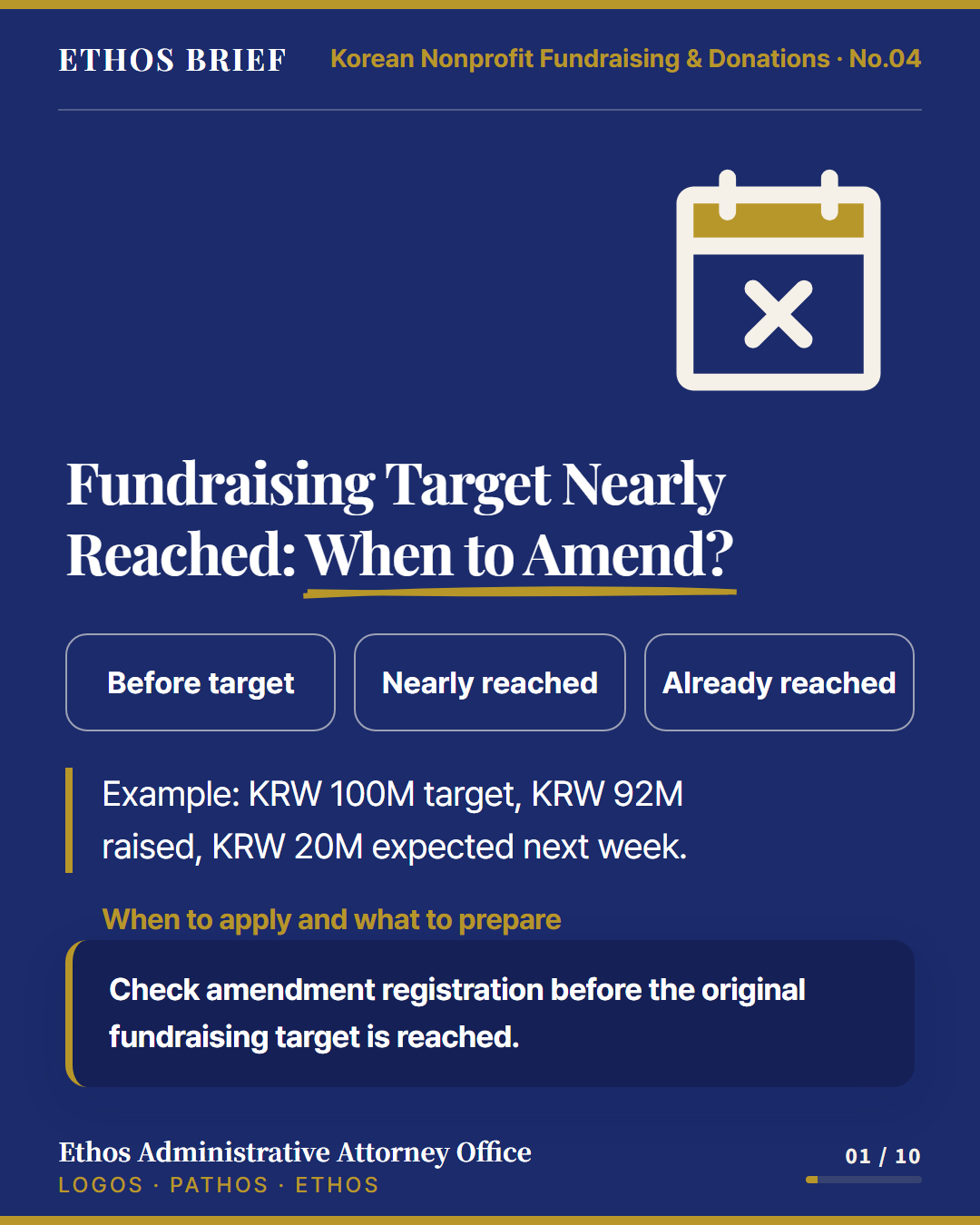
Three-point summary
- A nonprofit seeking to increase its registered fundraising target must apply for amendment registration before the original target is reached and before the registered collection period ends.
- Korea's 1365 Donation Portal recommends applying at least two weeks in advance. This is administrative guidance, not a universal statutory 14-day deadline. Filing an application does not mean the amendment has been completed.
- If the target has already been reached, the nonprofit must first address the obligation to stop fundraising and file a collection-completion report. Before that point, it should compare actual receipts with expected donations and prepare the revised plans.
A nonprofit in Korea has successfully registered a fundraising campaign.
Donations are arriving faster than expected, and a corporate donor has offered to make an additional contribution.
Should the organization accept the money first and amend its fundraising registration afterward?
The key is to review amendment registration before the existing target is reached.
Having time left in the registered fundraising period does not automatically mean the organization can continue collecting beyond its registered target.
Similarly, having money left to raise does not mean fundraising can continue after the registered collection period expires.
Fundraising registration is therefore not merely an administrative formality. The registered purpose, target amount, collection period, and use-of-funds plan must remain consistent with the organization's actual fundraising activities.
A KRW 100 Million Target With KRW 92 Million Already Collected
Consider the following hypothetical example.
A nonprofit association in Korea registers a fundraising campaign to provide essential supplies to 500 households in need.
The organization plans to provide KRW 200,000 worth of supplies to each household.
Its fundraising target is KRW 100 million.
After completing registration, the nonprofit begins requesting donations through its website and social media accounts.
The campaign receives a positive response.
The organization has already collected KRW 92 million, and a company announces that it plans to contribute another KRW 20 million the following week.
This creates an opportunity to expand the project, but it also raises an important registration question.
The figures are:
- Registered fundraising target: KRW 100 million
- Donations already received: KRW 92 million
- Amount remaining before the registered target: KRW 8 million
- Additional corporate donation expected: KRW 20 million
- Total if the expected donation is received in full: KRW 112 million
- Amount above the original registered target: KRW 12 million
The organization may welcome the opportunity to help more households.
However, the first question is not how to report the additional KRW 12 million after receiving it.
The first question is whether the organization can complete the necessary registration steps before reaching its existing target, and how the expected payment date should be coordinated with those steps.
A registered fundraising campaign operates under a defined collection and use plan.
If the nonprofit intends to collect more than the registered amount, it must review the requirements for amendment registration.
When Must a Fundraising Target Increase Be Registered?
Article 4(1) of Korea's Act on Collection and Use of Donations and Promotion of Donation Culture (기부금품법) requires a person or organization subject to the registration requirement to register a fundraising and use plan.
The provision also requires registration when the contents of that plan are to be changed.
In other words, completing the original fundraising registration does not remove the obligation to register relevant changes.
For an increase in the fundraising target, Korea's 1365 Donation Portal provides the following timing guidance:
Apply before the registered collection period expires and before the original fundraising target is reached.
Both conditions matter.
When the collection period is still open
Suppose the registered collection period has three months remaining.
The nonprofit might assume that there is no need to act immediately.
However, if cumulative donations are already approaching the registered target, the organization should review the target increase without waiting for the collection period to end.
The fact that the campaign has time remaining does not override the registered target.
When the collection period is about to expire
Now consider the opposite situation.
The nonprofit still has substantial room below its registered fundraising target, but the registered collection period will end next week.
In this case, extending the collection period may become the immediate issue.
The 1365 Donation Portal also instructs organizations to apply for an extension before the registered collection period expires.
An organization considering amendment registration should therefore check two questions together:
- How close are actual cumulative donations to the registered fundraising target?
- When does the registered fundraising period end?
The order of preparation depends on which limit is approaching first.
Source: Korean National Law Information Center, Article 4(1) of the Donations Act; 1365 Donation Portal, guidance on fundraising registration amendments.
Is Applying Two Weeks in Advance a Legal Deadline?
The 1365 Donation Portal recommends applying at least two weeks before the relevant deadline when seeking an increase in the fundraising target.
This recommendation accounts for administrative processing.
An application may require document examination, clarification, or supplementation.
The recommendation should not be confused with a statutory rule requiring every amendment application to be filed exactly 14 days in advance.
It is practical administrative guidance.
There is another important distinction.
Submitting an amendment application is not the same as completing amendment registration.
Suppose an organization applies to increase its registered target from KRW 100 million to KRW 120 million.
The submission of the application does not, by itself, establish that the new target has already been registered.
The organization must confirm the competent registration authority's processing status and the contents of the completed amendment.
What if the corporate donation is due next week?
Return to the hypothetical example.
The nonprofit expects an additional KRW 20 million contribution within one week.
That is less time than the two weeks recommended by the 1365 Donation Portal.
The shorter preparation period does not necessarily make filing an amendment application impossible.
However, the organization should promptly reconcile its current fundraising records, identify the proposed changes, and confirm the application procedure and required documents with the competent authority.
It must also manage ongoing fundraising activities so that the original registered target is not exceeded before the amendment has been completed.
If the corporate donor has already scheduled the payment, the organization may need to communicate about the timing after confirming the registration status.
This is why amendment preparation should not be postponed until the campaign is about to reach its original target.
Source: Korean National Law Information Center, Article 5 of the Enforcement Decree of the Donations Act; 1365 Donation Portal, amendment registration guidance.
Three Situations That Require Different Responses
An increase in the fundraising target does not always call for the same immediate action.
The nonprofit's current position matters.
Situation 1. There is still room under the target
Suppose a nonprofit has registered a fundraising target of KRW 100 million and collected KRW 60 million.
It expects another KRW 50 million through planned corporate contributions and fundraising events.
The organization still has KRW 40 million remaining below its current registered target.
This gives it an opportunity to prepare the amendment before reaching the limit.
The organization should examine:
- Whether the additional fundraising plans are sufficiently developed
- Whether the existing charitable project is being expanded
- How much the registered target needs to increase
- Whether the revised use-of-funds plan supports the proposed increase
Rather than waiting until the remaining amount becomes small, the nonprofit can begin preparing once the additional funding needs are sufficiently clear.
Situation 2. The target is nearly reached
Consider the original example again.
The organization has registered a target of KRW 100 million.
It has received KRW 92 million and expects an additional KRW 20 million next week.
The expected contribution is larger than the amount remaining below the registered target.
The nonprofit should therefore compare actual cumulative receipts with the timing and amount of expected contributions.
It should also determine whether other recurring donations, corporate contributions, or fundraising events might cause the target to be reached even earlier.
The organization needs to confirm the amendment procedure and processing status while managing its ongoing fundraising activities.
In particular, it should avoid exceeding the existing registered target before the amendment is completed.
Situation 3. The target has already been reached or exceeded
Suppose a nonprofit registered to collect KRW 100 million has actually collected KRW 115 million.
This is no longer simply a question of preparing for future additional donations.
Article 19(5) of the Enforcement Decree of the Donations Act provides that fundraising must stop immediately when the registered collection period ends or the fundraising target is reached.
It also requires submission of a fundraising completion report within 30 days after fundraising stops.
The nonprofit should therefore first establish:
- When the original registered target was reached
- When and how donations above that target were received
- Whether fundraising activity continued after the target was reached
- Whether the collection-stop and completion-reporting obligations have been addressed
Continuing to collect additional donations while merely preparing an amendment application is not an adequate response.
The organization should first examine its fundraising history, the requirement to stop fundraising, and its reporting obligations.
It should then confirm the appropriate administrative procedure with the competent registration authority.
A later amendment application does not automatically resolve fundraising that had already exceeded the original registered target.
Source: Korean National Law Information Center, Article 19(5) of the Enforcement Decree of the Donations Act.
Does a Promised Corporate Donation Count as Money Already Collected?
Suppose a company has informed the nonprofit that it intends to contribute KRW 20 million next week.
The funds have not yet been deposited.
A statement of intention to donate does not, by itself, establish that the money has already been received as part of the fundraising campaign.
If the nonprofit has actually received KRW 92 million, that amount is the starting point for checking its current fundraising records.
The additional KRW 20 million is different.
It is relevant to forecasting when the organization may reach or exceed the registered target, but it should be distinguished from donations already collected.
This leads to two different calculations.
Actual cumulative donations
These show how much of the original registered fundraising target has already been reached.
Expected contributions
These help the organization assess when the target may be reached and when amendment preparation is necessary.
The nonprofit should also examine the status of the corporate donor's commitment.
Has the company merely expressed an intention to contribute?
Has the contribution been internally approved?
Is the payment date confirmed?
These distinctions may affect the organization's practical preparation schedule.
Why the Bank Balance Is Not the Fundraising Total
A nonprofit must distinguish the total amount of donations collected from the amount of money remaining in its bank account.
Consider another simplified example.
The organization has collected KRW 92 million.
It has already spent KRW 30 million on its registered charitable project.
Assuming there have been no other account transactions, the remaining bank balance could be KRW 62 million.
However, the total amount already collected is still KRW 92 million.
The nonprofit cannot conclude that it may raise another KRW 38 million simply because only KRW 62 million remains in the account.
Spending part of the donations does not erase the fact that those donations were already collected.
For fundraising-target purposes, the relevant figures must be identified separately.
Three financial figures to keep separate
- Cumulative donations actually received for the registered campaign
- The current account balance after expenditure and other transactions
- Additional contributions expected but not yet received
There is also a distinction between donations and interest earned on deposited funds.
In Statutory Interpretation No. 14-0030, dated February 27, 2014, the Ministry of Government Legislation distinguished interest generated by bank deposits from the donations actually collected when interpreting whether a fundraising target had been reached.
The accounting records should therefore make it possible to distinguish actual fundraising receipts from bank interest and remaining cash.
This distinction matters when determining how close the organization is to its registered target.
Source: Korean Ministry of Government Legislation, Statutory Interpretation No. 14-0030 (February 27, 2014).