Can a Nonprofit Pay Salaries and Advertising Costs from Donations?
BySangjin Ji, Administrative Attorney3 years of embassy visa practiceLinkedIn
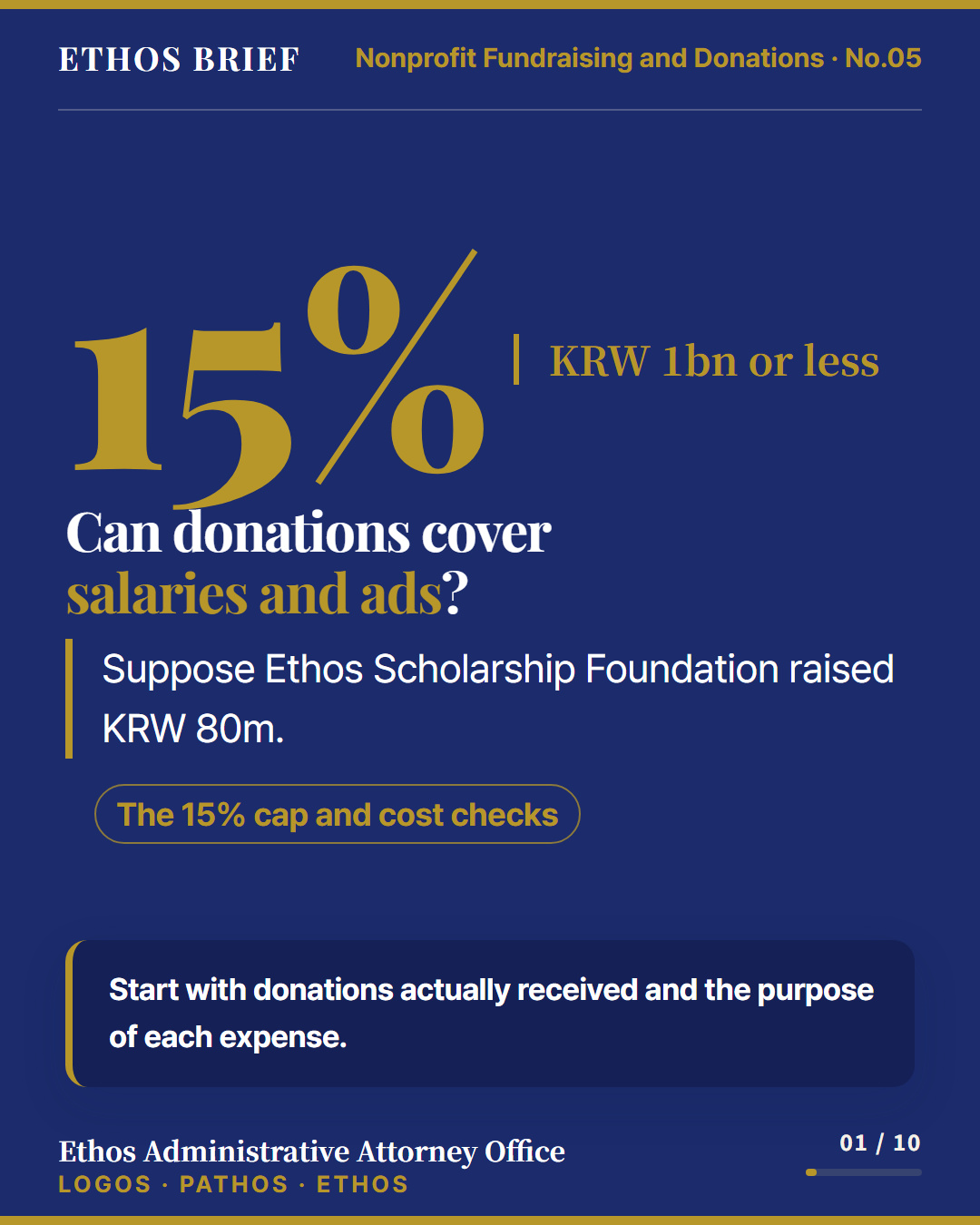
When a scholarship foundation raises donations, does every won have to go directly to students? Running a scholarship program also requires people to contact donors, reconcile receipts, review applications, and arrange payments. Staff salaries, advertising, and printed materials may therefore appear alongside the scholarships themselves.
Some of these costs may be paid from donations collected under Korea's donations law, provided that the expenditure falls within the legally permitted purposes and expense categories and remains within the applicable statutory limit. The foundation must also be able to explain what work was performed, which funds were used, and whether the expenditure matches its registered collection and use plan.
A common source of confusion is the difference between the registered fundraising target and the amount actually collected. The statutory percentage is applied to the donations actually received, not the target stated in the registration. Nor does compliance with a numerical ceiling, by itself, establish that every expense is permissible.
Consider a scholarship foundation preparing its spending approvals.
The Budget Is Below Donations Received. Why Might That Still Be a Problem?
Suppose a hypothetical organization called Ethos Scholarship Foundation registers a fundraising target of KRW 100 million to provide scholarships to students facing financial difficulties. It has received KRW 80 million so far.
The foundation plans to select 30 students and pay each KRW 2 million, for KRW 60 million in scholarships. Its planned supporting costs are:
- KRW 8 million in employee salaries: donor communications, donation receipt management, and work relating to scholarship selection.
- KRW 3 million in online advertising: publicity asking people to contribute to the scholarship fund.
- KRW 1 million in printing: booklets explaining the scholarship program and how to donate.
- KRW 2 million in audit-related costs: an audit activity the foundation is separately planning.
These additional costs total KRW 14 million. Together with the scholarships, planned expenditure is KRW 74 million, which is less than the KRW 80 million collected.
From a cash-flow perspective, the plan appears affordable. But two questions must be answered separately: Does the foundation have enough money, and is it legally permitted to pay each expense from these particular donations?
Article 12 of Korea's Act on Collection and Use of Donations and Promotion of Donation Culture (commonly referred to as the donations law, or 기부금품법) generally restricts the use of collected donations to their registered collection purpose, apart from expenses charged under Article 13 and specified statutory exceptions. Article 13 permits an appropriate portion of collected donations to cover eligible costs associated with collection, management, operations, use, and reporting, subject to a statutory percentage limit.
The foundation therefore needs to examine what each item in the KRW 14 million budget actually pays for, and which amounts it proposes to charge to its registered donations.
Why Is the Calculated Expense Cap KRW 12 Million, Not 15% of the Fundraising Target?
Article 13 of the donations law and Article 18 and Attached Table 1 of its Enforcement Decree specify limits based on the amount actually collected. The applicable maximum percentages are:
- Actual collections of KRW 1 billion or less: up to 15%.
- More than KRW 1 billion and up to KRW 10 billion: up to 13%.
- More than KRW 10 billion and up to KRW 20 billion: up to 12%.
- More than KRW 20 billion: up to 10%.
Although the foundation registered a KRW 100 million target, it has received only KRW 80 million. At the applicable rate of 15%, its calculated ceiling at this stage is KRW 12 million.
What, then, should it do about the KRW 14 million in planned salaries, advertising, printing, and audit-related costs?
If all KRW 14 million falls within the expenses governed by Article 13 and all of it is to be paid from the donations collected under this registration, the proposed charges exceed the calculated ceiling by KRW 2 million. Those are conditions, not findings about the actual expenses. And because these figures describe a proposed budget, they do not establish that the foundation has already breached the law.
Before approving payments, the foundation should identify the work behind each cost, compare the proposed spending with its registered use plan, and distinguish amounts already paid from amounts not yet disbursed.
A different source of funds might lawfully cover some expenditure, depending on the restrictions attached to that source. Having other income does not automatically make every use of it permissible. The foundation must establish how the income arose and whether it is subject to its own purpose or contractual conditions.
If additional donations are actually received, the ceiling can be recalculated based on the updated collection total. Expected donations that have not yet been received cannot be added to the current collection figure in advance.
The 15% rate is also not universal: the lower percentage bands above apply when actual fundraising exceeds the relevant thresholds. The statutory percentage is a ceiling, not a budget that the foundation is necessarily entitled to spend in full.
What Work Does the KRW 8 Million Salary Actually Pay For?
Suppose one employee was responsible for sending fundraising messages, recording incoming donations, and maintaining donor records. As scholarship payments approached, the same employee also accepted student applications, checked supporting documents, and prepared materials for the selection process.
The employee worked on both donor-facing activities and the scholarship program itself. It may be tempting either to classify the entire salary as a fundraising expense or to move part of it to a program-expense account based on a simple time split.
The accounting label does not replace evidence of the actual work or the statutory test.
The foundation can start with the employment contract and job description. These show the duties formally assigned to the employee. Emails sent to donors, donation receipt records, student application registers, and selection documents help establish what the employee actually did.
Payroll records and bank transfer details show when and how much was paid. They also need to be reconciled with records identifying the source of the payment. Where several activities share one bank account, the transfer alone may not establish which activity funded it.
The distinction matters because Article 13 is not limited to advertisements expressly soliciting donations. It also addresses eligible costs for managing, operating, using, and reporting on collected donations. An employee's involvement in scholarship selection does not automatically remove the associated salary from the statutory cost-appropriation limit.
Likewise, the fact that a prescribed use statement distinguishes program-delivery expenses from fundraising expenses does not, by itself, settle whether a payment falls within Article 13. The foundation needs to examine the employee's actual duties, the registered use plan, the funding source, and the relevant accounting and legal standards together.
Do KRW 3 Million in Advertising and KRW 1 Million in Printing Serve the Same Purpose?
Imagine an online advertisement saying:
Help fund scholarships for students who are struggling to continue their studies.
Its audience is prospective donors. The advertisement seeks contributions to the foundation's registered scholarship fundraising campaign. An advertising plan, contract, published material, invoice, and payment record can help establish that purpose.
Now consider a separate notice saying:
Information on scholarship eligibility, required documents, and application dates.
This notice addresses students applying for support. It forms part of the process of selecting scholarship recipients rather than requesting new donations.
Both pieces of material may appear under a broad heading such as “publicity.” Nevertheless, they perform different tasks. The actual message, audience, and registered program help explain the expenditure more reliably than the word used in the ledger.
The same principle applies to the KRW 1 million printing budget. A booklet explaining how to donate has a different immediate function from instructions for scholarship applicants. Reviewing the printing contract, quotation, delivered materials, and payment evidence reveals what was produced.
Still, an applicant-facing notice is not automatically excluded from the costs governed by Article 13. The law also addresses costs associated with the use and administration of donations. The expense must be assessed in the context of the actual work and applicable legal rules.
A shared website creates a similar question. If it hosts both a donation page and a scholarship application page, the purpose and basis of the website maintenance costs need to be examined before assigning them to one category. The fact that two activities appear on the same website does not establish an arbitrary allocation ratio.
How Should KRW 60 Million in Scholarship Payments Appear in the Donation Use Statement?
For the foundation, the KRW 60 million scholarship budget is directly connected to its registered purpose: supporting students who face financial difficulties. If the foundation selects 30 eligible students and pays KRW 2 million to each in accordance with the registered plan, it should be able to trace the payment records back to the selection process.
An entry stating only “scholarships — KRW 60 million” would not tell the whole story. Relevant records include the selection criteria, application notices, submitted applications, review materials, final selection decisions, and bank transfer confirmations showing who was paid, when, and how much.
The prescribed Donation Use Statement in Attached Form No. 5-2 to the Enforcement Decree records such particulars as the date of use, recipient or destination, expense category, purpose, and amount. Its instructions distinguish program-delivery expenses from fundraising expenses, and provide an illustrative scholarship-payment item under program-delivery expenses.
That distinction is useful for describing the actual use of funds. But it must not be confused with the separate statutory question under Article 13: whether particular expenses may be charged to donations within the applicable percentage cap.
Salaries and other operating costs cannot simply be removed from the Article 13 calculation by recording them as “program-delivery expenses.” The work performed, source of funds, and statutory treatment must still be examined.
If the foundation is subject to Korea's Accounting Standards for Public-Interest Corporations, Article 27 of those standards separately classifies costs into program-delivery expenses, general and administrative expenses, and fundraising expenses. The treatment in financial statements and the treatment of costs charged to donations under Article 13 serve different purposes; one does not automatically determine the other.
In practice, the foundation should maintain supporting records in distinct but connected groups: scholarship selection and payment evidence; payroll and work records; advertising and printing contracts and outputs; and its original fundraising registration and use plan.
Can Unspent Scholarship Donations Be Used for Another Public-Interest Program?
Suppose the foundation considers a youth career-education program after its scholarships are paid. Both scholarships and career education may serve worthwhile public-interest aims. The foundation's articles of incorporation may also permit several education-related activities.
But the organization's general mission is not the same as the specific purpose for which a particular donation campaign was registered.
Under Article 12(1) of the donations law, collected donations generally may not be spent outside the collection purpose, subject to the Article 13 expense provision and the exceptions expressly provided by law. A broadly worded nonprofit purpose in the foundation's articles of incorporation does not authorize the unrestricted transfer of registered scholarship donations to a separate education project.
Article 12(1) provides a route for considering another similar purpose, with approval from the registering authority under the prescribed procedure, where either:
- The original purpose of collection cannot be achieved; or
- Donations remain after they have been used for that purpose.
Article 12(2) further addresses approval where the proposed use under that exception falls within the same type of activity as the original collection purpose. The foundation must still follow the approval procedure; an internal board decision is not a substitute for approval from the registering authority.
Before considering another program, the foundation should determine whether its scholarship work has actually been completed. The KRW 80 million collected and KRW 60 million planned for scholarships do not, by themselves, establish an amount legally available for another purpose. Scholarship payments may still be pending, supporting costs may not yet have been settled, and obligations under the registered use plan may remain.
Next, it should compare the original collection and use plan with the proposal for youth education. Does the activity fall within the registered scholarship program? Is it an expansion of that program, or a separate project? The answer determines which legal conditions and potential approvals need to be considered.
Changing a plan for future fundraising is different from seeking to use donations already collected for another purpose. The foundation should not treat the latter as a mere change in an accounting heading.
Why Did a Korean Supreme Court Decision Begin with the Source of the Money?
A decision of the Supreme Court of Korea dated February 2, 2023 (Case No. 2021Do16765) is helpful in understanding why the legal character of funds matters.
The prosecution alleged that a registered fundraising association had used funds for staff salaries and publicity in excess of the statutory cost-appropriation limit and had spent some funds outside the registered collection purpose.
The Supreme Court, however, first examined whether money regularly received from the association's members as dues or supporting payments constituted donations subject to the donations law. It considered the association's articles, membership procedures, members' rights and obligations, and the organization's actual operations and handling of payments.
The Court concluded that the member payments at issue fell outside the statutory definition of donations, and it quashed and remanded the relevant guilty portion of the lower court's decision.
This was not a ruling that nonprofits may spend unrestricted amounts on salaries or advertising. The key question was whether the particular money was regulated as donations under the Act in the first place.
Nor can the result for an association's member-payment structure simply be applied to a scholarship foundation. Associations and foundations have different organizational arrangements, and the character of each payment must be established on its own facts.
For the hypothetical foundation, the practical lesson is to identify whether money in its accounts consists of donations collected under the registered scholarship campaign or income from another source. Donation receipts, bank records, and the basis on which funds were received should be compared before deciding which rules govern a salary or publicity payment.
Can a Past Payroll Payment Be Fixed by Renaming Its Accounting Category?
Suppose the foundation discovers that part of its planned payroll and advertising budget has already been paid. Moving an employee's salary from “fundraising expenses” to “program-delivery expenses” may reduce the total shown under the fundraising heading.
But it does not change what the employee did, which funds paid the salary, or when the money left the account.
For amounts already disbursed, the foundation should preserve the original records and reconcile the payroll ledger with bank transfers, employment documents, duty assignments, and records of actual work. Advertising payments should likewise be matched with contracts, the material actually published, invoices, and proof of payment.
It should then compare amounts already spent with amounts still proposed, rather than treating the entire KRW 14 million budget as a completed expenditure. The actual collection total and the aggregate costs charged to the relevant donations must also be identified.
An incorrect accounting entry may need to be corrected to reflect the supporting evidence. Reclassifying a past payment, however, does not automatically resolve a possible breach of a statutory expense limit or purpose restriction. A change to future spending plans, approval to use donations for another purpose, and the legal treatment of a past payment are separate questions.
If an alleged violation raises criminal-proceeding issues, those matters require review by a lawyer. The document preparation and permitted administrative filing services of an Administrative Attorney must be distinguished from criminal defense or litigation representation.
What Records Should Support the Donation Use Statement?
Article 14 of the donations law requires records and documents concerning the collection and use of donations to be prepared and maintained. Article 19 of its Enforcement Decree addresses the related documents and evidence supporting the receipt and disbursement of donated funds.
The goal is not merely to fill out a summary form. The foundation should be able to explain the actual transaction behind each amount.
- Scholarship payments: application notices, eligibility and selection criteria, review records, payment decisions, and bank transfer records showing recipient, date, and amount.
- Employee salaries: employment contracts, job assignments, records of the work performed, payroll records, and payment evidence.
- Advertising and printing: advertising drafts and published material, contracts, delivered booklets, invoices, and payment records.
- The overall fundraising account: registration documents, the collection and use plan, donation receipt records, bank statements, proposed spending schedules, and actual donation use records.
The foundation can start with its registered purpose and approved spending plan. It then compares the amounts actually received with the amounts already paid and those still planned. Each transaction should have evidence showing the nature of the work and its relationship to the registered fundraising activity.
This process supports later disclosure and reporting, but it also helps before payment approval. A mismatch between the registered plan and a proposed expense is easier to address when the payment has not yet been made.
What Should the Foundation Decide Before Approving the Payments?
Return to the hypothetical foundation's initial figures:
- KRW 80 million actually collected.
- KRW 60 million planned for student scholarships.
- KRW 14 million planned for salaries, advertising, printing, and audit-related costs.
- A KRW 12 million calculated limit at the applicable 15% rate for eligible costs charged to the registered donations.
The apparent KRW 2 million difference matters if all KRW 14 million is subject to Article 13 and all is to be funded from these donations. It is not a finding that the foundation has already overspent.
Before approving the budget, the person responsible for payments should bring together the collection registration, collection and use plan, donation receipts, bank statements, job and payroll records, advertising materials, and proof of expenses. Those records should establish what was received, what has already been paid, what remains planned, and which funding source is intended for each payment.
If the evidence does not adequately explain how a mixed-duty employee's salary or a shared publicity expense was calculated, the foundation should establish the facts and supporting basis before selecting an accounting category. If proposed spending differs from the registered plan, it should determine whether further documentation, an amendment to registered particulars, or approval for a different use of collected donations needs to be considered.
A bank balance cannot answer whether donations may be spent on a particular cost. The answer depends on the legal character of the funds, what work the expense covers, the statutory limit, and the purpose and conditions of the registered fundraising campaign.
Legal Sources
- Act on Collection and Use of Donations and Promotion of Donation Culture, Articles 12, 13, and 14.
- Enforcement Decree of that Act, Articles 18 and 19, Attached Table 1, and Attached Forms Nos. 5-2 and 9.
- Accounting Standards for Public-Interest Corporations, Article 27, where applicable.
- Supreme Court of Korea, February 2, 2023, Case No. 2021Do16765.
If your organization is considering salary or advertising payments from registered donations, you can provide its fundraising registration, collection and use plan, actual receipt and expenditure records, and supporting payroll or advertising documents to Ethos Administrative Attorney Office for a free preliminary review of the applicable cost ceiling, records requiring clarification, and administrative procedures that may need consideration; any subsequent document preparation or filing is a separately scoped paid service.
Three Key Takeaways
- Under Korea's donations law, some collected donations may be used for eligible salary, advertising, and related costs, subject to a statutory percentage limit based on actual collections.
- When actual collections are KRW 1 billion or less, the applicable ceiling is 15% or less; recording a payment as a program expense does not, by itself, settle whether Article 13 applies.
- Collected donations generally must be used for their registered purpose. A different use requires examination of the statutory grounds and any required approval from the registering authority.