
If AI Translation Was Advertised as Human Translation: Refunds, KFTC Reports, and Consumer Remedies
Hello, this is Administrative Agent Jean.
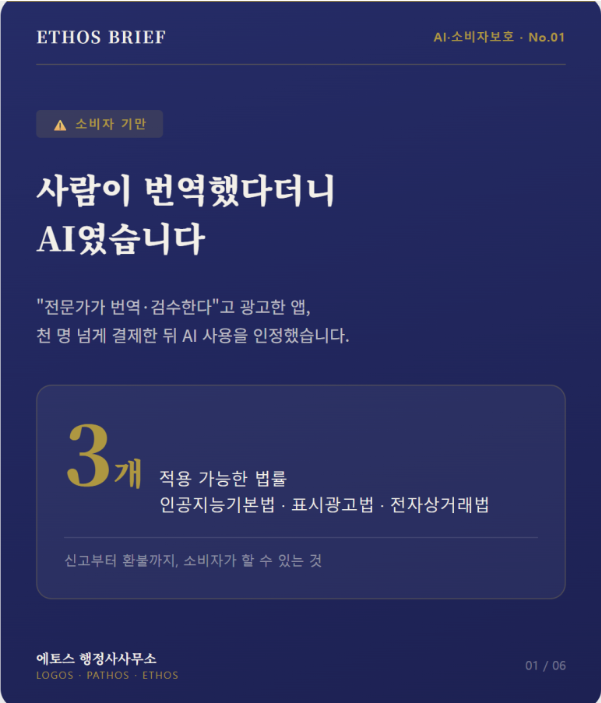
There was an app that claimed you could access hundreds of classic literature works for life by paying only KRW 19,800.
Its promotional wording was quite specific.
A university student on leave personally translates the works, and a novelist selected through the New Writer’s Contest reviews them.
Reportedly, more than a thousand users paid after relying on this explanation.
However, suspicions of AI translation were repeatedly raised, and the company eventually admitted that it had used AI in the translation process.
In this situation, three questions immediately arise from the consumer’s perspective.
I paid because I was told a human translated it. Can I get a refund?
Where should I report that the company concealed its use of AI?
The terms say no refund after download. Is a refund still possible?
This issue does not need to be viewed merely as a dispute over translation quality.
If the actual advertising and the content provided differ, the Fair Labeling and Advertising Act, the Act on Consumer Protection in Electronic Commerce, and, depending on the case, the AI Basic Act may all need to be reviewed.
In particular, if a consumer wants a refund, it is more important to first check the withdrawal period and evidence than to look for a reporting agency.
Is There No Problem If AI Translation Is Still Readable?
The core issue is not simply whether the translation quality is good or bad.
What matters is what the consumer relied on when paying.
In translations of classic literature, how historical context, nuance, and style are conveyed can affect the value judgment of the product.
Therefore, if the business actively advertised:
A human directly translated it.
A writer with a specific background reviewed it.
then whether that information was an important factor influencing the consumer’s purchase decision may become an issue.
If the actual work method differed from the advertisement, there are three major directions to check.
First, whether the advertisement claiming human translation differed from reality.
Second, if the product or service used generative AI, whether transparency obligations under the AI Basic Act apply.
Third, if the advertised content and the digital content actually provided differ, whether withdrawal is possible under the Electronic Commerce Act.
These three issues have different purposes.
A report to the Korea Fair Trade Commission is connected to administrative sanctions against unlawful advertising by the business, while withdrawal or consumer remedy is connected to recovering the money paid by the consumer.
If the Business Advertised Human Translation but Actually Used AI, Could This Be a Fair Labeling and Advertising Act Issue?
If the actual advertising content and the work method differ, and that difference could affect a consumer’s reasonable purchase decision, whether it constitutes false or exaggerated labeling or advertising under the Fair Labeling and Advertising Act may be reviewed.
Article 3 of the Fair Labeling and Advertising Act prohibits unfair labeling or advertising that may deceive consumers or cause consumers to misunderstand.
Therefore, the analysis does not look only at:
Was AI used?
You must look at how the advertisement was actually expressed.
For example:
Translation at the level of a professional translator.
and:
A university student directly translated it, and a novelist reviewed every work.
have different levels of factual specificity.
The latter is closer to a factual claim about who did what work.
If the actual work differed from the advertisement, the possibility of an issue under the Fair Labeling and Advertising Act may increase.
Under Article 9 of the Fair Labeling and Advertising Act, labeling or advertising that violates Article 3(1) may be subject to an administrative surcharge not exceeding 2% of related sales. If there are no sales or sales are difficult to calculate, a fixed administrative surcharge of up to KRW 500 million may become an issue under the statutory requirements.
However, the specific sanction level may vary depending on the content and duration of the violation, related sales, repetition, and other individual circumstances.
Could the AI Basic Act Also Apply?
If a business provides a product or service using generative AI, the transparency obligations under Article 31 of the AI Basic Act may become an issue.
The AI Basic Act took effect on January 22, 2026.
Article 31(1) provides that when an AI business operator intends to provide a product or service using high-impact AI or generative AI, it must notify users in advance that the product or service is operated based on AI.
Article 31(2) provides that when providing generative AI or a product or service using it, the business must indicate that the output was generated by generative AI.
The Enforcement Decree also provides various notification methods, such as contracts, terms of use, and screen displays.
Therefore, it is not accurate to conclude:
If AI is used even a little, every business must always disclose AI use.
What must actually be checked includes:
- What AI was used
- Whether it qualifies as generative AI under the law
- Whether the business qualifies as an AI business operator
- Whether AI was used only as an internal auxiliary tool
- Whether AI-generated outputs were provided as a product or service
- Whether any statutory exception applies
In particular, the Enforcement Decree allows all or part of the transparency obligations not to apply in cases such as use solely for internal business purposes.
Conversely, if AI-generated translations were provided as the core content of the service and consumers were not informed that the service was based on generative AI, Article 31 may need to be reviewed.
Does Violation of the AI Basic Act Immediately Mean a KRW 30 Million Fine?
This also needs to be distinguished.
Article 43 of the AI Basic Act provides for an administrative fine of up to KRW 30 million for certain violations.
One of them is failure to comply with the advance notification obligation under Article 31(1).
Therefore, instead of saying:
Every violation related to AI labeling obligations immediately results in a KRW 30 million fine.
it is necessary to check the sanction basis depending on which specific obligation was violated.
Actual application of the law should be determined after checking the business’s status, the nature of the AI used, the service structure, and the method of notification.
If the Terms Say “No Refund After Download,” Is a Refund Really Impossible?
If the advertised content and the content actually provided differ, the possibility of withdrawal does not necessarily disappear simply because the content was downloaded.
Digital content is somewhat different from ordinary goods.
Under Article 17(2) of the Electronic Commerce Act, ordinary withdrawal may be restricted once provision of digital content has begun.
That is why terms of use often include wording such as:
Digital content that has been downloaded or accessed cannot be refunded.
This can be important in cases of simple change of mind.
However, there is a separate rule when the advertised content and actual performance differ.
Article 17(3) of the Electronic Commerce Act provides that where goods or services differ from the labeling or advertising content, or are performed differently from the contract, the consumer may withdraw separately.
In other words, the analysis cannot stop at:
You downloaded it, so it is over.
How Would the Electronic Commerce Act Apply to an AI Translation Case?
Suppose the advertisement clearly stated:
A human directly translated it.
and the content actually provided is confirmed to have been made using generative AI.
In that case, the consumer may raise the issue of:
whether the advertised service and the service actually provided were the same.
The important point is not simply to argue that the AI translation quality was poor.
The facts should be organized in this structure:
I entered into the contract after seeing an advertisement for human translation, but what was actually provided differed from the advertised content.
This difference may be central to determining whether Article 17(3) of the Electronic Commerce Act applies.
Is the Withdrawal Period “3 Months or 30 Days”?
Both periods must be checked.
Article 17(3) of the Electronic Commerce Act provides that where goods or services different from the labeling or advertising are provided, withdrawal must be made within:
- 3 months from the date the goods or services were supplied
- 30 days from the date the consumer became aware, or could have become aware, of that fact
In particular, Ministry of Government Legislation interpretations explain that if 30 days have passed since the consumer became aware, or could have become aware, of the inconsistency, withdrawal may be restricted even if 3 months have not passed from the supply date.
Therefore, for example, if the company officially admitted AI use on August 1 and you confirmed it that day, you should not simply think:
It has not been 3 months since payment, so I am fine.
You should also check the 30-day period.
If you are considering a refund, it is better not to delay this point.
A No-Refund Clause Is Not Always Valid
Even if the terms state something like:
No refund is possible after download under any circumstances.
that one sentence does not eliminate all consumer rights recognized by law.
If a clause uniformly excludes even withdrawal grounds separately guaranteed by law, unfair terms under the Electronic Commerce Act and the Act on the Regulation of Terms and Conditions may also be reviewed.
However, rather than assuming the entire terms are automatically invalid, you must compare:
- The actual wording of the terms
- How it was explained at the time of contract
- The reason for refund asserted by the consumer
- Statutory grounds for withdrawal
First Check Whether You Are in a Situation Where Refund or Reporting Can Be Considered
It is advisable to check the following first.
1. Do You Have Advertising Materials Saying “A Human Worked on It”?
Preserve the advertising page, app store description, SNS posts, payment screen, and similar materials.
If possible, save them in a way that shows the URL, posting date, or screenshot time.
2. Do You Have Materials Where the Company Admitted AI Use?
Official notices, apologies, SNS posts, and customer service responses may be important.
However, the evidentiary meaning differs between a company saying:
We used AI in part.
and:
Most of the actual translation was generated by AI.
Therefore, the entire wording should be preserved.
3. When Was the Payment Date, and When Did You Learn About AI Use?
If you are considering withdrawal under the Electronic Commerce Act, you must check both:
3 months from the date of supply + 30 days from the date you became aware, or could have become aware, of the inconsistency
4. Did the Advertisement Actually Affect Your Purchase Decision?
Rather than simply saying:
I felt bad after finding out later.
a specific purchase history is important, such as:
I paid for this product instead of another service because it said a human translated it and a writer reviewed it.
Reporting and Refund Are Not the Same Procedure
Distinguishing this first makes the response easier.
| Desired Result | Possible Route to Consider | |---|---| | Investigation or sanctions for false or exaggerated advertising | Report to the Korea Fair Trade Commission | | Raising AI transparency obligation issues | Review petitions or procedures under the Ministry of Science and ICT | | Refund of the money I paid | Request withdrawal or refund from the business | | Resolution of refund dispute | 1372 consultation → Korea Consumer Agency remedy, etc. | | Dispute involving many victims | Review requirements for collective dispute mediation | | Monetary return or damages claim in court | Separate review of civil litigation or small claims |
Reporting to the KFTC does not automatically refund your card payment.
Administrative sanction procedures and individual monetary remedies must be distinguished.
What Should You Prepare to Report to the Korea Fair Trade Commission?
To raise a violation of the Fair Labeling and Advertising Act, what matters is ultimately materials comparing the advertisement and reality.
When preparing a report, the following can be organized structurally.
Information on the Reported Business
To the extent identifiable, organize:
- Trade name
- Corporate name
- Business information
- Mail-order sales information
- Service name operated
Original Advertisement at Issue
This is the most important material.
For example, preserve the exact expressions you are challenging, such as:
A university student on leave directly translated it.
A novelist selected through the New Writer’s Contest reviewed it.
If the advertisement may be deleted, it is advisable to preserve the full screen in advance.
Materials Showing the Actual Work Method
If there are notices or customer service responses where the business admitted AI use, they can be compared with the advertisement.
Purchase and Harm History
Organize chronologically:
- Payment date
- Amount
- Payment method
- When you saw the advertisement
- Reason for purchase decision
- When you learned about AI use
- Whether you requested a refund
- The business’s response
What Is the Problem?
Rather than attaching many materials, it is important to connect:
Advertisement content
→ actual content provided
→ difference between the two
→ effect of that difference on the purchase decision
What Issues Can Be Raised With the Ministry of Science and ICT?
Transparency issues involving products or services using AI may be connected to the AI Basic Act under the jurisdiction of the Ministry of Science and ICT.
The AI Basic Act includes not only transparency obligations but also provisions on fact-finding investigations by the Ministry of Science and ICT.
However, the Fair Labeling and Advertising Act and the AI Basic Act are not the same law.
For the KFTC, the focus should be the consumer misunderstanding issue:
The business advertised that humans performed the work, but the actual content differed.
For AI-related petitions, the focus should be the transparency issue:
This was a product or service using generative AI, but were the notifications or disclosures required by law properly made?
Even when using the same evidence, the issues checked under each law differ.
What Order Is Best If You Want a Refund?
1. First Communicate Your Intent to Withdraw or Request a Refund to the Business
Rather than simply saying:
Please refund me.
it is better to leave a specific reason.
For example, the structure may be:
The labeling and advertising explained that the content was translated and reviewed by humans, but I later confirmed that the actual work method differed from that advertisement. Based on Article 17(3) of the Electronic Commerce Act, which concerns cases where the labeling or advertising content differs from the actual content provided, I request withdrawal and refund of the payment.
The important point is not the exact wording itself, but delivering it in a way that leaves a record of when the refund was requested.
2. You Can Use 1372 Consumer Counseling
If the business refuses a refund or does not respond, you may consider consultation through the 1372 Consumer Counseling Center.
After consultation, depending on the nature of the case, it may proceed to remedy procedures through the Korea Consumer Agency.
Here as well, it becomes easier to explain the case if you organize:
- Advertising materials
- Payment materials
- Notices related to the business’s AI use
- Refund request records
- Business responses
3. If There Are Many Victims, Collective Dispute Mediation May Also Be Checked
If many consumers suffered the same or similar harm and the key issue is common, collective dispute mediation under the Framework Act on Consumers may be considered.
The Enforcement Decree of the Framework Act on Consumers provides that collective dispute mediation may apply where 50 or more consumers suffered the same or similar type of harm and important issues are common in fact or law.
However, the mere fact that 50 consumers gathered does not automatically establish collective dispute mediation.
The applicant, commonality of the case, and other statutory requirements must also be checked.
4. Court Procedures May Be Necessary in Some Cases
If no agreement is reached on an individual refund or damages claim, civil procedures may need to be considered.
Depending on the claim amount, small claims procedures may become relevant.
This is a court procedure separate from KFTC reports or administrative petitions.
Because an administrative agent cannot represent parties in civil litigation, this must be distinguished from the attorney’s role if litigation is actually needed.
5. You May Also Check Dispute Procedures With Card or Simple Payment Providers
If you paid by credit card or simple payment service, you may also check whether the payment provider operates an objection or dispute handling procedure.
However, the availability and requirements of what is commonly called a “chargeback” may differ depending on the card company, payment method, and transaction type.
Therefore, rather than assuming an automatic refund simply because the product differed from the advertisement, it is better to check the actual procedure of the relevant payment provider.
The First Thing to Do Is Evidence Preservation, Not Reporting
In these cases, evidence can become harder to secure over time.
In particular, online service advertisements and notices can be modified at any time.
If currently available, it is advisable to preserve the following first:
- Payment receipt
- Payment date
- Product or service sales page
- Advertisement saying “human translation”
- Wording describing translators and reviewers
- Terms of use at the time
- Refund rules related to download or use
- Notice admitting AI use
- Record of refund request
- Business response
- Materials showing when you first learned of AI use
In withdrawal cases, when you learned the fact can be connected to period calculation, so it is advisable to also organize the posting date of the AI-use admission notice and when you confirmed it.
How Can an Administrative Agent Help in This Process?
This case involves both administrative procedures and civil remedies.
Therefore, the scope of work should be distinguished.
Preparing Documents to Be Submitted to the KFTC or Other Administrative Agencies
An administrative agent may review the preparation of report or petition documents that structurally organize the advertisement content, actual provided content, evidence, and relevant laws.
The key is not to submit as many materials as possible.
It is to make the structure visible at a glance:
Advertisement → Reality → Difference → Consumer Misunderstanding
Organizing Materials According to the Issues of Each Administrative Agency
The Fair Labeling and Advertising Act issue handled by the KFTC and the AI Basic Act issue handled by the Ministry of Science and ICT are different.
Therefore, even in the same case, the emphasis of submitted materials may differ.
For Fair Labeling and Advertising Act issues, the difference between advertisement and reality is important.
For the AI Basic Act, what generative AI was used, what product or service was provided, and how notice was given are important.
Organizing Application Materials Related to Consumer Remedies
If available procedures such as Korea Consumer Agency remedy or collective dispute mediation are used, an administrative agent may review work to organize facts and materials.
However, representation in civil litigation and specific litigation acts are outside the scope of administrative agent work and must be distinguished.
Checklist Before Filing a Report
| Item to Check | Reason | |---|---| | Was human translation explicitly advertised? | Starting point for false or exaggerated advertising analysis | | Do you have screenshots of the advertisement? | Proves actual advertising content | | Do you have materials admitting AI use? | Confirms actual work method | | Is it clear what AI was used? | Review applicability of the AI Basic Act | | When was the payment date? | Check withdrawal period | | When did you learn that the advertisement and reality differed? | Check 30-day period | | Have you already requested a refund from the business? | Confirm dispute history | | Why did the company refuse the refund? | Check Electronic Commerce Act and terms issues | | Are there many consumers claiming the same harm? | Review possibility of collective dispute mediation |
What Matters More Than the Fact That AI Was Used Is What Was Promised
Using AI to create a service is not itself automatically illegal.
The same applies to selling AI-translated content.
The problem is what the business promised.
Selling content while disclosing that it was made with AI
and:
Advertising human direct work and review by a specific expert as product advantages, while actually producing it by a different method
can be different in how consumers understand the nature of the product.
Therefore, in such cases, rather than making a simple argument like:
“It is illegal because AI was used.”
it is much more important to organize:
“What fact was advertised, what was actually provided, and how that difference affected the consumer’s decision to contract.”
Closing
Services using AI will continue to increase.
As a result, the opposite type of problem may also increase.
For example, cases where AI was actually used but the service was advertised as if humans directly worked on it,
or cases where products without special AI functions are exaggerated and sold as AI products.
However, not every AI-related dispute is resolved under the same law.
If advertising is the issue, the Fair Labeling and Advertising Act should be reviewed.
If transparency of generative AI products or services is the issue, the AI Basic Act should be reviewed.
If refund is the issue, the Electronic Commerce Act should be reviewed.
If the terms themselves are the issue, the Act on the Regulation of Terms and Conditions should be reviewed.
If remedies for many consumers are needed, procedures under the Framework Act on Consumers should be reviewed separately.
Above all, if you are considering a refund, it is advisable to check deadlines and evidence first.
Advertisement pages and notices admitting AI use may later be deleted.
And for withdrawal under Article 17(3) of the Electronic Commerce Act, not only the 3-month period from supply but also the 30-day period from the date you became aware, or could have become aware, of the inconsistency may become an issue.
The first action you can take now is simple.
Keep the advertisement, payment records, terms, notices related to the company’s AI use, and refund request records in one folder.
Those materials become the starting point no matter which procedure you choose later.
References
- AI Basic Act, Article 31 — Obligation to secure AI transparency.
- AI Basic Act, Article 43 — Administrative fines.
- Enforcement Decree of the AI Basic Act, Article 23 — Methods and exceptions for notification and indication of transparency obligations.
- Fair Labeling and Advertising Act, Article 9 — Administrative surcharge.
- Act on Consumer Protection in Electronic Commerce, Article 17 — Withdrawal.
- Ministry of Government Legislation interpretation — interpretation of withdrawal periods where the content differs from labeling or advertising.
- Enforcement Decree of the Framework Act on Consumers — targets and procedures for collective dispute mediation.