
Establishing a Nonprofit Corporation Is Not the End: Annual Reporting, Public Disclosure, and the 3-Year Rule for Contributed Assets
Hello, this is Administrative Agent Jean.
Establishing a nonprofit corporation in Korea usually takes months.
You draft bylaws, organize officers, hold an inaugural meeting, apply for approval from the competent authority, complete registration, and prepare the basic operating documents.
After all that, many people naturally think:
Finally, it is done. Now we can focus on our projects.
But in practice, the real work starts after establishment.
A nonprofit corporation has annual duties. The problem is that many organizations do not receive a clear explanation of these duties during the establishment process.
For one or two years, there may be no contact from any authority. Then, several years later, the tax office or competent authority may reach out.
Your settlement documents were not disclosed.
Your annual activity report was not submitted.
Your contributed assets need to be reviewed.
At that point, the issue is no longer a simple paperwork matter.
If you are currently operating a nonprofit corporation, take out your bylaws, establishment approval certificate, and last year’s settlement documents. This article is a practical checklist for what to review.
Key Summary
| Category | Required Action | Deadline | Where to Submit | Risk If Missed | |---|---|---:|---|---| | Competent authority report | Business results, settlement statement, asset list, and related documents | Within 2 months after fiscal year-end | Competent authority | Correction request, inspection, possible cancellation of approval | | Settlement document disclosure | Public disclosure of settlement documents through Hometax | Within 4 months after fiscal year-end | National Tax Service Hometax | Possible penalty of 0.5% of total assets | | Contributed asset report | Report on contributed assets | Within 4 months after fiscal year-end | Hometax or competent tax office | Penalties and post-review risk | | Donation organization duties | Compliance report and donation use record management | Usually by the end of April for December-year entities | National Tax Service and related authorities | Possible revocation of donation-related status | | Use of contributed assets | Use contributed assets directly for public interest purposes | Generally within 3 years | Subject to post-review | Possible gift tax on unused amount |
You May Need to Report to Two Different Authorities
The most common misunderstanding is this:
Reporting to the competent authority and disclosing documents to the National Tax Service are separate duties.
Doing one does not complete the other.
1. Report to the Competent Authority
A nonprofit corporation is often required to submit annual materials to its competent authority within two months after the end of each fiscal year.
Commonly required documents include:
- Business plan for the next fiscal year
- Revenue and expenditure budget for the next fiscal year
- Business performance report for the completed fiscal year
- Revenue and expenditure settlement statement
- Asset list as of fiscal year-end
For a corporation with a December fiscal year-end, this usually means preparing the competent authority report by the end of February.
Civil Act Article 37 provides that the affairs of a juristic person are subject to inspection and supervision by the competent authority. Civil Act Article 38 also allows cancellation of establishment approval if the juristic person conducts activities outside its purpose, violates approval conditions, or engages in acts harmful to the public interest.
In other words, the authority that approved the corporation continues to supervise it after establishment.
2. Public Disclosure to the National Tax Service
If the corporation qualifies as a public interest corporation, settlement documents must be publicly disclosed through Hometax.
Inheritance Tax and Gift Tax Act Article 50-3 requires public interest corporations to disclose settlement documents within four months after the end of the fiscal year.
For a December fiscal year-end, the deadline is generally April 30.
Submitting documents to the competent authority does not replace Hometax disclosure.
The recipient, deadline, and forms are different.
“But We Are Not a Public Interest Corporation”
This is one of the most common questions.
“We are just a small incorporated association. Surely we are not a public interest corporation?”
Maybe. But it should not be assumed.
Whether an entity qualifies as a public interest corporation is not determined simply by whether it is an incorporated association or foundation.
The following factors may need to be reviewed together:
- Legal type of the organization
- Purpose stated in the bylaws
- Actual business activities
- Donation organization designation
- Whether contributed assets exist
- Relationship to designated donation rules under corporate tax law
- Designation by the Minister of Economy and Finance
- Whether activities fall under public interest fields such as religion, education, social welfare, medical services, culture, scholarship, or charity
For example, an incorporated association supporting multicultural families, scholarships, education, culture, academic research, or welfare should not assume that it has no public disclosure duties simply because it is small.
The first place to check is the purpose clause in the bylaws.
How Much Can the Penalty Be?
Inheritance Tax and Gift Tax Act Article 78(11) provides that if a public interest corporation fails to disclose settlement documents, or fails to correct disclosure errors within the deadline specified by the National Tax Service, a penalty equivalent to 0.5% of total assets may be imposed.
0.5% may sound small, but the actual amount can be significant.
| Total Assets | 1-Year Penalty | 3-Year Accumulation | |---:|---:|---:| | KRW 300 million | KRW 1.5 million | KRW 4.5 million | | KRW 500 million | KRW 2.5 million | KRW 7.5 million | | KRW 1 billion | KRW 5 million | KRW 15 million | | KRW 2 billion | KRW 10 million | KRW 30 million |
For a small nonprofit, KRW 2.5 million or KRW 5 million is not just an administrative cost.
It can reduce scholarships, educational programs, or next year’s core projects.
If the organization is donation-related, the issue can become even more serious. Failure to meet disclosure or compliance duties may create a risk of losing donation-related status. If that status is revoked, donors may lose tax benefits, and donation flows may stop.
A penalty affects money.
Loss of donation status affects trust.
Contributed Assets Must Generally Be Used Within 3 Years
There is another important rule separate from public disclosure.
Assets contributed to a public interest corporation must generally be used directly for public interest purposes within three years.
Inheritance Tax and Gift Tax Act Article 48(2)1 provides that if contributed assets are used outside direct public interest purposes, or are not used directly for public interest purposes within three years from contribution, gift tax issues may arise.
Consider this example.
A foundation is established with KRW 500 million in contributed assets.
Approval and registration are completed, and the office opens.
But scholarship selection is delayed, and the education program takes longer to prepare than expected.
Three years later, KRW 200 million of the contributed amount remains in a fixed deposit.
In that situation, simply saying “the project preparation was delayed” may not be enough.
Contributed assets are not just money held by the organization.
They are assets that must be used for the public interest purposes for which they were contributed.
National Tax Service Post-Review Is Real
These rules are not merely theoretical.
In its April 1, 2026 guidance, the National Tax Service emphasized that public interest corporations must comply with tax duties such as settlement disclosure, contributed asset reporting, and use of contributed assets for public interest purposes.
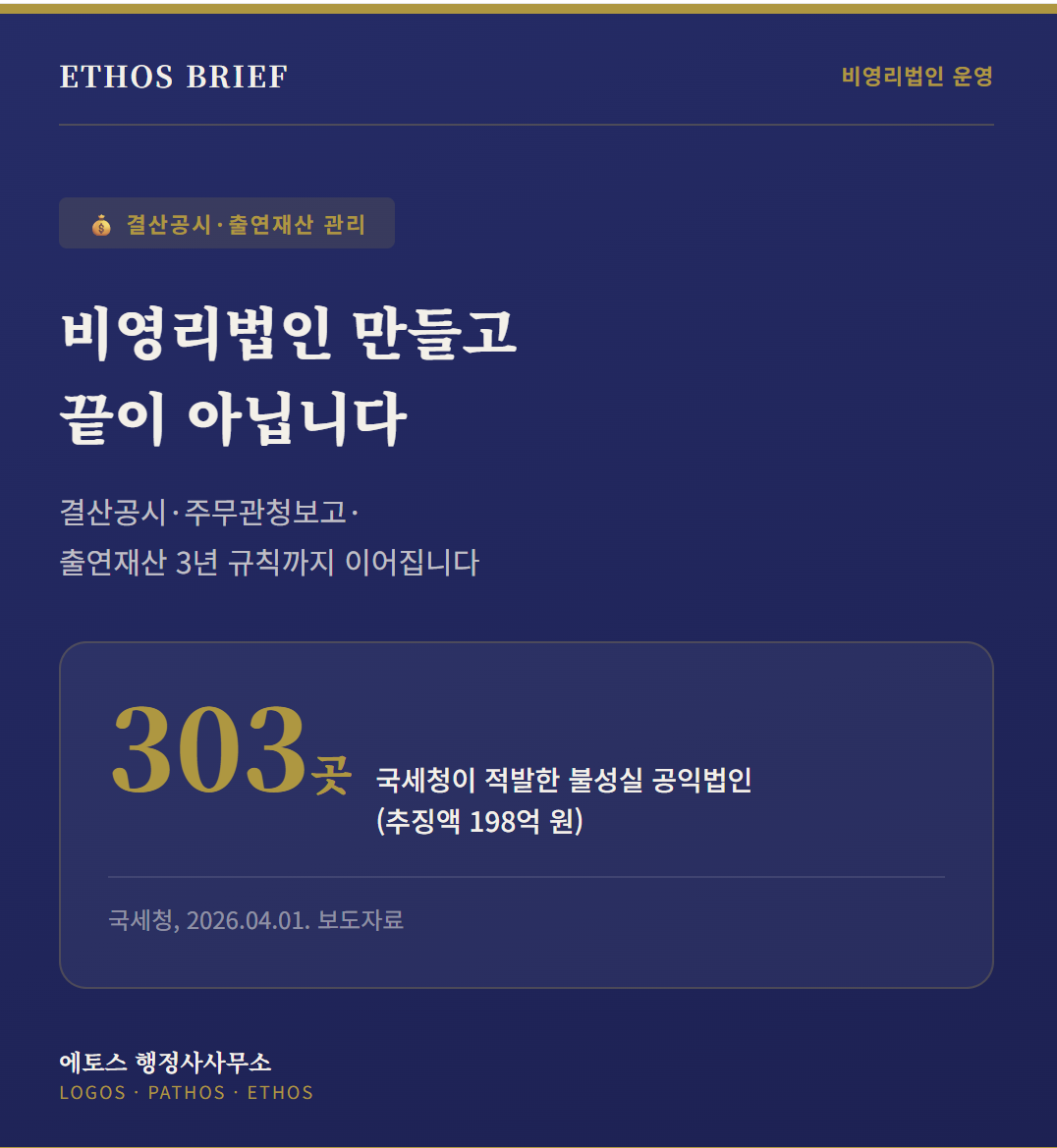
The National Tax Service also announced that in the previous year, 303 non-compliant public interest corporations were identified and KRW 19.8 billion was assessed.
Post-review of public interest corporations is actively conducted.
“No one has contacted us yet” does not necessarily mean the organization is safe.
It may simply mean the issue has not yet been reviewed.
7 Items to Check Now
Compare the following items against your bylaws, establishment approval certificate, and recent settlement documents.
- Could our organization qualify as a public interest corporation?
- Do our bylaws include education, welfare, scholarship, culture, academic, religious, or charitable purposes?
- Are we designated as a donation-related organization?
- Did we disclose last year’s settlement documents through Hometax?
- Did we submit annual business results and settlement documents to the competent authority?
- Have we received contributed assets?
- Were contributed assets used directly for public interest purposes within three years?
If you answered “I am not sure” to even one of these questions, a review is recommended.
If disclosure or competent authority reporting was missed, it is better to organize the current status before the National Tax Service or competent authority contacts you first.
Why Are These Duties So Often Missed?
It is usually not because the person in charge is careless.
The structure itself is complicated.
Disclosure forms may differ depending on asset size. Whether contributed asset reporting is required depends on the organization’s facts. Whether external tax confirmation or external audit is required can also vary depending on asset size and revenue.
Competent authority report forms differ by authority.
If a corporation moves its office from Seoul to Gyeonggi Province, the competent authority and reporting standards may change. If the organization adds new purpose activities, bylaw amendment approval may be required, and in some cases the competent authority may also change.
It is difficult for a small nonprofit’s internal manager to track all of this alone.
That is why many organizations find post-establishment nonprofit management harder than the establishment process itself.
Disclosure Errors and Non-Disclosure Require Different Responses
One important distinction should be made.
A disclosure error does not always immediately mean that a penalty is finalized.
Inheritance Tax and Gift Tax Act Article 78(11) imposes a penalty when a public interest corporation fails to disclose settlement documents or has errors in disclosed content and then fails to comply with the National Tax Service’s disclosure or correction request within the designated deadline.
This means the response depends on the situation.
Different responses may be needed if:
- No disclosure was made at all
- Disclosure was made, but the content was incorrect
- Contributed asset reporting was omitted
- The competent authority report was submitted, but Hometax disclosure was not made
- Hometax disclosure was made, but the competent authority report was not submitted
The important point is not to leave the issue unattended.
How Ethos Administrative Office Reviews Nonprofit Compliance
Nonprofit compliance often sits between administrative procedure and tax procedure.
Ethos Administrative Office can assist with the administrative side, including:
- Reviewing the purpose clauses in the bylaws
- Conducting a first-stage review of possible public interest corporation status
- Checking competent authority reporting duties
- Organizing annual business performance report materials
- Reviewing approval conditions in the establishment certificate
- Checking whether bylaw amendment approval may be needed
- Reviewing administrative risks related to donation organization designation
- Coordinating with tax professionals when tax disclosure or filing is required
Tax filing and tax representation are handled by qualified tax professionals such as certified tax accountants.
Administrative agents can support competent authority reporting, administrative document organization, approval-condition review, and related administrative procedures.
Frequently Asked Questions
Q. If we report to the competent authority, do we still need to disclose documents to the National Tax Service?
Yes, if your organization is subject to disclosure. Competent authority reporting and National Tax Service disclosure are separate procedures.
Q. Can a small incorporated association qualify as a public interest corporation?
Yes, it may. Size alone is not decisive. The bylaws, purpose activities, donation-related status, contributed assets, and actual operations should be reviewed together.
Q. Does late disclosure automatically lead to a penalty?
It depends. The response differs depending on whether there was no disclosure, incorrect disclosure, or a correction request from the National Tax Service.
Q. Is it okay to keep contributed assets in a bank deposit?
Temporary holding is not always a problem. However, contributed assets must generally be used directly for public interest purposes within three years. Long-term unused assets should be reviewed carefully.
Q. Can an administrative agent handle Hometax tax filings?
Tax filing and tax representation are generally handled by tax professionals. Administrative agents can support competent authority reports, administrative document preparation, approval-condition review, and coordination with tax professionals when needed.
Documents Helpful for Initial Review
If available, prepare the following:
- Bylaws
- Establishment approval certificate
- Corporate registry certificate
- Previous year’s business performance report
- Previous year’s settlement statement
- Asset list
- Donation organization designation documents
- Contributed asset records
- Hometax disclosure confirmation screenshot
- Proof of competent authority report submission
Even one photo of the bylaws can be enough to begin an initial review.
Closing
A nonprofit corporation does not end with establishment.
Once approval is granted, the corporation must continue to report, disclose, manage assets, and carry out its stated public purpose every year.
The difficulty is that not knowing these duties does not remove responsibility.
Penalties reduce project funds. Disclosure failures weaken trust. Missing competent authority reports may create approval-related risks.
If your organization is already operating, first check whether this year’s disclosure and reporting have been completed.
Even if something was missed, organizing it late is better than leaving it unresolved.