Can Korean Administrative Agents Conduct Fact-Finding? I Asked the Ministry of the Interior and Safety Directly
Hello, this is Jean, a licensed Administrative Agent in Korea.
Imagine that your business is subjected to an unannounced inspection.
A few days later, you receive a notice imposing an administrative fine. But the inspection report contains something that is simply not true.
It says: “The business operated after 10:00 p.m.”
But you actually closed at 9:50 p.m.
How do you prove it?
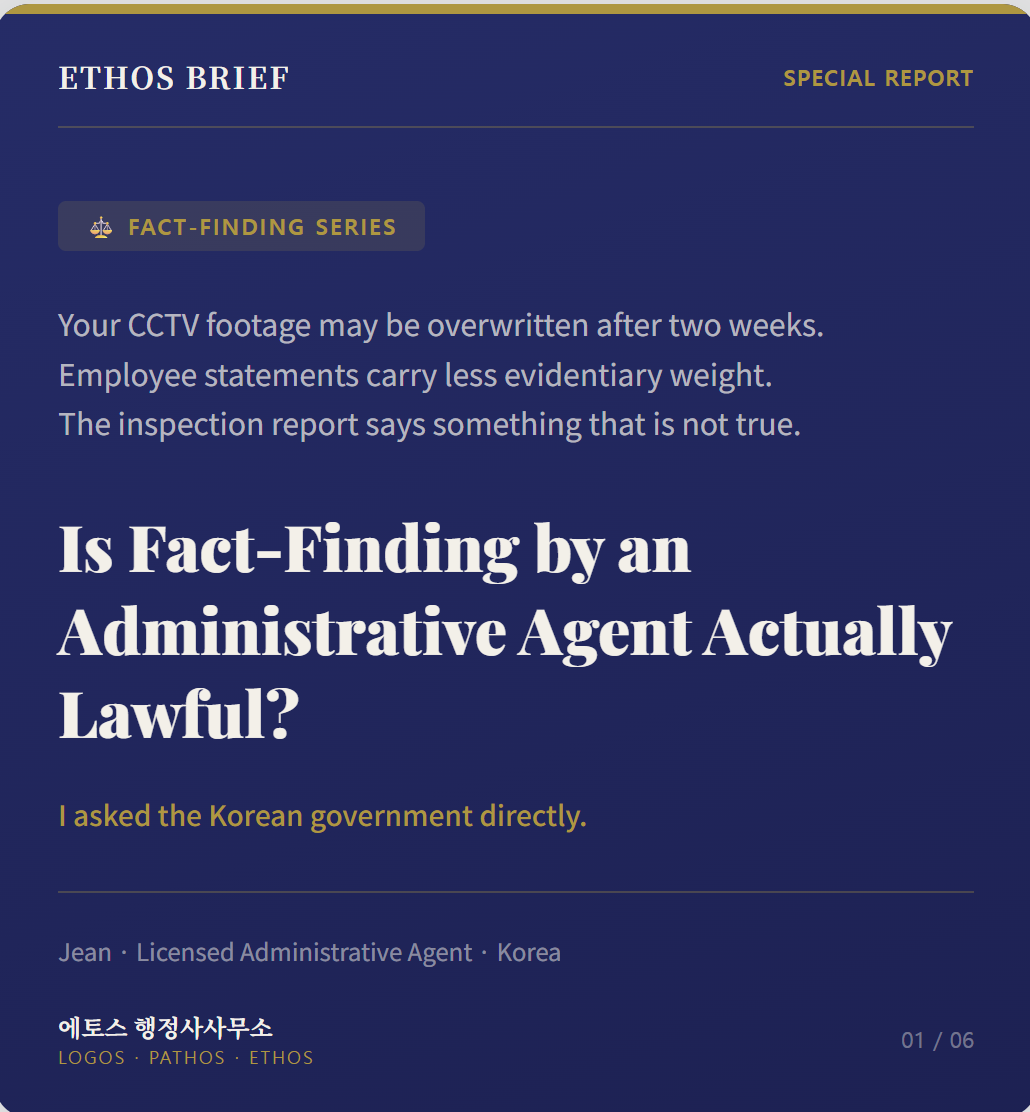
CCTV footage may be overwritten after two weeks. Statements from employees may carry less evidentiary weight because they have an interest in the outcome.
Then someone tells you: “Why not ask an Administrative Agent to conduct a fact-finding investigation?”
So you search for: “Administrative Agent fact-finding Korea.”
And that is when things become strange.
There are almost no comprehensive articles on the subject.
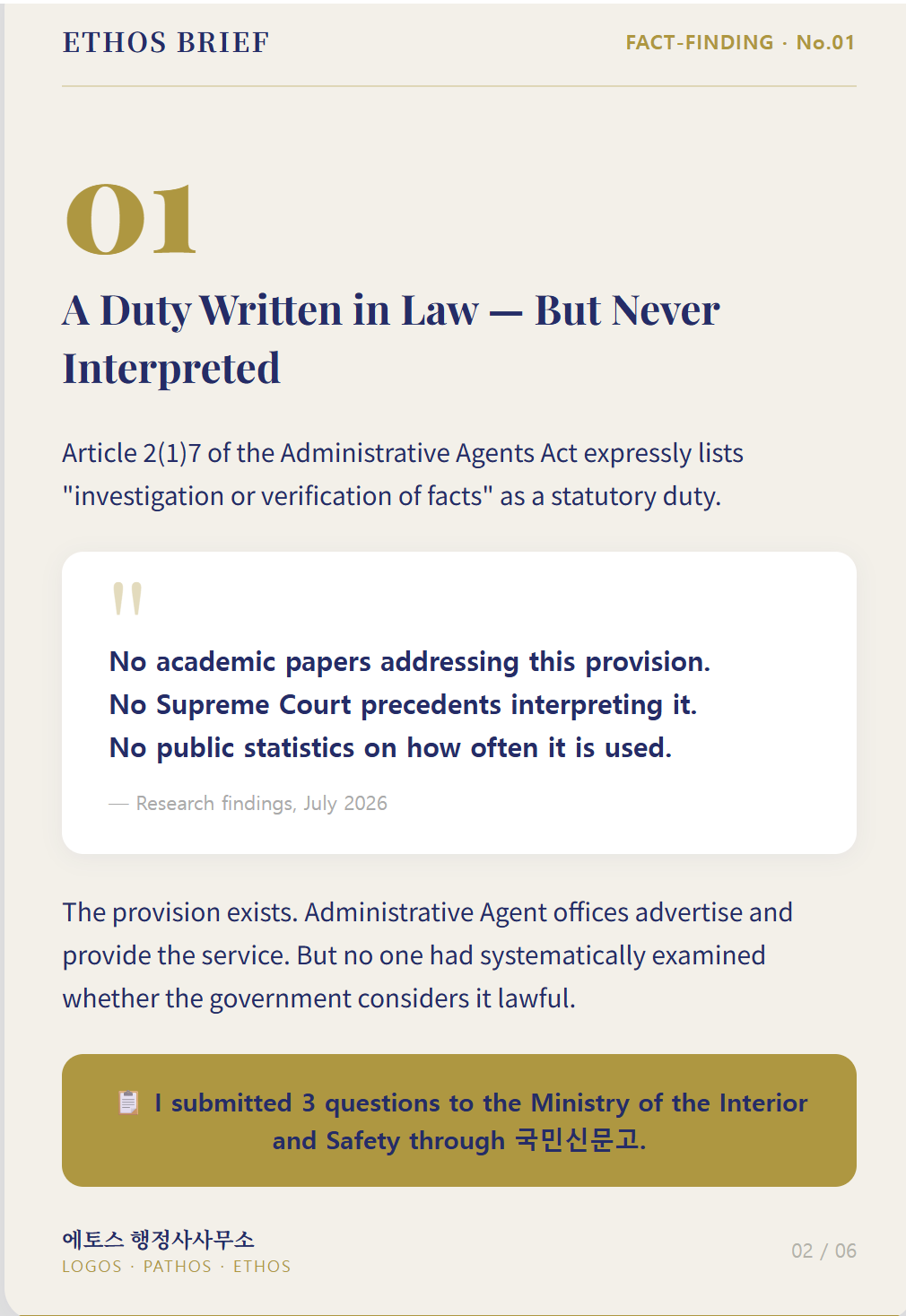
There appear to be no academic papers specifically addressing this provision, no Supreme Court precedents directly interpreting it, and no publicly available statistics showing how frequently such fact-finding services are performed.
Yet “fact investigation and verification” is expressly listed as one of the statutory duties of Administrative Agents under Korean law.
Very few people, however, have systematically examined what this provision actually permits.
That is why I started this series.
In this special article, I will discuss the official inquiry I submitted to the Ministry of the Interior and Safety regarding the legal basis for Administrative Agents conducting fact-finding work.
What Is “Fact Investigation and Verification” by an Administrative Agent?
As discussed in the previous article, Article 2(1)7 of the Administrative Agents Act provides for the investigation or verification of facts concerning affairs entrusted pursuant to statutes and regulations.
While writing this series, however, one question continued to bother me.
The work is written into the law, but is an Administrative Agent actually allowed to perform it in practice?
The Administrative Agents Act clearly refers to “fact investigation and verification.”
It is also true that Administrative Agent offices currently advertise and provide fact-finding services based on this provision.
But I wanted to know whether the Korean government had ever officially answered the more fundamental question:
Is this actually lawful?
I searched for authoritative materials.
There are few publicly available academic studies directly dealing with Article 2(1)7.
It is also difficult to find Supreme Court decisions directly interpreting this specific provision.
Even textbooks for the Administrative Agent examination often devote only a sentence or two to it.
This is striking because the scope of Administrative Agents’ work has otherwise been the subject of numerous government interpretations and opinions from the Ministry of Government Legislation.
If the provision exists but there is no clear interpretation, neither practitioners nor clients can confidently determine what is permitted.
So I decided to ask the government directly.
I Submitted These Questions Through the Korean Government’s Civil Petition System
In July 2026, I submitted three questions to the Ministry of the Interior and Safety through the 국민신문고, Korea’s official online civil petition system.
Question 1: Administrative Agent offices currently conduct fact-finding work based on Article 2(1)7 of the Enforcement Decree of the Administrative Agents Act. Is such activity legally permissible under the applicable statutes?
Question 2: In the phrase “entrusted pursuant to statutes and regulations,” does “statutes and regulations” include the Administrative Agents Act itself? Or must another individual statute expressly provide that the relevant matter may be entrusted to an Administrative Agent?
Question 3: Can an Administrative Agent lawfully conduct fact-finding in areas such as insurance claims investigations or labor-related investigations where other professional statutes may restrict the relevant activities?
The Ministry’s Answer Was Not What I Expected
The Ministry of the Interior and Safety responded, in substance, as follows:
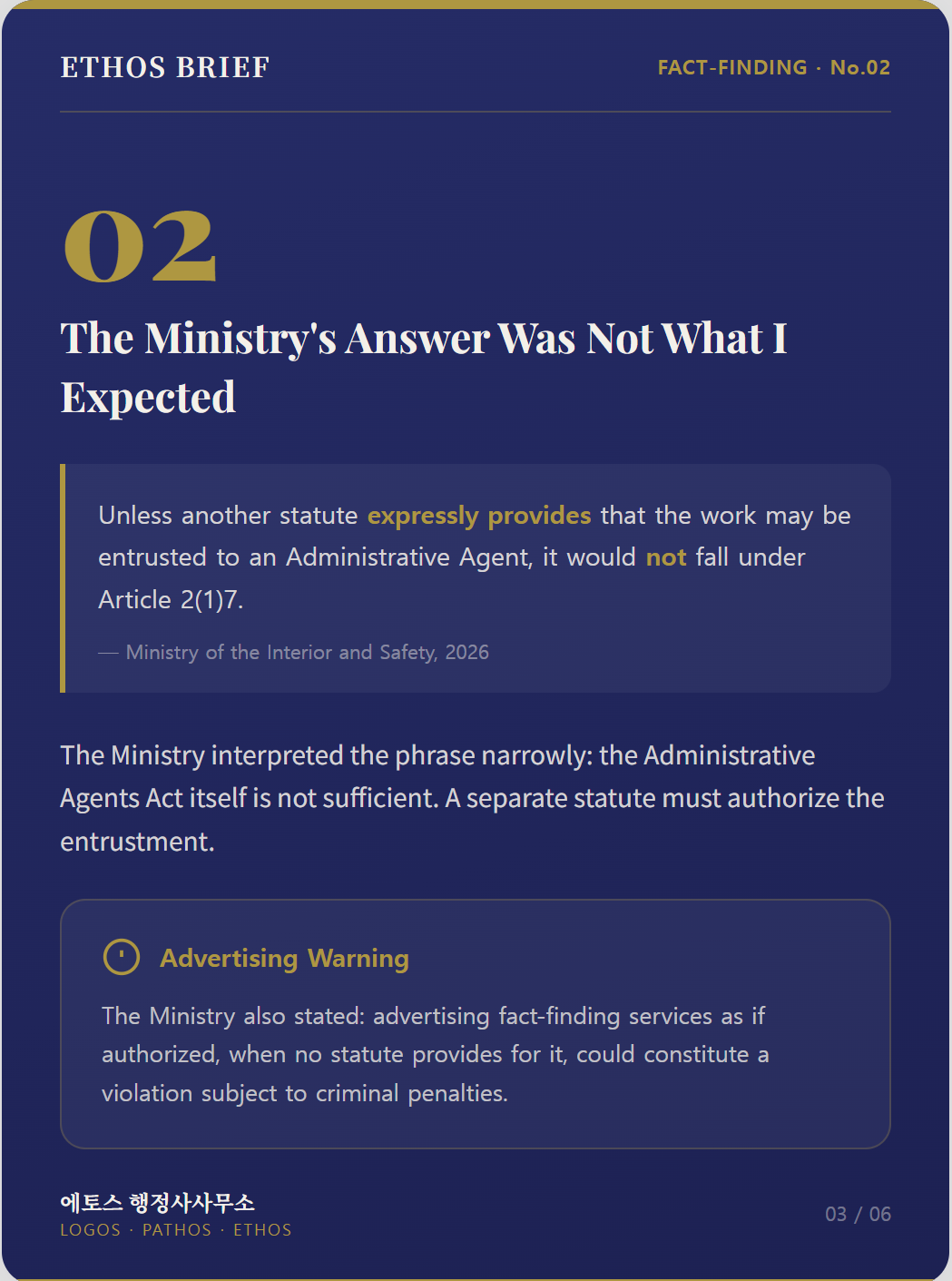
Unless the relevant fact-finding statute or regulation expressly provides that the relevant work may be entrusted to an Administrative Agent, the activity would not be considered work falling under Article 2(1)7 of the Administrative Agents Act.
Put simply, the Ministry interpreted the phrase “entrusted pursuant to statutes and regulations” narrowly.
According to this interpretation, another individual statute must expressly state that the relevant fact-finding work may be entrusted to an Administrative Agent. In other words, the Administrative Agents Act itself would not be sufficient to constitute the “statutory basis” required under Item 7.
Under this interpretation, an Administrative Agent cannot simply accept a private client’s request and conduct fact-finding based solely on Article 2(1)7. There would have to be a separate statutory provision authorizing such entrustment.
The Ministry went further.
It also referred to restrictions on advertising under Article 22 of the Administrative Agents Act.
The Ministry explained, in substance, that an Administrative Agent must not advertise work in a manner that falsely represents the scope of statutory duties, exaggerates or omits objective facts, or otherwise risks misleading consumers.
It further stated that if an Administrative Agent advertises fact-finding services as though they were duties authorized by the Administrative Agents Act when no relevant statute actually provides for such entrustment, such advertising could potentially constitute a violation of the Act.
A violation of the relevant advertising provision may be subject to criminal penalties under the Administrative Agents Act.
What Does This Mean for You?
**If You Are Considering Hiring an Administrative Agent for Fact-Finding **
According to the Ministry of the Interior and Safety’s interpretation, the legality of fact-finding performed under Article 2(1)7 is not as straightforward as many practitioners may have assumed.
If the Ministry’s interpretation is ultimately accepted, fact-finding services based solely on Item 7 could lose much of their practical legal foundation.
There is, however, an important distinction.
The preparation of documents relating to proof of rights, obligations, or facts under Article 2(1)2 is a separate issue.
Item 2 authorizes Administrative Agents to prepare documents concerning rights, obligations, or the certification of facts.
Accordingly, work such as preparing documents concerning contractual attendance, confirmation of residence, or confirmation of transactions may fall under a different statutory basis from Item 7.
The legal issue discussed in this article therefore concerns the scope of fact investigation and verification under Item 7, not every form of fact-related documentation performed by Administrative Agents.
**If You Are an Administrative Agent—or Interested in the Profession **
The Ministry’s interpretation raises an even more fundamental question.
If Article 2(1)7 can be used only where another statute expressly authorizes fact-finding to be entrusted to an Administrative Agent, then such statutes must actually exist for the provision to have meaningful application.
But it is extremely difficult to identify individual statutes that expressly provide:
This fact-finding work may be entrusted to an Administrative Agent.
If no such statutes exist, or if they are exceptionally rare, Article 2(1)7 risks becoming practically dormant.
That is why this issue matters well beyond a single type of service.
It concerns the practical meaning of one of the duties expressly listed in the Administrative Agents Act.
But the Ministry of Government Legislation Has Taken a Different Approach
There is another important piece of the puzzle.
In 2015, the Ministry of Government Legislation issued an interpretation concerning the overlap between the work of Certified Public Labor Attorneys and Administrative Agents. Although that interpretation did not directly address fact-finding under Item 7, it provides useful insight into how the Ministry of Government Legislation has approached the scope of Administrative Agents’ statutory duties.
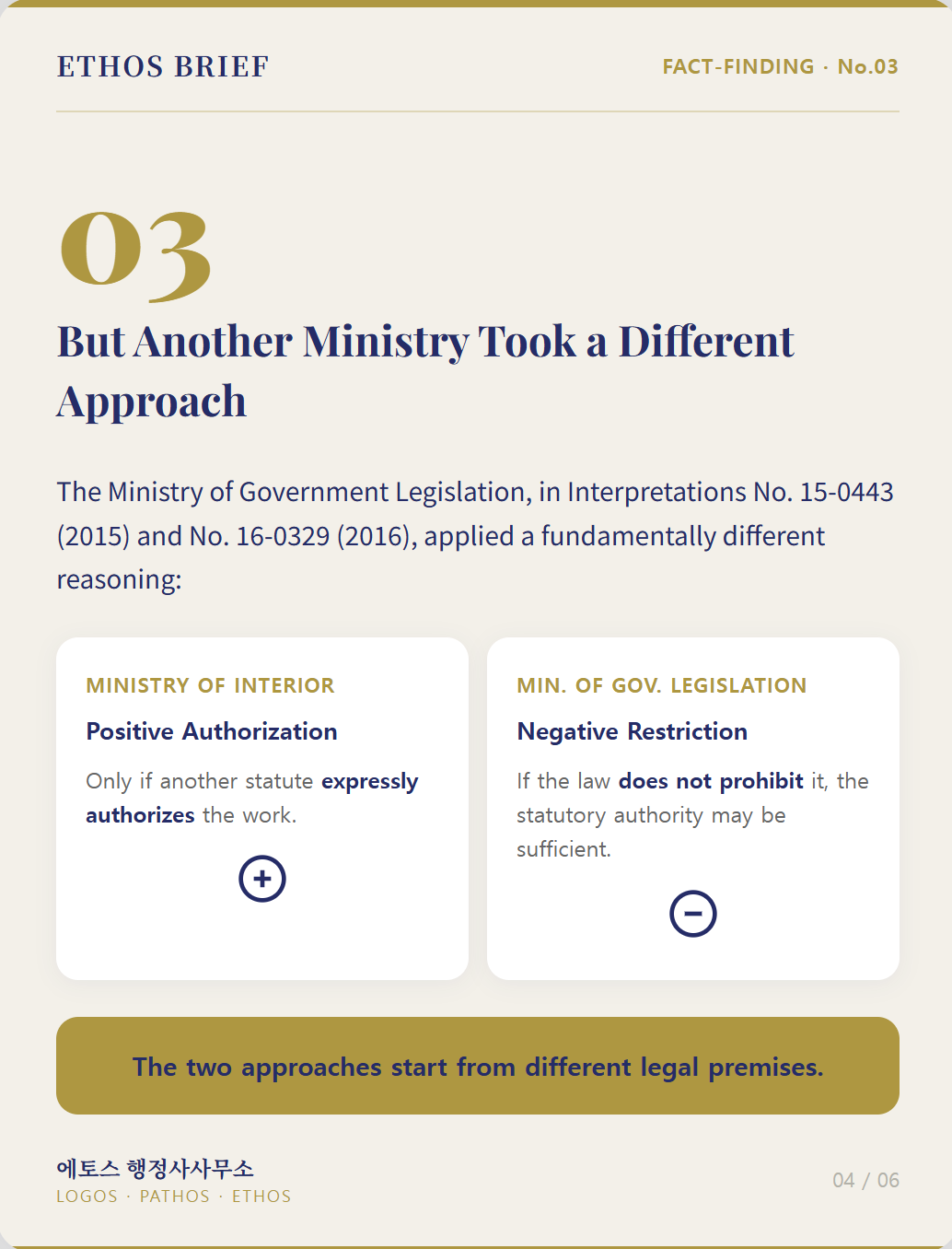
In Interpretation No. 15-0443 dated October 23, 2015, the Ministry concluded in substance that work falling within both the Certified Public Labor Attorney Act and the Administrative Agents Act may be performed by an Administrative Agent unless another law restricts that work.
The logic can be summarized as follows:
If the work falls within Article 2 of the Administrative Agents Act, and another statute does not expressly prohibit or reserve that work, the Administrative Agent may perform it.
This can be described as a negative restriction approach:
If the law does not prohibit it, the statutory authority under the Administrative Agents Act may be sufficient.
Under that reasoning, the Administrative Agents Act itself functions as an affirmative source of professional authority.
That interpretation could support a broader reading of Item 7.
The Ministry of the Interior and Safety, however, appears to take the opposite approach.
Its reasoning can be summarized as:
Unless another statute expressly authorizes the entrustment, the Administrative Agent may not perform the work under Item 7.
This is closer to a positive authorization approach:
The work is permissible only where another statute specifically authorizes it.
Under that interpretation, the Administrative Agents Act itself does very little work in defining the practical scope of Item 7.
The provision could therefore become extremely narrow—or even practically dormant.
There is another relevant interpretation.
In Interpretation No. 16-0329 dated August 9, 2016, the Ministry of Government Legislation considered loss-adjustment work regulated under the Insurance Business Act. It concluded that such work falls within an area restricted by another statute and therefore cannot be performed by an Administrative Agent.
Again, the structure is essentially:
If another statute restricts the work, the Administrative Agent cannot perform it.
This also begins from the negative-restriction model rather than the Ministry of the Interior and Safety’s positive-authorization model.
The two approaches therefore appear to start from different legal premises.
There Is Something Even More Puzzling
The divergence in interpretation is not the only unusual aspect of this issue.
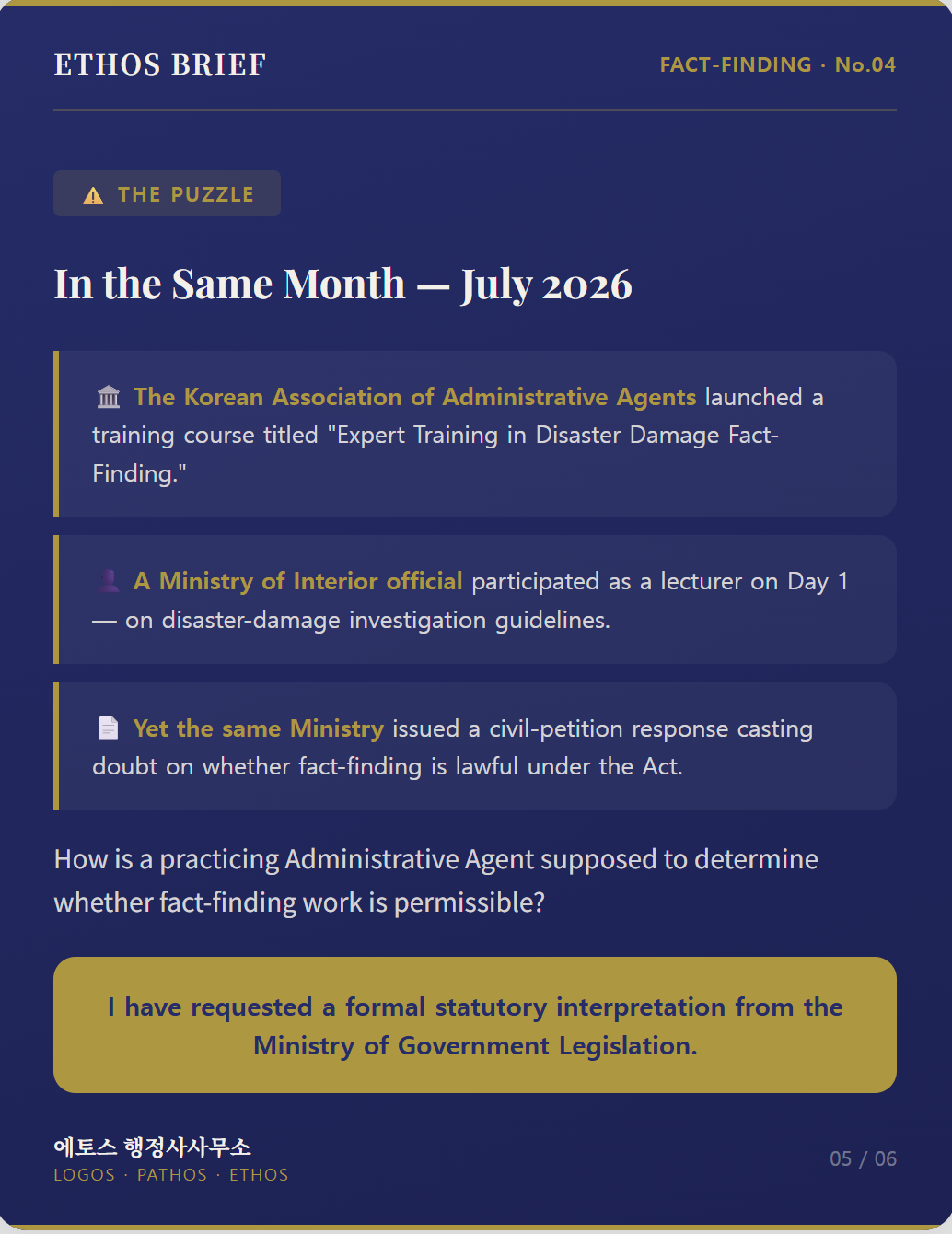
On July 22, 2026, the Korean Association of Administrative Agents launched a training program titled: “Training Course for Experts in Disaster Damage Fact-Finding and Administrative Remedies.”
According to press coverage, the course included: **investigation of damage caused by natural and social disasters, on-site investigation methods, evidence collection, preparation of fact-finding reports, disaster relief objections, and administrative appeals. **
One of the lecturers on the first day was an official from the Ministry of the Interior and Safety’s disaster recovery division. The lecture reportedly addressed guidelines for investigating natural-disaster damage and calculating recovery assistance.
That creates an unusual situation.
During the same month:
an organization representing Administrative Agents operated a professional training course explicitly centered on “fact-finding”; an official from the Ministry of the Interior and Safety participated as a lecturer;
yet another part of the same Ministry issued a civil-petition response suggesting that fact-finding may not constitute lawful Administrative Agent work unless separately authorized by another statute.
The professional body is training “fact-finding experts.”
The supervising ministry is participating in that training.
At the same time, the ministry’s civil-petition interpretation casts doubt on the statutory basis of such work.
How, then, is a practicing Administrative Agent supposed to determine whether fact-finding work is permissible?
That is why I decided to request a formal statutory interpretation from the Ministry of Government Legislation.
I Have Requested a Formal Statutory Interpretation
A civil-petition response from the Ministry of the Interior and Safety reflects the position of the responsible administrative authority, but it is not identical in status to a formal statutory interpretation issued by the Ministry of Government Legislation.
Formal statutory interpretations are reviewed through the Ministry of Government Legislation’s statutory interpretation process, taking into account the text of the legislation, relevant court precedents, principles of administrative law, legislative history, and other interpretive materials.
The central question I submitted is essentially this:
In Article 2(1)7 of the Administrative Agents Act and its Enforcement Decree, does the phrase “entrusted pursuant to statutes and regulations” mean: (a) that the Administrative Agents Act itself may serve as the statutory basis, so that an Administrative Agent may conduct fact-finding when entrusted by a client; or (b) that another individual statute outside the Administrative Agents Act must expressly state that the relevant fact-finding work may be entrusted to an Administrative Agent?
I also requested clarification regarding another closely related issue:
When an Administrative Agent verifies factual circumstances in order to prepare a document concerning certification of facts under Item 2, does that verification itself fall within the separate “fact investigation and verification” activity under Item 7, or is it merely an incidental act falling within the scope of Item 2?
The answer to this question could have significant practical consequences.
What Happens Next?
For now, the legal scope of fact-finding under Item 7 remains uncertain.
However, the separate authority to prepare documents concerning the certification of facts under Item 2 should not automatically be treated as identical to the disputed Item 7 issue. Accordingly, matters such as contractual attendance, converting recordings into written records, preparation of residence-related factual documents, or transaction-related factual documentation must be analyzed according to the legal basis applicable to each individual task.
If you are unsure whether your situation falls under Item 2 or Item 7, the distinction should be reviewed before proceeding.
For example, a single contract, notice, administrative disposition, or other relevant document may be enough to determine which statutory provision is potentially applicable.
When the Ministry of Government Legislation issues its interpretation, I will publish a follow-up article in this series and update the earlier articles accordingly.