
Starting an Entertainment Agency in Korea: Is Business Registration Enough?
Hello, this is Jean, a Korean Certified Administrative Agent.
Today, entertainment agencies in Korea are no longer limited to large companies such as JYP Entertainment.
Artists can debut through smaller agencies and achieve major success, as seen with groups such as RESCENE, XLOV, and ATEEZ. Actors may establish their own one-person agencies, and small management companies may represent only a handful of models, creators, or other talent.
As an extension of my previous series, “I Thought Business Registration Was Enough,” I will now look at Korea’s Popular Culture and Arts Planning Business registration system under the Popular Culture and Arts Industry Development Act.
This first article focuses on two questions:
Is ordinary business registration enough to start an entertainment agency in Korea?
And if not,
Who is actually required to register as a Popular Culture and Arts Planning Business?
This series will cover:
- [Popular Culture & Arts Planning Business ①] Starting an Entertainment Agency in Korea: Is Business Registration Enough? — Who Must Register? (This Article)
- [Popular Culture & Arts Planning Business ②] No Two Years of Experience? You May Still Qualify — Korea’s 2026 Registration Requirements
- [Popular Culture & Arts Planning Business ③] Do One-Person Agencies and Managers Need Registration? — Why Company Size Is Not the Main Test
- [Popular Culture & Arts Planning Business ④] What Documents Are Required for Registration? — From Proof of Experience to the Application
- [Popular Culture & Arts Planning Business ⑤] Already Operating Without Registration? — What Should You Check First?
- [Popular Culture & Arts Planning Business ⑥] Registration Is Not the End — Regular Compliance Checks Beginning in November 2026
Is a Korean Business Registration Certificate Enough to Start an Entertainment Agency?
Suppose you want to start a small entertainment agency in Korea.
You plan to manage one or two actors, develop a new singer, or connect models with advertisers.
You have chosen a company name, secured an office, and completed your Korean business registration.
Can you now sign an artist and begin operating?
There is one more issue to check.
You need to determine whether your planned activities fall within the definition of a “Popular Culture and Arts Planning Business” under Korea’s Popular Culture and Arts Industry Development Act.
If they do, an ordinary business registration certificate is not enough.
Article 26(1) of the Act requires a person who intends to operate a Popular Culture and Arts Planning Business to obtain a separate registration.
Article 40(1)(3) further provides that a person who operates such a business without registration in violation of Article 26(1) may face imprisonment for up to two years or a fine of up to KRW 20 million.
A person who intends to operate a popular culture and arts planning business shall register with the Minister of Culture, Sports and Tourism. The same shall apply when changing registered matters.
— Article 26(1), Popular Culture and Arts Industry Development Act
This is therefore more than a minor administrative formality.
And in recent years, the issue has become increasingly visible in Korea’s entertainment industry.
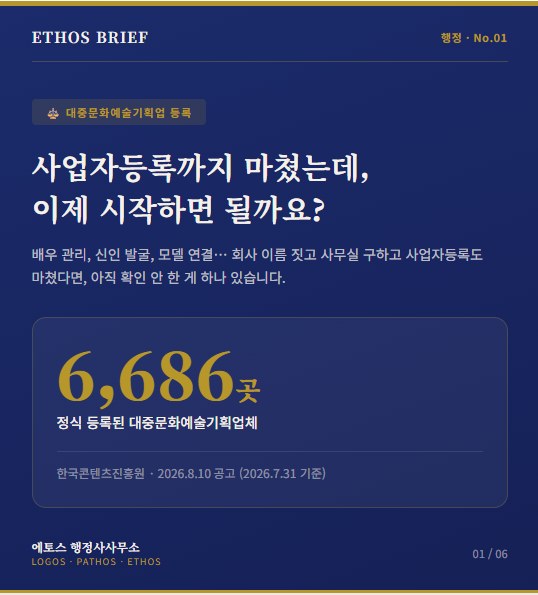
6,686 Businesses Were Registered as of July 2026
The Korea Creative Content Agency, or KOCCA, publishes a monthly list of businesses registered under Article 26 of the Popular Culture and Arts Industry Development Act.
The list for July 31, 2026, officially published on August 10, 2026, showed 6,686 registered businesses.
The pace of increase is also notable.
There were approximately 5,600 registered businesses in September 2025. By July 2026, the number had increased to 6,686.
In particular, media reports indicate that 177 businesses newly registered in December 2025 alone, shortly before the end of the Ministry of Culture, Sports and Tourism’s registration guidance period.
This does not necessarily mean that hundreds of entirely new entertainment agencies suddenly appeared during that period.
The increase also reflected businesses, including one-person agencies, that had already been operating but subsequently entered the formal registration system.
Several one-person agencies established by well-known entertainers, including Sung Si-kyung, Ji Suk-jin, and Nam Hee-seok, also proceeded with registration after their unregistered status became publicly known.
So it would be a mistake to assume:
“This registration only matters to large K-pop agencies.”
In 2025, the Government Introduced a Nationwide Registration Guidance Period
A statutory registration system can easily be overlooked if enforcement and administrative oversight are limited.
In 2025, however, the Korean government took direct action.
On September 18, 2025, the Ministry of Culture, Sports and Tourism announced a nationwide registration guidance period through December 31, 2025 for unregistered Popular Culture and Arts Planning Businesses.
The purpose was to encourage voluntary registration.
The Ministry also stated that businesses remaining unregistered after the guidance period could be subject to administrative investigation and referral for criminal investigation.
The important distinction here is that ordinary business registration and industry-specific registration are separate procedures in Korea.
Applying for registration as a Popular Culture and Arts Planning Business is not simply another step at the tax office.
According to the Ministry’s guidance, an application may be submitted through the competent metropolitan, provincial, city, county, or district authority for the location of the business.
This raises the next question:
What kind of business actually qualifies as a Popular Culture and Arts Planning Business?
The Actual Business Activity Matters More Than the Company Name
To determine whether a company falls within the registration requirement, the starting point is Article 2 of the Popular Culture and Arts Industry Development Act.
Article 2 defines concepts including the popular culture and arts industry, popular culture and arts services, popular culture artists, and Popular Culture and Arts Planning Businesses.
The Act defines a Popular Culture and Arts Planning Business as follows:
“Popular culture and arts planning business” means a business that provides or arranges popular culture and arts services of popular culture artists, or conducts training, guidance, counseling, etc. of popular culture artists for that purpose.
— Article 2(6), Popular Culture and Arts Industry Development Act
In practical terms, the key question is whether the business:
- provides or arranges artists’ activities; or
- trains, guides, or counsels artists for the purpose of providing such activities.
The company name itself is not decisive.
A business does not automatically fall outside the registration regime merely because its name is:
- “OO Agency”
- “OO Company”
- “OO Studio”
- “OO Casting”
- “OO Production”
What matters is what the company actually does in relation to the professional activities of actors, singers, models, or other popular culture artists.
KOCCA Also Uses Examples Broader Than a Traditional “Entertainment Agency”
In guidance included in various support-program announcements, KOCCA has provided examples of businesses associated with the Popular Culture and Arts Planning Business category, including:
- record production companies
- entertainment management businesses
- artist representation
- manager businesses
- entertainment companies
- model agencies
- casting directors
- performance arrangement businesses
This means the practical issue is broader than whether a company looks like a major K-pop agency.
Instead of asking:
“We do not have dozens of artists under exclusive contracts, so surely this does not apply to us?”
a more useful question is:
“Are we managing or arranging another person’s entertainment activities?”
However, a business does not automatically become subject to registration merely because its industry label appears on a list such as the above.
The final determination should still be based on the statutory definition and the company’s actual activities.
What Have Korean Courts Looked At?
Terms such as “provide” and “arrange” can feel abstract when read only in the statute.
A criminal case provides a more concrete example of the factors a court may consider.
In Seoul Central District Court, February 10, 2017, Case No. 2016No4343, a company had entered into a standard exclusive contract with an entertainer without registering as a Popular Culture and Arts Planning Business.
The relationship went beyond merely signing a contract.
According to the facts described in the judgment:
- the entertainer granted the company exclusive management authority over entertainment activities;
- the entertainer agreed not to engage in entertainment activities without the company’s prior approval;
- the company was involved in the final decision on whether the entertainer would appear in a film; and
- the company was involved in determining the appearance fee and filming schedule.
The defendant argued, in substance, that because the entertainer had received the film offer directly and was already under an exclusive contract, the company had not separately “provided” or “arranged” popular culture and arts services.
The appellate court rejected that argument and upheld the first-instance guilty finding for operating an unregistered Popular Culture and Arts Planning Business.
The important point is not the size or name of the company.
The court looked at matters such as who actually managed the entertainment activity, who decided on appearances, and who coordinated the terms and schedule.
That is why the business category written on a registration certificate or the title of a contract may not be enough to determine whether separate registration is required.
What About a One-Person Entertainment Agency?
A company is not automatically exempt simply because it is small.
Suppose Person A establishes a sole proprietorship and operates a one-person agency.
There are no employees.
However, A enters into contracts with two new actors, finds auditions for them, negotiates appearance terms with production companies, coordinates filming schedules, and receives income under the management agreements when engagements are secured.
The important question is not whether the company has zero employees or ten.
The question is whether the business is actually providing, arranging, or managing the actors’ popular culture and arts services.
The 2016No4343 case discussed above also examined the company’s actual management authority and involvement in the artist’s professional activities.
Therefore,
“I operate the agency alone.”
is not, by itself, an exemption from the registration requirement.
What If the Company Has No Artists Under Exclusive Contract?
Many people assume that an entertainment agency must have artists formally signed to exclusive contracts.
But the statutory definition also includes the arrangement of popular culture and arts services.
Consider Company B.
It has no actors under exclusive contract.
Instead, a production company asks:
“We need a model for this advertisement.”
Company B finds a model, connects the parties, coordinates the fee and schedule, and receives a commission when the engagement is completed.
In that situation, it may be difficult to conclude:
“We do not have any signed artists, so we are not an entertainment planning business.”
Casting businesses, model agencies, and performance-arrangement businesses may fall within this type of analysis.
What About Recruiting and Training Trainees?
The statutory definition is not limited to arranging appearances for artists who are already active.
It also covers businesses that train, guide, or counsel popular culture artists for the purpose of providing popular culture and arts services.
Suppose Company C recruits aspiring singers.
It provides vocal and performance training, advises them on image and career direction, and then connects their development to record releases, performances, or television activities.
This structure is different from simply providing general music lessons.
The business is recruiting and developing people with the objective of future popular culture and arts activities.
This does not mean that every vocal academy or acting school automatically becomes a Popular Culture and Arts Planning Business.
The important distinction is whether the training, guidance, or counseling is carried out for the purpose of providing or arranging popular culture and arts services.
Are All Content Production Companies Popular Culture and Arts Planning Businesses?
No.
The Act separately defines a Popular Culture and Arts Production Business and a Popular Culture and Arts Planning Business.
Article 2(4) defines a Popular Culture and Arts Production Business as a business that produces works such as broadcasting programs, films, performances, or records using popular culture and arts services.
Article 2(6), by contrast, covers businesses that provide or arrange artists’ services or train, guide, or counsel artists for that purpose.
Consider Company D.
It produces an advertising video.
The advertiser independently selects and contracts with the performer, while Company D only handles filming and editing.
In that case, the company’s principal activity is closer to producing the content, rather than arranging the actor’s or model’s professional services.
Now consider Company E.
It also produces advertising videos, but it maintains its own pool of actors or models.
When an advertiser requests talent, Company E recommends a suitable model, confirms availability, negotiates the appearance fee and filming schedule, and participates in the appearance contract.
That changes the analysis.
Company E is not only creating the finished video.
It may also be providing or arranging the actor’s or model’s popular culture and arts services to the advertiser.
A single company can therefore perform both production and planning functions.
Relevant questions include:
- Who contracts with whom?
- Who sources the performer?
- Who coordinates whether the performer will participate?
- Who negotiates the fee and schedule?
- How does the company earn its revenue?
Producing content featuring a person and arranging that person’s entertainment activities are not necessarily the same legal function.
What About YouTubers, Influencers, and Creator Management?
Managing a YouTuber or influencer does not automatically mean that the company is operating a Popular Culture and Arts Planning Business.
The analysis depends on the actual activities.
Suppose a company provides only:
- channel analytics
- advertising revenue settlement
- filming equipment support
- content editing
- copyright administration
In that situation, the business may primarily be supporting and managing the creator’s content and channel.
Now suppose the same company begins arranging the creator’s appearances on television programs, advertisements, or events and negotiates appearance fees, contract terms, and filming schedules.
The nature of the business becomes different.
The company is no longer merely supporting a YouTube channel.
It may also be providing or arranging the creator’s entertainment and appearance activities to third parties.
Advertising can raise a similar distinction.
Arranging a branded-content deal in which a creator promotes a product on their own YouTube channel is structurally different from arranging for that creator to appear as a model in a company’s advertisement and negotiating the appearance agreement, model fee, and filming schedule.
Therefore, the relevant question is not simply:
“Do we manage YouTubers?”
It is:
“What exactly are we managing?”
Is it the channel?
The content?
Advertising sales?
Or the creator’s own appearances in broadcasting, advertising, performances, or events?
The closer the company’s role is to the latter, the greater the potential connection with the statutory definition of a Popular Culture and Arts Planning Business.
The National Assembly Research Service also addressed changes in industry participants in its 2025 report, “A Popular Culture and Arts Planning Business Registration System in Need of Comprehensive Redesign,” and identified the institutional inclusion of new forms of planning businesses as a policy issue.
MCNs and influencer agencies are therefore examples of businesses that can be difficult to classify based on company name alone.
The actual activities of the creator, the scope of the company’s contractual and management authority, and the company’s revenue structure should be considered together.
Not Sure Whether Your Company Requires Registration?
One-person agencies, model agencies, content production companies, and MCNs often combine several different functions.
For these businesses, the company name alone may not answer the registration question.
The actual contracts and business operations should be reviewed, including how performers are sourced, who negotiates compensation and schedules, and how the business earns revenue.
Check Whether Your Business May Require Popular Culture and Arts Planning Business Registration
Why Is Separate Registration Necessary If You Already Have a Business Registration Certificate?
The statutory structure makes the distinction clear.
Article 26(1) imposes a separate registration obligation on a person intending to operate a Popular Culture and Arts Planning Business.
Article 26(3) also lists documents to be submitted for registration, including:
- registration application
- corporate registry documents, where applicable
- a copy of the business registration certificate
- documents proving satisfaction of the registration requirements
This structure is important.
A Korean business registration certificate does not replace Popular Culture and Arts Planning Business registration.
In fact, the business registration certificate is itself one of the documents submitted when applying for the separate industry registration.
Therefore, even if a company has completed tax registration, can issue tax invoices, and has properly established a corporation, it may still face a separate registration requirement if its actual activities fall within the statutory definition.
What Are the Basic Registration Requirements?
Article 26(2) of the Act establishes certain registration requirements.
In general, the applicant must satisfy one of the following:
At least two years of experience in a Popular Culture and Arts Planning Business, or completion of a prescribed education course.
For a corporation, at least one officer must satisfy the relevant requirement.
The business must also have an office.
Older materials may give the impression that:
“You cannot establish an entertainment agency unless you already have two years of industry experience.”
That is no longer the complete picture.
A 2025 legislative amendment introduced completion of the prescribed education course as an alternative route to satisfying the experience requirement.
The second article in this series will examine the experience requirement, proof of experience, and the education route in detail.
What If You Are Already Operating Without Registration?
The first step is to identify what business activities have already been conducted.
Relevant questions may include:
- What agreements have been entered into with actors, singers, or models?
- Have you actually arranged appearances?
- Have you participated in negotiations over appearance fees or other contract terms?
- Has the company decided or coordinated schedules and professional activities?
- Has the company received compensation for management or arrangement services?
- Have trainees been recruited or developed?
- Was the actual management work instead performed by another company?
As discussed above, the Seoul Central District Court’s February 10, 2017 decision in Case No. 2016No4343 did not focus only on whether a registration certificate existed.
The company’s actual involvement in the entertainer’s activities was examined.
Therefore, if the business has already begun operating, a useful first question is:
“Do the activities we have already conducted fall within the statutory definition of a Popular Culture and Arts Planning Business?”
The fifth article in this series will address situations involving businesses that are already operating without registration.
From November 2026, Registration Will Not Be the End of the Process
The Popular Culture and Arts Industry Development Act was amended again on May 19, 2026, with the relevant amendments scheduled to take effect on November 20, 2026.
The amended Article 26(4) requires the Minister of Culture, Sports and Tourism to check at least once a year whether registered businesses continue to satisfy the registration requirements under Article 26(2).
Where necessary, the authority may also require the business to submit relevant materials.
The cancellation framework will also be strengthened.
Beginning on November 20, 2026, amended Article 33(1)(2-2) will add failure to continue satisfying the requirements under Article 26(2) as a ground for cancellation of registration.
In other words, the system is moving away from:
“Obtain the certificate once and you are finished.”
toward:
“Continue to satisfy the registration requirements after registration.”
Post-registration compliance will be discussed in detail in Article 6 of this series.
Does Your Business Fall Within the Registration Requirement?
The key lesson is that the company’s name or size is less important than what the business actually does.
The questions below are not a legal decision tool. They are intended to help identify business structures that may warrant a closer registration review.
- Do you connect actors, singers, or models with third parties for appearances or professional activities?
- Do you negotiate appearance fees, contract terms, or filming schedules on their behalf?
- Does your company materially coordinate whether an artist accepts particular engagements?
- Do you recruit and train, guide, or counsel trainees for future broadcasting, performance, or music activities?
- Do you produce content while also sourcing actors or models and introducing them to advertisers or production companies?
- Does your MCN or influencer agency go beyond channel management and also arrange broadcasting, advertising, or event appearances?
If several of these questions describe your business, it may be necessary to look beyond the category written on the business registration certificate and review the actual contractual and operational structure.
As the case discussed above illustrates, the practical allocation of authority over appearances, compensation, schedules, and professional activities may be important.
What Should You Check Before Starting an Entertainment Agency in Korea?
If you are planning to start an entertainment or talent-management business, it is useful to separate the process into stages.
First, determine whether the planned business falls within the definition of a Popular Culture and Arts Planning Business.
If it does, check whether the registration requirements are satisfied.
Under the current law, relevant requirements include the two-year experience route or prescribed education route, together with the office requirement.
Once those requirements are satisfied, the supporting documents can be prepared and the registration application submitted to the competent authority.
The general sequence is:
① Determine whether registration is required
→ ② Check experience, education, office, and other registration requirements
→ ③ Prepare supporting documents
→ ④ File the registration application
For a business that has already begun operating, the analysis is somewhat different.
It is not enough to ask:
“Can we register now?”
The business should also identify what contracts it has entered into and what activities it has already performed.
If registrable activities have already been carried out without registration, additional legal and administrative issues may need to be considered.
If Your Registration Status Is Unclear
In practice, the most difficult cases are often businesses that sit between traditional categories.
Examples may include:
- one-person entertainment agencies
- casting businesses
- model agencies
- businesses combining content production and talent management
- MCNs and influencer agencies
- businesses combining trainee development and education
In these situations, the analysis should not stop with the company name or business registration certificate.
The actual contractual relationships, performer-sourcing process, negotiation of compensation and schedules, and revenue structure should be reviewed together.
We can review whether the current business model of an entertainment agency, one-person agency, model agency, casting business, or MCN may fall within Korea’s Popular Culture and Arts Planning Business registration requirement.
If the business has already begun operating, it is also important to examine what activities have already been conducted, rather than looking only at whether registration can be obtained going forward.
Request an Initial Registration Review
Initial review: free · Consultation: paid · Consultation fee credited upon engagement
Next: Can You Register Without Two Years of Experience?
Once you determine that the business requires registration, the next question is usually:
“Can I register if I do not have two years of industry experience?”
Older information can make the two-year experience requirement appear absolute.
The system has changed.
In the next article, I will explain the education-course route available to new applicants without two years of experience, as well as how relevant experience may be documented.
[Popular Culture & Arts Planning Business ②] No Two Years of Experience? You May Still Qualify — Korea’s 2026 Registration Requirements
References
- Popular Culture and Arts Industry Development Act, Articles 2, 26, 33, and 40
- Ministry of Culture, Sports and Tourism, materials concerning the 2025 nationwide registration guidance period for Popular Culture and Arts Planning Businesses
- Korea Creative Content Agency (KOCCA), Register of Popular Culture and Arts Planning Businesses, as of July 31, 2026
- Korea Creative Content Agency (KOCCA), support-program announcements and guidance concerning Popular Culture and Arts Planning Businesses
- National Assembly Research Service, A Popular Culture and Arts Planning Business Registration System in Need of Comprehensive Redesign, 2025
- Seoul Central District Court, February 10, 2017, Case No. 2016No4343
- Asia Economy, January 13, 2026, report concerning the increase in registered Popular Culture and Arts Planning Businesses