
Game Development — Required Registration Before Uploading to App Stores
Hello, this is Administrative Agent Jean.
Over the weekend, on my way to Itaewon, I came across an unmanned tobacco store.
Near university areas, I also noticed more unmanned claw machine shops.
New forms of business are growing quickly: unmanned stores, drone businesses, game development, AI services, pet businesses, and shared kitchens. At first glance, it is easy to think, “Business registration should be enough.” In reality, however, many of these businesses require separate registration, permission, or notification.
Licensing and permits are often called the heart of administrative agent work.
In this series, we are looking at licensing procedures that are easy to miss when starting a new type of business, and where an administrative agent can help.
- Unmanned stores — 3 licensing issues people often miss
- Drone business — 3 registration steps before business registration
- Game development — required registration before uploading to app stores ← This article
- AI services — one business code can determine eligibility for government support
- Pet businesses — why pet food may require food manufacturing registration
- Shared kitchens — licensing changes once the structure becomes outsourced
Read Part 1: https://blog.naver.com/attorney_jean/224335126223
Read Part 2: https://blog.naver.com/attorney_jean/224339040711
A spent two years developing a mobile game alone. A is confident in its quality.
Now only the launch remains.
A goes to the tax office and registers the business under business code 722000, software development and supply. The plan is to upload the game to Google Play and the App Store the following week.
But just before launch, A hears this:
“Have you received game rating classification? To apply for rating classification, you may need a game production business registration certificate.”
A had never heard of this.
The business was registered, and the game was already complete. Is there really another registration?
Yes. There is.
And if game production business registration or rating classification is missed, the issue may go beyond a simple correction request. It may become a criminal penalty issue.
The Game Industry Promotion Act requires separate registration for those who intend to operate a game production or game distribution business. Operating without registration may result in imprisonment for up to two years or a criminal fine of up to KRW 20 million under Article 45, subparagraph 2 of the Act.
This is not an administrative fine. It is a criminal penalty.
There is also an actual criminal case where the unregistered business provision was at issue. In Jeju District Court Decision 2023Godan1973, rendered on August 14, 2024, the defendant was found guilty in a case involving multiple violations, including unregistered business operation under the Game Industry Promotion Act, provision of a game different from the rated content, and currency exchange business.
Of course, not every indie game developer is in the same situation as that case.
The key point is that “unregistered business operation” is a provision that can actually be applied.
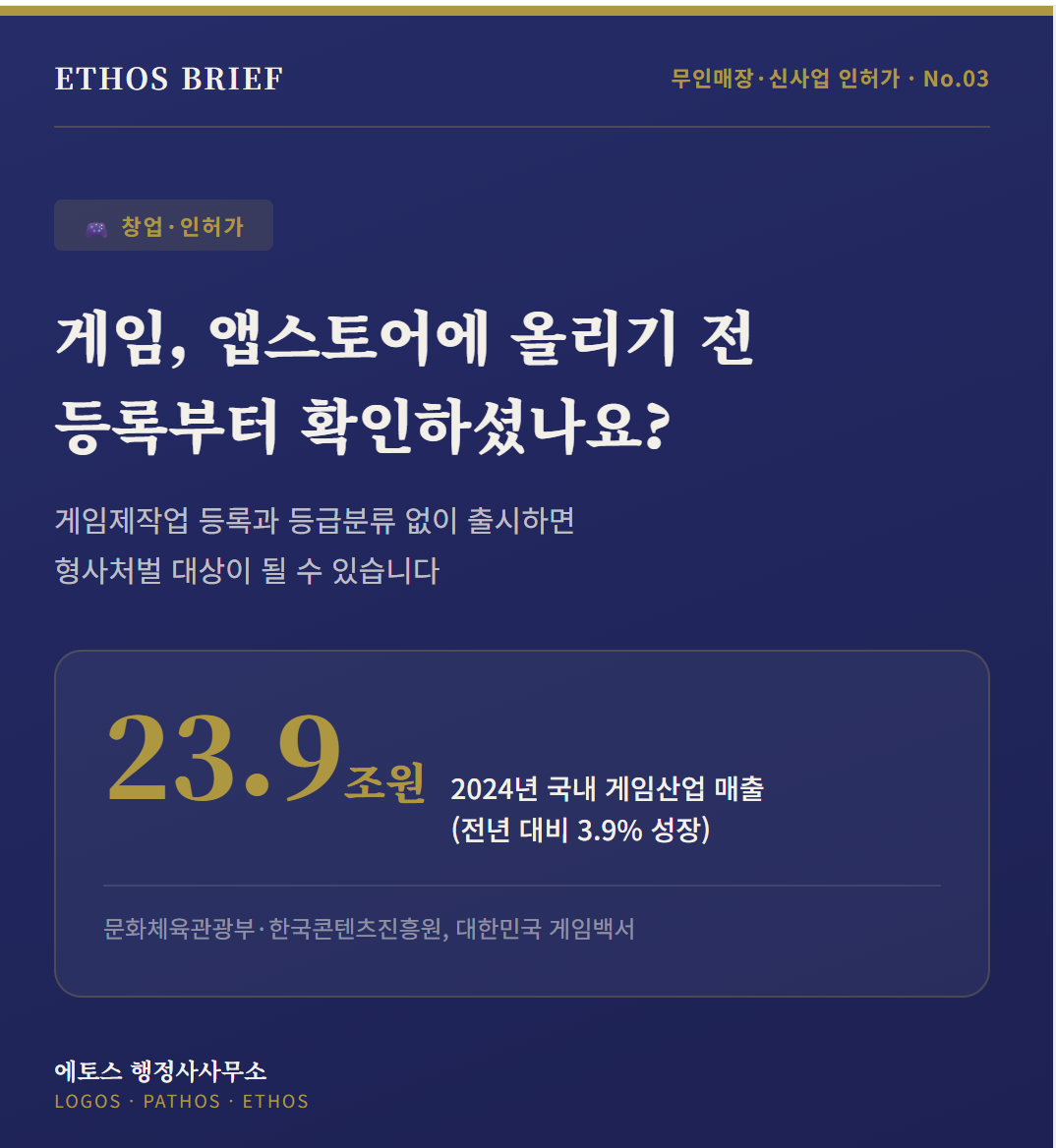
In 2024, Korea’s game industry generated KRW 23.8515 trillion in revenue, a 3.9% increase from the previous year. The industry employed 87,576 people, and 54,285 of them worked in game production and distribution, accounting for 62% of the total. Korea ranked fourth globally in market share, and game exports reached USD 8.50346 billion.
(Ministry of Culture, Sports and Tourism; Korea Creative Content Agency, Korea Game White Paper)
The market is enormous.
But many indie game developers and solo founders are still blocked at launch because they do not know about game production business registration and rating classification.
Toss’s App in Toss mini-app platform also distinguishes tax office business registration from game production business registration in its game registration guide. The basic point is that business registration at the tax office is for tax purposes, while game production business registration is a separate procedure under the Game Industry Promotion Act through the local government.
Today, let’s summarize the three key procedures A did not know about.
1. I Made a Game. What Else Do I Need Besides Business Registration?
Article 25(1) of the Game Industry Promotion Act requires anyone who intends to operate a game production or game distribution business to register with the relevant local government, such as the mayor, county governor, or district office head.
The key point is that this is not tax office business registration.
Game production business registration is a separate registration with the local government.
So what is a game production business?
Article 2, subparagraph 4 of the Game Industry Promotion Act defines it as a business that plans or reproduces and produces game products.
In other words, even if you plan, code, and launch the game alone, it may still fall under game production business if it is done for business purposes. Whether you are a corporation or a sole proprietor does not change that basic distinction.
Even if you have registered with the tax office as a software development business, the separate obligation to register as a game production business under the Game Industry Promotion Act may still apply.
Documents Required for Game Production Business Registration
Based on Article 15 of the Enforcement Rule of the Game Industry Promotion Act, the following documents are generally required for game production business registration.
| No. | Document | Note | |---:|---|---| | 1 | Game production business registration application | Form No. 4 | | 2 | Copy of office lease agreement | If the premises are leased | | 3 | Statement of production facilities and equipment | Required for game production business | | 4 | Corporate registry certificate | For corporations, usually verified through administrative information sharing |
There is no registration application fee, but registration license tax may apply.
The amount may vary depending on license category and business location, so confirmation with the relevant local government is necessary.
The documents look simple at first.
But one part often causes trouble in practice.
It is the statement of production facilities and equipment.
The law does not provide a highly detailed standard format for how to list the equipment. As a result, the required level of detail may differ by district office.
Some offices ask for PC specifications, development equipment, and software license lists in detail. Others accept a simple list.
The same applies when using a home as the business office.
If there is no lease agreement, the question becomes how to prove use of the home, whether a home-use confirmation form is needed, and whether owner consent is required. These details may vary depending on local administrative practice.
Legal provisions can be found through a search.
But in practice, the important questions are:
- Which department should receive the application?
- How detailed should the facilities and equipment statement be?
- How should home office use be documented?
- What documents should be submitted if the office requests correction?
- How should the registration certificate connect to the rating classification process?
This is administrative practice.
What Happens If You Operate Without Registration?
| Violation | Legal Basis | Penalty | |---|---|---| | Unregistered operation of game production or distribution business | Game Industry Promotion Act Articles 25 and 45(2) | Up to 2 years imprisonment or fine up to KRW 20 million | | Registration by false or improper means | Game Industry Promotion Act Article 35(1)1 | Business closure order | | Failure to file change registration | Game Industry Promotion Act Articles 25(2) and 35 | Business suspension of up to 6 months or business closure |
As shown by the Jeju District Court 2023Godan1973 decision mentioned above, unregistered operation can actually become an issue in criminal cases.
“I made a healthy game, so it should be fine” is not enough.
The content of the game and the registration obligation are separate issues.
2. Can I Launch Immediately After Registration? Rating Classification Remains
Even after game production business registration is completed, you cannot simply upload the game to the App Store right away.
As a rule, games must receive rating classification before distribution or provision for use.
Article 21(1) of the Game Industry Promotion Act provides that anyone who intends to produce or distribute a game for distribution or provision for use must receive rating classification from the Game Rating and Administration Committee or a self-rating classification business operator before doing so.
What happens if a game is distributed without rating classification?
Article 32(1)1 and Article 44(1)2 of the Game Industry Promotion Act may apply, and the penalty can be imprisonment for up to five years or a fine of up to KRW 50 million.
This is heavier than unregistered business operation.
In other words, the Act treats distribution without rating classification very seriously.
Order Matters
Sometimes developers finish the game and only then apply for rating classification, only to hear that a game production business registration certificate is required.
At that point, the launch schedule is immediately delayed.
The basic order is:
- Game production business registration
Local government, such as district office - Rating classification application
Game Rating and Administration Committee or self-rating classification business operator - Completion of rating classification
- Launch on App Store or Google Play
A missed Step 1, so Step 2 was blocked.
Rating Categories
Game ratings are generally divided as follows.
| Rating | Meaning | |---|---| | All ages | Available to everyone | | 12+ | Not available to users under 12 | | 15+ | Not available to users under 15 | | Adults only | Not available to users under 18 | | Trial use | Limited to testing or exhibition purposes |
If you follow the game industry, you may have heard of the constitutional complaint related to Article 32(2)3 of the Game Industry Promotion Act. That case reportedly involved more than 210,000 petitioners.
This shows how significant the social debate around rating classification is.
However, under current law, rating classification remains mandatory.
Anyone preparing an actual launch must follow the law and procedures currently in effect.
Not Every Game Uses the Same Rating Path
Another important point is this:
Not every game must go through the same Game Rating and Administration Committee review process.
Depending on the case, the following routes should be reviewed:
- GRAC review-type rating classification
- Open-market self-rating or simplified route
- Simplified path for all-ages games
- Possible exemption for certain educational or learning games
- Limited classification for testing or exhibition purposes
Mobile games are especially tied to open-market structures such as the App Store and Google Play, so it is important to determine which route applies to your game.
This is also where an administrative agent can help.
To avoid launch delays, the entire flow should be organized at once: whether the game requires formal review, whether a simplified path is available, whether a registration certificate is needed, whether exemption may apply, and how rating information should be reflected in app store listings.
Also, games continue to update after launch.
A 2025 amendment to the Game Industry Promotion Act introduced a prior reporting system for content changes to games that have already received rating classification. This means rating and post-launch compliance issues may arise with each update.
Launching a game may not be the end. It may be the beginning of administrative management.
If the order between registration and rating classification is confusing before launch, it is better to check the requirements first.
3. Game Production, Distribution, and Provision — Choosing the Wrong Category Can Force You to Start Over
The Game Industry Promotion Act broadly divides game-related businesses into three categories.
If you choose the wrong category, the registration or permission process may start incorrectly from the beginning.
| Category | Definition | |---|---| | Game production business | Business of planning or reproducing and producing game products | | Game distribution business | Business of importing game products or owning/managing copyrights and supplying them to game provision businesses | | Game provision business | Business of providing game products for public use |
There are two points people often confuse.
1. “I Am a Software Developer. Do I Also Need Game Production Business Registration?”
If you directly create and prepare to launch a game for business purposes, you should review whether game production business registration is required.
Choosing software development or information and communications as your tax office business code does not remove obligations under the Game Industry Promotion Act.
Tax office business registration is for tax purposes.
Game production business registration is a separate procedure under the Game Industry Promotion Act.
2. What If I Import a Foreign Game and Service It in Korea?
In that case, game distribution business may be the issue, not game production business.
Both game production and game distribution may require registration with the local government, but the required documents and application forms are different.
| Category | Application Form | Feature | |---|---|---| | Game production business | Form No. 4 | Statement of production facilities and equipment required | | Game distribution business | Form No. 5 | Business plan required |
A 2024 amendment introduced a domestic agent designation obligation for certain game distribution or game provision businesses that do not have an address or place of business in Korea.
(Game Industry Promotion Act Article 31-2)
Failure to designate a domestic agent may result in an administrative fine, so structures involving foreign publishers or overseas developers should be reviewed carefully.
Game Provision Business Requires Extra Caution
Game production and game distribution are generally “registration” procedures.
In contrast, some types of game provision business may require “permission.” For example, certain complex game provision businesses may require permission rather than simple registration.
Registration and permission have different legal weight.
If permission is required, the business cannot begin unless the legal requirements are met, and the review process is usually stricter.
So when preparing a game business, the following should be reviewed together:
- Whether it is game production business
- Whether it is game distribution business
- Whether it is game provision business
- Whether the procedure is registration, permission, or notification
- Which rating classification route applies
- Whether GRAC review or an open-market simplified path applies
- Whether domestic agent designation is required because of an overseas publisher or overseas business
- Whether post-launch update reporting or change registration is required
If each item is searched and handled separately, the order can get tangled.
If the order gets tangled, the launch schedule may be delayed like A’s case.
Penalties at a Glance
The following are common violations related to game launch.
| Violation | Legal Basis | Penalty | Type | |---|---|---|---| | Unregistered game production or distribution business | Game Industry Promotion Act Articles 25 and 45(2) | Up to 2 years imprisonment or fine up to KRW 20 million | Criminal | | Distribution of unrated game | Game Industry Promotion Act Articles 32(1)1 and 44(1)2 | Up to 5 years imprisonment or fine up to KRW 50 million | Criminal | | Distribution of a game different from the rated content | Game Industry Promotion Act Articles 32(1)2 and 45(4) | Up to 2 years imprisonment or fine up to KRW 20 million | Criminal | | Encouraging gambling or currency exchange business | Game Industry Promotion Act Articles 28 and 32, Article 44(1) | Up to 5 years imprisonment or fine up to KRW 50 million | Criminal | | Failure to file change registration | Game Industry Promotion Act Articles 25(2) and 35 | Business suspension of up to 6 months or business closure | Administrative | | Failure to designate domestic agent | Game Industry Promotion Act Articles 31-2 and 48 | Administrative fine up to KRW 20 million | Administrative | | Failure to submit post-management materials, etc. | Game Industry Promotion Act Articles 31 and 48 | Administrative fine may apply | Administrative | | Failure to report content changes after rating classification | Related provisions under the 2025 amended Game Industry Promotion Act | Administrative fine may apply | Administrative |
The most serious issue is distribution of an unrated game.
It can result in imprisonment for up to five years or a fine of up to KRW 50 million.
This is heavier than unregistered business operation.
That is why rating classification should not be treated as a mere formality.
Recent changes to the Game Industry Promotion Act continue to expand post-launch compliance, including probability-type item disclosure obligations, domestic agent designation, and management of content changes after rating classification.
In other words, game licensing is not something you check only once before launch.
Where Do People Get Stuck When Preparing Alone?
Let’s return to A’s case.
A completed only tax office business registration and prepared for launch. To correct the process later, A would need to go through the following steps.
- Delay launch
- Prepare proof of business premises
If using a home, check the local district office’s practice - Prepare the statement of production facilities and equipment
Match the level required by the local office - Apply for game production business registration with the local district office
- Respond to correction requests
- Receive the registration certificate
- Apply for rating classification through GRAC or a self-rating classification business operator
- Respond to review or supplementation requests
- Reflect the rating information in App Store or Google Play listing
- Launch
A spent two years making the game, but the launch could be delayed by at least two to four weeks because of administrative procedures. If rating review and supplementation periods are included, it may take longer.
What would have been different if A had checked with an administrative agent from the beginning?
The business structure would have been reviewed during development.
- Whether the business is game production or distribution
- Whether the rating route is GRAC review or open-market simplified path
- Whether rating exemption may apply
- Whether a registration certificate is required
- Whether a home office can be used
- How to prepare the statement of production facilities and equipment
- Whether update reporting is required after launch
If local government registration is completed alongside development, the rating classification process can begin as soon as the game is complete.
Once the registration certificate is issued, the rating application can proceed, and rating certificate information can be reflected in app store listings. The launch flow becomes much smoother.
The same applies after launch.
You must continue checking whether content change reporting is required for each update, whether change registration has been triggered, whether probability-type item disclosure obligations are being met, and whether the live service differs from the rated content.
Making a game and operating a game business are different.
Developers need to complete the game, and the administrative procedures need to be aligned separately.
What Changes When You Work With an Administrative Agent?
Game production business registration is an administrative registration procedure filed with a government agency.
Under Article 2 of the Certified Administrative Agents Act, preparing and submitting documents to administrative agencies can fall within an administrative agent’s scope of work.
Tax accountants handle taxes, attorneys handle litigation and legal disputes, and administrative agents handle permit, registration, and notification documents and procedures submitted to administrative agencies.
Before game launch, an administrative agent can check the following:
- Whether the business is game production, distribution, or provision
- Whether registration, permission, or notification is required
- Which documents must be submitted to the local district office
- How to prepare the statement of production facilities and equipment
- Which rating classification route applies
- Whether post-launch updates and content changes require reporting
- Whether domestic agent designation is required because of an overseas business or publisher
- For foreign founders, whether the current visa status allows the relevant business activity
It is simply a matter of getting the order right.
But if the order is wrong, the launch may be delayed like A’s case. If the order is right, you can build a structure where launch preparation is completed alongside development.
Check first, for free, whether the game you are preparing is subject to registration.
Game Launch Does Not End With Development
The most frustrating situation in game development is finishing the game but delaying launch because of administrative procedures.
Solo developers and indie game founders often handle development, business registration, store registration, and marketing alone. In that process, it is easy to miss game production business registration and rating classification.
Before uploading to app stores, check at least the following:
- Am I subject to game production business registration?
- Is ordinary software development business registration enough?
- Could this be game distribution or game provision business?
- Is the rating path GRAC review or open-market simplified classification?
- Does the rating application require a game production business registration certificate?
- Is content change reporting required after launch updates?
- Are there post-launch obligations such as probability-type item disclosure?
- Is domestic agent designation required because of an overseas business?
- If the founder is a foreign national, does the current visa status allow the game business?
Business registration may be the starting point.
But in the game industry, it is not the end.
Game production business registration, rating classification, and post-launch compliance must all be aligned for the service to start safely.
The next article will be Part 4: AI Services — One Business Code Can Determine Eligibility for Government Support.
Many people preparing an AI chatbot service wonder whether to register under “software development,” “information and communications,” or “data processing.”
That one choice can affect eligibility for government support programs and even VAT treatment.
In the next article, we will explain why “it is an AI business, so any IT code should be fine” is not the right approach.