
Cohabitation, De Facto Marriage, and Proof Documents in Korea: Notarization vs. Administrative Agent Fact Confirmation
Hello, this is Administrative Agent Jean.
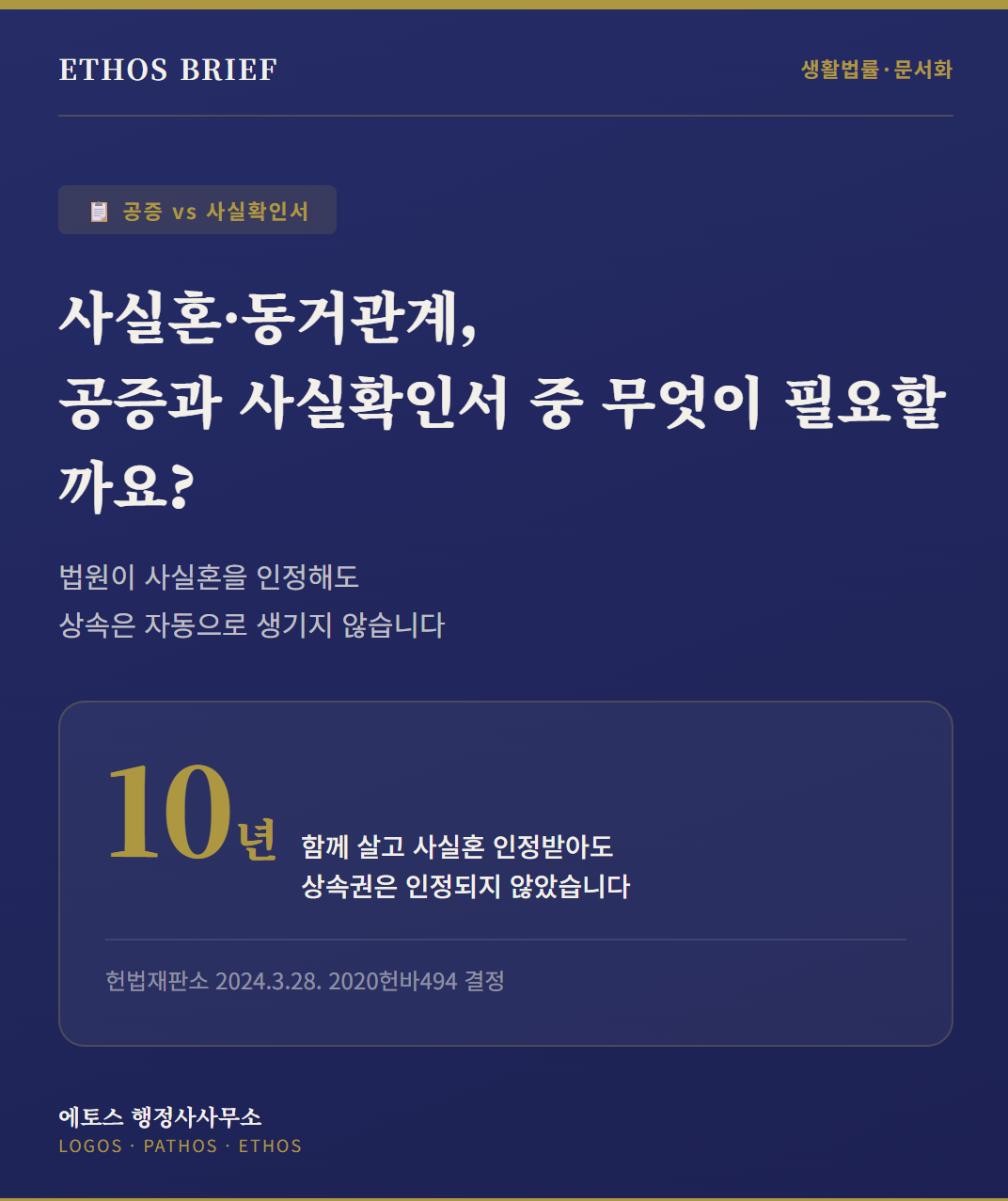
A lived with B from December 2007 to April 2018, for more than 10 years.
The court recognized that the two had been in a de facto marital relationship.
Then B suddenly passed away.
A believed that the property they had built together would be protected in some way.
But the result was different.
The property went to B’s siblings.
On March 28, 2024, the Constitutional Court of Korea unanimously held that Article 1003(1) of the Civil Act was not unconstitutional. Under the Civil Act, the term “spouse” with inheritance rights refers to a legally married spouse, and a de facto spouse is generally not included.
In other words, even if you lived together for 10 years, and even if a court recognizes the relationship as a de facto marriage, inheritance does not arise automatically.
This case shows one clear reality.
If you want legal protection in a cohabiting, de facto marital, or unmarried partner relationship, you need to design the relationship and property arrangements in writing while both partners are alive.
Two documents often come up in this context:
notarization and an administrative agent’s fact confirmation statement.
They may look similar because both relate to “proof,” but their purpose and legal effect are different.
Key Summary
| Category | Notarization | Administrative Agent Fact Confirmation | |---|---|---| | Main function | Confirms document authenticity or formal legal act | Organizes and confirms factual circumstances | | Common use | Monetary agreement, certified agreement, certain notarized deeds | Cohabitation facts, shared expenses, shared residence | | Enforceability | Possible only for certain notarized deeds meeting legal requirements | No direct enforcement power | | Truth of contents | Certification of private documents generally focuses on authenticity | Organizes facts based on statements and materials reviewed | | Suitable for | Large property, debt, settlement, high dispute risk | Administrative submission, immigration materials, relationship proof | | Important limit | Must be handled by a notary | Not a notarization, court judgment, or litigation representation |
Why Documents Are Needed During Life
The most dangerous moment in a cohabiting or de facto relationship is not when the relationship is going well.
Problems usually appear when:
- One partner suddenly passes away
- The relationship ends and the deposit or household items must be divided
- One partner paid more living expenses but has no records
- Family members or third parties deny the relationship
- An agency or public institution asks for proof of shared life
- Immigration or visa procedures require explanation of living arrangements
For legally married spouses, marriage registration automatically creates many legal effects.
For de facto spouses, cohabiting partners, and unmarried couples, the situation is different.
Living together does not automatically create every legal right.
That is why it is important to leave the substance of the relationship in documents.
What Is Notarization?
Notarization is a system where a notary officially confirms a legal act, document, or certain formal facts.
It usually appears in two forms.
1. Notarial Deed
A notarial deed is an official document prepared directly by a notary.
It is often used for clear monetary obligations, such as loans, repayment agreements, or settlement payments.
If certain legal requirements are met and the deed includes a consent-to-enforcement clause, it may allow compulsory execution without obtaining a separate court judgment.
However, not every notarized document automatically has enforcement power.
The specific effect must be confirmed at the notarization stage.
2. Certification of Private Document
This is where the parties prepare a contract or agreement, and the notary certifies the signatures or formation of the document.
It may be used for cohabitation agreements, settlement agreements, undertakings, and similar private documents.
However, certification of a private document generally confirms that the document was executed by the parties.
It does not automatically guarantee that every factual statement written inside the document is true.
What Is an Administrative Agent Fact Confirmation Statement?
An administrative agent fact confirmation statement is a document prepared within the scope of the Administrative Agent Act, especially documents concerning rights, obligations, or proof of facts.
An administrative agent may organize factual circumstances based on the parties’ statements, submitted materials, living records, contractual relationships, and the purpose of administrative submission.
For example, the document may organize:
- When the partners began living together
- How living expenses were shared
- Who paid the housing deposit or monthly rent
- What items were purchased jointly
- How the relationship was known to family or acquaintances
- What facts need to be submitted to an administrative agency
- What living foundation must be explained in immigration or visa procedures
An administrative agent fact confirmation statement is not notarization.
It is not a court judgment.
It is not an enforceable title.
Instead, it can be used to organize facts and evidence for administrative submission, dispute prevention, and relationship proof.
Notarization vs. Fact Confirmation: What Is the Difference?
| Item | Notarization | Administrative Agent Fact Confirmation | |---|---|---| | Main purpose | Confirms document formation, signatures, or legal act | Organizes facts of shared life and relationship | | Prepared by | Notary | Administrative agent | | Enforcement power | Possible for certain notarial deeds only | None | | Remote process | Depends on notary procedure | May be possible depending on the case | | Cost structure | Based on notary fee regulations | Depends on scope and complexity | | Best use | Money, deposit, property settlement, high dispute risk | Cohabitation, living expenses, administrative proof | | Limit | Does not always prove truth of all contents | Not notarization or court enforcement |
In short:
Notarization strengthens the contractual side.
An administrative agent fact confirmation statement strengthens the factual explanation side.
One is not always better than the other.
In some cases, both may be useful.
When Should You Consider Notarization?
Notarization should be considered when:
- A large housing deposit or purchase fund is involved
- One partner lent money to the other
- One partner promises to pay a fixed amount after separation
- There is a high risk that the other party may refuse payment
- A will, legacy, or inheritance-related arrangement is needed
- Future legal disputes are likely
For wills, legacies, inheritance planning, and high-value property issues, consultation with an attorney or notary may be necessary.
When Is an Administrative Agent Fact Confirmation Useful?
An administrative agent fact confirmation statement may be useful when:
- You need to explain cohabitation to an administrative agency
- You need to organize living facts for visa extension or change
- You need documents for health insurance, company benefits, or institutional submission
- You want to record how living expenses were shared
- You need to organize shared residence, shared spending, and shared life
- You want to prepare an evidence file before a dispute arises
The key is not merely saying, “We lived together.”
The key is showing what materials prove that shared life.
Can I Use an AI-Generated Cohabitation Agreement?
AI can be useful for making a first draft.
But using it as-is can be risky.
AI cannot properly confirm:
- The actual living expense structure
- Deposit and rent contribution records
- Ownership of jointly purchased items
- Settlement rules after separation
- The wording required by a specific institution
- Whether notarization is needed
- Whether the document is suitable for administrative submission
- Whether the facts connect properly to visa or immigration procedures
A document can look polished and still be weak in practice.
For cohabitation agreements and fact confirmation statements, the facts matter more than the template.
Documents That May Be Prepared for Cohabiting or De Facto Partners
Depending on the situation, the following documents may be considered.
1. Cohabitation Agreement
This document sets out the basic rules for living together.
It may include:
- Residence and period of cohabitation
- Housing deposit contribution ratio
- Rent, maintenance fee, and utility payment method
- Living expense sharing rules
- Ownership of jointly purchased items
- Settlement rules when the relationship ends
- Pet care and cost allocation
- Amendment and termination procedure
2. Living Expense Contribution Statement
This organizes who paid what, when, and how.
It is especially useful when shared expenses are paid through one partner’s bank account or card.
3. Shared Residence Fact Confirmation Statement
This organizes the fact that two people lived together at the same address for a certain period.
Supporting materials may include:
- Lease agreement
- Utility payment records
- Bank transfer records
- Delivery address records
- Statements from acquaintances
4. Property Ownership and Settlement Agreement
This organizes the ownership and settlement method for jointly purchased furniture, appliances, vehicles, deposits, and other major expenditures.
It is much easier to prepare this while the relationship is stable than after conflict begins.
5. Administrative Submission Fact Summary
This document selects only the facts necessary for a specific institution, such as immigration, company benefits, insurance, or residence-related procedures.
In many cases, submitting a full private agreement is not ideal.
A purpose-specific fact summary may be more practical.
Situation-Based Guide
| Situation | Document To Consider | |---|---| | Large housing deposit or purchase fund | Notarization or attorney review | | Living expense or rent sharing | Cohabitation agreement + fact confirmation | | Need to prove shared residence to an agency | Administrative agent fact confirmation | | Need relationship proof for visa or immigration | Fact confirmation + visa-specific document review | | Preparing for death or inheritance issues | Will or legacy review + fact documentation | | Reducing settlement disputes after separation | Cohabitation agreement + property settlement agreement | | Stronger proof of contract formation | Certification of private document | | Considering compulsory execution for payment | Notarial deed review |
What You Should Check Now
If you are currently cohabiting or in a de facto relationship, check the following:
- Whose name is on the lease?
- Who paid the housing deposit?
- Who pays rent and maintenance fees?
- Whose bank account or card is used for living expenses?
- Is there a list of jointly purchased items?
- Who is listed as insurance beneficiary or emergency contact?
- How have family and acquaintances recognized the relationship?
- Have you ever agreed on settlement rules after separation?
- Have you discussed property arrangements if one partner dies?
If more than half of these are unclear, documentation may be needed.
FAQ
Q. If a de facto marriage is recognized, does inheritance follow?
Generally, no.
The Constitutional Court held on March 28, 2024 that limiting spousal inheritance to legally married spouses under the Civil Act is not unconstitutional.
Recognition of a de facto relationship does not automatically create inheritance rights.
Q. Can an administrative agent fact confirmation statement secure property rights by itself?
No.
It can organize facts and evidence, but it does not create inheritance rights or enforcement power.
For property transfer, legacy, will, litigation risk, or enforcement issues, consultation with an attorney or notary may be required.
Q. Does notarization always allow compulsory execution?
No.
Compulsory execution depends on the type and contents of the notarized document.
Certification of a private document usually confirms document formation and does not itself become an enforceable title.
Q. Are cohabitation agreements only for same-sex couples?
No.
They may be useful for unmarried heterosexual couples, same-sex couples, remarriage partners, long-term cohabiting couples, and de facto spouses.
If there is no marriage registration, living expenses and property arrangements should be documented.
Q. We have lived together for years. Is it still meaningful to prepare documents now?
Yes.
The longer the relationship, the more there may be to organize: living expenses, deposits, jointly purchased property, family interactions, and records of shared life.
A document prepared now can at least establish clear rules going forward and organize past materials together.
Closing
Even after 10 years of living together, and even if a court recognizes a de facto relationship, inheritance does not arise automatically.
That is the current legal reality.
For cohabiting partners, de facto spouses, and unmarried couples, preparing documents during life is one of the most practical ways to protect the relationship.
Notarization is useful for strengthening contractual formation and possible enforcement.
An administrative agent fact confirmation statement is useful for organizing shared life facts for administrative submission and dispute prevention.
The important question is not simply which document is better.
The real question is:
What facts must be proven?
What agreement must be written?
Which institution may later review these documents?
Relationships may begin with trust, but disputes are resolved through documents.
If you are living with someone and have no written records yet, now is the time to review your situation.