
Contracts Are War ② 3 Ways to Challenge Toxic Clauses After Signing
Hello, this is Administrative Agent Jean.
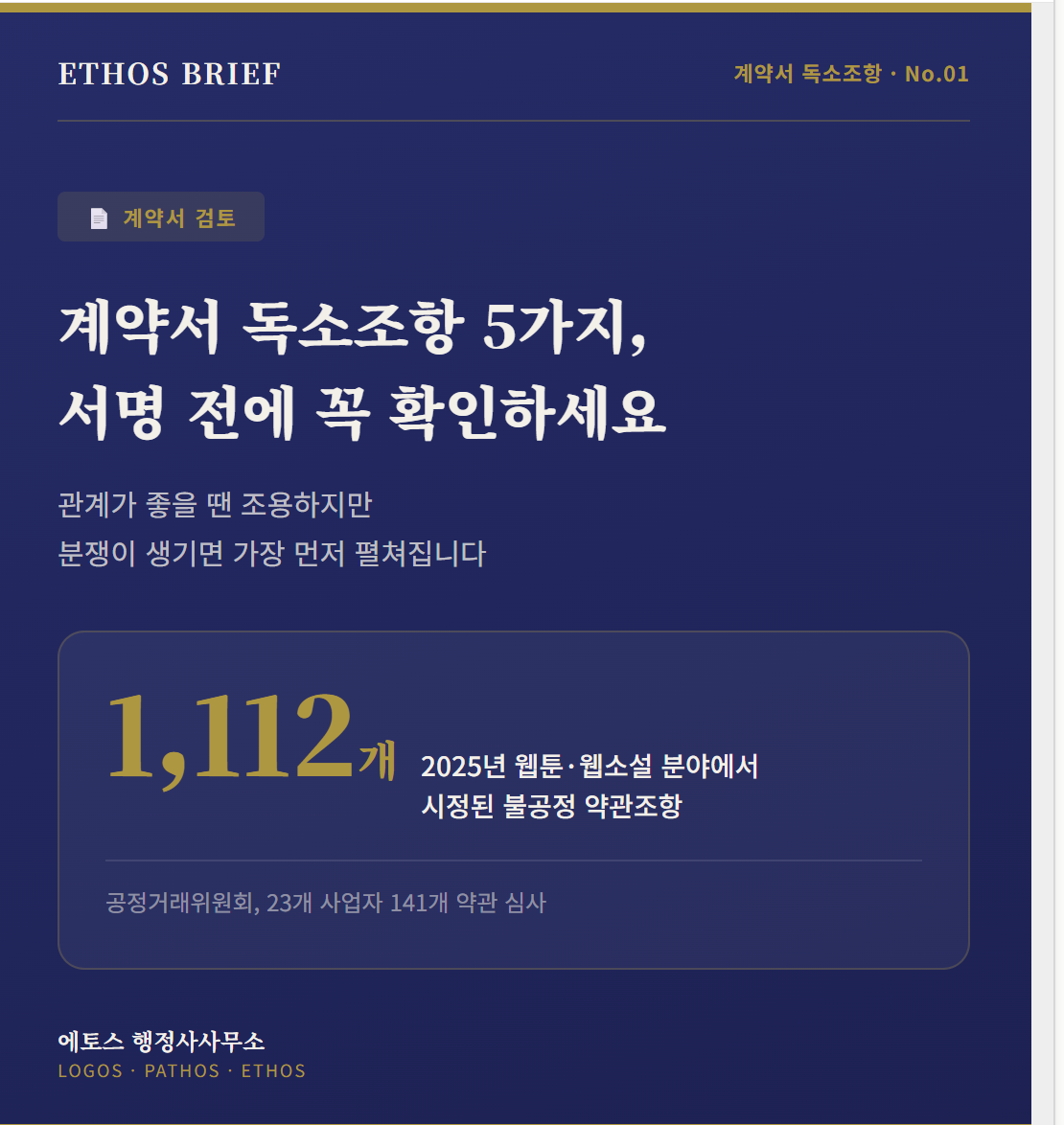
In the previous article, we looked at five common toxic clauses hidden in freelance contracts, lease special clauses, and service agreements.
We also pointed out one important fact.
Platform terms of service may be challenged under Korea’s Act on the Regulation of Terms and Conditions, but individually signed contracts are different.
Once signed, a contract generally binds the parties.
So if a contract you already signed contains a toxic clause, is there nothing you can do?
Not necessarily.
There are several routes under the Korean Civil Act.
But there is a problem.
The person claiming invalidity or reduction must prove it.
That is not easy.
So the conclusion of this article is the same as Part 1:
It is much better to check the contract before signing than to fight after signing.
Still, you need to know what tools exist.
If you do not know whether you have a weapon, you cannot even begin to negotiate or respond.
Key Summary
| Route | Legal Basis | Core Argument | Main Difficulty | |---|---|---|---| | Act contrary to social order | Civil Act Article 103 | Freedom of contract has limits | Must prove the clause reaches the level of social-order violation | | Unfair juristic act | Civil Act Article 104 | The other side exploited strained circumstances, rashness, or inexperience | Must prove significant imbalance and exploitation | | Reduction of penalty | Civil Act Article 398(2) | Liquidated damages are excessive | Must distinguish liquidated damages from contractual penalty |
Route 1. Invalidity for Violation of Social Order
Article 103 of the Korean Civil Act provides that a juristic act whose object is contrary to good morals and other social order is null and void.
In plain language, even if both parties signed a contract, the clause may be invalid if it is socially unacceptable to an extreme degree.
Freedom of contract matters.
But it is not unlimited.
For example, suppose someone signs an agreement promising never to marry anyone else after breaking up with their partner.
Even if both people signed it, such an agreement may be hard to treat as valid because it excessively restricts personal freedom and may violate social order.
The same idea can apply to toxic contract clauses.
Especially when the Act on the Regulation of Terms and Conditions does not directly apply to an individually negotiated contract, Civil Act Article 103 can become an important route.
Case Example: Shifting All Risk Through Economic Superiority
The Supreme Court decision of February 23, 2023, 2022Da287383, shows that Article 103 can apply even in business contracts.
In that case, a party with superior economic power imposed an additional agreement that shifted excessive risk to the other party.
The original contract had specific rules on the scope and procedure of liability.
But a later separate agreement changed the structure so that, if certain loans became problematic, almost all risk was shifted to the other party regardless of the reason.
The Supreme Court held that such an agreement could be invalid under Article 103.
The core reasoning was that when a party in a superior economic position uses that position to obtain an unfair benefit and impose excessive burdens on the other party, the agreement may lose social validity.
How This Appears in Contracts
Article 103 review may be needed for clauses such as:
- Clauses imposing all damages on only one party
- Clauses requiring you to bear all risk even when the other party is at fault
- Clauses creating practically unlimited liability
- Clauses imposing excessive sanctions only on the weaker party
- Clauses excessively restricting occupation, business activity, or daily life
However, a clause is not invalid simply because it is unfavorable.
You must show a level of excessiveness that can be evaluated as contrary to social order, such as abuse of economic superiority, unfair benefit, and forced burden.
Route 2. Unfair Juristic Act: Exploiting Strained Circumstances, Rashness, or Inexperience
Article 104 of the Korean Civil Act provides that a juristic act that is remarkably unfair due to a party’s strained circumstances, rashness, or inexperience is null and void.
This rule is designed to regulate exploitative transactions.
The Supreme Court decision of March 12, 2024, 2023Da301712, restated the requirements of Article 104.
There are two main requirements.
1. Objective Requirement
There must be a significant imbalance between performance and counter-performance.
In other words, what you provide and what the other side provides must be remarkably disproportionate under social norms.
A slightly unfavorable deal is not enough.
2. Subjective Requirement
The imbalance must have been created by exploiting the affected party’s strained circumstances, rashness, or inexperience.
Importantly, all three do not need to be proven.
One may be enough.
“Strained circumstances” does not only mean financial distress.
It may include mental or psychological pressure and urgent circumstances.
“Inexperience” may refer to lack of general transactional experience, not just lack of expertise in one specific field.
How This Appears in Contracts
Article 104 review may be relevant where:
- A foreigner signs a Korean lease without fully understanding the special clauses
- A freelancer accepts extremely unfavorable terms because they urgently need work
- An inexperienced founder signs a one-sided contract with a larger company or platform
- A tenant accepts excessive special clauses because they urgently need housing
- A party accepts broad penalty, copyright, or liability clauses without understanding the structure
But Proof Is Difficult
In practice, Article 104 is difficult to prove.
The party claiming invalidity generally needs to explain:
- That they were in strained circumstances, rash, or inexperienced
- That the other party knew this
- That the other party exploited it
- That there was a significant imbalance between performance and counter-performance
It is not enough to say the contract was unfavorable.
An unfavorable contract and an unfair juristic act that is legally invalid are different.
This is why review before signing matters so much.
Route 3. Reduction of Excessive Penalty
One of the most dangerous clauses in a contract is the penalty clause.
For example:
If Party B breaches the contract, Party B shall pay the entire remaining contract amount and an additional penalty of KRW 30 million.
Or:
For one year after termination, Party B shall not engage in similar work, and if violated, all revenue earned shall be paid to Party A.
Penalty clauses can be powerful in actual disputes.
But if they are excessive, they may be challenged.
Article 398(2) of the Korean Civil Act provides that if the estimated amount of damages is unreasonably excessive, the court may reduce it.
In other words, the full amount written in the contract is not always automatically enforced.
First, Identify the Legal Character of the Penalty
There are two main types of penalty clauses.
1. Liquidated Damages
This means the parties pre-agreed on the amount of damages in case of breach.
If the amount is unreasonably excessive, a court may reduce it under Civil Act Article 398(2).
2. Contractual Penalty
This is a sanction designed to compel performance.
The Supreme Court has held that contractual penalties are different from liquidated damages, so Article 398(2) does not apply by analogy.
However, even contractual penalties are not completely immune.
If the penalty is excessively heavy compared to the creditor’s interest, it may be challenged as partially or fully invalid under Article 103.
What To Check in the Contract
When reviewing a penalty clause, first check:
- Whether it is liquidated damages
- Whether it is a contractual penalty
- Whether both functions are mixed
- Whether the amount is proportional to actual damage
- Whether it applies uniformly regardless of the degree of breach
- Whether it applies symmetrically to both parties
- Whether post-termination restrictions are excessive
Even if the contract uses the same word “penalty,” the legal character may differ.
Even if the contract does not expressly say “contractual penalty,” a court may interpret it based on the structure and context of the clause.
Common Limits of These Three Routes
The three routes above are tools that may be used after signing.
But they share the same limits.
You must prove the claim.
It takes time.
It costs money.
If the other side does not compromise, court involvement may become necessary.
And going to court does not guarantee invalidity or reduction.
Before Signing vs. After Signing
| Category | Before Signing | After Signing | |---|---|---| | Main task | Revise or remove risky clauses | Argue invalidity or reduction | | Cost | Relatively low | Litigation or representation costs may increase | | Time | Often reviewable within days | May take months or longer | | Burden of proof | Risk can be adjusted in advance | Claiming party must prove invalidity | | Predictability | Contract structure can be revised | Outcome depends on later judgment | | Stress | Lower | Higher |
The same contract can produce a completely different result depending on timing.
Before signing, you revise one sentence.
After signing, you fight over that sentence.
If You Already Signed, What Should You Do First?
If you already signed the contract and discovered a problematic clause, do not react emotionally right away.
Organize the matter in this order.
1. Secure the Original Contract
Keep the signed copy, PDF, email attachment, and any version received through messenger.
2. Mark the Problem Clauses
Check penalty, termination, damages, copyright, non-compete, repair responsibility, and non-refundable clauses first.
3. Organize the Facts
Write down the timeline of the negotiation, what the other party explained, your position at the time, whether you were under pressure, and why you accepted the unfavorable terms.
4. Collect Evidence
Collect emails, text messages, KakaoTalk messages, quotations, revision requests, payment records, and explanation materials from the other party.
5. Review Negotiation Possibility
Before litigation, some cases may be resolved through a demand letter, renegotiation, or settlement agreement.
6. Identify Whether It Has Become a Legal Dispute
If litigation, injunction, damages claim, criminal complaint, or urgent legal risk is already involved, attorney consultation may be required.
An administrative agent can help organize the contract and factual materials and prepare documents related to rights, obligations, and administrative matters.
However, litigation representation and legal dispute representation are attorney work.
How an Administrative Agent Can Help
Ethos Administrative Office can assist before a dispute becomes larger, including:
- Reviewing toxic clauses
- Analyzing penalty clause structure
- Distinguishing liquidated damages and contractual penalty
- Drafting contract revisions
- Drafting freelance and service agreements
- Reviewing lease special clauses
- Preparing settlement agreements, undertakings, and fact confirmation statements
- Preparing a contract negotiation timeline
- Preparing administrative submission documents
- Creating issue summary tables before consultation
Contract review is not litigation representation.
It is the process of identifying and organizing risky clauses before the dispute grows.
FAQ
Q. Can a contract already signed be invalidated?
It may be possible in some cases.
Civil Act Articles 103, 104, and 398(2) may provide routes to challenge invalidity or reduction.
However, the actual possibility depends on the contract language and facts.
Q. Is an unfavorable contract invalid under Article 104?
No.
A contract is not invalid simply because it is unfavorable.
There must be a significant imbalance and exploitation of strained circumstances, rashness, or inexperience.
Q. Are penalties always reduced?
No.
If the clause is liquidated damages, the court may reduce it if it is unreasonably excessive.
If it is interpreted as a contractual penalty, Article 398(2) may not apply, and Article 103 may need to be reviewed separately.
Q. If the contract says “contractual penalty,” is that final?
Not necessarily.
Courts may review not only the label but also the structure, purpose, overall contract, and function of the clause.
Q. What changes if I review the contract before signing?
Before signing, risky clauses can be removed or revised.
For example, penalties can be adjusted to actual damages, revision rounds can be limited, and copyright transfer can be narrowed.
After signing, you must argue invalidity or reduction, which is much harder.
Closing
Even after signing, there may be ways to respond.
Invalidity for violation of social order.
Unfair juristic act.
Reduction of excessive liquidated damages.
These are real tools under the Korean Civil Act.
But strong tools are not always easy to use.
They require proof, time, and cost.
That is why the most important moment in contract review is not after the dispute begins.
It is before signing.
Before signing, one sentence can be changed.
After signing, that same sentence may become the center of a dispute.
Before you sign a contract, at least identify where the dangerous clauses are.
Ethos Administrative Office can help review the contract structure and toxic clauses before they become a problem.