
What Happens If a Foreign National Uses a Korean Delivery Account? — Why Immigration May Look at the Account Holder, Payment Flow, and Prior Statements
Hello, this is Administrative Agent Jean.
When we are hungry but do not want to cook, delivery is often the first thing that comes to mind.
These days, delivery riders in Korea are not only Korean nationals. Foreign nationals are also increasingly involved in delivery work.
But when a foreign national works in Korea, the first question is not simply, “Can I earn money?”
The first question should be:
“Is this activity permitted under my current visa status?”
Delivery work is no exception.
Because delivery, parcel, and platform-based side jobs can often be started through an app, some foreign nationals begin working without first confirming whether the activity is allowed under their visa status. That can later become an immigration issue.
In this series, “Foreign Delivery Work, Side Jobs, and Korean Visas,” we are looking at practical issues such as whether delivery work is permitted by visa type, use of third-party accounts, illegal employment detection, departure orders, deportation, objections, and administrative appeals.
① Can a foreign national work as a delivery rider in Korea? Check the visa first
② D-2 students cannot do delivery work, even with part-time work permission
③ What happens if a foreign national uses a Korean delivery account? ← This article
④ I was caught doing delivery work — what is the difference between an administrative fine, departure order, and deportation?
⑤ If you receive a deportation notice, check the “7-day” issue before the “90-day” issue
⑥ Can an E-9 worker do delivery work after regular working hours?
⑦ What happens if a foreign delivery rider is also caught driving without a license or insurance?
Can a foreign national simply use a Korean friend’s delivery account?
If delivery work under a foreign national’s own name is not permitted, can the person simply use a Korean friend’s delivery account?
This has actually happened.
In a 2026 case, a delivery agency operator was sent to the prosecution for allegedly providing Korean-name delivery accounts to 67 foreign nationals, receiving 5.5% of delivery fees and an additional KRW 200,000 to 250,000 per month per person as account-use fees.
The alleged improper gain identified by the authorities was approximately KRW 140 million.
(Hankyung, April 14, 2026, “Korean-name accounts provided to 67 foreign riders for illegal employment… sent to prosecution”)
On the other hand, a foreign national was also detected after allegedly using a Korean-name delivery account for 1 year and 7 months and earning approximately KRW 52 million from delivery work.
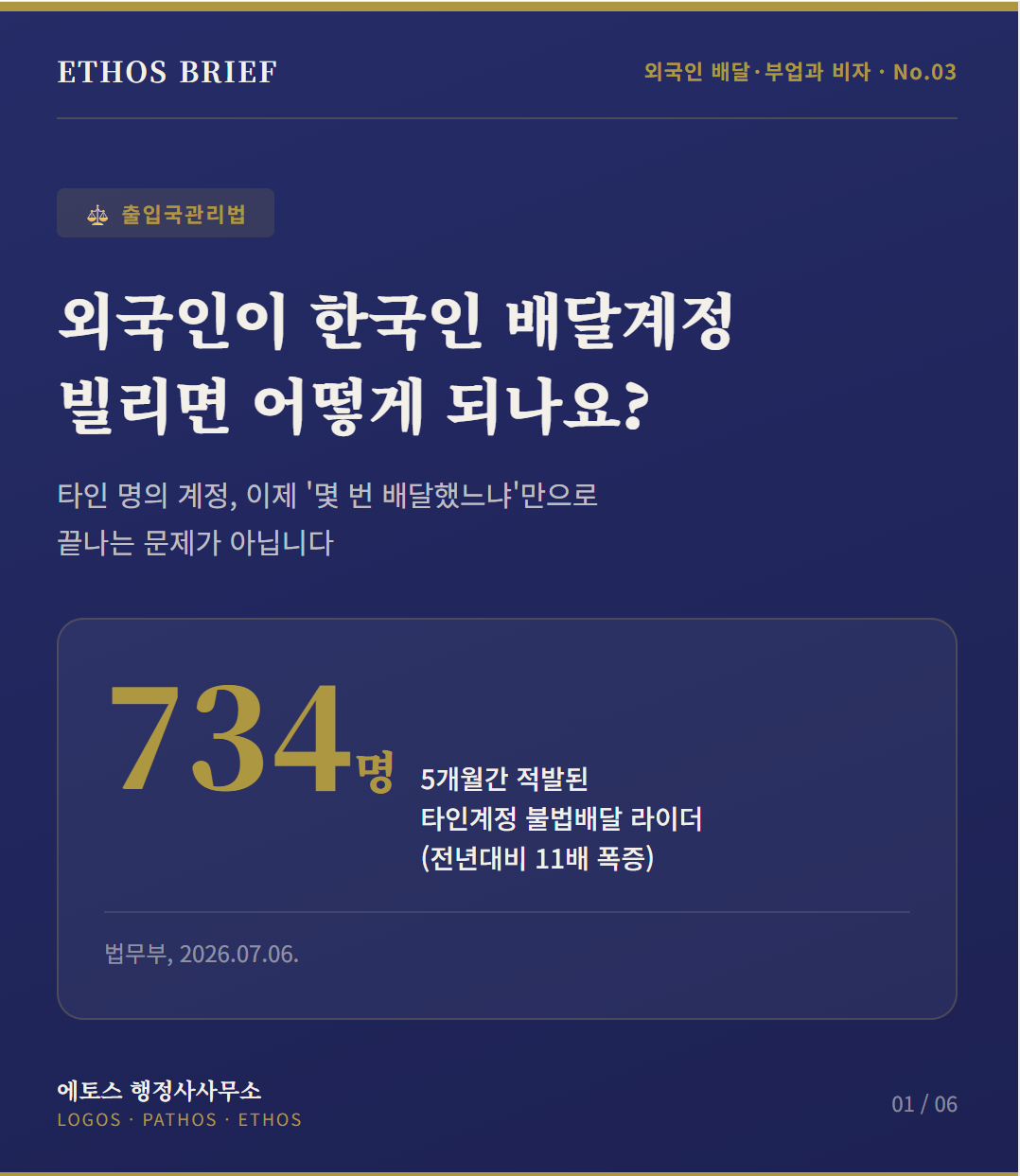
(Ministry of Justice, July 6, 2026, “734 foreign riders detected over five months for illegal delivery work using other people’s accounts, an eleven-fold increase”)
So this issue is no longer just a simple matter of:
A foreign national borrowed a friend’s ID and did delivery work.
The problem becomes more complex because the person registered on the account may be different from the actual rider, the person receiving settlement payments may be different from the person who actually performed the work, and in some cases the person who provided the account may also become part of the investigation.
From January to May 2026, the Ministry of Justice detected 734 foreign delivery riders and 16 delivery businesses in relation to illegal delivery work by foreign nationals.
The Ministry also stated that it was separately investigating business operators who provided delivery app accounts registered under other people’s names to foreign nationals.
In this article, we will look at why using a third-party delivery account is risky, and what should be reviewed if a foreign national has already used such an account and an immigration issue has arisen.
Are “account theft” and “borrowing an account” the same thing?
The Ministry of Justice’s 2026 press release used expressions such as “another person’s account” and “using another person’s account.”
However, the detailed enforcement examples do not refer only to cases where someone secretly stole a password or accessed an account without the account holder’s knowledge.
Some cases involved delivery business operators or account holders allegedly providing Korean-name accounts to foreign nationals in exchange for money.
Using someone’s account without their knowledge and using an account that the Korean account holder knowingly provided are different factual situations.
For that reason, it is not accurate to describe every case simply as “account theft” or “identity theft.”
This article mainly focuses on the latter situation:
A Korean account holder provides the account, and the foreign national actually performs delivery work using that account.
Even if the Korean account holder consented, the foreign national’s delivery activity does not automatically become lawful.
At the same time, the account holder’s responsibility cannot be reduced to one sentence such as:
I only lent the account.
The actual role of each person must be reviewed.
The account was Korean, but the actual delivery period and income were identified separately
Let us look at the actual case mentioned earlier.
A foreign national allegedly used a Korean-name delivery account and performed delivery work in the Gangnam area of Seoul for 1 year and 7 months, earning approximately KRW 52 million.
The important point is not only the amount of KRW 52 million.
The important point is that although the account was registered under a Korean name, the authorities separately identified who actually performed the delivery work, how long the person worked, and how much income was generated.
In other words, it is not safe to assume:
The app shows a Korean name, so the work will be treated as if a Korean person did it.
For immigration purposes, the following facts may become important:
- Who actually performed the delivery work
- When the delivery work started and ended
- How frequently the delivery work was performed
- Where the account came from
- How the delivery income was settled and transferred
Therefore, when reviewing an immigration case, it is not enough to look only at the account name.
The actual delivery activity must be reconstructed in chronological order.
Immigration authorities are not only looking at foreign riders — they are also looking at the account supply route
Another important point in the 2026 enforcement data is the 16 delivery businesses that were also detected.
This shows that the enforcement scope is not limited to the foreign national’s individual delivery activity.
It also extends to surrounding structures, including account providers and delivery businesses.
The Ministry of Justice stated that it had detected business operators who provided delivery app accounts registered under other people’s names to foreign nationals, and that it would strengthen investigations into account-providing brokers.
In other words, enforcement is moving from:
Foreign rider → Account provider → Delivery business → Account supply structure
This means that if a foreign national is investigated for using a third-party account, it may become necessary to review not only whether the person performed delivery work, but also:
Who provided the account, whether money was paid for the account, and whether the same person provided accounts to other foreign nationals.
Is a one-time favor between friends the same as an “account business”?
No. The facts can be very different.
A Korean friend lending an account once to one foreign friend without payment is different from a person repeatedly supplying accounts to dozens of foreign nationals while receiving monthly fees.
The key question is not only:
Was the account lent?
The more important question is:
What role did the account provider actually play?
The Supreme Court of Korea has held that “employment” under the Immigration Act means receiving labor from a foreign national who is not permitted to engage in such employment activity and paying remuneration for that labor.
(Supreme Court Decision 2018Do3690, May 14, 2020, Immigration Act violation)
The Supreme Court has also held that even where a company employee hired a foreign national without proper employment status, the company representative could not automatically be treated as the person who employed the foreign national merely because he was in a position to know about the situation.
(Supreme Court Decision 2017Do3005, June 29, 2017, Immigration Act violation)
These cases show that responsibility under the Immigration Act is not determined simply because a person’s name appears in the case or because the person is somehow related to the situation.
The actual conduct must be reviewed.
For example, the following facts may matter:
- Whether the account was provided only once
- Whether the account was provided repeatedly
- Whether the account provider received money
- Whether the account provider handled settlement payments
- Whether the account provider connected the foreign national to a delivery business
- Whether the account provider recruited multiple foreign nationals
These facts help determine how the account provider’s conduct may be evaluated under the Immigration Act.
The account provider’s role should be separated by factual pattern
The law does not officially classify third-party delivery account cases into the following three categories.
However, for purposes of understanding the structure of an actual case, it is useful to separate the account provider’s role based on repetition, payment, and level of involvement.
1. One-time, unpaid lending between friends
A Korean friend provides an account to one foreign friend without receiving separate payment.
The foreign national performs the delivery work, and the settlement money is only passed through the Korean friend.
Even in this case, the foreign national’s actual delivery activity remains a separate immigration issue.
However, it is not accurate to automatically treat the account provider as if the case were the same as an organized broker-type case involving many foreign nationals.
2. Repeated paid account lending
The account is provided continuously for several months in exchange for a monthly payment or a percentage of delivery income.
In this situation, it becomes necessary to review whether the payment was:
- A simple favor between friends
- Payment for use of the account
- Compensation for connecting the person to delivery work
- Compensation for handling settlement payments
3. Organized provision to multiple foreign nationals
This refers to a structure where accounts are repeatedly provided to multiple foreign nationals, while the provider is also involved in connecting delivery work or handling settlement payments and receives fees or commissions.
In the reported 67-person case, the operator allegedly recruited foreign nationals through SNS, provided Korean-name accounts, and received 5.5% of delivery fees plus KRW 200,000 to 250,000 per month.
(Hankyung, April 14, 2026, “Korean-name accounts provided to 67 foreign riders for illegal employment… sent to prosecution”)
All three situations involve the use of another person’s delivery account.
But the repetition, payment relationship, number of people involved, settlement involvement, and connection to delivery work are very different.
Therefore, when reviewing the account provider’s responsibility, it is not enough to say only:
The account was lent.
The actual role must be reviewed in detail.
If a foreign national is caught using a third-party delivery account, does that always mean deportation?
No.
Detection does not mean that every foreign national will face the same immigration outcome.
In the Ministry of Justice’s enforcement from January to May 2026, 734 foreign nationals were detected.
Among them, 68 were subject to departure-related measures, including deportation, while 643 received administrative fines totaling KRW 1,628,700,000.
The administrative fines ranged from KRW 1 million to KRW 10 million per person.
The remaining cases were under investigation, referral, or police transfer.
The Ministry of Justice also stated that it considered the degree of violation, period of unauthorized employment, and stay record when determining the measures.
Therefore, it is not accurate to say:
If a foreign national is caught using a third-party account for delivery work, deportation is automatic.
Article 46 of the Immigration Act is structured to allow deportation where certain grounds are met.
But that does not mean that every case is decided without standards.
In the 2026 enforcement data, the Ministry itself stated that the degree of violation, period of unauthorized work, and stay record were considered.
So the most important question is:
What are the specific facts of my case?
Another way to put it is:
How is my case structured, and what issue is the immigration office currently focusing on?
That is why individual case review matters.
If immigration has already contacted you, this is no longer a general search issue
If the immigration office has already contacted you about delivery work, the first step is to identify the scope of the investigation.
First, what is immigration trying to confirm?
Is immigration only asking:
Did you actually perform delivery work?
Or is immigration also asking:
Who provided the account?
Or even:
Were there other foreign nationals using the same account?
The scope of the investigation affects the facts that need to be prepared.
Second, what statements have already been made?
If there has already been an interview or investigation, it is important to organize what questions were asked and what answers were given, to the extent possible.
Third-party account cases can involve conflicting statements between the foreign national and the Korean account holder.
The foreign national may say:
My Korean friend gave me the account for delivery work.
The account holder may say:
I did not know the account would be used for delivery.
The foreign national may say:
I paid a monthly account fee.
The account holder may say:
That money was not an account fee.
At the investigation stage, it is therefore important to check whether the statements already made are consistent with the documents and payment records.
Third, what type of measure is being considered?
Is the case at the administrative fine notice stage?
Is a departure-related measure being considered?
Or is the immigration office still investigating the facts?
Even if the situation can be described simply as “immigration contacted me,” the actual procedural stage may be very different from case to case.
If immigration has already contacted you or issued a summons, it is important to review your current visa status, delivery period, account source, settlement records, and prior statements together, rather than relying only on general information.
If you have received any document from immigration, even one document may be enough to begin reviewing the case.
Free initial review · Paid consultation · Consultation fee deductible upon engagement
Why should settlement and transfer records be reviewed?
Settlement and transfer records may help identify the actual role of the account holder.
For example, suppose KRW 3 million is settled into an account registered under Min-su’s name.
But the actual delivery work was performed by James, a foreign national.
Min-su receives KRW 3 million, sends KRW 2.8 million to James, and keeps KRW 200,000.
This immediately raises a question:
What was the KRW 200,000?
Was it a simple personal reimbursement between friends?
Was it an account-use fee?
Was it compensation for connecting James to delivery work?
Was it compensation for handling the settlement?
The facts must be reviewed.
In the 67-person case, the operator was also alleged to have received a percentage of delivery fees and separate account-use fees.
Therefore, in these cases, it is useful to review:
Account provision relationship + platform settlement + re-transfer records
The amount itself is not the only issue.
The character of the money may help explain the actual role of the account provider.
The following records and statements should be reviewed together:
- Account name
- Actual delivery period
- Delivery activity records
- Settlement records
- Transfer records between the account holder and the foreign national
- Messages or KakaoTalk conversations about account provision
- Whether an account-use fee was paid
- Statements made during the investigation
I lent my account to a foreign friend. Can I also have a problem?
In this situation, the key is not merely that the account was under your name.
The key is your actual role.
For example, the following questions matter:
- Did you know that the foreign national was using the account for delivery work?
- How long did you provide the account?
- Was the account provided repeatedly?
- Did you receive money?
- Did you receive settlement payments and transfer them onward?
- Did you keep part of the income?
- Did you provide accounts to multiple foreign nationals?
- Did you connect foreign nationals to a delivery business?
- Did you manage the delivery work?
As discussed above, responsibility under the Immigration Act is not automatically established simply because a person is related to the case.
On the other hand, if the person recruited multiple foreign nationals, provided accounts, received fees, and connected them to delivery work, the facts may be evaluated differently.
If you are a foreign national, organize your case this way
If you have already performed delivery work using another person’s account, review the following facts:
- Your exact current visa status
- Which delivery platform was used
- Whose name was registered on the account
- Who the account holder is
- Your relationship with the account holder
- How you obtained the account
- When you started and stopped using the account
- Approximate number of deliveries or scale of activity
- Whose bank account received the delivery payments
- How the money was later transferred to you
- Whether you paid any account-use fee or commission
- Whether other foreign nationals used the same account
- Whether the platform contacted you about identity verification or account issues
- Whether immigration has already contacted or summoned you
- What statements you have already made during any investigation
- Whether you have received an administrative fine notice, departure-related document, or other immigration document
A larger number of checked items does not automatically determine a specific measure or criminal responsibility.
However, it may mean that the immigration office has more facts to review, and that the case may be difficult to explain as a simple matter of “I only did delivery a few times.”
This is where review by an administrative agent can matter
In immigration-related cases, the important work is not simply finding a legal provision and saying:
This is illegal.
Or:
This will be a departure order.
If a case has already been detected or if immigration has already contacted you, the key is to organize the following facts together:
Current visa status, actual delivery period, how the account was obtained, settlement and transfer records, prior statements, and the current stage of the immigration procedure.
Only after that can the case be reviewed properly.
For example, it may be necessary to distinguish whether the current issue is mainly an administrative fine issue, or whether a departure-related measure may also need to be considered.
In the 2026 enforcement data, not all 734 detected foreign nationals received the same outcome.
Therefore, if you have already received contact from immigration, it is not enough to ask only whether the activity was illegal.
It is important to organize the visa status, actual delivery period, account source, settlement records, prior statements, and current procedure into one case record.
An administrative agent can assist in organizing immigration-related facts, reviewing supporting materials, and examining the relevant administrative procedure.
If immigration has already contacted you, check these materials first
If you are a foreign national, it is useful to organize the following:
- Alien Registration Card or exact current visa status
- Name registered on the delivery account used
- Period during which the account was used
- Settlement and transfer records
- Whether any account-use fee or commission was paid
- Conversations related to the account provision
- Any summons, administrative fine notice, departure-related document, or other document received from immigration
If you are the Korean account holder, it is useful to review:
- To whom the account was provided
- How many people received access to the account
- How long the account was provided
- Whether money was received
- Whether you handled settlement payments
- Whether you connected other foreign nationals
- Whether you received any document from immigration or an investigative authority
If you have already been interviewed, even one document received from immigration and a record of the questions asked can help identify the current stage of the case.
A third-party delivery account case is not only about whether delivery work was performed.
The structure becomes clearer when the actual person, account, money flow, statements, and immigration procedure are reviewed together.
If you have your Alien Registration Card, account information, settlement and transfer records, and if immigration has already contacted you, any document received from immigration, those materials may be enough to begin reviewing the case.
If you have already received a summons, administrative fine notice, or departure-related document, it is important to review the documents and facts you currently have.
In a third-party account case, even where the issue is generally described as “delivery work,” the relevant review may differ depending on the period of use, how the account was obtained, the settlement relationship, prior statements, and the current procedural stage.
Free initial review · Paid consultation · Consultation fee deductible upon engagement
In the next article, we will look at the next issue:
When illegal delivery work by a foreign national is confirmed, what is the difference between an administrative fine, departure order, and deportation, and why do some cases end with an administrative fine while others lead to departure-related issues?