[Foreign Delivery & Side Jobs in Korea ①] Can Foreigners Work as Delivery Riders in Korea? Check Your Visa First — 734 Riders Caught in 5 Months
![[Foreign Delivery & Side Jobs in Korea ①] Can Foreigners Work as Delivery Riders in Korea? Check Your Visa First — 734 Riders Caught in 5 Months cover](https://24twwbxsszxyfawd.public.blob.vercel-storage.com/blog/%EC%8A%A4%ED%81%AC%EB%A6%B0%EC%83%B7-2026-08-16-130439-nFpzfHGXJRDDtVOXlm8FlNXFo7p9i5.png)
Hello, this is Jean, a Certified Administrative Agent.
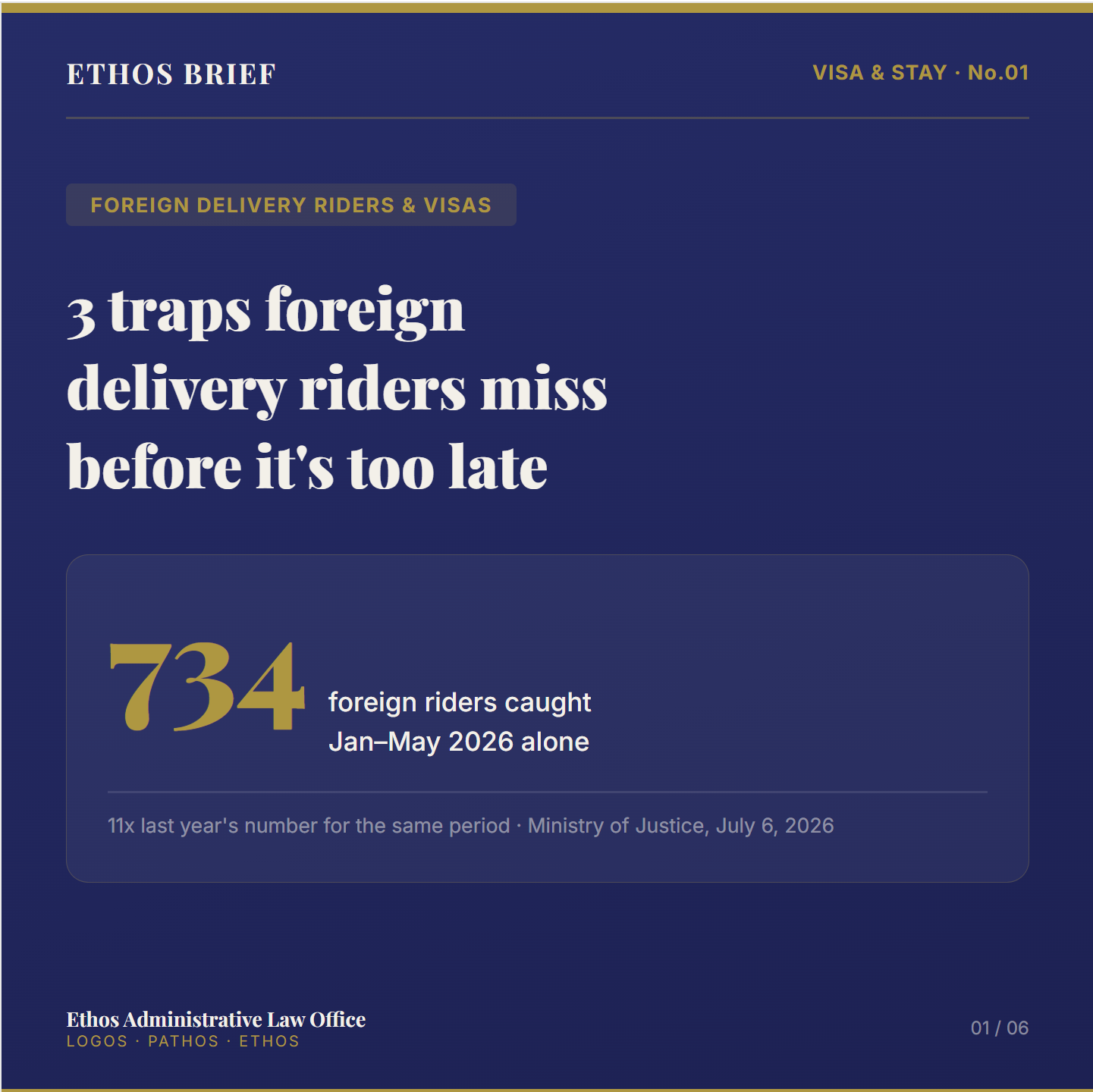
Compared with 67 cases during the same period last year, this is an increase of approximately 11 times. By nationality, Vietnamese nationals accounted for 444 cases, Chinese nationals 164 cases, and Uzbek nationals 86 cases. In Seoul alone, 282 foreign riders were caught. In addition, 16 delivery businesses that provided delivery accounts to foreign nationals were also detected. The Ministry of Justice subsequently recommended that delivery platform operators introduce facial recognition systems. (Ministry of Justice, July 6, 2026, “734 Foreign Riders Caught Making Illegal Deliveries Using Other People’s Accounts Over Five Months — 11-Fold Increase Year-on-Year”)
It may seem like all you need to do is download a delivery app and start earning money.
Especially when people around you say:
I’m doing it too.
Just use a friend’s account.
If you only make a few deliveries, how would immigration ever find out?
That can make it seem even easier. But even if a D-2 international student or an E-9 worker only makes a few deliveries after work, the key issue is not “how much money did you earn?” but rather “is this activity permitted under your current status of stay?”
If your visa does not allow the activity, the consequences may go far beyond simply having your delivery app account suspended. It can become a violation of the Immigration Act and, depending on the circumstances, may affect your permission to stay or even lead to an order to leave Korea. If you are currently making deliveries or considering starting, take out your Residence Card and check your status of stay before opening the delivery app.
Can I Make Deliveries with My Visa?
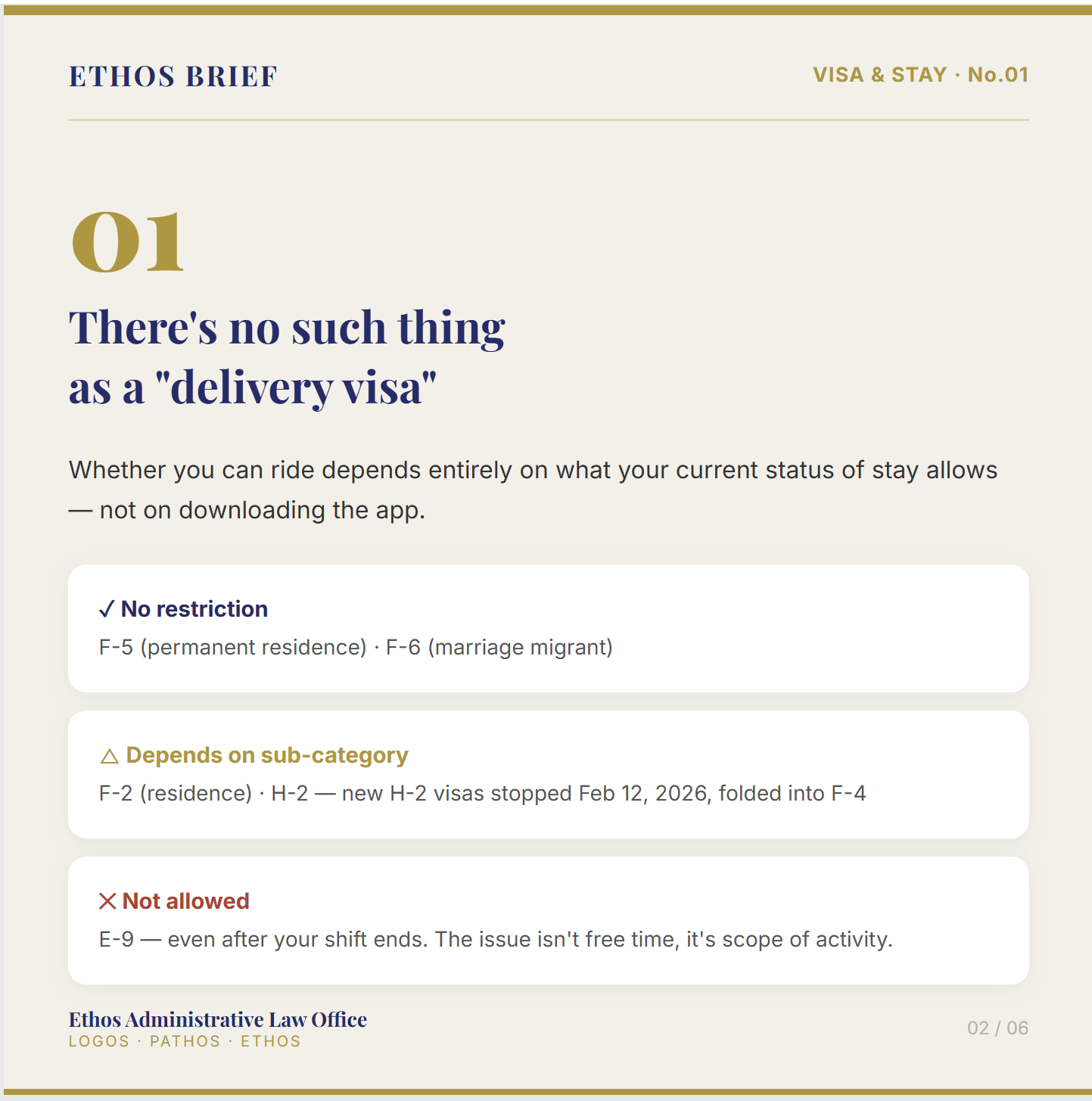
The bottom line is that Korea does not have a separate status of stay called a “delivery visa.” So what matters is whether your current status of stay permits this type of employment activity. Let’s start by checking the status of stay shown on your Residence Card.
○ Representative Statuses of Stay Without Employment Restrictions
- F-5 (Permanent Resident) — In principle, there are no restrictions on employment activities.
- F-6 (Marriage Migrant) — In principle, employment activities are also unrestricted.
However, if you actually perform delivery work as an independent contractor or through a platform arrangement, matters such as business registration, driver licensing, and insurance must be reviewed separately from your immigration status.
△ Cases Where the Specific Subcategory Must Be Checked
- F-2 (Resident) — You should not assume that every type of F-2 status permits all forms of employment. The permitted scope of activities may differ depending on the specific F-2 subcategory and the basis on which it was granted. You should first check the exact status shown on your Residence Card.
- H-2 (Work and Visit) — From February 12, 2026, the overseas Korean status system was reorganized primarily around F-4 status, and new H-2 visa issuance was discontinued. Existing H-2 holders may remain until the maximum permitted period of stay and may change their status to F-4.
There is one important point to keep in mind.
As discussed in the previous article, H-2 has been integrated into the F-4 framework.
However, that does not mean that holding F-4 status allows you to perform any kind of work freely. F-4 status still carries separate restrictions on employment activities, and even under the 2026 reform, employment eligibility was expanded gradually to certain occupations. Therefore, if you hold H-2 or F-4 status, do not rely only on the name of your status of stay. You should separately confirm whether delivery work falls within the permitted scope of activities.
✕ Statuses of Stay Under Which You Should Not Perform Delivery Work
- E-9 (Non-professional Employment) — This status allows employment at the workplace authorized under the Employment Permit System. Isn’t my time after work my own free time?
It is easy to think this way, but making deliveries through a platform after work is not simply an issue of working hours. The real issue is whether the activity falls within the employment activities permitted under your status of stay. We will cover this separately in Part ⑥. → ⑥ Is It Illegal for an E-9 Foreign Worker to Make Deliveries After Work?
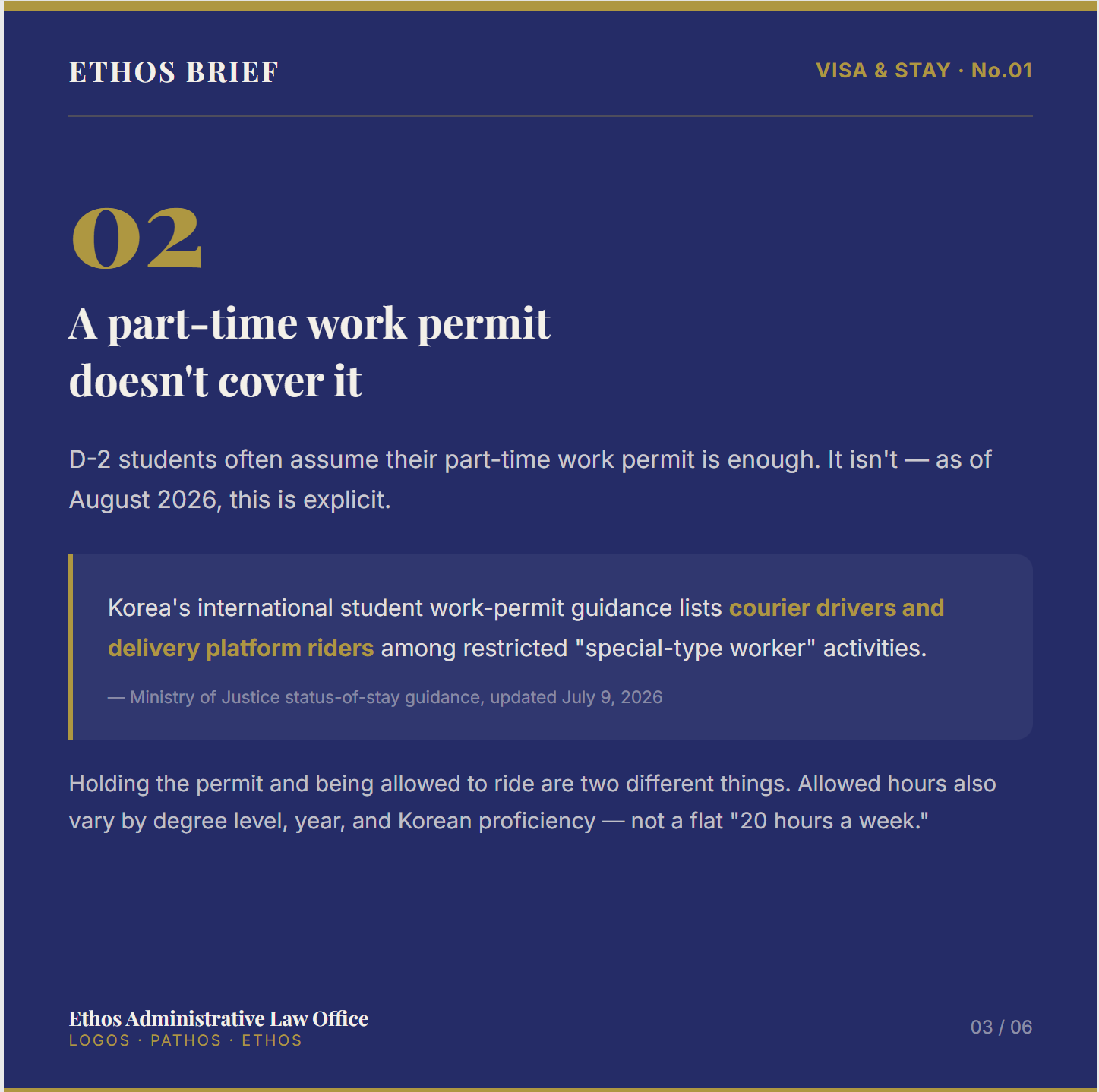
- D-2 (Student) — Receiving permission for part-time employment does not mean delivery work is automatically permitted. Current guidance on part-time employment for international students specifically lists activities such as parcel delivery drivers, delivery agency riders, and designated drivers as restricted forms of work performed by specially employed workers.
I have permission for part-time employment, so delivery work should be okay too.
You should not make that assumption. We will examine this in detail in Part ②.
- D-4 (General Trainee) — Even where part-time employment is permitted, you must remain within the scope of the authorization granted. You should not independently begin working as a delivery rider.
- C-3 (Short-Term Visit), B-1, B-2, etc. — These statuses are, in principle, not intended for employment activities. By this point, you have probably checked which category your own visa falls under. If your status is unclear or falls into a conditional category, send me a photo of your Residence Card. I can check free of charge whether your status permits delivery work.
My Friend Also Has an F-2 Visa and Can Do It. Why Do I Need to Check Mine?
This is another question I often hear from people who come in for visa consultations.
Having the same broad visa code does not necessarily mean that your immigration status is exactly the same.
Even within F-2 status, the permitted scope of activities may differ depending on the legal basis and specific subcategory of residence.
So the statement,
My friend also has an F-2 visa and works for Coupang Eats.
cannot be used to determine whether your own employment activity is lawful.
For immigration purposes, the relevant question is not what your friend is doing, but what specific status of stay has been granted to you.
If you have not started making deliveries yet, this is the easiest stage at which to check.
If you have already been making deliveries for several months, the situation is different.
At that point, the issue is no longer limited to whether your visa technically permits delivery work. You also need to consider how long you have been doing it, whose account you used, and how the income was paid.
I Have Permission for Part-Time Employment. Doesn’t That Mean I Can Make Deliveries?
D-2 international students ask this question particularly often.
You need money for living expenses and tuition, and if you have already obtained permission for part-time employment, it may feel strange to hear that delivery work is still prohibited.
However, as of August 2026, the following activities are included among the restricted fields for part-time employment by international students: Activities performed by specially employed workers, including parcel delivery drivers, delivery agency riders, designated drivers, insurance agents, workbook tutors, and door-to-door salespersons.
In other words, “I have permission for part-time employment” and “I am permitted to work as a delivery rider” are not the same thing. You cannot work as a delivery agency rider simply because you have part-time employment authorization. In addition, the permitted working hours for international students are not governed by a single rule such as “20 hours per week.” The permitted number of hours varies depending on the degree program, year of study, Korean language proficiency, and whether the university is officially accredited. Let’s say a D-2 student has been making deliveries for eight months using a friend’s account.
The student thought it was acceptable because part-time employment permission had already been obtained. But the student was also riding a motorcycle without a valid license. The student is caught during an enforcement operation and transferred to the competent immigration office.
Because use of another person’s identity and unlicensed driving are involved, the matter may go beyond a simple financial penalty and result in a deportation order. The student may be detained at an immigration detention facility while repatriation procedures begin. There may be no time to recover the remaining tuition fees or settle a housing deposit. If a five-year entry restriction is imposed, the student’s three years of study, Korean language ability, work experience, and personal relationships built in Korea may effectively be cut off all at once. Even after five years, returning to Korea may mean having to start over from the beginning. There is enough to say about D-2 status to justify an entire article, so we will examine it in detail in Part ②.
If I Use a Korean Friend’s Account, I Won’t Get Caught, Right?
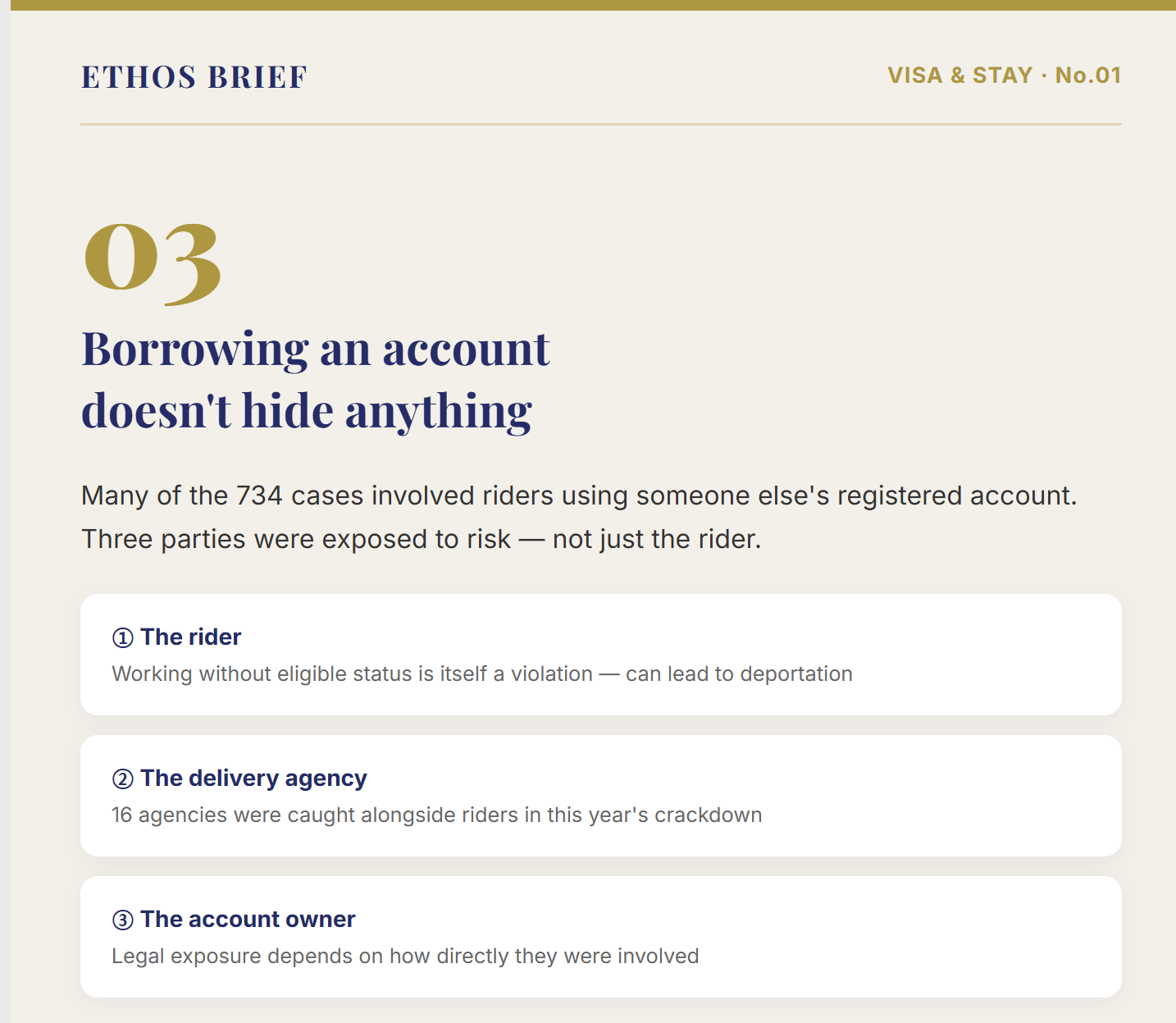
The 2026 enforcement operation discussed above specifically targeted this type of conduct. According to the Ministry of Justice, the foreign riders who were caught had performed unauthorized delivery work using other people’s delivery accounts. Sixteen businesses that had provided delivery accounts to foreign nationals were also caught. The key issue is not simply whose name appears on the account, but who actually performed the work. The foreign national: If you perform delivery work under a status of stay that does not authorize such employment, you may be found to have engaged in unauthorized employment under the Immigration Act.
Saying,
The account wasn’t in my name, so technically I wasn’t the person contracted with the platform.
does not erase the fact that you personally performed the delivery work. The person or business providing or arranging the account: Depending on the level of involvement in organizing or facilitating unauthorized employment, the provider may also face separate legal issues.
In the 2026 enforcement operation, 16 businesses that provided delivery accounts to foreign nationals were also detected.
Where an individual simply lends an account to a friend, the legal consequences must be assessed separately based on the actual form and extent of that person’s involvement. We will break down this structure in detail in Part ③.
How Does Immigration Find Out That Someone Is Making Deliveries?
In the past, some people would say, If you use a Korean person’s account, they won’t know.
But following the recent enforcement operation, this type of arrangement itself has become a major focus of enforcement. When the Ministry of Justice announced that 734 foreign delivery riders had been caught in July 2026, it also recommended that delivery platform companies introduce facial recognition systems.
Simply put, the authorities are seeking to strengthen procedures for checking whether the person registered on the account is the same person actually making the deliveries.
It’s only a few deliveries. It should be fine.
It’s my friend’s account, so no one will know.
Starting delivery work based on assumptions like these is risky. The important question is not how to avoid enforcement, but whether the activity itself is permitted under your current status of stay before you begin.
“If I Get Caught, Can’t I Just Pay a Fine and Be Done with It?”
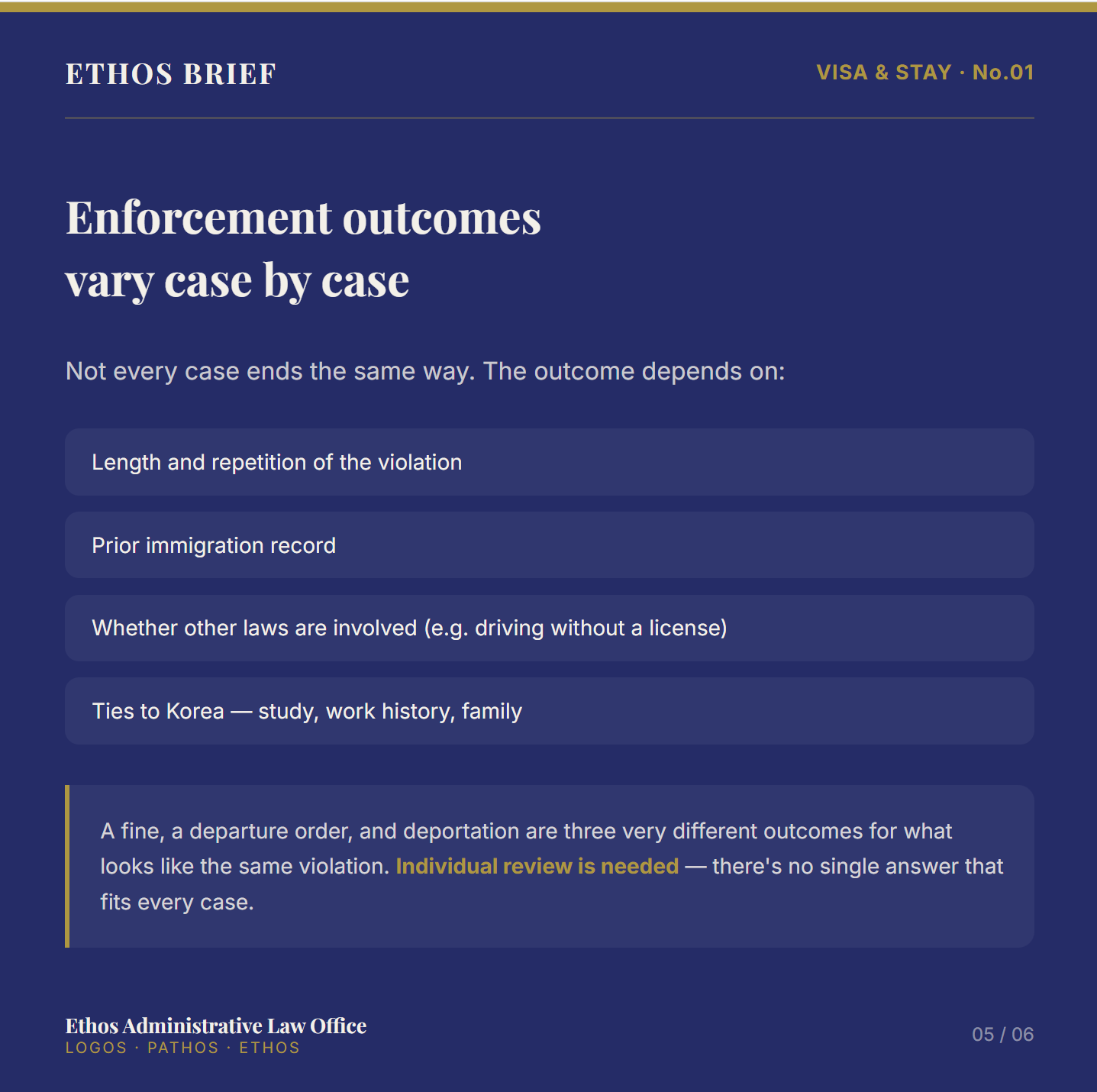
It is not that simple. First, there is an important distinction in terminology. A penalty payment imposed through a notification disposition is not the same as a criminal fine. A penalty payment under the Immigration Act is a monetary sanction imposed through the notification disposition process, whereas a criminal fine is a criminal punishment imposed through criminal proceedings. When unauthorized employment is discovered, several different consequences may need to be considered depending on the seriousness of the violation and the person’s immigration circumstances. ① Penalty Payment / Notification Disposition — A penalty payment may be imposed depending on the violation. However, you should not assume that paying it automatically guarantees that your current status of stay will remain valid. Depending on the seriousness of the violation and your immigration circumstances, the matter may separately affect future extension or change of stay applications, or lead to departure-related measures. ② Departure Order — A measure under Article 68 of the Immigration Act requiring the foreign national to leave Korea voluntarily within a specified period. ③ Deportation Order — A measure under Article 46 of the Immigration Act. A deportation order may lead to immigration detention and removal procedures and can also affect future entry into Korea. In some cases, entry restrictions can last for several years. This may mean having to leave Korea without sufficient time to properly settle studies, employment, housing deposits, and other aspects of daily life. So who receives only a penalty payment, who is issued a departure order, and which cases result in deportation? At this stage, simply looking at the visa code is no longer enough. Factors such as the duration of the violation, whether it was repeated, previous Immigration Act violations, use of another person’s account, the person’s ties to Korea, and whether other violations occurred at the same time may all become relevant. Court decisions and administrative appeals also show that a short period of unauthorized employment does not automatically result in relief, while the mere existence of unauthorized employment does not mean every case will have the same outcome. Even among cases involving “unauthorized employment,” the result can vary depending on the circumstances. For that reason, in Part ④ we will examine actual court decisions and administrative appeal cases.
Where Does My Situation Fall?
Go through the checklist below. □ I already started making deliveries without checking whether my status of stay permits it. □ I hold a status such as D-2 or E-9 that restricts employment activities. □ I am using a delivery account registered in someone else’s name. □ My delivery income is being paid through someone else’s bank account. □ I have been making deliveries for several months rather than only a few days or weeks. □ There is also a problem with my motorcycle license or insurance. (→ See Part ⑦) □ Immigration has already contacted me. □ I have already received a Departure Order or Deportation Order. Having several boxes checked does not automatically mean that you will be deported. However, if any of these apply, you should not limit the issue to a simple question such as “Is delivery work allowed under my visa?” You need to review what activities have already taken place. If you have reached this point and there is anything you are unsure about, send me a photo of your Residence Card or immigration notice. I can initially check whether your situation appears safe or whether further review is needed. In These Cases, You May Not Need to Hire a Professional Immediately
If you have not yet started delivery work, your exact status of stay is clear, and you can confirm the permitted scope through official guidance, you may first check with HiKorea or your local immigration office. The best way to deal with an immigration problem is to confirm the rules before starting the activity. However, the situation is different if any of the following apply:
- You have already been making deliveries for several weeks or months.
- You used another person’s account.
- You have a previous violation of the Immigration Act.
- Immigration has requested that you appear or submit an explanation.
- You have received a Departure Order or Deportation Order.
- Other violations, such as unlicensed driving or lack of insurance, are also involved. At this stage, searching only for Can a D-2 holder make deliveries?
is not enough to assess the whole case. The matter may have already moved beyond a simple visa question and become an immigration enforcement or disposition issue. If You Received a Deportation Order, Do Not Start Counting from “90 Days”
This is one point you should remember. If you receive a Deportation Order, Article 60 of the Immigration Act allows you to file an objection within seven days from the date you receive the Deportation Order. This is a separate procedure from the 90-day period applicable to administrative appeals. So if you have already received a Deportation Order, it can be dangerous to think, Administrative appeals have a 90-day deadline, so I still have plenty of time.
The first deadline you need to check may be seven days. Also, filing an administrative appeal does not automatically suspend enforcement of the disposition. Where necessary, the requirements and procedures for suspension of execution must be reviewed separately. We will go through this step by step in Part ⑤.
How Much Does It Cost?
Administrative agent fees vary depending on the case. Simply confirming whether a particular status of stay permits delivery work is very different in complexity and workload from handling an administrative appeal against an immigration disposition. A basic review of status of stay may be free or subject to a small consultation fee, while representation in an administrative appeal will vary depending on the complexity of the case, including the type and duration of the violation and the available evidence. The exact fee is provided after reviewing the basic facts of the case. There is no charge for the initial review stage. If you send your Residence Card or immigration notice, I can first review the basic situation and explain the general direction of the case. That concludes our overview of delivery and side jobs for foreign nationals in Korea.
- F-5 and F-6 status holders are, in principle, not subject to restrictions on employment activities.
- F-2 holders need to confirm the permitted employment scope of their specific subcategory.
- Delivery agency riders are expressly listed among restricted part-time employment activities for D-2 international students.
- E-9 workers should not independently engage in delivery work outside their authorized workplace and employment scope.
- Unauthorized delivery work using another person’s account became a major target of Ministry of Justice enforcement in 2026.
- The Ministry of Justice recommended that delivery platform companies introduce facial recognition systems.
- The deadline for filing an objection against a Deportation Order is seven days from the date the order is received. There are also several matters that require individual review.
- The permitted employment scope of specific F-2 subcategories and the occupations available to H-2 and F-4 holders.
- The duration and seriousness of the violation if delivery work has already taken place.
- The effect of using another person’s account.
- Whether the case is likely to result in a penalty payment, Departure Order, or Deportation Order.
- The effect of previous violations, unlicensed driving, or lack of insurance.
- Whether an objection, administrative appeal, or other remedy may be available. If you have not started yet, checking first is the cheapest and safest approach. If you are already making deliveries, take some time to organize what you have done so far. And if you have already received a notice from immigration, the question is no longer simply: Can I make deliveries with my visa?
It has become: How should I deal with the immigration case that has already arisen?