
Received a Deportation Order in Korea? Check the “7-Day” Deadline Before Focusing on “90 Days”
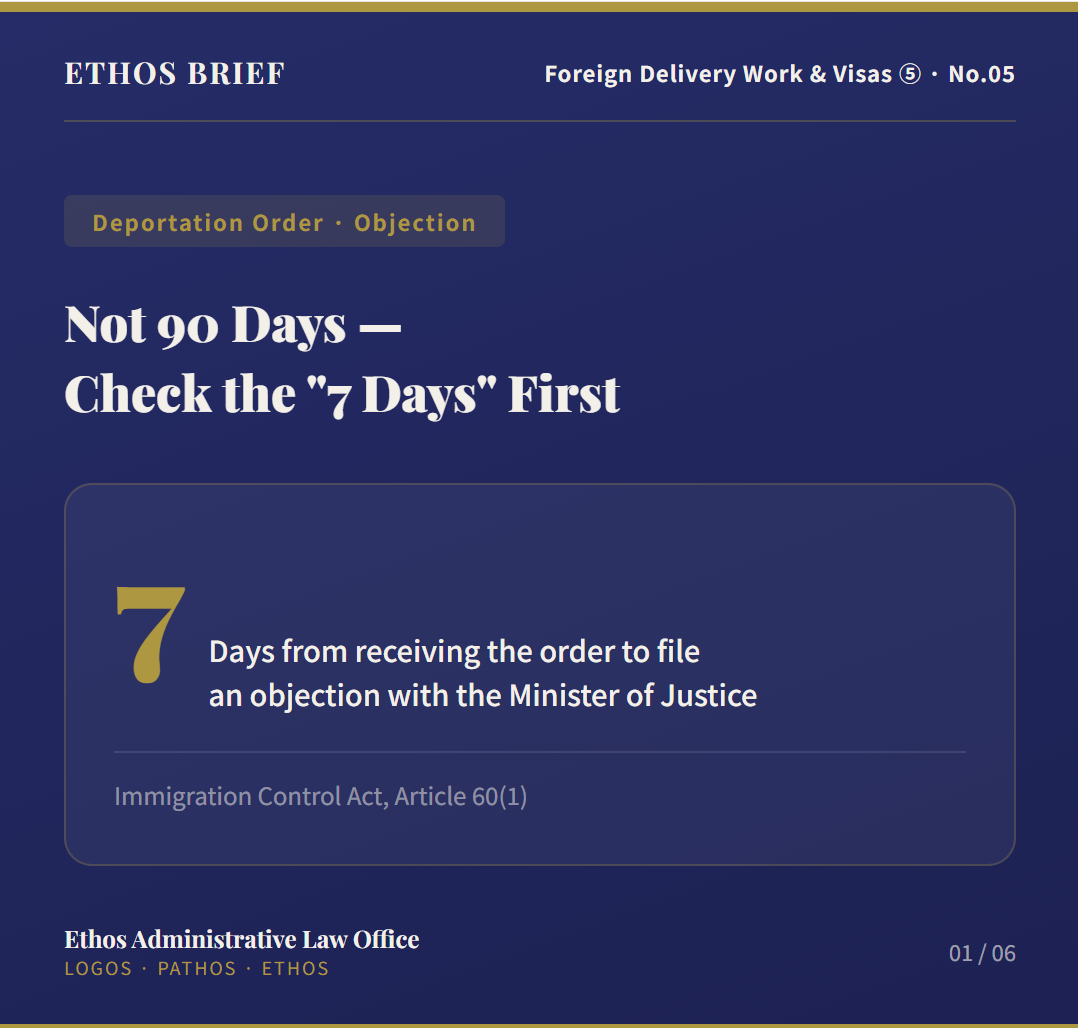
You have received a deportation order.
You search online and find that an administrative appeal can generally be filed within 90 days.
So it is easy to put the document aside and think:
“I still have time.”
But if the document is a deportation order, there is another deadline you should check before focusing on the 90-day period.
7 days.
As of August 2026, Article 60 of Korea’s Immigration Act provides that a foreign national who objects to a deportation order may file an objection with the Minister of Justice, through the competent immigration office, within 7 days from the date the Deportation Order is received.
This does not mean:
“The deadline for deportation cases is 7 days, not 90 days.”
The official Korean Deportation Order (강제퇴거명령서) itself refers to both procedures.
An objection to the Minister of Justice within 7 days
and
an administrative appeal or administrative litigation within 90 days
may both appear in the procedural framework.
Therefore, after receiving a deportation order, there are at least three separate questions to consider:
1. Is the 7-day objection period still open?
2. What is the applicable period for an administrative appeal or administrative litigation?
3. What happens to enforcement of the deportation order while those procedures are pending?
The third question is particularly important.
Filing an administrative appeal or lawsuit does not automatically suspend enforcement of a deportation order.
This article explains the difference between the 7-day and 90-day procedures, the relationship between deportation, immigration detention and enforcement, and actual Korean administrative and court decisions in which deportation orders were either cancelled or upheld.
If You Have Already Received a Deportation Order, You Are Beyond the Basic Visa-Eligibility Stage
Foreign nationals who engage in activities not permitted under their status of stay do not all receive the same immigration disposition.
For example, during the Ministry of Justice’s enforcement campaign against unauthorized foreign delivery riders from January through May 2026, 734 foreign nationals were detected.
Of those, 643 were subject to penalty payments, while 68 were subject to departure-related measures, including deportation.
In other words:
Delivery violation = automatic deportation
is not an accurate formula.
However, if you have actually received a Deportation Order, the case has already moved beyond the basic question:
“Does my visa allow this activity?”
The questions now become:
What disposition was issued, why was it issued, and what procedures and deadlines are currently available?
The Official Document Is a “Deportation Order,” Not Simply a Deportation Notice
Foreign nationals sometimes describe the document by saying:
“Immigration gave me a deportation notice.”
But the official document is called a Deportation Order (강제퇴거명령서).
The form prescribed under the Enforcement Rule of the Immigration Act is titled:
강제퇴거명령서
DEPORTATION ORDER
The document generally identifies matters such as:
- the reason for deportation
- the applicable legal provisions
- the method of enforcement
- the country of repatriation
A Deportation Order is therefore not simply an informational letter saying:
“You must leave Korea.”
It is the formal document identifying the legal basis on which the deportation disposition has been made.
So if you have received a document from Korean immigration, look first at the exact title at the top.
Does it say:
Departure Order (출국명령서)?
Or does it say:
Deportation Order (강제퇴거명령서)?
They are not the same document.
Why Is the “7-Day” Deadline Important?
The reason is Article 60 of the Immigration Act.
A foreign national who objects to a deportation order may submit an objection within 7 days from the date the Deportation Order is received.
The objection is addressed to the Minister of Justice, but it is submitted through the competent regional immigration office.
The immigration office does not simply forward the objection form by itself.
Under the Immigration Act, relevant examination decisions and investigation records are also submitted to the Minister of Justice in connection with the objection.
The Enforcement Decree further provides for the immigration office to submit its opinion and for the Minister of Justice to issue a decision stating matters such as the conclusion, reasons and applicable legal provisions.
This means the 7-day objection is not simply a request saying:
“Please reconsider my case.”
It is a formal objection procedure specifically established by the Immigration Act for deportation orders.
Does That Mean the “90-Day Administrative Appeal” Is Wrong?
No.
This is one of the most commonly misunderstood points.
The official Deportation Order used by the Ministry of Justice refers to both:
an objection to the Minister of Justice within 7 days
and
an administrative appeal or administrative litigation within 90 days.
So this is not a question of:
7 days vs. 90 days — which one is correct?
They are different procedures.
7 Days
This refers to the objection to the Minister of Justice under Article 60 of the Immigration Act.
90 Days
This is a separate period that may apply when considering an administrative appeal or administrative litigation.
Therefore, if someone receives a Deportation Order and thinks:
“Administrative appeals have a 90-day deadline, so I still have two months.”
there may be a problem.
The 7-day objection period under Article 60 may expire long before then.
On the other hand, if the 7-day period has already passed, it is also inaccurate to conclude automatically:
“Every possible procedure is now over.”
The official Deportation Order separately refers to administrative appeal and litigation procedures.
For that reason, the better question in a deportation case is not simply:
“How many days do I have left?”
but:
“Which procedural deadline am I calculating?”
The 7-Day Objection Is Also Connected to a Special Provision on Permission to Stay
There is another provision that should be read together with the 7-day objection procedure.
It is Article 61 of the Immigration Act, concerning special permission to stay.
This provision applies when the Minister of Justice reviews an objection under Article 60.
One important feature is that even where the objection itself is not considered sufficient to establish that:
“The deportation order was legally wrong,”
the law still allows consideration of whether the foreign national should be permitted to remain in Korea under certain circumstances.
The Act provides for the possibility of permission to stay where, for example, the person previously held Korean nationality or where there are special circumstances requiring continued stay in Korea.
This creates two different questions.
The first is:
“Was the deportation order itself unlawful or incorrect?”
The second is:
“Even if a statutory ground for deportation exists, are there special circumstances that justify continued stay in Korea?”
These questions may sound similar, but legally they are not identical.
For that reason, the 7-day objection should not be understood merely as:
“A faster version of an administrative appeal.”
The Immigration Act itself connects the objection procedure with a separate assessment of special circumstances relating to continued stay.
This does not mean:
“Having family in Korea prevents deportation.”
Actual cases show very different outcomes.
A Deportation Order Was Cancelled Even Though the Overstay Was Clear
Consider Central Administrative Appeals Commission Case 2020-22960, decided April 13, 2021.
The applicant had previously overstayed in Korea, voluntarily departed, and later entered Korea again.
She then overstayed again.
The second period of unlawful stay identified in the decision alone was 1 year, 2 months and 28 days.
In other words, this was not a case where the applicant argued:
“I never violated the Immigration Act.”
Nevertheless, the Central Administrative Appeals Commission cancelled the deportation order.
The applicant had a Korean spouse and a young child.
At the time, the child was under two years old and required care from the mother.
The spouse had a severe disability and was receiving livelihood, medical and housing assistance.
After considering these circumstances, the Commission concluded that the disadvantage imposed on the applicant was greater than the public interest achieved through deportation.
The lesson from this decision is not:
“If you have a child, your deportation order will be cancelled.”
The point is different.
Whether an Immigration Act violation occurred and whether deportation should remain the appropriate disposition can be separate questions.
The family circumstances were also not evaluated merely by looking at the existence of a family relationship certificate.
The decision considered concrete facts such as:
the young child’s actual caregiving needs, the spouse’s degree of disability, and the family’s financial circumstances.
In Another Case, a Long-Established Life in Korea Was Not Enough to Prevent Deportation
Looking only at favourable cases can be misleading.
In Central Administrative Appeals Commission Case 2020-10693, decided August 11, 2020, the request to cancel a deportation order was rejected.
The applicant was an F-4 Overseas Korean who had been born in Korea and was conducting business and real-estate rental activities in Korea.
He argued that his family, relatives, and social and economic foundation were all in Korea.
However, he had been sentenced to six months’ imprisonment for indecent assault and had a previous criminal record.
The Commission upheld the deportation order after considering factors including the public interest in maintaining national safety and public order.
Therefore:
“I have lived in Korea for a long time.”
“My family is in Korea.”
“My business is also in Korea.”
may all be relevant circumstances.
But none of them necessarily determines the outcome by itself.
The reason for the deportation order must be considered together with the weight of the individual circumstances presented against it.
What Matters Is Not Simply Saying “I Have Family in Korea,” but What Can Actually Be Established
Comparing the two cases above helps show where deportation cases may diverge.
Do you have a Korean spouse?
That may be relevant.
But it does not automatically determine the result.
Do you have a minor child?
That may also be important, but again, it is not automatically decisive.
Depending on the case, the actual review may involve much more specific factors, including:
- the child’s age
- the actual caregiving relationship
- illness or disability of a spouse
- whether another caregiver is available
- financial dependency
- whether the family actually lives together
- the foreign national’s history of stay in Korea
- previous Immigration Act violations
- criminal history
- the nature and seriousness of the conduct that led to the deportation order
In other words, in a deportation case:
“I have special circumstances.”
may be only the beginning.
The more important question may be:
“What exactly are those circumstances, and what documents or evidence can establish them?”
This is where general online information begins to diverge from an individual case review.
What If the Legal or Factual Basis of the Deportation Order Itself Is Wrong?
Humanitarian or family circumstances are not the only issues that may matter.
It may also be necessary to examine whether the legal and factual premises of the deportation order itself are correct.
One example is Seoul Administrative Court, August 18, 2022, Case 2021Guhap78282.
The foreign national in that case was a recognized refugee who had committed multiple criminal offenses in Korea, including assault, bodily injury and indecent assault.
The factual circumstances were therefore highly unfavorable.
Nevertheless, the court cancelled both the deportation order and detention order.
A recognized refugee is protected by the principle of non-refoulement.
The immigration authorities therefore needed to examine matters such as the country to which the person would actually be removed and whether repatriation there would expose the person to persecution or torture.
The court found problems with how those matters had been addressed.
This case is legally different from an ordinary unauthorized-employment or delivery-work case.
It should not be applied mechanically to those cases.
But it demonstrates an important principle.
The inquiry does not always end with:
“Did this person engage in conduct that could constitute a ground for deportation?”
There may also be a separate question:
“Were the legal requirements and procedural premises necessary for the deportation disposition properly satisfied?”
What Should Be Rechecked in an Unauthorized Employment or Delivery Case?
Consider a D-2 international student who used another person’s delivery account.
During the immigration investigation, the student stated:
“I did delivery work for about one month.”
But suppose the investigation underlying the Deportation Order describes the unauthorized employment period as six months.
The case should not necessarily be reduced to:
“D-2 students are restricted from delivery work, so that is the end of the matter.”
It may also be necessary to check:
whether the unauthorized-employment period relied on by immigration actually matches the objective records.
The opposite can also happen.
The person may insist:
“I only worked for one month.”
But platform settlement records or bank-transfer records may show repeated income over six months.
In that situation, the credibility of the new explanation itself may become an issue.
For this reason, reviewing a deportation case may require comparing:
- statements made during the immigration investigation
- the period during which the delivery account was used
- platform activity records
- settlement records
- bank-transfer records
- entry and departure records
- prior Immigration Act violations
- other criminal or administrative violations
The Immigration Act itself reflects this structure.
When an objection under Article 60 is forwarded to the Minister of Justice, the examination decision and investigation records are submitted together with it.
So the new objection does not exist in isolation.
It is reviewed together with the record already created during the immigration investigation.
After Receiving a Deportation Order, Think About Three Different Timelines
A deportation case should not be viewed as having only one deadline.
The First Is “7 Days”
This is the objection to the Minister of Justice under Article 60 of the Immigration Act.
The critical date is the date on which the Deportation Order was actually received.
The Second Is “90 Days”
The official Deportation Order also refers to an administrative appeal or administrative litigation within 90 days.
The Third Is “Enforcement”
This is the part most easily overlooked.
“I can file an administrative appeal within 90 days.”
and
“The deportation order cannot be enforced for 90 days.”
do not mean the same thing.
Does Filing an Administrative Appeal or Lawsuit Automatically Stop Deportation?
No, not automatically.
The general rule under Korea’s administrative appeal system is that filing an appeal does not, by itself, suspend the effect or enforcement of the administrative disposition.
The Administrative Appeals Act therefore provides a separate mechanism for suspension of execution where statutory requirements, including urgency and the need to prevent serious harm, are satisfied.
Administrative litigation follows a similar structure.
Filing a lawsuit and:
preventing enforcement of the deportation order while the court considers the case
are separate legal questions.
This distinction was addressed in Supreme Court Order 2017Mu846, March 7, 2018, where suspension of execution of a deportation order was considered separately from the underlying litigation.
In other words:
whether the deportation order should ultimately be cancelled
and
whether it should be enforced before that decision is made
are not the same question.
This is why simply knowing about a “90-day deadline” may not be enough in a deportation case.
If You Are in Immigration Detention, Deportation and Detention Should Also Be Distinguished
A foreign national who receives a deportation order is not always immediately placed on a flight out of Korea.
Where immediate repatriation is not possible, the person may in some circumstances be held in an immigration detention facility under the Immigration Act.
This means an actual case may involve both:
a deportation order
and
a detention order or current detention status.
Article 60 of the Immigration Act provides that if the Minister of Justice finds an objection to be justified and the person is detained, the person must be released from detention without delay.
Supreme Court precedent has also treated enforcement of a deportation order and enforcement of a detention order as legally distinguishable matters.
Therefore, if the person is already in an immigration detention facility, asking only:
“Can the deportation order be cancelled?”
may not fully describe the current procedural situation.
It may be necessary to look at:
the deportation order + detention status + enforcement status
together.
What Should You Do First Within the 7-Day Period?
Receiving a Deportation Order is stressful.
It is therefore understandable that someone may immediately search for an objection form and begin writing:
“This is unfair.”
But before doing that, it is useful to organize the case chronologically.
For example:
D-2 international student
↓
Delivery work using another person’s account
↓
Immigration investigation
↓
Unauthorized employment confirmed
↓
Penalty-payment notification
↓
Deportation Order received
↓
Three days have passed since receipt
↓
Current detention status checked
Once the case is arranged this way, the immediate issues become easier to identify.
Next, check the stated reason for the disposition.
Which legal provision is written on the Deportation Order?
Then examine the facts on which immigration relied.
Is the unauthorized-employment period correct?
Whose account was used?
How were the earnings generated and settled?
What was stated during the immigration investigation?
Only after that should the next question be examined:
Are there separate circumstances requiring continued stay in Korea?
The order of analysis matters.
Is Saying “This Was My First Violation” Enough?
Being a first-time offender may be relevant depending on the case.
But actual administrative decisions show that one fact alone does not determine the outcome.
Depending on the case, issues may include:
- whether this was the first violation
- how long the unauthorized employment continued
- whether income was repeatedly generated
- whether another person’s account was used
- what was stated during the investigation
- whether there were previous Immigration Act violations
- whether there are separate criminal cases
- the person’s current status of stay
- family relationships and actual life circumstances in Korea
In particular:
“I have family in Korea.”
may be the beginning of the analysis, but it is not necessarily the conclusion.
The relevant questions may include:
Who is the family member? What is the actual relationship? Is there genuine caregiving or financial dependency? What documents can demonstrate those circumstances?
If the 7-Day Period Has Already Passed, Is Everything Over?
Not necessarily.
The official Deportation Order separately refers to administrative appeal or administrative litigation within 90 days, in addition to the 7-day objection procedure.
Therefore, if seven days have already passed, it may be necessary to check:
- the exact date the Deportation Order was received
- whether the 7-day period has in fact expired
- the current enforcement stage
- whether the person is currently detained
- whether an administrative appeal or litigation period remains open
- whether there are factual or legal grounds to dispute the disposition
- whether enforcement-related measures require separate consideration before the underlying case is decided
At the same time, the existence of a 90-day period does not mean:
“I can look into this two months from now.”
The deadline for challenging a disposition and the current enforcement status of that disposition are separate issues.
If You Have a Deportation Order, Check These Points First
There are several things you can identify yourself before seeking an individual review.
- Does the document actually say “Deportation Order (강제퇴거명령서)” at the top?
- On what date did you actually receive it?
- Has the 7-day period already passed?
- What deportation grounds and legal provisions are stated?
- Are you currently detained in an immigration detention facility?
- What facts did you admit or state during the immigration investigation?
- Does the employment or delivery period relied on in the disposition match the actual records?
- Are there relevant circumstances involving a Korean spouse, minor child, illness, disability or financial dependency?
- Do you have previous Immigration Act violations or criminal convictions?
- Have you already started an objection, administrative appeal or administrative litigation?
It may also help to arrange relevant documents chronologically, including:
- the Deportation Order
- penalty-payment documents
- documents received during the immigration investigation
- your Residence Card
- delivery-platform records
- settlement and bank-transfer records
- family documents
- school or employment documents
- medical or disability-related records
The purpose is not simply to collect as many documents as possible.
The purpose is to identify the factual and procedural position of the case as it currently stands.
What Can You Check Yourself, and When Does Individual Review Become Necessary?
You can first confirm whether the document is actually a Deportation Order, when it was received, which legal provisions are stated as the grounds for deportation, whether you are currently detained, and whether the 7-day period appears to have passed.
You can also organize your family documents, medical records, school or employment records, platform settlement records, and immigration documents in chronological order.
From that point, however, the analysis becomes case-specific.
Determining whether the 7-day objection, a 90-day administrative appeal, administrative litigation, or another procedural response remains relevant; whether the factual or legal premises of the Deportation Order can be disputed; whether special circumstances relating to continued stay have legal significance; whether new documents conflict with statements already made during the investigation; and whether enforcement or detention issues require separate review depends on the actual documents and procedural stage.
In deportation cases, one fact such as:
“I have family in Korea.”
“I have lived here for a long time.”
“This was my first violation.”
is rarely enough by itself to predict the outcome.
Actual administrative decisions show both sides: some deportation orders have been cancelled because of concrete caregiving and humanitarian circumstances, while others have been upheld despite long-standing family, economic and social ties to Korea.
In Summary — Check the Procedures You Still Have, Not Just the Number of Days Remaining
The number that first stands out after receiving a Deportation Order is 7 days.
Article 60 of the Immigration Act provides for an objection to the Minister of Justice within 7 days from the date the Deportation Order is received.
But the 90-day period is not necessarily wrong.
The official Deportation Order separately identifies the 7-day objection procedure and administrative appeal or administrative litigation within 90 days.
And filing an administrative appeal or lawsuit does not automatically suspend enforcement of the deportation order.
For that reason, a deportation case should not be reduced to:
“You have 90 days to file an administrative appeal.”
That may overlook another procedure.
At the same time:
“Seven days have passed, so nothing can be done.”
may also be an inaccurate conclusion.
The first thing to determine is:
When did you actually receive the Deportation Order?
Then check:
Why was the deportation order issued?
After that, examine whether the factual basis matches the available records, what procedures may still be available, and whether the statements already made during the immigration investigation are consistent with the documents you may now submit.
Actual Korean administrative decisions include cases where a deportation order was cancelled despite an underlying immigration violation because of specific family and caregiving circumstances, as well as cases where deportation was upheld despite long-established ties to Korea.
For that reason, the question:
“Can my deportation order be cancelled?”
cannot be answered from the word “deportation” alone.
You can request a free initial review of your Deportation Order and the date you received it to check which procedures may still be available in your situation.