Why Can Similar Restaurant Violations Lead to Different Suspension Outcomes?
BySangjin Ji, Administrative Attorney3 years of embassy visa practiceLinkedIn
A restaurant in South Korea may face a business suspension for serving alcohol to a minor. For an owner who receives an advance notice of suspension, the first concern is often how long the restaurant will have to close.
Even a short suspension can disrupt reservations, employee schedules, and ongoing business expenses.
But does every restaurant that commits the same violation receive the same outcome?
Two actual administrative appeal decisions show why the answer is no.
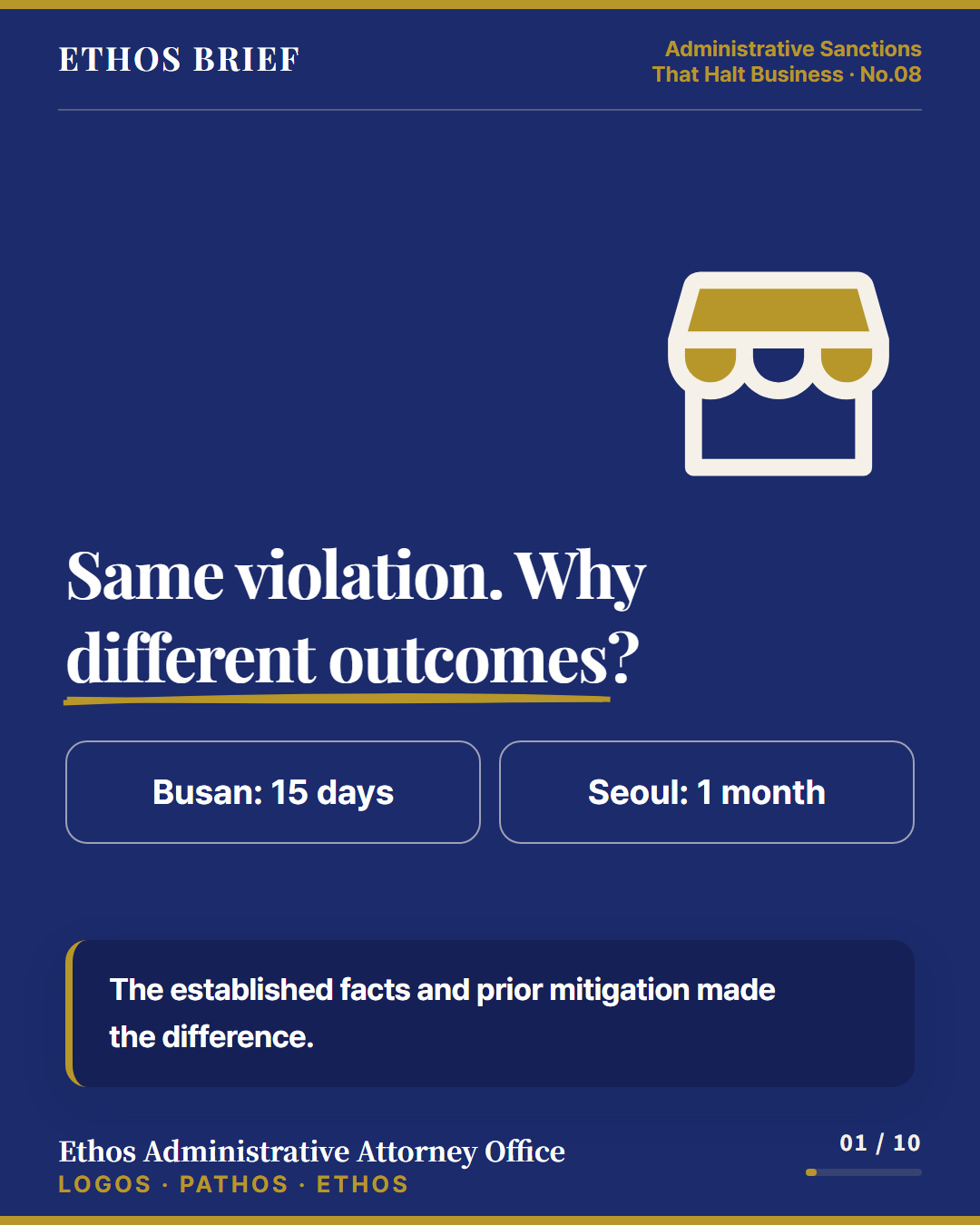
In Busan, a restaurant's two-month suspension was reduced to 15 days. In Seoul, another restaurant's suspension remained at one month, even though the owner had also received a favorable prosecutorial decision.
Both restaurants had served alcohol to minors. Both cases involved a decision to suspend indictment, known in Korea as giso-yuye.
Yet the administrative appeal outcomes were different.
The key distinction was not simply whether the owners had been treated leniently by prosecutors. It was which facts were established, which circumstances could justify mitigation, and whether those circumstances had already been reflected in the administrative sanction.
The law has also changed since those decisions.
Following an amendment effective April 19, 2024, the standard business suspension for a first violation involving the provision of alcohol to minors was reduced to seven days.
These historical cases therefore do not determine the suspension period that applies today. They remain useful because they demonstrate how administrative authorities distinguish the violation itself from the circumstances relevant to the sanction.
Why Was a Two-Month Suspension Reduced to 15 Days in Busan?
On December 3, 2009, a restaurant in Busan was found to have served alcoholic beverages to minors.
There were eight customers involved in the incident, five of whom were minors.
According to the restaurant owner's explanation, the business was being operated by the owner's younger sibling because the owner had experienced health difficulties.
The sibling had limited experience running the restaurant and was reportedly working alone, moving between the kitchen and dining area.
The owner argued that some customers were regular visitors whose ages had previously been checked. While the sibling was preparing food, additional customers allegedly joined the group, including minors.
However, the administrative authority disputed important parts of that explanation.
It found that the claim that all five minors had joined later was not sufficiently supported. The authority also pointed to the presence of minors among customers who had already been at the restaurant.
The central issue was whether alcoholic beverages had been provided to minors without the necessary identification checks.
The Administrative Procedure
The local authority issued an advance notice of a two-month business suspension on January 6, 2010.
The owner submitted a written response on January 12.
Nevertheless, the authority issued the final two-month suspension order on January 20.
The owner subsequently filed an administrative appeal seeking cancellation of the sanction.
The administrative appeals committee did not accept the owner's account in its entirety.
It found that alcohol had been provided to minors without verifying their identification and that the violation itself had been established.
However, the committee reached a different conclusion when considering the proportionality of the suspension period.
It took into account several circumstances:
- The restaurant had no previous record of the same type of violation.
- The sibling who had actually operated the restaurant had received a prosecutorial decision to suspend indictment.
- The restaurant was a small business with limited resources.
The committee recognized the public interest in protecting minors.
At the same time, it considered a two-month suspension excessively burdensome in light of the circumstances of this particular case.
On February 23, 2010, the suspension was reduced from two months to 15 days.
The important distinction is that the committee did not erase the underlying violation.
The business had still violated the relevant rules. What changed was the period of the administrative sanction.
This distinction matters when preparing a response to a restaurant suspension notice.
An owner disputing whether a violation occurred must identify the facts and evidence supporting that position.
An owner who acknowledges the violation but seeks a reduced suspension must explain the circumstances relevant to mitigation under the applicable legal criteria.
Those are different arguments and require different supporting records.
Source: Busan Administrative Appeal No. 2010-038, February 23, 2010.
Decision: https://www.law.go.kr/LSW/deccInfoP.do?deccSeq=144874&mode=3
Why Was a One-Month Suspension Upheld in Seoul?
A separate case in Seoul reached a different result.
On November 20, 2008, a restaurant was found to have served alcohol to an 18-year-old minor.
The owner argued that it had been difficult to recognize the customer as a minor.
According to the owner's explanation, the customer had a mature physical appearance and appeared to be socializing naturally with university students who regularly visited the restaurant.
On December 15, 2008, prosecutors decided to suspend indictment.
A suspension of indictment is a prosecutorial decision not to bring the criminal case to trial after considering the circumstances. It does not automatically eliminate a separate administrative sanction imposed on the restaurant.
At the time, the standard administrative sanction for a first violation involving alcohol served to minors was a two-month business suspension.
The administrative authority considered the prosecutorial decision and applied the mitigation rules then in force.
On December 29, 2008, it reduced the suspension from two months to one month.
The owner nevertheless filed an administrative appeal seeking cancellation of the remaining suspension.
The Seoul administrative appeals committee examined the records and found that the provision of alcohol to a minor had been established.
It also considered the fact that the administrative authority had already reduced the sanction to reflect the prosecutorial decision.
The committee concluded that there was no sufficient basis to cancel the remaining suspension.
On April 6, 2009, the appeal was dismissed, leaving the one-month suspension in place.
What Made These Cases Different?
The Busan committee reduced a two-month suspension after examining the absence of similar prior violations, the prosecutorial decision, and the restaurant's circumstances.
In Seoul, the administrative authority had already incorporated the prosecutorial decision into the one-month sanction.
The appellate body did not grant further relief.
The two decisions demonstrate why a prosecutorial decision alone does not establish that an administrative suspension must be cancelled or reduced.
A restaurant owner should examine both the reason for the prosecutorial decision and the administrative authority's explanation of how it affected the sanction.
Source: Seoul Administrative Appeal No. 2009-21, April 6, 2009.
Decision: https://www.law.go.kr/LSW/deccInfoP.do?deccSeq=144629&mode=3
What Is the Current Suspension Period for Serving Alcohol to Minors?
The historical cases above were decided under earlier versions of Korean food sanitation regulations.
The relevant rules changed on April 19, 2024.
The Food Sanitation Act (「식품위생법」) prohibits food service businesses from providing alcoholic beverages to minors.
Administrative sanctions may be imposed under Article 75 of the Act.
Under Article 89 and Appendix 23 of the Enforcement Rule of the Food Sanitation Act, the current standard sanctions for providing alcohol to minors are:
- First violation: business suspension for 7 days.
- Second violation: business suspension for 1 month.
- Third violation: business suspension for 2 months.
Before the April 2024 amendment, the standards were substantially more severe:
- First violation: business suspension for 2 months.
- Second violation: business suspension for 3 months.
- Third violation: revocation of the business license or closure of the establishment.
The amendment reduced the standard suspension period, particularly for first-time violations.
However, a restaurant cannot determine the applicable sanction merely by counting how many times it has been inspected.
The authority must determine whether the conduct falls within the same violation category and how the relevant repeat-violation rules apply.
A previous sanction for improperly storing food is not automatically treated as a previous violation involving alcohol served to minors.
What About Violations That Occurred Before April 19, 2024?
The April 2024 amendment included transitional provisions.
Under Article 2 of the supplementary provisions, the revised standards for serving alcohol to minors also applied to certain violations committed before April 19, 2024, where the administrative sanction procedure was still pending on that date.
For example, a violation discovered in early April 2024 could fall under the amended standards if the administrative procedure remained pending on April 19.
The actual date of the violation and the procedural status at the effective date therefore matter.
For a current suspension notice, the first step is to identify the violation category, the applicable version of the rules, and the alleged violation count.
Source: Food Sanitation Act, Articles 44 and 75; Enforcement Rule, Article 89 and Appendix 23; Prime Ministerial Ordinance No. 1951, April 19, 2024.
Can a Restaurant Be Exempted from Suspension When a Minor Uses Someone Else's ID?
Consider a restaurant employee who checks a customer's identification document before serving alcohol.
Later, an investigation establishes that the customer was a minor using another person's identification document.
Can the restaurant still be sanctioned?
Korean law provides specific grounds for exemption from administrative sanctions in these circumstances.
Article 75(1) of the Food Sanitation Act and Article 52(3) of its Enforcement Decree establish the relevant requirements.
The circumstances addressed by these provisions include:
- A minor forging an identification document.
- A minor altering an identification document.
- A minor using another person's identification document.
- Violence or threats by a minor preventing the business operator from verifying the customer's age.
- Certain investigative or prosecutorial outcomes, or a judicial suspension of sentence, where the legally specified circumstances are recognized.
These are not automatic exemptions whenever an employee says that an identification document was checked.
The facts must establish the relevant conduct and its connection to the operator's inability to know or verify that the customer was a minor.
For example, CCTV footage may show an employee receiving and examining an identification document.
That footage could establish that an identification check took place.
However, it does not necessarily establish that the document belonged to someone else or that its misuse prevented the employee from recognizing the customer as a minor.
Evidence of identity misuse may need to be considered alongside the footage.
Employee statements and investigative records may also be relevant.
Why the Reason for a Prosecutorial Decision Matters
A 2020 interpretation issued by the Ministry of Food and Drug Safety addressed a restaurant incident involving minors who used identification documents belonging to other people.
The operator had checked the birth year shown on the identification document but had not confirmed whether the person presenting it was the person identified in the document.
Prosecutors subsequently suspended indictment.
The Ministry distinguished that prosecutorial outcome from a finding that the operator was unaware of the customer's age because of identity-document misuse.
The decision had involved considerations such as the operator's lack of prior offenses and the circumstances of the violation.
The Ministry concluded that the exemption requirements under the law then in force had not been established.
This interpretation is useful for understanding the distinction between a favorable prosecutorial outcome and the specific legal grounds for exemption.
However, it reflects the law as it stood in 2020.
On March 29, 2024, the Enforcement Decree was amended to expand the circumstances in which an administrative sanction must be exempted.
Under the amended framework, evidence such as CCTV footage or statements may establish the relevant identity-document misuse or coercion without necessarily waiting for the final outcome of criminal proceedings.
The requirements and restrictions under Article 52(3) and (4) must still be applied.
These include specific limitations connected with renewed criminal investigations, prosecution, and final guilty judgments, with the statutory treatment of suspended sentences distinguished where applicable.
The key question is therefore not simply whether an identification check occurred.
It is whether the specific legal conditions for exemption have been established through the available evidence.
Source: Food Sanitation Act, Article 75(1); Enforcement Decree, Article 52(3) and (4); Ministry of Food and Drug Safety, Food Safety Policy Division-7201, July 16, 2020.
When Can an Established Violation Lead to a Reduced Suspension?
Not every case involves forged or misused identification documents.
Sometimes the violation itself is established, but the circumstances may support mitigation of the suspension period.
The relevant provisions appear in Article 89 and Appendix 23, Part I, General Standard 15, of the Enforcement Rule of the Food Sanitation Act.
Under the specified conditions, the suspension period may be reduced by up to one-half.
Two grounds are particularly relevant when examining restaurant sanctions.
Minor Violations or Slight Negligence Without Intent
General Standard 15(e) addresses circumstances where the violation is minor in degree or results from slight negligence without intent.
For example, an employee may fail to check the identification of one or more customers even though the restaurant has instructed staff to verify customers' ages.
The fact that such instructions existed does not automatically establish a statutory ground for mitigation.
The actual circumstances must be examined.
Relevant questions include who served the alcohol, which customers were checked, and how the failure to verify age occurred.
The competent authority determines whether the circumstances meet the requirements of the mitigation provision.
Suspension of Indictment or Suspension of Sentence
General Standard 15(f) addresses certain cases in which prosecutors suspend indictment or a court grants a suspension of sentence.
The prosecutorial or judicial outcome is not the only requirement.
The provision additionally requires a finding that the violation lacked intent or that it posed no risk of harm to human health from a public-health perspective.
The relevant conditions must therefore be considered together.
A prosecutorial decision may be an important document, but its reasoning and relationship to the administrative violation matter.
The Seoul case illustrates this distinction.
The owner obtained a suspension of indictment, and the administrative authority had already taken that decision into account when reducing the original two-month suspension to one month.
The appellate committee did not consider that same circumstance sufficient to cancel the remaining sanction.
Mitigation is governed by the applicable legal criteria and the authority's discretion.
Providing relevant records does not guarantee that every suspension will be reduced by one-half.
Three Packs of Expired Noodles: Why Was a 15-Day Suspension Reduced to 7 Days?
Violations involving food storage can also lead to business suspension.
An actual Seoul case in 2024 involved three packs of instant noodles whose marked consumption period had expired the previous day.
On March 20, 2024, inspectors found the three packs at a restaurant.
The consumption period printed on the products had ended on March 19.
The local authority determined that the products were being stored for cooking or sale.
It imposed a 15-day business suspension for a first violation.
To understand this case, it is important to distinguish storing expired food for cooking or sale from actually selling or using that food.
The Food Sanitation Act and its Enforcement Rule prohibit the relevant conduct, but the sanctions differ according to the specific violation.
For expired food being transported, displayed, or stored for cooking or sale, the standard sanctions are:
- First violation: business suspension for 15 days.
- Second violation: business suspension for 1 month.
- Third violation: business suspension for 3 months.
Where expired products are actually sold or used in preparing food, the standard sanction begins at a one-month suspension for a first violation.
This means the legal classification depends on what the restaurant was doing with the products.
If an operator maintains that the products had already been separated for disposal, the state of the products and any disposal markings at the time of inspection may be relevant.
A later explanation that the food was intended for disposal should be distinguished from contemporaneous evidence showing how it was actually stored.
The Administrative Appeal Outcome
The Seoul Metropolitan Administrative Appeals Committee considered the noodle case on June 10, 2024.
The underlying violation was not rejected.
However, the committee considered the degree and circumstances of the violation and applied the mitigation provisions in Appendix 23, Part I, General Standard 15(e).
The 15-day suspension was reduced to 7 days.
This result does not establish that every product whose consumption period expired only one day earlier qualifies for the same reduction.
The type and quantity of food, the extent to which its consumption period had expired, its storage purpose, and any actual use or sale may all be relevant to the applicable legal assessment.
Was a 10% Rule Applied?
A separate point requires attention.
On August 29, 2024, the Seoul Metropolitan Government submitted a proposal to the Ministry of Food and Drug Safety concerning mitigation for expired food.
The proposal included the possibility of considering cases where the period elapsed after expiration was within 10% of the product's original consumption period.
That was a proposed regulatory amendment.
It was not the legal standard applied by the committee in the noodle case.
The actual reduction from 15 to 7 days was based on the mitigation provision then in force and the committee's consideration of the violation's circumstances.
A regulatory proposal should not be treated as a binding rule unless it has actually been adopted.
Source: Seoul Metropolitan Council, Report on Proposals for Legislative Amendments, concerning Seoul Administrative Appeal No. 2024-934 and the June 10, 2024 decision.
Does a Second Inspection Automatically Mean a Second Violation?
An establishment may be inspected more than once, but that does not necessarily mean the latest incident is legally classified as a second violation.
The applicable repeat-violation rules focus on the nature of the conduct and the relevant sanction history.
Consider a restaurant sanctioned last year for keeping expired ingredients for cooking or sale.
This year, it is found to have served alcohol to a minor.
Although the restaurant has been sanctioned on two occasions, the two incidents involve different categories of violation.
They should not automatically be counted as the first and second occurrences of the same violation.
Appendix 23, Part I, General Standards 5 and 6, sets out rules for determining the applicable sanction level when violations are repeated.
For violations such as serving alcohol to minors, the ordinary repeat-violation period is generally one year.
Certain violations under Articles 4 through 6, Article 8, and Article 19 of the Food Sanitation Act, as well as the specified provision concerning the prohibition of arranging sexual transactions, are subject to a three-year period.
The applicable period therefore depends on the statutory violation category.
The Difference Between a Violation Date and a Sanction Date
A violation may occur on one day, be discovered later, and result in a final administrative sanction several weeks or months afterward.
Those dates are not interchangeable.
The relevant provisions address the relationship between a previous administrative sanction and subsequent conduct and detection.
Where several incidents or sanctions are involved, a simple count of inspection reports may produce the wrong result.
An actual Supreme Court decision illustrates the problem.
Supreme Court Decision 2014Du2157
On June 12, 2014, the Supreme Court of Korea decided case 2014Du2157, involving an order to close a food service establishment.
The operator had committed several violations and received multiple administrative sanctions.
The relevant sequence included:
- November 2, 2011: an earlier violation occurred.
- April 12, 2012: a one-month suspension was imposed for that violation.
- July 30, 2012: a three-month suspension was imposed for violations committed on January 11 and March 2, 2012.
- June 14, 2012: a separate violation occurred.
- November 20, 2012: that June violation was discovered.
- January 10, 2013: the authority ordered the establishment to close, treating the June violation as a third violation.
The key question was when the June 14 violation had occurred.
It took place after the first administrative sanction of April 12, but before the second sanction of July 30.
The fact that the violation was discovered later, in November, did not change when the conduct actually occurred.
The Supreme Court held that the June 14 incident should be treated as a second violation rather than a third violation for the purpose of the applicable sanction framework.
It upheld the lower court's conclusion that the closure order based on the third-violation classification was unlawful.
The Court dismissed the authority's appeal.
This judgment concerned the facts and rules applicable to that case. Its specific suspension periods and closure standard should not be transferred automatically to a different modern restaurant violation.
However, the decision demonstrates the importance of comparing the dates of the conduct, the prior sanctions, and the later discovery of the conduct.
Appendix 23 also contains a separate rule for repeating the same violation while an administrative sanction procedure is already pending.
Under General Standard 4, repetition during the pending procedure can trigger an additional sanction calculated according to that provision.
The correct classification therefore depends on whether the conduct occurred during an earlier pending procedure or after an administrative sanction had already been issued.
If an advance notice describes an incident as a second or third violation, the prior sanction documents should be compared with the current records before accepting the classification.
Source: Supreme Court of Korea, June 12, 2014, Decision 2014Du2157.
Judgment: https://www.law.go.kr/LSW/precInfoP.do?precSeq=174782
Can a Restaurant Pay a Fine Instead of Closing Temporarily?
A restaurant facing suspension may want to know whether it can remain open by paying a monetary sanction instead.
Article 82 of the Food Sanitation Act provides for a fine in place of business suspension in circumstances permitted by law.
This is a mechanism under which the authority may impose a monetary administrative sanction instead of suspending operations.
The April 19, 2024 amendment also made it possible to consider this substitution for certain first and second violations involving alcohol served to minors, subject to the applicable requirements.
However, the operator does not have an unrestricted right to choose a fine instead of suspension.
The competent authority must determine whether the particular violation is eligible and whether any statutory exclusion applies.
When May Substitution Be Excluded?
Article 92 and Appendix 23, Part III, of the Enforcement Rule identify categories for which substitution by a fine is generally excluded.
For food service businesses, these include certain third violations and cases involving outstanding unpaid fines, among other specified circumstances.
Certain conduct involving minors and premises legally classified as harmful to minors is also treated separately under the applicable exclusion rules.
The exact violation stated in the administrative notice therefore matters.
An incident involving serving alcohol to a minor should not be assumed to be legally identical to every other violation involving minors.
Appendix 23, Part III, Item 4, provides a limited exception for certain violations that would otherwise be excluded.
Where the circumstances satisfy the mitigation criteria under Part I, General Standard 15, substitution by a fine may still be allowed for specified excluded categories.
However, that exception does not apply to every excluded violation.
The exclusions expressly retained by the regulation, together with the statutory restrictions in Article 82(1), must still be respected.
How Is the Fine Calculated?
Where substitution is legally available, the amount is calculated under Article 53 and Appendix 1 of the Enforcement Decree of the Food Sanitation Act.
For food service businesses, the calculation generally begins with the total sales revenue for the preceding year.
The revenue category determines the applicable monetary amount per day of suspension.
That daily amount is then applied to the relevant suspension period.
Therefore, two restaurants facing the same seven-day suspension could receive different fine amounts because their relevant sales figures differ.
For a recently opened business or another case where the previous year's total revenue cannot be calculated in the ordinary way, the regulation provides methods for annualizing quarterly, monthly, or daily revenue.
This calculation should be based on the applicable legal rules and actual business records.
A restaurant should also consider the practical difference between a temporary closure and the financial burden of paying a fine.
Substitution may preserve business operations, but it does not necessarily eliminate the economic consequences of the violation.
The fine must also be paid according to the applicable requirements.
Article 82(4) addresses the consequences of non-payment, including circumstances in which the authority may cancel the fine and impose a suspension or pursue collection under the law.
Exemption, Mitigation, and Substitution Are Different
These mechanisms address different legal questions.
- Exemption: whether the relevant administrative sanction must be waived because the statutory exemption requirements are satisfied.
- Mitigation: whether an established violation qualifies for a reduction in the suspension period under the applicable discretionary criteria.
- Substitution by a fine: whether an eligible suspension may be replaced by a monetary administrative sanction.
A fine replacing suspension is also different from a criminal fine imposed through criminal proceedings.
The available route depends on the violation, the applicable conditions, and the competent authority's decision.
Source: Food Sanitation Act, Article 82; Enforcement Decree, Articles 53 and 54 and Appendix 1; Enforcement Rule, Article 92 and Appendix 23.
What Should You Check After Receiving an Advance Notice?
An advance notice is not the same as a final business suspension order.
The Administrative Procedures Act generally requires an authority to give advance notice before imposing a sanction that restricts a party's rights.
The notice identifies the facts forming the basis of the proposed sanction, the relevant legal grounds, the intended administrative action, and the procedure for submitting a response.
A restaurant owner should begin with the document actually received.
The important questions include:
- What specific violation is alleged?
- Which legal provision is being applied?
- Is the authority treating the incident as a first or repeat violation?
- What suspension period is proposed?
- What is the deadline for submitting a response, and which authority will receive it?
Once those details are identified, the owner can compare the notice with the available evidence.
CCTV Footage and Transaction Records
In a case involving alcohol served to minors, CCTV footage may help establish when customers entered the restaurant and whether staff checked identification.
Order and payment records may show when alcoholic beverages were ordered or paid for.
These records do not necessarily prove the same facts.
For example, a payment record may establish a transaction time without identifying the age of the person who received the alcohol.
CCTV footage showing an identification check may establish that an employee examined a document without proving that every member of a group was checked.
Where the operator claims that a minor used someone else's identification document, additional evidence of that misuse may be necessary.
A written response should distinguish what the records establish from what the operator or employee remembers.
Records of Previous Sanctions
Where the notice refers to a repeat violation, the earlier administrative sanction should be obtained and reviewed.
The previous violation category and sanction date can then be compared with the current alleged conduct and its relevant dates.
This helps determine whether the repeat-violation classification has been applied correctly.
Prosecutorial Decisions
If the operator received a suspension of indictment or another relevant prosecutorial outcome, the decision and its stated grounds may be important.
The restaurant should also determine whether the administrative authority has already considered that outcome when calculating the proposed or final sanction.
As the Seoul case demonstrates, the fact that a circumstance exists and the question of whether it has already been reflected in the sanction are separate issues.
Why Does the Response Deadline Matter?
Under the Administrative Procedures Act, a party generally has an opportunity to submit its position before a restrictive administrative sanction is finalized.
Article 21(3) requires the authority to set the period for submitting a response with consideration of a period of at least ten days.
The actual deadline must be checked against the notice received in the individual case.
CCTV footage may be deleted or overwritten after a period of time, so relevant footage should be preserved where available.
Staff statements, transaction records, previous sanction documents, and prosecutorial decisions may also need to be collected.
Under Article 27 of the Administrative Procedures Act, the affected party may submit views and supporting evidence before the decision.
An effective written response should identify the particular facts being disputed or acknowledged and explain what the supporting evidence shows.
A general statement that the sanction feels unfair may not address the statutory questions the authority must decide.
What If a Final Suspension Order Has Already Been Issued?
Once a final administrative sanction has been issued, the procedural position changes.
The operator should examine the final order, its effective date, and the available avenues for challenging it.
Under Article 27 of the Administrative Appeals Act, the ordinary filing period for an administrative appeal seeking cancellation is generally 90 days from the date the person becomes aware of the disposition.
As a general rule, a separate 180-day period also runs from the date of the disposition, subject to statutory exceptions.
Both periods may be relevant.
They should not be calculated automatically from the date the restaurant is scheduled to stop operating.
Filing an administrative appeal does not, by itself, suspend the effect or enforcement of the business suspension.
A stay of execution is a separate matter governed by Article 30 of the Administrative Appeals Act and its applicable conditions.
This distinction matters when deciding what procedure is still available after the final order has been issued.
What Can the Owner Prepare, and What Can an Administrative Attorney Handle?
A restaurant owner can begin by identifying the relevant documents and preserving the evidence.
The advance notice, inspection records, CCTV footage, order and payment records, previous administrative orders, and prosecutorial decisions may all have different roles.
The more difficult step is determining what each record establishes and how those facts relate to the statutory criteria.
Consider an advance notice that identifies a particular time when alcohol was allegedly served.
The CCTV recording and payment record might show different timestamps.
The first question is what each timestamp actually represents.
Was it the time a customer arrived, an order was placed, payment was completed, or alcohol was provided?
Those distinctions may matter when preparing a factual explanation.
Ethos Administrative Attorney Office may, within the agreed scope of engagement and the limits of applicable law, assist with examining and organizing such records for administrative submissions.
This can include comparing the violation category and dates stated in the advance notice with inspection records and earlier administrative sanctions.
Where identity-document misuse is raised, the relevant footage, statements, and investigative records may be organized to explain which facts have been established.
Where mitigation is requested, the applicable criteria and supporting records can be addressed in written submissions.
For a potential substitution by a fine, the applicable eligibility requirements, exclusions, and relevant revenue documents may need to be identified.
Preparation of administrative documents and legally permitted filing services are distinct from the authority's power to determine the sanction.
Detailed document preparation and submission services are undertaken according to the agreed scope of work and fees.
Representation in administrative appeals or litigation that requires separate statutory authority is not included within the ordinary administrative document preparation and filing work of an Administrative Attorney.
The ultimate decision to exempt a sanction, reduce a suspension, or substitute a fine remains with the competent authority.
The practical lesson from the Busan and Seoul cases is that a previous restaurant's result does not establish what will happen in another case.
The starting point is the individual notice, the facts that can actually be established, and the legal criteria applicable to those facts.
Key Legal Sources
- Food Sanitation Act, Articles 44, 75, and 82.
- Enforcement Decree of the Food Sanitation Act, Article 52(3) and (4), Articles 53 and 54, and Appendix 1.
- Enforcement Rule of the Food Sanitation Act, Articles 89 and 92, Appendices 17 and 23.
- Amendment under Prime Ministerial Ordinance No. 1951, April 19, 2024.
- Administrative Procedures Act, Articles 21 and 27.
- Administrative Appeals Act, Articles 27 and 30.
- Busan Administrative Appeal No. 2010-038, February 23, 2010.
- Seoul Administrative Appeal No. 2009-21, April 6, 2009.
- Supreme Court of Korea, June 12, 2014, Decision 2014Du2157.
- Seoul Metropolitan Council, Report on Proposals for Legislative Amendments concerning Administrative Appeal No. 2024-934.
- Ministry of Food and Drug Safety, Food Safety Policy Division-7201, July 16, 2020.
- Ministry of Food and Drug Safety, Food Policy Coordination Division-4786, May 30, 2016.
Common Questions
Q. Is the standard suspension still two months for a restaurant's first violation involving alcohol served to a minor?
A. No. Following the April 19, 2024 amendment, the standard period for a first violation is seven days. The final outcome depends on the applicable violation category, repeat-violation rules, and any statutory exemption or mitigation grounds.
Q. Does a prosecutorial decision to suspend indictment automatically cancel a restaurant's business suspension?
A. No. The administrative exemption and mitigation rules have separate conditions. It is also necessary to determine whether the prosecutorial decision has already been reflected in the administrative sanction.
Q. Can a restaurant pay a fine instead of serving a business suspension?
A. This may be possible where the law permits substitution. The authority must assess the relevant violation, statutory exclusions, applicable exceptions, and the legally prescribed calculation method.
If your restaurant has received an advance notice or final suspension order, Ethos Administrative Attorney Office offers a free initial review of the procedural stage, the relevant legal provisions, and the documents to prioritize based on the notice and available evidence, including CCTV, transaction records, prior sanction documents, or prosecutorial decisions.
Three Key Takeaways
For serving alcohol to minors, the current standard first-violation sanction is a seven-day business suspension, while statutory exemption and mitigation depend on separate conditions.
The Busan and Seoul administrative appeal decisions demonstrate why established violations may produce different outcomes depending on the relevant circumstances and what the authority has already considered.
A restaurant should compare the violation stated in its notice with the available evidence, prior sanctions, and response deadline before determining what position can be supported.